Admin Management: How to Use an AI Medical Scribe for Faster Follow-Ups
Learn how to use an AI medical scribe to streamline clinic workflows, master new note types, and reduce after-hours charting with our comprehensive guide.
The Hidden Burden of Clinical Documentation
For many clinicians, the end of the patient day is just the beginning of a second shift. After-hours charting is a primary driver of burnout, often leading to rushed notes that lack critical detail or a mounting pile of incomplete records that create significant medico-legal anxiety. Whether you are running a private practice or managing a high-volume university clinic, the requirement for high-quality documentation often feels at odds with the need for efficient patient throughput.
This guide will teach you exactly how to integrate an AI medical scribe into your daily workflow. We will explore how to go beyond basic SOAP notes, master complex document formats like H&P or discharge summaries, and implement quality control measures that ensure patient safety. From GPs to specialists and telehealth providers, this roadmap is designed to return hours to your week while improving the accuracy of your clinical records.
What a medical scribe solves in modern practice
The real cost of traditional documentation isn’t just time; it is the cognitive load of trying to remember specific patient nuances while navigating a complex EMR interface. When doctors are forced to type while a patient speaks, eye contact is lost, and the therapeutic alliance suffers. Delayed notes often result in ‘memory decay,’ where subtle but important details—like a specific medication reaction or a niche social history detail—are omitted, potentially impacting future care decisions.
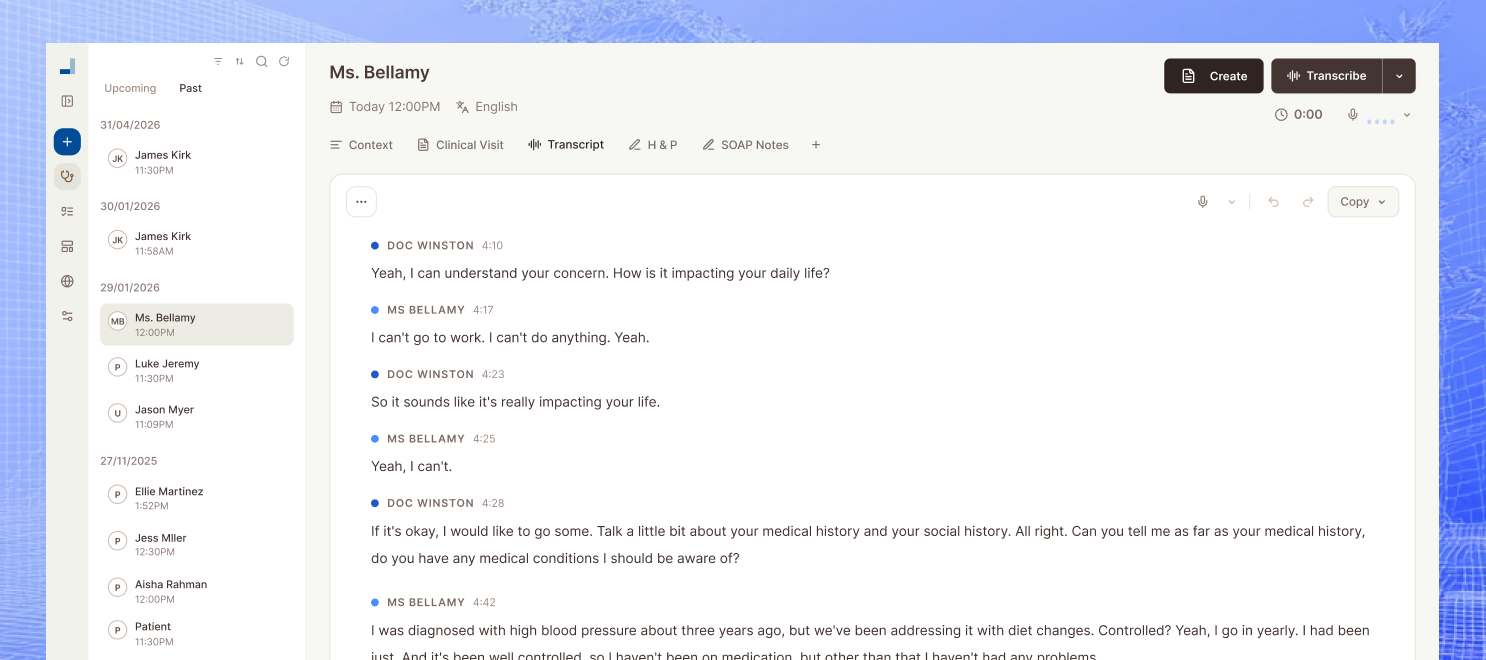
An AI medical scribe acts as an assistive layer, capturing the conversation in real-time so the clinician can focus entirely on the patient. It is important to understand that these tools are not independent practitioners; they are sophisticated assistants. The clinician remains the final authority, responsible for reviewing, editing, and signing off on the generated content. By removing the manual burden of transcription and synthesis, the AI allows for more thorough and reflective documentation without the associated time penalty.
- Reduces administrative burnout by automating the first draft of clinical notes.
- Improves patient-provider interaction by eliminating the need to type during consults.
- Ensures more granular detail is captured consistently across all patient encounters.
- Acts as an assistive tool where the clinician maintains final clinical oversight.
Note types you can generate beyond SOAP
While the SOAP format is a staple of medicine, modern practice requires a much broader range of documentation. History and Physical (H&P) notes are essential for new admissions, requiring a depth of background that can be tedious to compile manually. Similarly, consult notes and referral letters must bridge the gap between providers, ensuring that the next clinician in the care chain has a clear, actionable summary of the encounter.
Procedure notes and discharge summaries present their own challenges, often requiring specific technical language and structured data. An AI medical scribe can intelligently categorize conversation points into these specific formats, ensuring that follow-up notes and progress updates remain concise yet comprehensive. This structure is not just about convenience; it is vital for audit readiness and maintaining a high standard of continuity of care within a multi-disciplinary team.
- Generates comprehensive H&P, consult notes, and complex procedure logs automatically.
- Streamlines the creation of referral letters and discharge summaries for better care transitions.
- Maintains high quality for audits through structured, standardized documentation patterns.
- Adapts to follow-up and progress note formats to ensure long-term care continuity.
How to implement an AI medical scribe step-by-step in a real clinic
Starting with an AI medical scribe doesn’t require an overnight overhaul of your entire practice. Begin by selecting one specific visit type, such as routine follow-ups or standard wellness checks, to get a feel for the technology. This allows you to calibrate the AI’s output to your personal writing style and specific clinical requirements without the pressure of a complex multi-system case.
Next, you should configure your templates according to your specialty. Whether you are in pediatrics, orthopedics, or psychiatry, the AI should be told which data points are most critical for your records. Once your templates are ready, simply begin capturing the encounter, whether it is an in-person visit or a telehealth session. The AI will listen to the ambient conversation, filtering out the small talk to focus on the clinical facts.
After the encounter, the review and edit process should be rapid. Look for key clinical findings, verify dosages, and ensure the plan aligns with your intended actions. Because the AI has already done the heavy lifting of structure and syntax, you are simply acting as the editor-in-chief. Finally, reuse these outputs to instantly populate referral forms or letters to other specialists, eliminating the need for separate dictation sessions.
- Start with one common visit type to build confidence and refine the AI’s output.
- Customize specialty-specific templates to ensure the most relevant data is captured.
- Use the AI for both in-person and telehealth sessions for a unified workflow.
- Review and edit notes quickly to maintain clinical accuracy and signature speed.
How to keep note quality high and reduce mistakes
The most common failure points in AI-assisted documentation involve “note bloat” or the inclusion of irrelevant dialogue. To prevent this, clinicians should develop a lightweight review habit—spending 60 to 90 seconds per note to verify that the problem list is accurate and that the plan is clearly articulated. Establishing team standards for how medications and lab values should be presented also helps maintain a high baseline of quality across the entire clinic.
- Audit notes for ‘note bloat’ to ensure only clinical relevant info is kept.
- Verify all medication names and dosages during a quick post-encounter review.
- Standardize documentation templates across the team for consistent record-keeping.
Privacy, consent, and patient trust
Patient trust is the foundation of the medical relationship. Most patients are receptive to the use of an AI scribe when it is explained as a tool that allows the doctor to listen better. A simple script like, ‘I’m using a digital assistant to help me capture our conversation so I can focus on you instead of my computer screen. It’s secure and helps me keep better records,’ usually suffices for most encounters.
- Always follow local regional regulations regarding patient recording and data storage.
- Use a simple, transparent script to explain the benefits of the AI scribe to patients.
- Ensure your chosen tool follows strict security and data retention principles.
Rolling it out across a clinic without disruption
For a smooth rollout, implement a two-week pilot plan with a small group of early adopters within the clinic. Track metrics such as the reduction in after-hours charting and the time spent on each note. Once the pilot group has refined the templates and workflow, they can serve as internal mentors for the rest of the staff, ensuring that the transition is collaborative rather than forced.
- Execute a short pilot program to catch workflow bottlenecks early.
- Monitor time-saved metrics to demonstrate the ROI of the technology.
- Align templates across the organization to ensure data portability.
Mcoy AI is an AI medical scribe that records and transcribes patient encounters, then generates multiple clinical note types (H&P, progress notes, consult notes, follow-up notes, procedure notes, discharge summaries, referral letters, and more). With over 200 customizable templates and an interactive AI chat feature, clinicians can easily create letters, forms, and other essential documents. This tool is designed to integrate seamlessly into a busy practice, ensuring that the heavy lift of documentation is handled by technology while the clinician retains total control over the final record.
Conclusion
Transitioning to a modern documentation workflow doesn’t have to be overwhelming. By adopting a structured approach—starting with a pilot, customizing your templates, and maintaining a solid review process—you can significantly reduce the time spent on administrative tasks. Learning how to use an AI medical scribe effectively is the fastest way to reclaim your personal time and refocus on what matters most: patient care. Start with a small pilot today and experience the difference in your daily clinical life.
What a serious review table should cover
| Decision area | Common mistake | Better clinic-ready approach | Metric to watch |
|---|---|---|---|
| Workflow design | Treat how to use an ai medical scribe for faster follow-ups as a one-off documentation task | Build a repeatable process with clear ownership and review points | Time to complete documentation |
| Team adoption | Assume every clinician will naturally use the same process | Train for consistency and define exception handling early | Active user adoption |
| Quality review | Only check notes when a problem is reported | Audit a sample of notes weekly and review edge cases | Edit rate per note |
| Operational follow-through | Leave admin actions outside the documentation workflow | Use the same encounter data for referrals, letters, and follow-up tasks | Completion rate for next-step tasks |
Related reading
If you are working through how to use an ai medical scribe for faster follow-ups, it helps to read this alongside Admin Management: How to Reduce Admin Errors in Clinical Notes, Admin Management: Medication List Template with Examples, and Specialty Guides: A Practical Guide to Smarter Clinical Documentation. Those guides cover adjacent workflow, implementation, and evaluation questions so the decision does not sit in isolation.
FAQ
How accurate are AI medical scribes in real clinics?
AI medical scribes are highly accurate at capturing the factual essence of a conversation, often picking up details that a tired clinician might overlook. However, their accuracy depends on the clarity of the audio and the clinical context provided. They are excellent at drafting, but they should never be considered a replacement for professional clinical judgment.
Do I still need to review every note?
Yes, the clinician is legally and ethically responsible for every word in the medical record. While the AI does the heavy lifting of drafting and formatting, a quick review is essential to verify accuracy, correct any nuance, and ensure the final note reflects your clinical intent. Most doctors find this review takes less than a minute.
What note types can an AI scribe generate besides SOAP?
AI scribes are incredibly versatile and can generate a wide range of documents including History and Physicals (H&P), detailed consult notes, and complex procedure logs. They can also create discharge summaries, referral letters, and brief follow-up notes. The flexibility of the technology allows it to adapt to almost any structured clinical format you require.
Will this work for telehealth and in-person consults?
Most modern AI scribes are designed to work seamlessly across both environments. For in-person visits, the device acts as an ambient listener on a desk, while for telehealth, it can often be integrated directly into the meeting software or capture audio via the system’s output. The result is a consistent documentation style regardless of how the patient is seen.
How do I explain recording/transcription to patients?
The best approach is transparency and focusing on the benefit to the patient. Explain that the tool allows you to stop looking at the computer and start looking at them. Most patients appreciate the extra attention and are comfortable with the technology once they understand it is a secure way to ensure their record is as accurate as possible.
How do clinics prevent note bloat?
Preventing note bloat starts with setting up concise templates that tell the AI exactly which sections are relevant for a specific visit type. Clinicians should also be trained to briefly review the output for fluff and utilize ‘concise mode’ settings if the AI tool offers them. Standardizing what constitutes a ‘good note’ within the clinic also helps maintain brevity.
How long does template setup take?
Initial template setup usually takes between 10 to 30 minutes, depending on the complexity of your specialty. Most platforms offer pre-built templates that can be used immediately, which you can then tweak over your first week of use. Once the templates are set, they require very little ongoing maintenance.
What’s the safest way to start if I’m skeptical?
The safest way to start is with a ‘shadow’ trial. Use the AI scribe during a few non-complex follow-up appointments while still keeping your traditional notes. Compare the AI’s output to your own notes at the end of the day. This low-pressure environment allows you to see the quality of the transcription and drafting without any risk to your clinical workflow.