Specialty Guides: A Practical Guide to Smarter Clinical Documentation
Practical guide for doctors on smarter clinical documentation using better workflows and AI tools to reduce admin and improve care.
Clinical documentation is essential to medicine, but for many doctors it has become one of the most exhausting parts of the job. Notes stretch into evenings, paperwork interrupts consultations, and documentation often feels disconnected from real clinical thinking. Despite advances in digital health, many clinicians feel that documentation takes more time, not less.
Smarter clinical documentation is not about doing less documentation. It is about doing documentation that is clearer, faster, and better aligned with how care actually happens. When documentation works with clinicians rather than against them, it supports patient care instead of competing with it.
This practical guide breaks down how doctors and clinics can improve clinical documentation in realistic ways, without compromising care quality, safety, or professionalism.
Why documentation feels harder than it should
Documentation has expanded for understandable reasons. Healthcare is more regulated. Care teams are larger and more distributed. Records must support continuity, billing, compliance, and medico-legal standards.
The problem is not that documentation exists. The problem is how it is created.
Most documentation systems expect doctors to translate dynamic, conversational care into rigid formats after the fact. This translation takes time, effort, and concentration, especially when done hours later. The cognitive burden adds up quickly.
When documentation is poorly designed, it becomes a parallel job rather than a by-product of care.
Smarter documentation starts with purpose
Before improving documentation, it helps to clarify its purpose. Clinical documentation exists to support patient care, communication, and accountability. It does not exist to capture every word spoken or every thought considered.
Smarter documentation focuses on what future readers actually need. This includes clinical reasoning, key findings, decisions made, and next steps. When documentation stays aligned with purpose, it becomes shorter, clearer, and more useful.
Notes that are easier to read are often faster to write. This is one of the most overlooked truths in documentation improvement.
Structure is your biggest time saver
Unstructured notes feel flexible, but they are time-consuming. Starting from a blank page requires decisions about order, phrasing, and formatting before content even begins.
Structured documentation reduces this friction. Familiar frameworks guide thinking and reduce repetition. For most clinicians, structured notes also reduce errors and omissions.
This does not mean rigid templates that force unnatural language. Smarter structure supports clinical flow while leaving room for nuance.
Well-designed structure allows doctors to think clinically instead of clerically.
Stop recreating the same notes every day
A major source of documentation fatigue is repetition. Many doctors write variations of the same note dozens of times a day.
Follow-ups, chronic disease reviews, mental health reviews, and procedural notes often share the same backbone. When this backbone is recreated manually each time, time and energy are wasted.
Smarter documentation relies on reusable frameworks. When the structure is already there, clinicians can focus on what is different, not what is routine.
Over time, this dramatically reduces documentation time without affecting quality
Change when documentation happens, not just how
One of the most practical improvements clinics can make is changing when documentation happens.
Delayed documentation is slower documentation. When notes are written hours later, clinicians must rely on memory. This increases cognitive load and often leads to over-documentation to compensate for uncertainty.
Smarter documentation captures information closer to the moment of care. When key details are recorded during or immediately after the consultation, notes become refinement rather than reconstruction.
This shift alone can significantly reduce after-hours charting.
Reduce duplication to unlock real gains
Duplication is one of the biggest hidden drains in clinical documentation. Information discussed once is often rewritten multiple times for notes, referral letters, patient summaries, and forms.
This repetition adds no clinical value. It increases error risk and consumes time.
Smarter documentation systems capture information once and reuse it across multiple outputs. When a single source of truth feeds notes, referrals, and letters, documentation becomes faster and more consistent.
Reducing duplication is often the fastest way to reduce workload.
Let technology remove work, not add it
Technology can either simplify documentation or make it worse. Many clinicians have experienced systems that add clicks, fields, and interruptions without reducing effort.
Smarter documentation tools work quietly in the background. They capture information, organise it, and present it for quick review. The clinician remains in control, but no longer carries the full administrative burden.
The key question is simple. Does this tool reduce steps, or does it add them.
The role of AI in smarter clinical documentation
AI has become one of the most practical tools for improving documentation when used correctly.
Instead of replacing clinicians, AI supports them by handling repetitive clerical tasks. Modern AI tools can transcribe consultations, structure notes, and draft documentation automatically.
This changes documentation from a writing task into a review task. Review is faster, less mentally demanding, and easier to complete during the workday.
When used well, AI does not compromise care. It enhances clarity and consistency while saving time.
This is where Mcoy AI fits into smarter clinical documentation workflows.
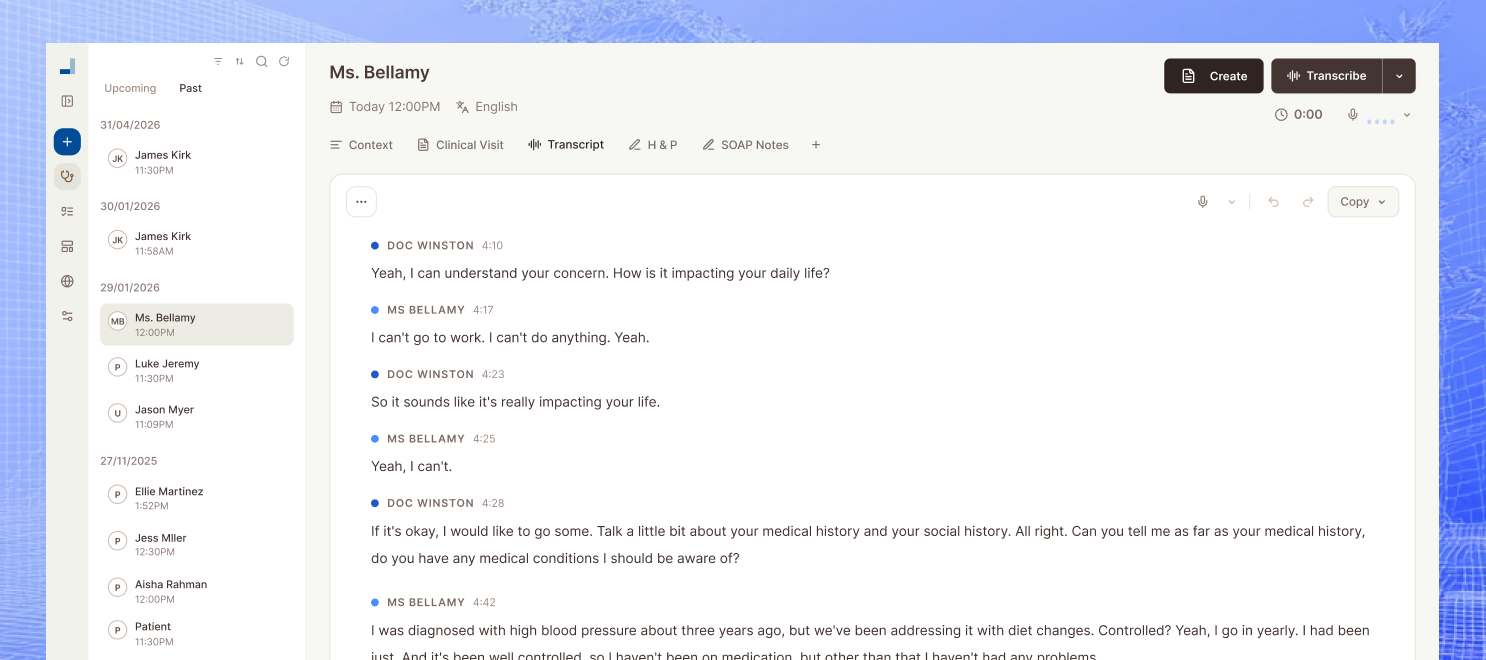
Mcoy AI is an AI medical scribe designed to make clinical documentation faster and more practical for doctors. It records and transcribes patient encounters, turns conversations into structured SOAP notes, and generates clinical documents using over 200 customisable templates built for different specialties. Doctors can chat with their encounters, create referral letters, forms, and reports from the same consultation data. By handling the heavy lifting of documentation, Mcoy AI helps clinicians reduce admin time while maintaining high clinical standards.
The result is documentation that supports care instead of competing with it.
Smarter notes are often shorter notes
Long notes are not necessarily better notes. In many cases, excessive detail obscures important information.
Smarter documentation focuses on relevance. Clear problem lists, concise assessments, and structured plans are easier to read and more clinically useful.
Shorter notes also reduce follow-up work. Other providers spend less time searching for key details. Staff ask fewer clarification questions. Patients receive clearer instructions.
Reducing note length is often a sign of improved documentation, not reduced care.
Reduce fear-driven over-documentation
A significant amount of documentation overload is driven by fear. Doctors worry about audits, complaints, or medico-legal risk, so they document more than necessary.
Clear standards reduce this fear. When clinicians know what is required and what is optional, documentation becomes more confident and efficient.
Structured templates and AI-assisted tools help ensure required elements are consistently captured. This allows doctors to document thoroughly without excess narrative.
Smarter documentation reduces anxiety as well as workload.
Protect focus to improve documentation quality
Documentation quality suffers when clinicians are interrupted constantly. Switching between patients, messages, and notes increases error risk and mental fatigue.
Smarter documentation workflows protect focus. Capturing information during consultations and reviewing notes in focused blocks is more efficient than constant partial documentation.
AI-generated drafts make this approach possible. Doctors can complete documentation in fewer, more focused sessions.
Better focus leads to better notes and less exhaustion.
Smarter documentation improves patient care
Improving documentation is not just an efficiency exercise. It directly affects patient care.
Doctors who are less burdened by paperwork are more present. They listen better. They think more clearly. Patients feel more engaged and understood.
Clearer documentation also improves continuity of care. Other providers can quickly understand the clinical picture and decisions made.
Smarter documentation strengthens the entire care ecosystem.
Small changes compound quickly
Smarter documentation does not require a complete overhaul. Small improvements add up.
Saving two minutes per patient can free hours each week. Reducing duplication removes entire categories of work. Improving templates reduces decision fatigue.
Clinics that focus on incremental improvements often see meaningful results within weeks.
Treat documentation as a system problem
Documentation is often treated as an individual responsibility. Doctors are expected to cope with growing demands through efficiency and discipline.
In reality, documentation is a system problem. When systems demand too much or capture information poorly, no amount of personal effort will fix it.
Smarter documentation comes from better design, not harder work.
Building sustainable documentation practices
Sustainable clinical practice requires documentation that supports clinicians instead of draining them.
Smarter documentation respects time, reduces cognitive load, and improves clarity. It allows doctors to finish work during the workday and focus on patient care.
The goal is not minimal documentation. It is meaningful documentation.
When documentation becomes practical, medicine becomes sustainable again.
What a serious review table should cover
| Decision area | Common mistake | Better clinic-ready approach | Metric to watch |
|---|---|---|---|
| Workflow design | Treat a practical guide to smarter clinical documentation as a one-off documentation task | Build a repeatable process with clear ownership and review points | Time to complete documentation |
| Team adoption | Assume every clinician will naturally use the same process | Train for consistency and define exception handling early | Active user adoption |
| Quality review | Only check notes when a problem is reported | Audit a sample of notes weekly and review edge cases | Edit rate per note |
| Operational follow-through | Leave admin actions outside the documentation workflow | Use the same encounter data for referrals, letters, and follow-up tasks | Completion rate for next-step tasks |
Related reading
If you are working through a practical guide to smarter clinical documentation, it helps to read this alongside Specialty Guides: How to Run a More Efficient Medical Practice in 2026, Specialty Guides: How to Improve Patient Encounters, and Compare & Choose: AI Medical Scribe Cost: Is It Worth the Price? A Full Guide for Doctors and Clinics. Those guides cover adjacent workflow, implementation, and evaluation questions so the decision does not sit in isolation.
FAQ
Does smarter documentation mean less thorough notes
No. Smarter documentation focuses on relevance and clarity rather than length.
Can AI documentation be trusted
AI assists with drafting. Doctors review and approve all content, maintaining responsibility and accuracy.
Will patients notice changes
Patients often notice improved attention and engagement when doctors are less focused on screens.
Is this approach suitable for small clinics
Yes. Smaller clinics often benefit quickly because workflows are easier to adjust.
How long does it take to see results
Many doctors see improvements within days or weeks after improving documentation workflows.