Admin Management: How to Use an AI Scribe for Work Notes and Fit Notes
Learn how an AI medical scribe automates work notes and fit notes to save time. Optimize your clinical workflow and reduce documentation burnout today.
What a medical scribe solves in modern practice
The modern clinical environment is increasingly defined by the weight of administrative tasks. For many practitioners, the real cost of documentation isn’t just the hours spent typing after the clinic has closed; it is the cognitive load that persists throughout the day. When a clinician is focused on capturing every detail for a work note or fit note, they are often less present for the patient in front of them. This leads to delayed notes, rushed entries, and a persistent sense of burnout that affects the quality of care provided.
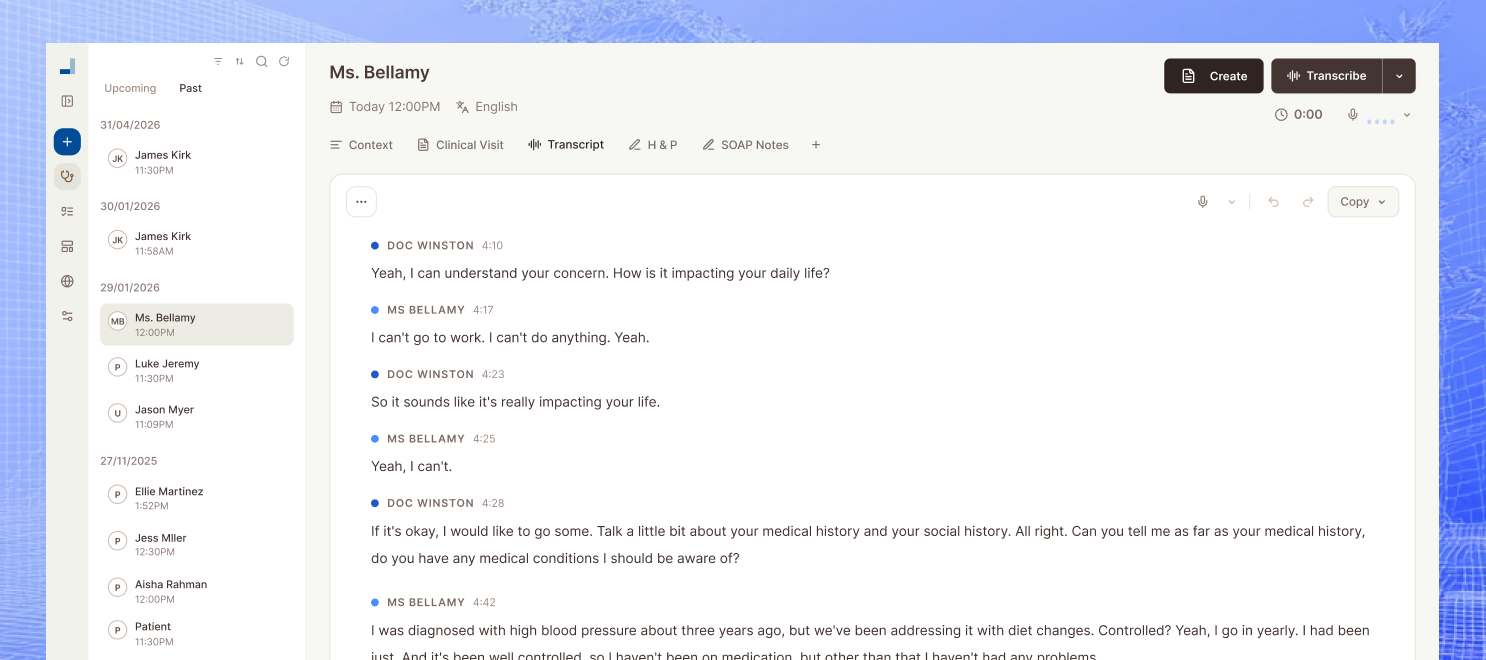
An AI medical scribe acts as an intelligent assistant that handles the heavy lifting of data capture. It is important to understand that these tools are assistive in nature; the clinician remains the final authority and is responsible for the accuracy of every document generated. By recording the dialogue between a doctor and patient, the technology allows the provider to maintain eye contact and engage deeply, knowing that the structural requirements of the encounter are being managed in the background.
- Reduces the ‘pajama time’ spent on administrative tasks after hours.
- Decreases cognitive load by capturing details in real-time.
- Enhances patient-provider interaction by removing the screen barrier.
- Provides a structured draft that only requires a quick final clinician review.
Note types you can generate beyond SOAP (H&P and more)
While the SOAP format is a staple in medical training, real-world practice requires a much broader range of documentation. Clinical encounters are diverse, and a one-size-fits-all approach to notes often fails to capture the nuances of a specialist consult or a detailed procedure. Efficiently generating History and Physicals (H&P), progress notes, and consult notes is essential for maintaining a high standard of professional communication within a healthcare network.
Beyond standard encounters, specialized documentation such as procedure notes, discharge summaries, and referral letters are critical for continuity of care. When these notes are structured correctly, they ensure that the next provider in the chain of care has a clear, concise understanding of the patient’s status. Audit readiness is also improved when documentation follows a consistent, high-quality format that reflects the complexity of the medical decision-making process.
- H&P and Progress Notes: Essential for tracking long-term patient health and inpatient care.
- Consult and Referral Letters: Vital for professional communication between specialists.
- Procedure Notes: Detailed logs that ensure every step of a clinical intervention is recorded.
- Discharge Summaries: High-level overviews that facilitate safe transitions of care.
How to implement AI medical scribe step-by-step in a real clinic
Starting with an AI medical scribe doesn’t require a total overhaul of your current systems. The most successful implementations begin with a single visit type—usually one that is repetitive or documentation-heavy, such as a standard follow-up or a work note assessment. By focusing on one area first, you can get a feel for how the technology captures your natural speaking style and patient interactions before scaling up to more complex cases.
The next step involves setting up specialty-specific templates. Whether you are in a university clinic or private practice, your documentation needs are unique. Once your templates are configured, you simply capture the encounter, whether it is happening in-person or via a telehealth platform. The AI processes the ambient audio and generates a draft based on the template you selected. This streamlined approach ensures that the output is always relevant to the specific clinical context.
After the encounter, the clinician performs a rapid review and edit. Because the AI has done 90% of the work, this usually takes less than a minute. Finally, the generated text can be reused for auxiliary documents like work notes, fit notes, or insurance forms. This ‘write once, use many’ philosophy significantly cuts down on redundant data entry and ensures that all documents related to a single visit are perfectly aligned.
- Start small with one visit type to build confidence in the technology.
- Customize templates to match your specialty and regional requirements.
- Capture encounters seamlessly across both in-person and digital formats.
- Review, edit, and repurpose the output for various administrative forms.
How to keep note quality high and reduce mistakes
Quality control is the cornerstone of safe clinical documentation. Common failure points in traditional charting often include missing medications, incorrect numerical values, or ‘note bloat’ where irrelevant information masks the core clinical narrative. When using automated tools, it is vital to maintain a lightweight review habit. Clinicians should ensure that the final note accurately reflects the problem list and the specific plan discussed during the visit.
Establishing team standards also helps in maintaining consistency across a practice. By agreeing on what constitutes a high-quality note, a clinic can ensure that every practitioner is producing documentation that is both concise and legally robust. Regular brief audits of generated notes can help identify any recurring errors or areas where templates might need adjustment to better serve the clinicians’ needs.
- Implement a ‘final check’ workflow to verify meds and vital stats.
- Avoid note bloat by using concise, specialty-specific templates.
- Set clear practice-wide standards for documentation quality.
- Conduct periodic reviews to ensure the AI output aligns with clinical reality.
Privacy, consent, and patient trust (plain English)
Trust is the foundation of the patient-doctor relationship, and introducing new technology into the exam room requires transparency. While consent regulations vary significantly by region and local policy, the general principle should always be to inform the patient and gain their verbal agreement before recording. Most patients are supportive once they realize the technology allows their doctor to listen more and type less.
A simple way to explain this to a patient is: ‘I’m using an AI assistant today to help me take notes so I can focus entirely on you instead of the computer screen. It records our conversation and turns it into a medical record for me to review. Is that okay with you?’ This approach frames the technology as a benefit to the patient’s care experience rather than a digital intruder. Following general security and data retention principles will further ensure that patient information remains protected at all times.
- Always follow local and regional guidelines regarding patient consent.
- Use a simple, benefit-focused script to introduce the technology to patients.
- Explain that the recording is purely for documentation accuracy.
- Ensure the privacy settings meet the high standards required for medical data.
Rolling it out across a clinic without disruption
For clinic owners and university medical centers, a phased rollout is the most effective strategy. A two-week pilot plan with a small group of ‘super-users’ allows the practice to work out any kinks in the workflow before a full launch. During this period, it is helpful to track metrics such as time saved per patient, the reduction in after-hours charting, and the overall completeness of the notes generated.
Training should focus not just on the software itself, but on template alignment. When every clinician knows how to use the specific formats for their specialty, the transition becomes much smoother. By the time the full clinic adopts the tool, the pilot group can serve as internal mentors, ensuring that the technology is viewed as a solution to burnout rather than an additional task to manage.
- Execute a two-week pilot to refine workflows and gather feedback.
- Monitor time-saving metrics and note quality during the initial phase.
- Align templates across the team to ensure documentation consistency.
- Utilize internal champions to lead the training for other staff members.
Mcoy AI is an AI medical scribe that records and transcribes patient encounters, then generates multiple clinical note types including H&P, progress notes, consult notes, follow-up notes, procedure notes, discharge summaries, referral letters, and more. With over 200 customizable templates and an interactive AI chat, clinicians can easily create letters, forms, and complex documents tailored to their specific needs, significantly reducing the administrative burden of modern medicine.
FAQ
Transitioning to new technology often brings up practical questions. Here are the most common inquiries regarding the use of AI in daily clinical documentation.
How accurate are AI medical scribes in real clinics?
AI scribes are remarkably accurate in capturing clinical dialogue and translating it into medical terminology. Recent advancements in natural language processing allow these tools to distinguish between casual conversation and pertinent medical data. However, accuracy also depends on the clarity of the audio and the clinician’s brief review of the final output. Most users find that the drafts require only minimal corrections before they are ready for the EHR.
Do I still need to review every note?
Yes, the clinician remains the legally responsible party for the accuracy of medical records. While the AI does the majority of the documentation work, a quick final review is necessary to ensure all specific nuances, medications, and dosages are correct. This review habit is the best way to maintain high safety standards and ensure the note reflects your professional judgment accurately.
What note types can an AI scribe generate besides SOAP?
Modern AI scribes are capable of generating a wide variety of documentation beyond the standard SOAP format. This includes History and Physicals (H&P), complex consultation letters, procedure notes, and even discharge summaries. By using different templates, the system can reorganize the captured data to fit the specific requirements of the document type you need at that moment.
Will this work for telehealth and in-person consults?
Most AI medical scribing solutions are designed to be flexible and work across both in-person and telehealth environments. The system captures audio from the computer or a mobile device, making it easy to use during a video call or a standard face-to-face visit. This consistency allows for a unified documentation workflow regardless of how the patient is being seen.
How do I explain recording/transcription to patients?
The best approach is to be direct and highlight the benefit to the patient. You might say that the tool allows you to give them your full attention without having to type on a keyboard. Most patients appreciate the extra eye contact and the fact that their doctor is listening more intently to their concerns during the visit.
How do clinics prevent note bloat?
Note bloat is prevented by using highly specific and concise templates that prioritize relevant clinical information over raw transcription data. By configuring the AI to follow structured formats, the output remains focused on the primary diagnosis, findings, and plan. This makes the notes easier for other providers to read and prevents the medical record from becoming unnecessarily cluttered.
How long does template setup take?
Setting up basic templates usually takes just a few minutes, especially when starting with pre-built specialty options. Many clinicians find they can customize their most-used templates within their first hour of using the system. Over time, these can be further refined to perfectly match your specific style of practice and regional requirements.
What’s the safest way to start if I’m skeptical?
The safest way to start is by using the tool for one or two non-complex patient visits per day. Choose follow-up appointments where the history is already well-known. This allow you to see the quality of the output without any pressure. As you become more comfortable with the review and editing process, you can gradually expand its use to all of your daily encounters.
Conclusion
Integrating an AI medical scribe into your workflow is one of the most effective ways to reclaim time and reduce the stress of daily charting. By automating the creation of everything from complex H&Ps to essential work notes and fit notes, you can shift your focus back to where it belongs: patient care. The transition is straightforward when approached with a clear pilot plan and consistent template usage. Start your journey with an AI medical scribe today and experience the professional freedom of a streamlined clinical workflow.
What a serious review table should cover
| Decision area | Common mistake | Better clinic-ready approach | Metric to watch |
|---|---|---|---|
| Workflow design | Treat how to use an ai scribe for work notes and fit notes as a one-off documentation task | Build a repeatable process with clear ownership and review points | Time to complete documentation |
| Team adoption | Assume every clinician will naturally use the same process | Train for consistency and define exception handling early | Active user adoption |
| Quality review | Only check notes when a problem is reported | Audit a sample of notes weekly and review edge cases | Edit rate per note |
| Operational follow-through | Leave admin actions outside the documentation workflow | Use the same encounter data for referrals, letters, and follow-up tasks | Completion rate for next-step tasks |
Related reading
If you are working through how to use an ai scribe for work notes and fit notes, it helps to read this alongside Admin Management: How to Reduce Admin Errors in Clinical Notes, Admin Management: Medication List Template with Examples, and Compare & Choose: Turn Your Best Note Into a Reusable Template | Full Guide. Those guides cover adjacent workflow, implementation, and evaluation questions so the decision does not sit in isolation.
FAQ
How accurate are AI medical scribes in real clinics?
AI scribes are highly accurate in capturing clinical terminology and narrative flow. They use sophisticated language models to distinguish between medical data and general conversation. While the draft is usually excellent, clinicians should always perform a quick check for specific figures and medication names.
Do I still need to review every note?
Absolutely, clinician oversight is required for all medical documentation. The AI provides a comprehensive draft that accounts for the majority of the writing, but the doctor must verify its clinical accuracy. This process usually takes less than a minute per patient.
What note types can an AI scribe generate besides SOAP?
Flexible AI tools can generate H&Ps, consult letters, procedure notes, and discharge summaries. By switching templates, the AI reorganizes the captured data into the appropriate professional format. This ensures that every document meets the specific requirements of the clinical context.
Will this work for telehealth and in-person consults?
Yes, the technology is designed to capture audio from various sources, including mobile devices and desktop microphones. This makes it a perfect fit for both traditional office visits and virtual telehealth appointments. The workflow remains consistent regardless of the patient’s location.
How do I explain recording/transcription to patients?
Most clinicians find that patients respond well when told the tool allows for better eye contact and attention. Informing the patient that the AI acts as a digital assistant for the medical record builds transparency and trust. Patients generally prefer a doctor who is looking at them rather than at a computer screen.
How do clinics prevent note bloat?
By using structured templates, the AI produces concise summaries rather than word-for-word transcripts. This ensures that the documentation is relevant, readable, and focused on the medical decision-making process. Well-designed templates are the best defense against over-documentation.
How long does template setup take?
Initial setup is very fast, often taking only a few minutes with pre-configured specialty sets. Fine-tuning templates to match your personal clinical ‘voice’ can be done incrementally over the first few days of use. It is a highly intuitive process for most practitioners.
What’s the safest way to start if I’m skeptical?
Begin by using the AI for a few simple follow-up appointments each day. This low-pressure environment allows you to see the quality of the documentation first-hand. Most clinicians feel confident enough to use it for all encounters within just a week of testing.