Compare & Choose: Turn Your Best Note Into a Reusable Template | Full Guide
Learn how to turn your best note into a reusable template. Streamline documentation, reduce burnout, and improve note accuracy with our expert guide.
The Hidden Cost of Manual Documentation
Every clinician knows the sinking feeling of finishing a full day of patient care only to be met with a mountain of unfinished charts. The cycle of after-hours charting is more than just a nuisance; it is a primary driver of practitioner burnout and medico-legal anxiety. When you are rushing to finish notes late at night, the risk of inconsistency or missing critical details increases significantly, regardless of whether you are a GP, a specialist, or managing a busy university clinic.
This guide will teach you the strategic workflow for capturing your highest-quality documentation and transforming it into a scalable system. We will explore note formats that go far beyond the standard SOAP note, discuss quality control measures to protect your practice, and provide a clear rollout plan for your team. By the end of this article, you will understand how to turn your best note into a reusable template that saves hours of administrative labor every week.
What a medical scribe solves in modern practice
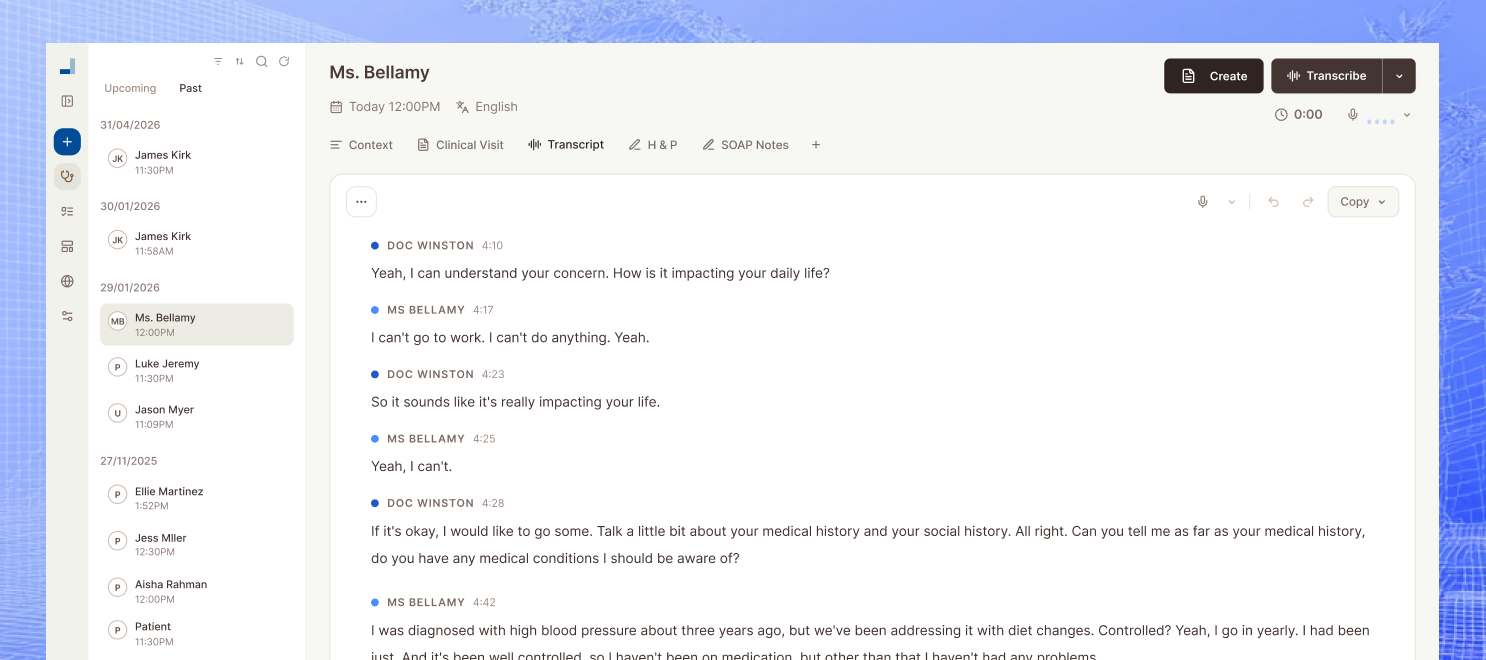
The real cost of documentation is measured in cognitive load and time taken away from patients. When doctors are forced to act as data entry clerks, the quality of engagement during the encounter suffers. Manual charting often leads to delayed notes, which can compromise the accuracy of the record. An AI medical scribe acts as an assistive partner, handling the heavy lifting of transcription and structural organization while the clinician maintains final responsibility and oversight.
Modern transcription tools do not replace the doctor’s judgment; rather, they serve as a high-fidelity memory aid. They capture the nuances of the conversation that might otherwise be forgotten by the time you sit down to type. This shift allows practitioners to focus on the person in front of them, knowing that the technical requirements of the medical record are being addressed in the background.
- Reduces administrative burnout and the ‘pajama time’ spent on charts.
- Ensures high-fidelity capture of patient details during the encounter.
- Decreases cognitive load by removing the need to multitask between listening and typing.
- Empowers clinicians to focus on complex medical decision-making.
Note types you can generate beyond SOAP (H&P and more)
While the SOAP note is the industry standard for daily progress, complex clinical environments require much more. A comprehensive template system should accommodate History and Physicals (H&P), detailed consult notes, and specific procedure notes. For university clinics and specialists, the ability to quickly generate referral letters or discharge summaries is a game-changer for continuity of care and professional communication.
The structure of your notes matters immensely for audit readiness and peer review. A well-organized follow-up note or specialized consult report ensures that the next provider in the care chain has a clear understanding of the patient’s trajectory. Moving beyond a ‘one size fits all’ approach allows for better clinical handovers and a more professional presentation of your practice’s work.
- Supports diverse formats like H&P, progress notes, and consult reports.
- Improves referral letter quality for better inter-provider communication.
- Enhances audit readiness through consistent, structured documentation.
- Provides clarity in follow-up notes and procedure-specific records.
How to implement turn your best note into a reusable template step-by-step
To begin the transition, start by identifying one specific visit type that you perform frequently, such as a routine follow-up or a standard physical. Instead of trying to overhaul your entire library at once, focus on perfecting the flow for this single encounter. Take the time to document this visit perfectly once, ensuring all necessary headings, physical exam findings, and assessment plans are clearly defined according to your specialty’s standards.
Once you have this ‘gold standard’ note, you can begin setting up templates based on that specific structure. Whether you are using a digital platform or an AI-assisted system, you want to define the sections that remain constant versus those that change with each patient. This allows you to capture the encounter—whether in-person or via telehealth—using a consistent framework that triggers the right clinical prompts every time.
As you move through your day, review and edit these outputs quickly at the conclusion of each visit. The goal is to spend less than a minute refining what has been generated rather than starting from a blank screen. Over time, you can reuse these polished outputs to automatically populate referral letters or school forms, ensuring the data only needs to be verified once before it serves multiple administrative purposes.
- Select one frequent visit type to standardize first.
- Create specialized templates that mirror your best clinical thinking.
- Capture encounters seamlessly across in-person and telehealth settings.
- Review, edit, and repurpose note data for forms and letters.
How to keep note quality high and reduce mistakes
Automation is powerful, but it requires a lightweight review habit to avoid common failure points like ‘note bloat’ or missing medications. Clinicians should develop a 30-second review checklist: verify the problem list, check that specific values (like blood pressure) are accurate, and ensure the plan matches the actual discussion had with the patient. Setting a high team standard for these reviews prevents errors from cascading into the permanent record.
- Establish a rapid review habit for every generated note.
- Watch for ‘note bloat’ by keeping templates concise and relevant.
- Verify critical data points like dosage and specific lab values.
- Ensure the final assessment aligns with the shared decision-making process.
Privacy, consent, and patient trust
Patient trust is the foundation of clinical practice. While consent requirements for recording vary significantly by region, a transparent approach is always best. Most patients are happy to participate in a recorded encounter when they understand it allows their doctor to listen more closely and provide better care. Briefly explaining that the technology is an extension of the medical record helps demystify the process.
- Consult local regulations to ensure your consent forms are compliant.
- Use a simple script: ‘I use a digital assistant to ensure I don’t miss any of your details.’
- Ensure your documentation partners use enterprise-grade security.
- Always allow patients to opt-out without any impact on their care.
Rolling it out across a clinic without disruption
Success in a clinic-wide rollout depends on a phased approach. Start with a two-week pilot involving one or two early adopters who can iron out the technical kinks. During this time, track metrics like the reduction in after-hours charting and the time to note completion. This data will be vital for convincing more skeptical colleagues that the change is worth the initial learning curve.
- Launch a 14-day pilot with a small group of clinicians.
- Monitor time-saved and note-completeness as key KPIs.
- Standardize templates across the team for clinical consistency.
- Provide brief, practical training sessions focused on editing workflow.
Mcoy AI is an AI medical scribe that records and transcribes patient encounters, then generates multiple clinical note types (H&P, progress notes, consult notes, follow-up notes, procedure notes, discharge summaries, referral letters, and more). It features 200+ customizable templates and an AI chat to create letters, forms, and other documents, helping you spend more time with patients and less time on paperwork.
The Future of Streamlined Documentation
Standardizing your documentation is the most effective way to reclaim your time and improve the quality of your practice. By following this guide on how to turn your best note into a reusable template, you are building a more sustainable career. Start with one template today and lead your clinic into a more efficient, patient-centered future.
What a serious review table should cover
| Decision area | Common mistake | Better clinic-ready approach | Metric to watch |
|---|---|---|---|
| Workflow design | Treat turn your best note into a reusable template | full guide as a one-off documentation task | Build a repeatable process with clear ownership and review points |
| Team adoption | Assume every clinician will naturally use the same process | Train for consistency and define exception handling early | Active user adoption |
| Quality review | Only check notes when a problem is reported | Audit a sample of notes weekly and review edge cases | Edit rate per note |
| Operational follow-through | Leave admin actions outside the documentation workflow | Use the same encounter data for referrals, letters, and follow-up tasks | Completion rate for next-step tasks |
Related reading
If you are working through turn your best note into a reusable template | full guide, it helps to read this alongside Compare & Choose: Best Tools Doctors Use to Save Time on Clinical Notes, Compare & Choose: Medical Scribing Services: Are They Worth It?, and Compare & Choose: How to Evaluate AI Medical Scribe Accuracy: 2024 Guide. Those guides cover adjacent workflow, implementation, and evaluation questions so the decision does not sit in isolation.
FAQ
How accurate are AI medical scribes in real clinics?
Modern AI scribes are remarkably accurate, often capturing clinical nuances that manual typing misses. However, they are designed as assistants, meaning they provide a high-quality draft that requires a final check. Most clinicians find that they only need to make minor tweaks to ensure the note is perfect before signing off.
Do I still need to review every note?
Yes, as the licensed provider, you are legally responsible for the accuracy of your clinical documentation. The goal of an AI-assisted template is not to remove the review process but to make it significantly faster. A quick 30-to-60-second review is usually all that is needed to verify the generated content against your clinical findings.
What note types can an AI scribe generate besides SOAP?
Beyond the standard SOAP note, advanced tools can generate History and Physicals (H&P), procedure notes, consult letters, and discharge summaries. You can also use templates for insurance-specific forms or referral letters to other specialists. This flexibility ensures that every type of patient interaction is documented correctly.
Will this work for telehealth and in-person consults?
Yes, most modern solutions are designed to handle both environments seamlessly. For telehealth, the system can often record the audio directly from the call, while for in-person visits, a mobile device or tablet acts as the recording interface. The resulting note quality remains high regardless of the setting.
How do I explain recording/transcription to patients?
The best approach is to be direct and highlight the benefit to the patient. You might say, ‘I use a medical scribe tool so I can focus 100% on you instead of typing on my computer.’ Most patients appreciate the extra eye contact and attention they receive when the doctor isn’t distracted by a screen.
How do clinics prevent note bloat?
Clinics can prevent note bloat by using concise templates that only prompt for relevant information. It is important to avoid ‘copy-pasting’ large sections of redundant text. Instead, focus on using AI to capture the specific changes and assessment for the current visit, keeping the record lean and readable.
How long does template setup take?
Initial setup for a basic template can take as little as 10 to 15 minutes. Once you have a ‘best-case’ note, you simply define the structure you want the AI to follow. Most clinicians find that their library of templates grows organically over the first few weeks of use until they have a perfect set for every scenario.
What’s the safest way to start if I’m skeptical?
The safest way to start is by using the system for your simplest, most routine visits. This allows you to gain confidence in the technology without the pressure of a complex medical case. As you see the time savings and accuracy for routine care, you can gradually expand to more difficult consultations.