Admin Management: How to Use AI Scribe for Pathology Requests | Full Guide
Learn how to optimize your clinical workflow by using an AI scribe to generate pathology requests, H&P notes, and referrals with 200+ templates. Read more.
What a medical scribe solves in modern practice
The modern clinical environment is increasingly defined by the weight of administrative tasks. Documentation often takes more time than the actual patient interaction, leading to ‘pajama time’ where doctors finish charts late at night. This administrative burden isn’t just a nuisance; it increases the risk of cognitive fatigue, which can lead to missed clinical details and delayed pathology orders. When a clinician is rushed, the quality of both the clinical note and the subsequent orders can suffer.
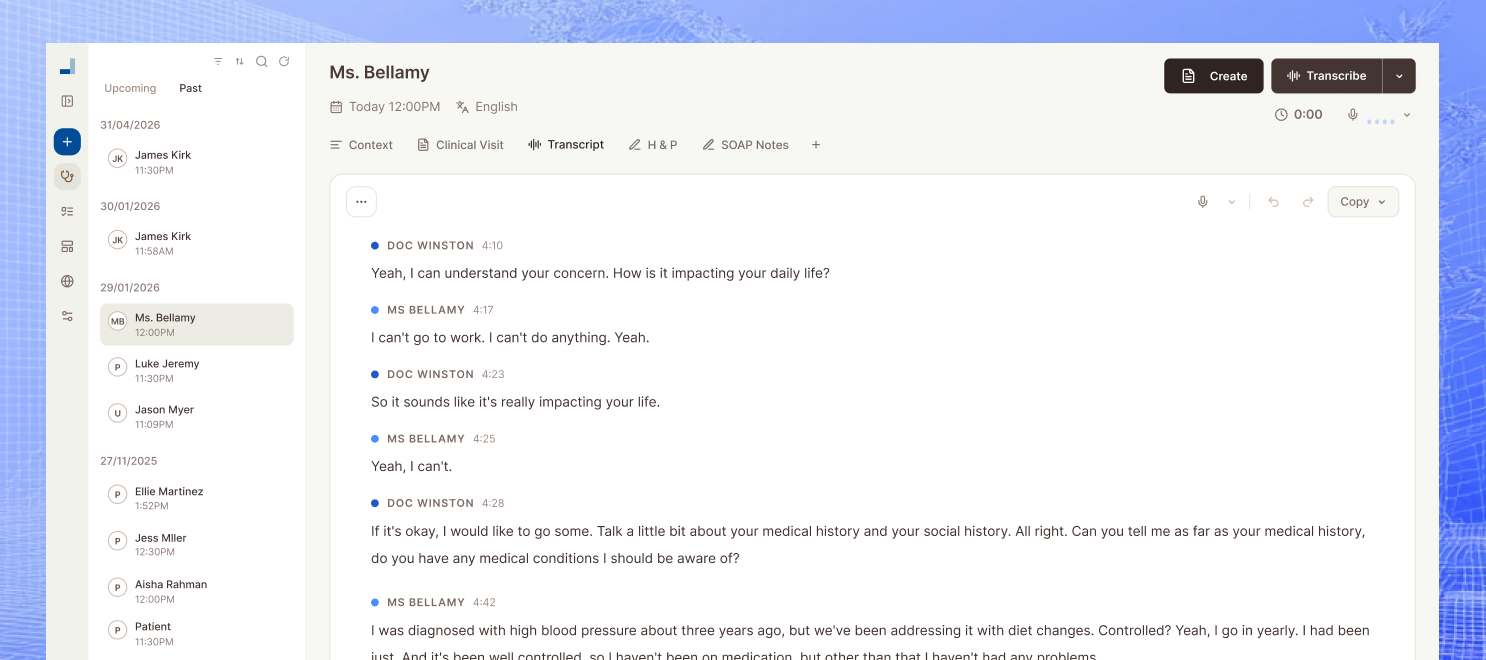
An AI medical scribe serves as an assistive layer in this process. By capturing the natural conversation between the doctor and patient, the AI filters out the ‘noise’ and extracts the relevant clinical data. It is important to remember that these tools are assistive; the clinician remains the final authority and must review and sign off on all outputs. However, by removing the need to type while the patient is speaking, the AI allows for better eye contact and a more focused diagnostic process.
- Reduces the cognitive load associated with simultaneous listening and typing.
- Eliminates after-hours documentation by generating drafts in real-time.
- Ensures clinical nuances are captured rather than forgotten post-consult.
- Allows the clinician to focus entirely on patient interaction and physical exams.
Note types you can generate beyond SOAP (H&P and more)
While the SOAP note is the industry standard, modern medicine requires a much broader range of documentation types to ensure continuity of care. Using an AI scribe allows for the instant generation of History and Physical (H&P) reports, which provide a more comprehensive overview than a standard progress note. This is particularly useful in hospital settings or for complex new patient intakes where a detailed narrative of the patient’s state is required.
Structure matters significantly for audit readiness and medicolegal protection. Beyond progress notes, AI tools can generate specialized consult notes, follow-up summaries, and even procedure notes. For clinics managing chronic diseases, having a consistent follow-up note structure ensures that progress—or lack thereof—is easily trackable over years of treatment. When these notes are structured correctly, they also make the process of generating referral letters and pathology requests much more fluid, as the underlying clinical reasoning is already well-documented.
- H&P reports provide a comprehensive baseline for new patient encounters.
- Consult notes ensure specialized advice is clearly communicated to referring doctors.
- Procedure notes capture technical details and immediate post-op plans accurately.
- Discharge summaries facilitate safe transitions of care between facilities.
How to implement pathology requests with an AI scribe step-by-step
Integrating the ability to create pathology requests into your workflow starts with selecting a single visit type to pilot. For many, this begins with routine physicals or chronic disease management visits where blood work is standard. Start by verbalizing your clinical reasoning during the exam; for example, mentioning why you are ordering a full blood count or lipid panel aloud so the AI captures the intent behind the request.
Once you have captured the encounter, you select a pathology-specific template or a referral template. The AI processes the conversation and identifies the specific tests mentioned. It then organizes these into a structured draft. You review this draft alongside your clinical note, ensuring that the ICD-10 codes or clinical indications for the tests are correctly mapped to the findings discussed during the visit.
After the review, you can take the output and quickly populate your EMR’s order entry system. Because the AI has already summarized the ‘why’ behind the tests, you spend less time searching for the right justification codes. Finally, you can reuse these outputs to generate a brief letter to the patient explaining what the tests are for and any preparation required, such as fasting. This creates a cohesive loop from conversation to order to patient education.
- Start with one common visit type to build a repeatable capture habit.
- Verbalize test requirements during the consult to ensure AI capture.
- Review the generated clinical justification for the pathology request.
- Use the distilled data to quickly populate EMR order fields.
How to keep note quality high and reduce mistakes
One of the biggest risks in AI-assisted documentation is ‘note bloat’ or the inclusion of irrelevant information. To maintain high quality, clinicians should adopt a lightweight review habit. This involves scanning the generated text for ‘hard data’ like medication dosages, specific dates, and lab values mentioned during the consult. While the AI is excellent at capturing context, the clinician must ensure that the final note reflects their actual clinical decision-making process.
Setting team standards is also vital for university clinics or multi-provider practices. If everyone uses the same template logic, the AI learns to produce more consistent results. This prevents the ‘wrong problem list’ scenario where old issues are carried forward into a new note without relevance. A quick 30-second review after the patient leaves the room is usually enough to catch errors and ensure the note is audit-ready and professional.
- Scan all notes specifically for numerical accuracy and medication doses.
- Prune irrelevant conversation history to prevent cluttered medical records.
- Standardize templates across the clinic for consistent documentation quality.
- Conduct a final clinical sign-off immediately after the encounter.
Privacy, consent, and patient trust (plain English)
Patient trust is the foundation of any successful implementation of AI in the clinic. Before recording, always obtain consent according to your local regulations and clinic policies. Most patients are comfortable with technology when they understand it helps their doctor focus more on them and less on a computer screen. Keep the explanation simple and transparent.
You might say: ‘To make sure I’m fully listening to you instead of typing on my computer, I use an AI assistant to help me draft my notes. It records our conversation and turns it into a medical summary for your file. Is that okay with you?’ This approach frames the technology as a benefit to the patient experience rather than a data collection hurdle.
- Always follow local jurisdictional guidelines regarding informed consent.
- Frame the AI as a tool that improves eye contact and patient-centered care.
- Ensure the patient knows they can request to stop the recording at any time.
- Adhere to strict data security protocols for storage and transcription.
Rolling it out across a clinic without disruption
Transitioning an entire clinic to an AI-driven workflow should happen in phases. A two-week pilot with a small group of ‘early adopter’ clinicians allows the practice to iron out any workflow kinks. During this period, track metrics such as the time spent on notes after the final patient has left and the subjective level of provider burnout. Most clinics see a significant reduction in ‘paperwork stress’ within the first ten days.
Training is the final piece of the puzzle. Ensure that all staff, from the front desk to the practitioners, understand the basic workflow. If everyone knows how the templates are aligned and how the data flows from the audio capture to the final pathology request, the rollout will be seamless. Regular check-ins during the first month help align the AI’s output with the specific documentation style of the practice.
- Run a 14-day pilot to identify workflow bottlenecks.
- Measure time saved on documentation as a key success metric.
- Align templates across the practice to ensure uniform record-keeping.
- Host brief weekly feedback sessions during the initial launch phase.
Mcoy AI is an AI medical scribe that records and transcribes patient encounters, then generates multiple clinical note types (H&P, progress notes, consult notes, follow-up notes, procedure notes, discharge summaries, referral letters, and more). With over 200+ customizable templates and an interactive AI chat, clinicians can effortlessly create letters, forms, and secondary documents like pathology request justifications. It is designed to fit naturally into the clinician’s workflow, ensuring that every encounter is documented accurately without the manual strain of traditional typing.
In conclusion, the transition to automated documentation is more than just a time-saving measure; it is a way to reclaim the joy of practicing medicine. By following a structured implementation plan, clinicians can leverage an AI scribe to handle everything from routine progress notes to complex pathology requests. The key is consistent review, clear patient communication, and choosing a tool that supports the wide variety of note types required in a modern clinic. Start your pilot today and see how to use an AI scribe to create pathology requests to streamline your daily workflow.
What a serious review table should cover
| Decision area | Common mistake | Better clinic-ready approach | Metric to watch |
|---|---|---|---|
| Workflow design | Treat how to use ai scribe for pathology requests | full guide as a one-off documentation task | Build a repeatable process with clear ownership and review points |
| Team adoption | Assume every clinician will naturally use the same process | Train for consistency and define exception handling early | Active user adoption |
| Quality review | Only check notes when a problem is reported | Audit a sample of notes weekly and review edge cases | Edit rate per note |
| Operational follow-through | Leave admin actions outside the documentation workflow | Use the same encounter data for referrals, letters, and follow-up tasks | Completion rate for next-step tasks |
Related reading
If you are working through how to use ai scribe for pathology requests | full guide, it helps to read this alongside Admin Management: How to Reduce Admin Errors in Clinical Notes, Admin Management: Medication List Template with Examples, and AI & Medicine: How to Customize SOAP Note Templates in Minutes | Mcoy. Those guides cover adjacent workflow, implementation, and evaluation questions so the decision does not sit in isolation.
FAQ
How accurate are AI medical scribes in real clinics?
AI medical scribes currently offer very high accuracy, often exceeding 90-95% in capturing the core clinical facts of an encounter. However, accuracy depends on the clarity of the audio and the complexity of the medical terminology used. It is essential for the clinician to review all transcripts to ensure specific details like dosages and lateralities are correct.
Do I still need to review every note?
Yes, the clinician is legally and professionally responsible for the accuracy of the medical record. While the AI does the heavy lifting of drafting and formatting, a human review is necessary to catch any hallucinations or omissions. This review usually takes less than a minute once you are familiar with the output format.
What note types can an AI scribe generate besides SOAP?
Modern AI scribes are highly versatile and can generate H&P reports, consult notes, procedure notes, and discharge summaries. They can also assist in drafting referral letters and the clinical justification needed for pathology requests. Many platforms offer over 200 specialized templates to match your specific field of medicine.
Will this work for telehealth and in-person consults?
Most AI scribing tools are designed to work across both modalities. For in-person visits, the device’s microphone captures the room’s audio, while for telehealth, the AI can often integrate directly with the video platform or record the system audio. The quality of the draft remains high as long as the conversation is audible.
How do I explain recording/transcription to patients?
The best way is to be direct and highlight the benefit to the patient. Explain that the tool allows you to look at them instead of a screen and ensures their medical history is recorded with perfect detail. Most patients appreciate the increased attention and the transparency of the process.
How do clinics prevent note bloat?
Clinics prevent note bloat by using concise templates and training providers to verbalize only relevant findings. You can also customize your AI settings to summarize sections briefly rather than providing a word-for-word transcript. Regular audits of note length can help maintain a standard of ‘brief but comprehensive.‘
How long does template setup take?
Basic template setup usually takes only a few minutes. Most clinicians start with pre-built templates and then spend 10-15 minutes over their first few days fine-tuning them to their specific preferences. The AI learns from your edits, so the process becomes even faster over time.
What’s the safest way to start if I’m skeptical?
The safest way to start is with a ‘shadow’ pilot. Use the AI during a few sessions with non-complex patients or during mock encounters. Once you see the accuracy of the drafts and the security of the data handling, you can gradually roll it out to your full patient load.