AI & Medicine: How to Customize SOAP Note Templates in Minutes | Mcoy
Learn how to customize SOAP note templates to save hours on charting. Boost clinic efficiency with our guide to automated medical documentation for doctors.
What a medical scribe solves in modern practice
The modern healthcare landscape is plagued by an invisible epidemic: documentation burden. For every hour spent with a patient, clinicians often spend two hours at a computer. This heavy cognitive load leads to delayed notes, missed clinical nuances, and significant after-hours charting that eats into personal time. The result is a rushed patient experience and a high risk of clinician burnout, particularly in high-volume settings like university clinics.
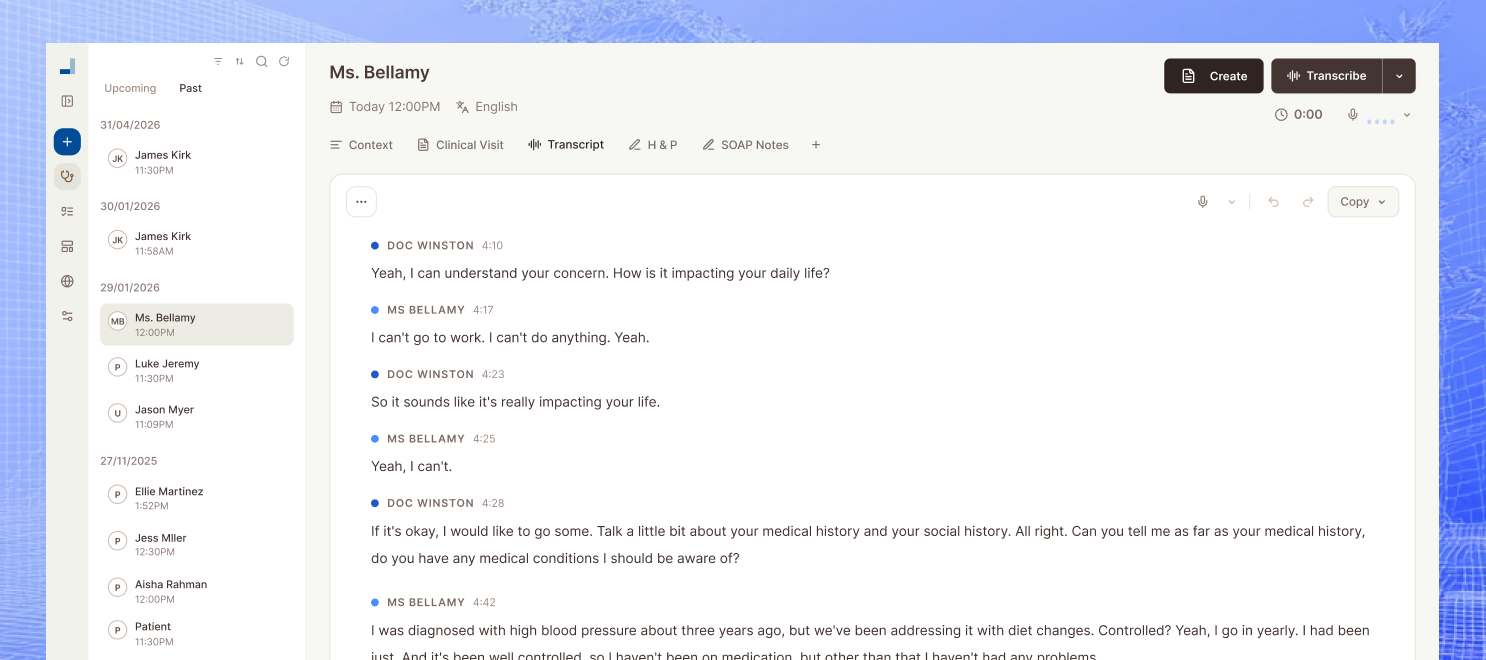
An AI medical scribe addresses these issues by acting as an intelligent assistant during the encounter. It captures the natural conversation between the doctor and patient, filtering out the noise to focus on clinical relevance. It is important to remember that while the technology is highly sophisticated, it remains assistive. The clinician maintains final responsibility for the accuracy of the medical record, ensuring that professional judgment always leads the way.
- Reduces the time spent on manual data entry after patient hours.
- Minimizes cognitive load by capturing details in real-time.
- Improves note completion rates and billing accuracy.
- Allows clinicians to focus on eye contact and patient rapport.
Note types you can generate beyond SOAP (H&P and more)
While the SOAP format is a staple in medical training, it represents only a fraction of the documentation required in a modern private practice or university clinic. Effective continuity of care requires diversity in documentation styles. For example, a new patient requires a comprehensive History and Physical (H&P) that establishes a baseline, whereas an established patient may only need a focused follow-up note or a progress note to track chronic condition management.
Beyond these, specialized encounters demand specific structures. Procedure notes must accurately detail techniques and outcomes, while discharge summaries and referral letters serve as vital communication tools for the broader care team. When these notes are structured correctly, they ensure audit readiness and high-quality handovers. Using a system that supports varied formats ensures that the documentation matches the clinical intent of the visit.
- Comprehensive H&P notes for new patient intakes and diagnostics.
- Consultation and referral letters to streamline specialist communication.
- Procedure and discharge notes to maintain legal and clinical standards.
- Progress and follow-up notes for efficient longitudinal care.
How to implement Customize SOAP Note Templates step-by-step in a real clinic
To begin implementing a system to customize SOAP note templates, start small by choosing one specific visit type, such as routine physicals or standardized follow-ups. By focusing on a single workflow, you can identify how the AI interprets your specific clinical style without overwhelming your staff. This initial focus allows the team to see immediate benefits in time savings before scaling the solution across the entire practice.
Next, you should configure your templates by specialty. A cardiologist and a pediatrician have different requirements; ensure your chosen tool reflects these nuances. Once the templates are ready, capture the encounter naturally, whether in-person or via telehealth. The system should absorb the dialogue seamlessly. After the visit, perform a quick review and edit of the generated draft to ensure it aligns with your preferences and the patient’s specific needs.
Finally, leverage the output for broader administrative tasks. A well-generated note can be the foundation for referral letters, insurance forms, or school notes. By reusing the core documentation, you eliminate redundant typing and ensure that all external communications are consistent with the medical record. This streamlined approach turns a single encounter into a suite of necessary clinical documents.
- Start with one high-volume visit type to simplify the initial transition.
- Personalize templates to match your specialty and clinical vocabulary.
- Review drafts immediately after the encounter for maximum accuracy.
- Repurpose note data for letters and forms to save administrative time.
How to keep note quality high and reduce mistakes
Maintaining high note quality requires awareness of common failure points such as missing medications, incorrect laboratory values, or the dreaded “note bloat.” Note bloat occurs when redundant information is carried over, making the documentation difficult to read. To combat this, clinicians should adopt a lightweight review habit where they scan for factual accuracy and delete unnecessary repetitive sections before finalizing the entry.
Establishing team standards is also critical, especially in a collaborative clinic environment. Having a shared understanding of what constitutes a high-quality note ensures that every clinician and scribe is on the same page. Regular brief audits can help identify recurring errors and refine the AI’s performance over time. Consistency is the key to preventing medico-legal complications and ensuring patient safety.
- Implement a 60-second review process for every generated note.
- Audit notes periodically to identify and correct systematic errors.
- Set clear documentation standards for all clinicians in the group.
- Focus on brevity and clinical relevance to prevent note bloat.
Privacy, consent, and patient trust (plain English)
Patient trust is built on transparency. When introducing recording or transcription technology, it is essential to follow local regulations and institutional policies. While specific laws vary by region, the principle remains the same: patients should be informed and give their consent. Explaining the benefits of the technology—such as being able to focus more on them and less on the computer—usually mitigates any privacy concerns.
A simple script can help: “I’m using a digital assistant today to take notes so I can focus entirely on our conversation. It’s secure and helps me ensure your records are as accurate as possible. Are you comfortable with me using this?” Most patients appreciate the extra attention they receive when the doctor isn’t buried in a screen. Always ensure that the data retention policies of your software tools align with your professional requirements.
- Always obtain verbal or written consent based on local policy.
- Explain the technology as a tool for better patient-doctor focus.
- Ensure the software meets standard medical data security protocols.
- Maintain a clear policy on how long recordings and transcripts are kept.
Rolling it out across a clinic without disruption
A successful rollout starts with a two-week pilot phase involving one or two “champion” clinicians. This allows the clinic to iron out technical kinks and workflow bottlenecks before a full-scale launch. During this time, the pilot group can provide feedback on which templates work best and where additional training might be needed for the rest of the staff.
Tracking specific metrics is the only way to prove the ROI of the transition. Monitor indicators such as hours saved per week, the reduction in after-hours charting, and the speed of note completion. If the data shows that clinicians are leaving on time and notes are more complete, the rest of the team will be much more eager to adopt the new workflow and modernize their practice.
- Launch a 14-day pilot with a small group of tech-savvy doctors.
- Measure time saved and note completeness to gauge success.
- Hold weekly 15-minute briefings to share tips and template adjustments.
- Align templates across the team for better data consistency.
Mcoy AI is an AI medical scribe that records and transcribes patient encounters, then generates multiple clinical note types (H&P, progress notes, consult notes, follow-up notes, procedure notes, discharge summaries, referral letters, and more). It features 200+ customizable templates and an AI chat to create letters, forms, and documents quickly, allowing clinicians to focus on care rather than paperwork.
Conclusion
Mastering clinical documentation doesn’t require hours of manual labor. By adopting a system where you can customize SOAP note templates and automate complex drafts, you reclaim your schedule and improve the quality of patient care. The transition from manual entry to AI-assisted charting is the most effective way to eliminate burnout in modern medical practice. Start with a small pilot today to see how quickly your workflow can transform.
What a serious review table should cover
| Decision area | Common mistake | Better clinic-ready approach | Metric to watch |
|---|---|---|---|
| Workflow design | Treat how to customize soap note templates in minutes | mcoy as a one-off documentation task | Build a repeatable process with clear ownership and review points |
| Team adoption | Assume every clinician will naturally use the same process | Train for consistency and define exception handling early | Active user adoption |
| Quality review | Only check notes when a problem is reported | Audit a sample of notes weekly and review edge cases | Edit rate per note |
| Operational follow-through | Leave admin actions outside the documentation workflow | Use the same encounter data for referrals, letters, and follow-up tasks | Completion rate for next-step tasks |
Related reading
If you are working through how to customize soap note templates in minutes | mcoy, it helps to read this alongside AI & Medicine: How to Simplify Clinical Notes for Busy Doctors, AI & Medicine: How Doctors Can Improve SOAP Notes, and AI & Medicine: How to Use AI Medical Scribe Notes Effectively | Mcoy Blog. Those guides cover adjacent workflow, implementation, and evaluation questions so the decision does not sit in isolation.
FAQ
How accurate are AI medical scribes in real clinics?
AI medical scribes are exceptionally accurate at capturing the dialogue and clinical facts of an encounter. However, they are not a replacement for medical judgment. They act as a sophisticated draft generator that the clinician must always review and approve. In most cases, the accuracy is high enough to significantly reduce the time spent on manual editing.
Do I still need to review every note?
Yes, reviewing every note is a mandatory part of clinical responsibility. While the AI does the heavy lifting of transcription and formatting, the clinician must ensure that the medical assessment and plan are 100% accurate. A quick 30-to-60-second review is usually all that is required to finalize a high-quality note.
What note types can an AI scribe generate besides SOAP?
Beyond the standard SOAP format, an AI scribe can generate History and Physicals (H&P), procedure notes, discharge summaries, and consult letters. It can also produce specialized follow-up notes and referral documents. This versatility ensures that every aspect of the patient journey is documented in the appropriate professional format.
Will this work for telehealth and in-person consults?
Yes, modern AI scribes are designed to work seamlessly in both environments. For in-person visits, the device captures room audio, while for telehealth, it integrates with your computer audio to record the virtual conversation. The quality of the transcription remains high regardless of the encounter medium.
How do I explain recording/transcription to patients?
The best way to explain this to patients is to frame it as a benefit to their care. You might say that the tool allows you to listen more intently to their concerns rather than typing on a keyboard. Most patients are very supportive when they realize it leads to a more focused and personal consultation.
How do clinics prevent note bloat?
Clinics prevent note bloat by using concise templates and setting clear expectations for note length. AI scribes can be programmed to summarize only the most relevant clinical points, avoiding the repetition of entire medical histories in every progress note. Regular reviews help keep the documentation focused and readable.
How long does template setup take?
Initial template setup usually takes just a few minutes if you are using pre-built clinical standards. Deep customization for a specific specialty might take an hour or two of refinement over the first week. Once the templates are set, they require very little ongoing maintenance.
What’s the safest way to start if I’m skeptical?
The safest way to start is with a small pilot program involving non-critical or routine follow-up visits. This allows you to test the technology’s accuracy and workflow integration without any pressure. As you gain confidence in the output, you can gradually expand its use to more complex patient encounters.