Admin Management: How to Use AI Scribe for Forms & Certificates | Mcoy Health
Learn how to use an AI scribe to automate clinical forms, medical certificates, and documentation. Streamline your workflow and reduce administrative burnout.
The Administrative Crisis in Modern Medicine
For many clinicians, the day doesn’t end when the last patient leaves the exam room. Instead, it transitions into a second shift of administrative labor—filling out work capacity certificates, school excuse notes, and complex insurance forms. This after-hours charting is a primary driver of physician burnout, leading to rushed notes and a constant state of medico-legal anxiety. The mental load of remembering every specific detail to include in a referral or a disability form while managing a high-volume patient load is unsustainable for modern private practitioners and university clinics alike.
This guide will teach you a transformative workflow that goes beyond simple transcription. You will learn how to leverage automated documentation to generate diverse note formats, maintain high quality control, and ensure patient privacy while rolling out a seamless system across your practice. Whether you are a GP, a specialist, or managing a high-flow telehealth service, mastering the use of an AI scribe to create forms and certificates will reclaim hours of your personal time and improve the accuracy of your clinical paper trail.
What a medical scribe solves in modern practice
The real cost of documentation isn’t just measured in minutes; it’s measured in cognitive load. When a doctor spends half a consultation staring at a screen to ensure every data point is captured for a later form, the patient-provider connection suffers. Delayed notes often lead to ‘documentation amnesia,’ where nuanced details of the patient’s presentation are lost, potentially impacting the quality of care and increasing the risk of audit failures. An automated system captures the dialogue in real-time, allowing the clinician to remain fully present.
It is important to understand that an AI medical scribe is an assistive tool, not a replacement for clinical judgment. The AI handles the heavy lifting of capturing the conversation and organizing it into a structured format, but the clinician remains the final authority. You are responsible for reviewing, editing, and signing off on the generated content. By offloading the synthesis of the note, you reduce the ‘friction’ of starting from a blank page for every certificate or medical form.
- Reclaims hours spent on after-hours charting and administrative tasks.
- Reduces cognitive load by capturing real-time dialogue during encounters.
- Enhouses patient engagement by allowing clinicians to focus on the person, not the screen.
- Acts as a high-fidelity assistant while keeping the clinician in total control of the final output.
Note types you can generate beyond SOAP (H&P and more)
While the SOAP note is the industry standard, it is often insufficient for the diverse needs of a busy clinic. Comprehensive care requires structured History and Physical (H&P) reports for new admissions, detailed consult notes for specialists, and concise progress notes for chronic disease management. Each of these serves a different purpose in the continuity of care, ensuring that the next provider—or the same provider months later—has a clear understanding of the clinical trajectory.
Beyond standard notes, AI tools are now capable of generating procedure notes, discharge summaries, and referral letters that are ready for review in seconds. This diversity in output ensures audit readiness and high-quality handovers. When a transition of care occurs, having a well-structured discharge summary or a detailed referral letter created directly from the encounter transcript prevents critical information from falling through the cracks, such as medication changes or follow-up requirements.
- Generate H&P, consult notes, and follow-up notes tailored to specific specialties.
- Automate complex documents like discharge summaries and referral letters.
- Ensure audit readiness through consistent, structured documentation.
- Improve handover quality by providing clear, detailed summaries of patient encounters.
How to implement AI scribe for forms step-by-step in a real clinic
Transitioning your clinic starts with a focused approach. Don’t try to automate every single visit type on day one. Instead, select one common visit type—such as a standard follow-up or a specific physical exam—to test the workflow. This allows you to calibrate the system without overwhelming your staff. Begin by setting up templates tailored to your specialty, ensuring the AI knows exactly which headers and data points are most relevant to your specific patient population.
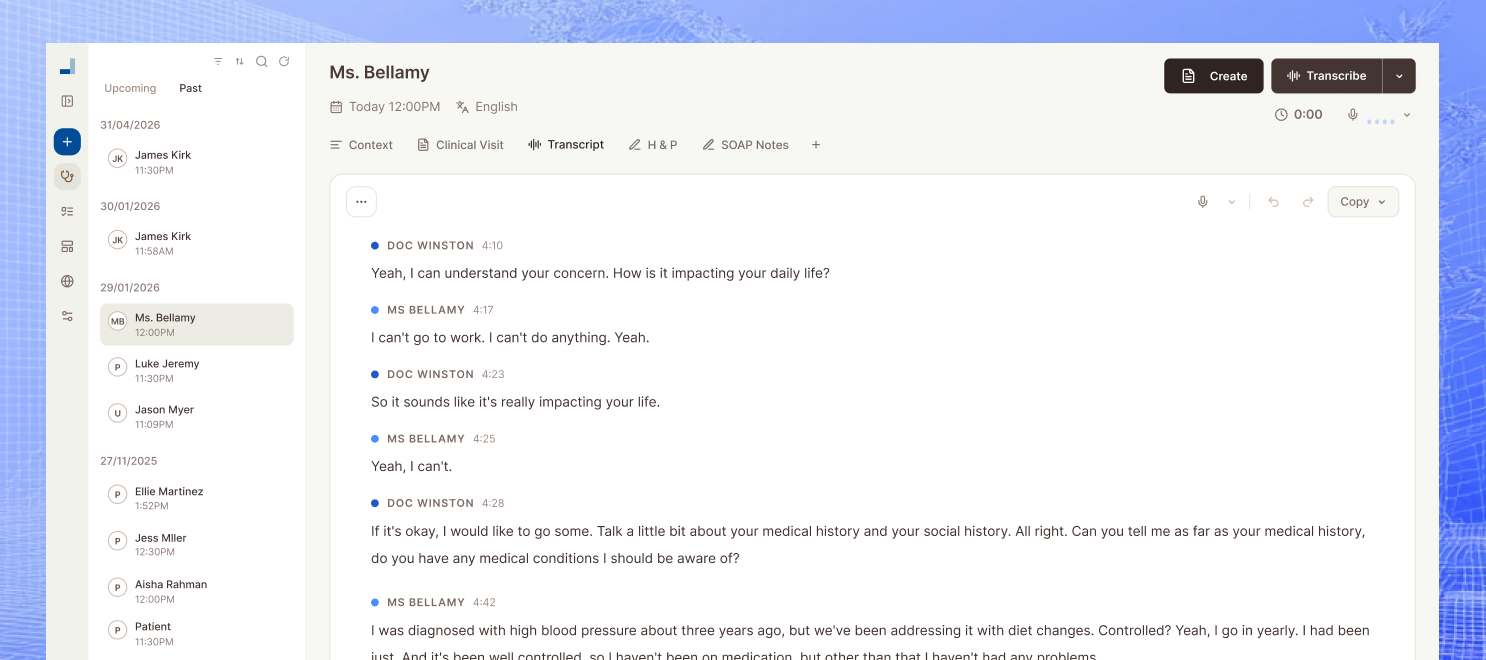
During the encounter, whether it is in-person or via telehealth, simply capture the conversation naturally. You don’t need to change the way you speak to the patient; the AI is designed to filter out the small talk and focus on the clinical substance. After the patient leaves, the system will generate the draft. Spend a minute or two performing a ‘review and edit’ to ensure specific values or nuances are captured perfectly.
Once the primary note is finalized, you can reuse that structured data to trigger the creation of secondary documents. For example, if the patient needs a work certificate, the AI can pull the relevant symptoms and restrictions directly from the note into a pre-formatted certificate template. This ‘once-and-done’ approach to data entry ensures that the information in your forms perfectly matches the clinical note, reducing errors and saving significant time.
- Start with one specific visit type to master the initial workflow.
- Utilize specialty-specific templates to guide the AI’s output structure.
- Capture encounters naturally without modifying your clinical bedside manner.
- Leverage the final clinical note to instantly populate forms and letters.
How to keep note quality high and reduce mistakes
The most common failure points in clinical documentation involve missing medications, incorrect numerical values, or ‘note bloat’—the inclusion of irrelevant information that hides the actual clinical plan. To prevent this, practitioners must develop a lightweight review habit. Instead of reading every word, scan for the ‘Big Three’: the medication list, the assessment/plan, and any specific diagnostic values (like BP or lab results). Setting team standards for what a ‘gold standard’ note looks like helps keep the AI’s outputs consistent across the entire clinic.
Standardization is your best defense against errors. By using consistent templates, you train your own eye to look for information in the same place every time. If you notice the AI consistently missing a certain detail, such as social history or a specific test, adjust your template prompts to prioritize those fields. High-quality documentation is a collaborative effort between the clinician’s expertise and the AI’s processing power.
- Scan the medication list and assessment/plan as high-priority review areas.
- Establish clinic-wide standards for note length and detail level.
- Adjust templates regularly to capture specific data points consistently.
- Focus on accuracy over quantity to avoid the pitfalls of note bloat.
Privacy, consent, and patient trust (plain English)
Patient trust is the foundation of any clinical encounter. When introducing a recording or transcription tool, transparency is key. While consent requirements vary by region, it is best practice to follow your local healthcare board’s policies regarding digital recordings and data retention. In most cases, a simple verbal explanation is sufficient to put patients at ease. Explain that the tool allows you to focus on them rather than the keyboard, which usually results in a positive patient response.
You might say: ‘I’m using an AI assistant today to help me capture our conversation for your medical record. This allows me to listen to you better instead of typing while we talk. Is that okay with you?’ Most patients appreciate the extra attention they receive when the doctor isn’t buried in a laptop. From a security standpoint, ensure the system you use adheres to industry-standard encryption and data protection principles, protecting the patient’s most sensitive information.
- Always follow local regulations and institutional policies regarding patient consent.
- Use a simple, transparent script to explain the tool’s benefit to the patient.
- Prioritize security and encryption to maintain data integrity.
- Foster trust by demonstrating that the technology improves the doctor-patient connection.
Rolling it out across a clinic without disruption
To roll out an AI scribe without disrupting clinic flow, begin with a two-week pilot program involving a small group of ‘super-users.’ These clinicians can identify any bottlenecks in the workflow and help refine templates before the full launch. During this phase, track specific metrics such as time saved per day, the reduction in after-hours charting, and the completeness of notes compared to the previous manual system. These data points provide the evidence needed to encourage adoption among more skeptical staff members.
Training should focus on template alignment and the ‘review-edit-sign’ cycle rather than technical minutiae. Once the pilot group is comfortable, expand to the rest of the clinic in phases. Ensure that everyone understands how to access and modify the templates so that the documentation reflects the unique voice and needs of each provider. This phased approach minimizes downtime and ensures that the transition to automated documentation is seen as a benefit, not a burden.
- Conduct a two-week pilot with a small group to troubleshoot the workflow.
- Track time savings and note quality metrics to prove the tool’s value.
- Provide focused training on template customization and the review process.
- Phase the rollout to ensure continuous clinic operations and staff alignment.
Mcoy AI is an AI medical scribe that records and transcribes patient encounters, then generates multiple clinical note types, including H&P, progress notes, consult notes, follow-up notes, procedure notes, discharge summaries, referral letters, and more. With over 200 customizable templates and an interactive AI chat feature, clinicians can instantly create professional letters, forms, and documents based on the captured encounter, significantly reducing the administrative burden on the practice.
Frequently Asked Questions
Automation in a clinical setting often leads to several practical questions regarding accuracy and implementation. Below are the most common inquiries from practitioners looking to optimize their workflow.
How accurate are AI medical scribes in real clinics?
AI medical scribes are highly accurate in capturing clinical dialogue, often outperforming manual note-taking by catching details clinicians might forget to write down. However, they are sensitive to audio quality, so clear speech in a quiet room is best. Because they are trained on medical terminology, they handle complex diagnoses and drug names remarkably well. Always remember that the final accuracy check is the responsibility of the licensed professional.
Do I still need to review every note?
Yes, you must review every note before signing off and adding it to the patient’s permanent record. While the AI is excellent at synthesizing information, it can occasionally misinterpret a nuanced clinical point or omit a specific detail you deem important. A quick one-minute review ensures that the note accurately reflects your clinical judgment and the patient’s status. This review process is also a critical legal and professional requirement for medical documentation.
What note types can an AI scribe generate besides SOAP?
Beyond the standard SOAP note, modern AI scribes can generate History and Physicals, consult notes, referral letters, and procedure summaries. They are also capable of creating follow-up instructions and patient education summaries based on the encounter. This flexibility allows the scribe to support various aspects of the clinical workflow, from the initial consultation to discharge and coordination of care with other specialists.
Will this work for telehealth and in-person consults?
AI scribes are designed to be versatile and work seamlessly for both in-person and telehealth consultations. For telehealth, the system can often capture the audio directly from the computer or mobile device used for the video call. In-person, a smartphone or tablet placed on the desk is typically sufficient to capture the conversation. This ensures a consistent documentation experience regardless of how you interact with your patients.
How do do I explain recording/transcription to patients?
The best way to explain it is to focus on the benefit to the patient: better eye contact and a more focused physician. Tell them that the tool is a ‘digital assistant’ that helps you keep more accurate records so you don’t have to type while they speak. Most patients are very supportive when they realize it means their doctor will be listening more intently to their concerns. Transparency and a brief explanation go a long way in maintaining trust.
How do clinics prevent note bloat?
Note bloat is prevented by using concise templates and setting specific instructions for the AI regarding the desired length and detail level. Clinicians should choose templates that prioritize actionable data and relevant clinical findings over exhaustive transcripts of every word spoken. Regularly refining your templates to exclude redundant information helps keep the records clean and easy for other providers to read. Consistency in how the AI is prompted is key to maintaining brevity.
How long does template setup take?
Basic template setup usually takes only a few minutes, as many systems come with pre-built options for common specialties. Customizing those templates to your specific preferences might take an additional 10 to 15 minutes of tweaking. Once a template is set, it can be used indefinitely, meaning the small upfront time investment pays off significantly in daily time savings. Many clinicians find they only need 3-5 core templates to cover 90% of their visits.
What’s the safest way to start if I’m skeptical?
The safest way to start is to use the AI scribe for a single, non-complex visit type for one week. Use it for standard follow-ups where the clinical stakes are lower and the documentation is more predictable. This allows you to gain confidence in the system’s accuracy and reliability without the pressure of a full-scale implementation. Once you see the time savings and the quality of the notes, you can gradually expand its use to more complex encounters.
Conclusion
Implementing a structured documentation workflow allows you to transition from a burnt-out administrator back to a focused clinician. By following the step-by-step rollout and focusing on high-quality templates, you can automate the most tedious parts of clinical work. Using an AI scribe to create forms and certificates is no longer a futuristic concept—it is a practical necessity for any modern clinic aiming to improve efficiency and patient care. Start your pilot today and see how much time you can reclaim for your patients and yourself.
What a serious review table should cover
| Decision area | Common mistake | Better clinic-ready approach | Metric to watch |
|---|---|---|---|
| Workflow design | Treat how to use ai scribe for forms & certificates | mcoy health as a one-off documentation task | Build a repeatable process with clear ownership and review points |
| Team adoption | Assume every clinician will naturally use the same process | Train for consistency and define exception handling early | Active user adoption |
| Quality review | Only check notes when a problem is reported | Audit a sample of notes weekly and review edge cases | Edit rate per note |
| Operational follow-through | Leave admin actions outside the documentation workflow | Use the same encounter data for referrals, letters, and follow-up tasks | Completion rate for next-step tasks |
Related reading
If you are working through how to use ai scribe for forms & certificates | mcoy health, it helps to read this alongside Admin Management: How to Reduce Admin Errors in Clinical Notes, Admin Management: Medication List Template with Examples, and AI & Medicine: How to Create Clinic Templates for AI Scribing | Mcoy. Those guides cover adjacent workflow, implementation, and evaluation questions so the decision does not sit in isolation.
FAQ
How accurate are AI medical scribes in real clinics?
AI medical scribes are highly accurate in capturing clinical dialogue, often outperforming manual note-taking by catching details clinicians might forget to write down. However, they are sensitive to audio quality, so clear speech in a quiet room is best. Because they are trained on medical terminology, they handle complex diagnoses and drug names remarkably well. Always remember that the final accuracy check is the responsibility of the licensed professional.
Do I still need to review every note?
Yes, you must review every note before signing off and adding it to the patient’s permanent record. While the AI is excellent at synthesizing information, it can occasionally misinterpret a nuanced clinical point or omit a specific detail you deem important. A quick one-minute review ensures that the note accurately reflects your clinical judgment and the patient’s status. This review process is also a critical legal and professional requirement for medical documentation.
What note types can an AI scribe generate besides SOAP?
Beyond the standard SOAP note, modern AI scribes can generate History and Physicals, consult notes, referral letters, and procedure summaries. They are also capable of creating follow-up instructions and patient education summaries based on the encounter. This flexibility allows the scribe to support various aspects of the clinical workflow, from the initial consultation to discharge and coordination of care with other specialists.
Will this work for telehealth and in-person consults?
AI scribes are designed to be versatile and work seamlessly for both in-person and telehealth consultations. For telehealth, the system can often capture the audio directly from the computer or mobile device used for the video call. In-person, a smartphone or tablet placed on the desk is typically sufficient to capture the conversation. This ensures a consistent documentation experience regardless of how you interact with your patients.
How do I explain recording/transcription to patients?
The best way to explain it is to focus on the benefit to the patient: better eye contact and a more focused physician. Tell them that the tool is a ‘digital assistant’ that helps you keep more accurate records so you don’t have to type while they speak. Most patients are very supportive when they realize it means their doctor will be listening more intently to their concerns. Transparency and a brief explanation go a long way in maintaining trust.
How do clinics prevent note bloat?
Note bloat is prevented by using concise templates and setting specific instructions for the AI regarding the desired length and detail level. Clinicians should choose templates that prioritize actionable data and relevant clinical findings over exhaustive transcripts of every word spoken. Regularly refining your templates to exclude redundant information helps keep the records clean and easy for other providers to read. Consistency in how the AI is prompted is key to maintaining brevity.
How long does template setup take?
Basic template setup usually takes only a few minutes, as many systems come with pre-built options for common specialties. Customizing those templates to your specific preferences might take an additional 10 to 15 minutes of tweaking. Once a template is set, it can be used indefinitely, meaning the small upfront time investment pays off significantly in daily time savings. Many clinicians find they only need 3-5 core templates to cover 90% of their visits.
What’s the safest way to start if I’m skeptical?
The safest way to start is to use the AI scribe for a single, non-complex visit type for one week. Use it for standard follow-ups where the clinical stakes are lower and the documentation is more predictable. This allows you to gain confidence in the system’s accuracy and reliability without the pressure of a full-scale implementation. Once you see the time savings and the quality of the notes, you can gradually expand its use to more complex encounters.