AI & Medicine: How to Create Clinic Templates for AI Scribing | Mcoy
Learn how to build and optimize clinic templates for AI scribing. Streamline your H&P, SOAP notes, and referrals to save time and reduce burnout.
The Hidden Burden of After-Hours Documentation
For many clinicians, the end of the patient day is only the beginning of a second shift. The weight of administrative documentation, from rushed SOAP notes to the constant anxiety of a medico-legal audit, often leads to significant burnout. Whether you are a solo private practitioner or managing a busy university clinic, the pressure to produce high-quality, consistent notes while maintaining patient engagement is a difficult balancing act.
This guide provides a comprehensive roadmap for mastering clinic templates for AI scribing. We will explore how to transition beyond basic SOAP formats, optimize your clinical workflow, ensure data privacy, and maintain rigorous quality control. By the end of this article, you will have a clear plan for rolling out personalized templates that reflect your unique clinical voice across general practice, specialty consultations, and telehealth encounters.
What a medical scribe solves in modern practice
The true cost of documentation is measured in more than just minutes; it is measured in cognitive load. When a doctor is forced to multi-task between a physical exam and a keyboard, the quality of both the patient interaction and the resulting note can suffer. Delayed documentation often results in lost nuances, as the specific details of a complex case can blur by the time a clinician sits down to finalize the chart at 8:00 PM.
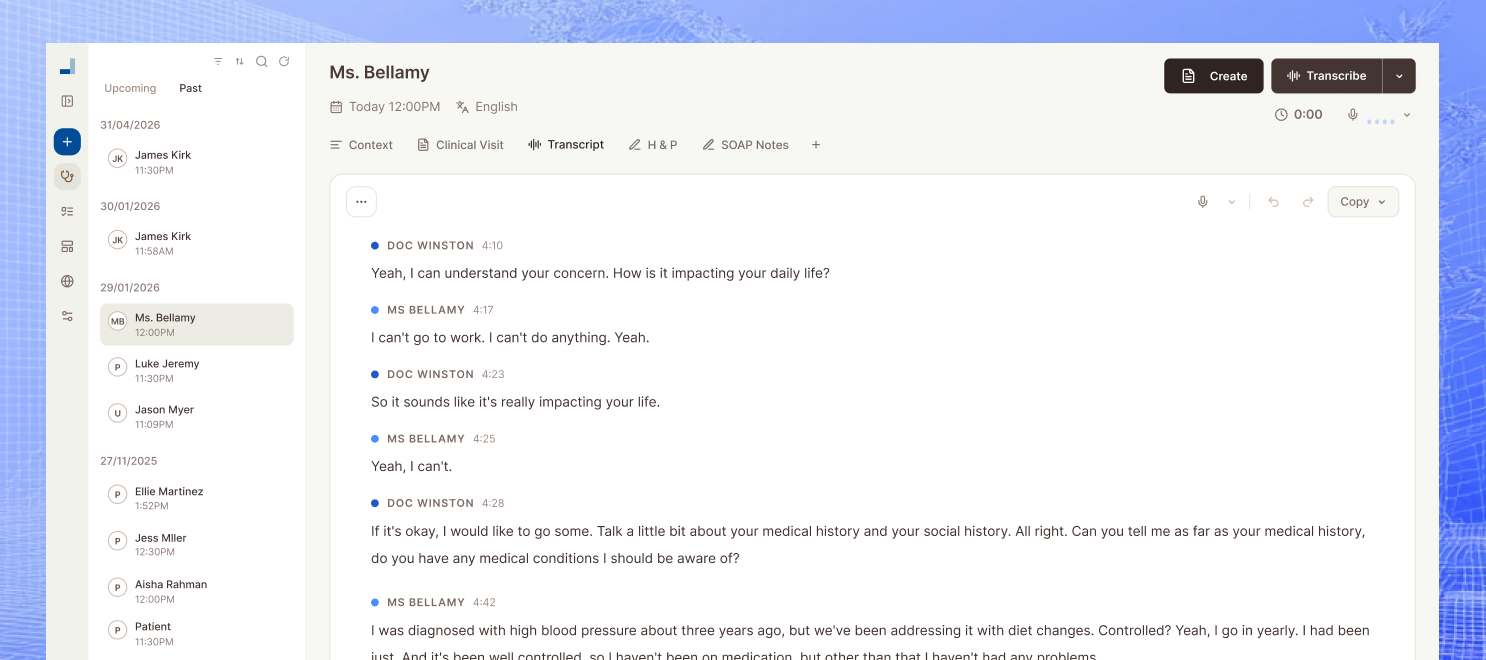
An AI medical scribe acts as an intelligent assistant, capturing the raw data of a conversation so the clinician can focus on the human in front of them. It is important to remember that these tools are assistive, not autonomous. While the AI processes the dialogue and structures the narrative, the clinician remains the final authority, responsible for reviewing and validating every clinical claim. This partnership ensures that the documentation is both timely and accurate without sacrificing the physician’s oversight.
- Reduces the cognitive burden of remembering every patient detail.
- Eliminates hours of manual typing and after-hours charting.
- Allows for improved eye contact and patient-centered communication.
- Provides a consistent structure for every encounter in the clinic.
Note types you can generate beyond SOAP (H&P and more)
While the SOAP note is the industry standard for daily progress, modern medicine requires a much broader range of documentation formats. Comprehensive History and Physical (H&P) notes are essential for new admissions, requiring a level of detail that covers systemic reviews and social histories. Consult notes and referral letters, on the other hand, must be concise and targeted, highlighting specific clinical questions for specialists to address.
Specialized procedures and transition periods also demand unique structures. Procedure notes must capture specific instruments, techniques, and immediate outcomes, while discharge summaries serve as the critical bridge for continuity of care. By utilizing diverse templates, a clinic ensures that every hand-over is seamless and every audit trail is robustly defended with structured data. This variety prevents the “one size fits all” approach that often leads to missing information in complex cases.
- H&P and Progress Notes for comprehensive long-term tracking.
- Consultation and Referral Letters for professional medical communication.
- Procedure Notes and Discharge Summaries for acute care transitions.
- Follow-up notes tailored to chronic disease management.
How to implement clinic templates for AI scribing step-by-step
Starting your journey with automated documentation works best when you begin with a single visit type, such as routine follow-ups or standard physical exams. This allows you to calibrate your expectations and see how the AI interprets your specific terminology before moving on to more complex cases. Once you are comfortable, you can begin tailoring your templates by specialty, ensuring that a cardiology consult looks fundamentally different from a pediatric wellness check.
During the encounter, whether it is an in-person visit or a telehealth session, focus entirely on the patient. The AI captures the natural flow of the conversation, including the subjective complaints and the objective findings you verbalize during the exam. After the patient leaves, the system instantly organizes this data into your chosen template. This narrative flow ensures that the note reflects the actual consultation rather than a generic summary.
The next step is a quick review and edit phase. Instead of writing from scratch, you are now an editor, verifying the medication dosages and the assessment plan the AI has drafted. Finally, these structured outputs can be reused instantly to generate outside documents. A well-formatted progress note can be converted into a referral letter or a school excuse form with minimal extra effort, significantly reducing the administrative tail of every appointment.
- Identify one high-volume visit type to begin your pilot phase.
- Select or build templates that match your specific specialty needs.
- Review AI-generated drafts as an editor rather than a writer.
- Repurpose clinical notes for letters and forms to save additional time.
How to keep note quality high and reduce mistakes
Even the most advanced systems can face challenges such as “note bloat” or the omission of specific lab values if not properly supervised. Quality control starts with a lightweight review habit; taking sixty seconds to scan the assessment and plan section ensures that the most critical clinical decisions are perfectly represented. Establishing team-wide standards for what a “gold standard” note looks like helps maintain consistency across the entire organization.
- Verify medication names and specific dosages in every note.
- Watch for redundant phrasing to keep documentation concise.
- Ensure the problem list aligns with the subjective narrative.
- Create a monthly peer-review check for note quality.
Privacy, consent, and patient trust
Trust is the foundation of the patient-physician relationship, and introducing recording technology requires transparency. Always follow your local regional policies regarding recording consent and data retention. A simple, patient-friendly explanation goes a long way: “To focus entirely on our conversation today, I’m using an AI assistant to take our clinical notes so I don’t have to type while we talk. Is that okay with you?”
- Obtain verbal or written consent based on local regulatory standards.
- Explain the benefit to the patient (better eye contact and focus).
- Ensure the AI provider adheres to modern security and encryption standards.
- Maintain a clear policy on how long recordings are stored or processed.
Rolling it out across a clinic without disruption
A successful rollout involves a structured two-week pilot with a small group of “super-users.” During this time, the clinic should track metrics such as time saved per note and the reduction in after-hours work. This data provides the evidence needed to encourage more skeptical staff members. Once the pilot is complete, align your templates across the team to ensure that every provider is producing notes that meet the clinic’s professional standards.
- Select 2–3 champions to lead the initial implementation.
- Track time-savings and clinician satisfaction scores weekly.
- Align template styles to ensure a unified clinical brand.
- Schedule brief feedback loops to refine templates during the first month.
Mcoy AI is an AI medical scribe that records and transcribes patient encounters, then generates multiple clinical note types including H&P, progress notes, consult notes, follow-up notes, procedure notes, discharge summaries, referral letters, and more. With over 200+ customizable templates and an interactive AI chat, clinicians can easily create letters, forms, and complex documents tailored to their specific workflow needs, reducing administrative overhead while improving documentation accuracy.
Conclusion
Transitioning to an automated documentation workflow is the most effective way to reclaim your time and focus on patient care. By mastering your clinic templates for AI scribing, you move away from the burden of manual entry and toward a system of high-quality, structured data. Start with a small pilot, refine your templates, and watch your administrative stress disappear. Your journey toward a more efficient practice begins with the first note.
What a serious review table should cover
| Decision area | Common mistake | Better clinic-ready approach | Metric to watch |
|---|---|---|---|
| Workflow design | Treat how to create clinic templates for ai scribing | mcoy as a one-off documentation task | Build a repeatable process with clear ownership and review points |
| Team adoption | Assume every clinician will naturally use the same process | Train for consistency and define exception handling early | Active user adoption |
| Quality review | Only check notes when a problem is reported | Audit a sample of notes weekly and review edge cases | Edit rate per note |
| Operational follow-through | Leave admin actions outside the documentation workflow | Use the same encounter data for referrals, letters, and follow-up tasks | Completion rate for next-step tasks |
Related reading
If you are working through how to create clinic templates for ai scribing | mcoy, it helps to read this alongside AI & Medicine: How to Simplify Clinical Notes for Busy Doctors, AI & Medicine: How Doctors Can Improve SOAP Notes, and AI & Medicine: Follow-Up Notes: Creating Consistency With AI Guide. Those guides cover adjacent workflow, implementation, and evaluation questions so the decision does not sit in isolation.
FAQ
How accurate are AI medical scribes in real clinics?
AI medical scribes are remarkably accurate in capturing the clinical narrative, often identifying nuances that a human might miss during a busy day. However, their accuracy is highest when the clinician verbalizes physical exam findings and the plan clearly during the encounter. They are designed to be 90-95% accurate, leaving the final 5% for the physician to refine during the review process.
Do I still need to review every note?
Yes, reviewing every note is a mandatory clinical and legal requirement. While the AI does the heavy lifting of drafting and formatting, the clinician is the only one who can verify that the medical logic and patient facts are 100% correct. This review typically takes less than a minute compared to the ten minutes it might take to write the note from scratch.
What note types can an AI scribe generate besides SOAP?
Beyond the standard SOAP format, an AI scribe can generate detailed History and Physicals (H&P), consultation notes, procedure reports, referral letters, and discharge summaries. It can also produce patient instructions and follow-up plans. The versatility depends on the specific templates you choose to activate within the system.
Will this work for telehealth and in-person consults?
AI scribing is highly effective for both telehealth and in-person environments. In telehealth, the system can capture audio directly from the computer’s output, while in-person visits rely on a microphone (usually via a smartphone or tablet). The transcription quality remains high as long as the audio is clear and the parties are audible.
How do I explain recording/transcription to patients?
The best approach is complete transparency centered on patient benefit. Let them know that the technology allows you to listen more closely to their concerns instead of staring at a screen. Most patients are very supportive when they realize it leads to better care and more undivided attention from their doctor.
How do clinics prevent note bloat?
Note bloat is prevented by using concise templates that instruct the AI to only include relevant clinical information. Clinicians can further reduce bloat by reviewing the summary and removing any redundant sections. Setting specific parameters within your custom templates helps keep the output focused and professional.
How long does template setup take?
Basic template setup can take as little as 10 to 15 minutes. Most systems come with pre-built library templates for common specialties. Customizing these to match your specific clinical voice or unique workflow usually happens incrementally over the first week of use as you refine the outputs to your liking.
What’s the safest way to start if I’m skeptical?
The safest way to start is with a ‘shadow’ trial. Use the AI scribe during your encounters but continue your normal documentation for a few days. Compare the AI’s output to your manual notes to see the accuracy and time-savings for yourself. This low-pressure environment allows you to build trust in the tool before fully switching over.