Admin Management: How to Use an AI Scribe for Discharge Summaries | Mcoy
Learn how to use an AI scribe for discharge summaries. Improve clinical workflow, reduce burnout, and ensure accurate patient transitions with AI automation.
The Hidden Burden of Clinical Documentation
For many clinicians, the end of a patient encounter doesn’t signify the end of the work. Instead, it marks the beginning of a grueling ritual of after-hours charting and administrative catch-up. Discharge summaries, in particular, represent one of the most time-consuming yet critical documents in a patient’s journey. The pressure to balance speed with medico-legal accuracy often leads to burnout, rushed notes, and a persistent feeling of anxiety regarding potential omissions.
This guide provides a comprehensive roadmap for integrating an AI scribe to create discharge summaries and other vital clinical documents. We will explore how to optimize your workflow, move beyond basic SOAP notes, maintain high data quality, and handle patient privacy with transparency. Whether you are a solo private practitioner, part of a busy multi-specialty group, or managing a university clinic, these strategies are designed to reclaim your time without sacrificing care quality.
What a medical scribe solves in modern practice
The real cost of traditional documentation isn’t just measured in minutes; it is measured in cognitive load. When a doctor is forced to multi-task between listening to a patient and typing on a keyboard, the therapeutic alliance suffers. Manual charting often leads to delayed notes that are finished 24 to 48 hours later, when specific clinical nuances may have faded from memory. This delay creates a bottleneck in communication between primary care providers and specialists.
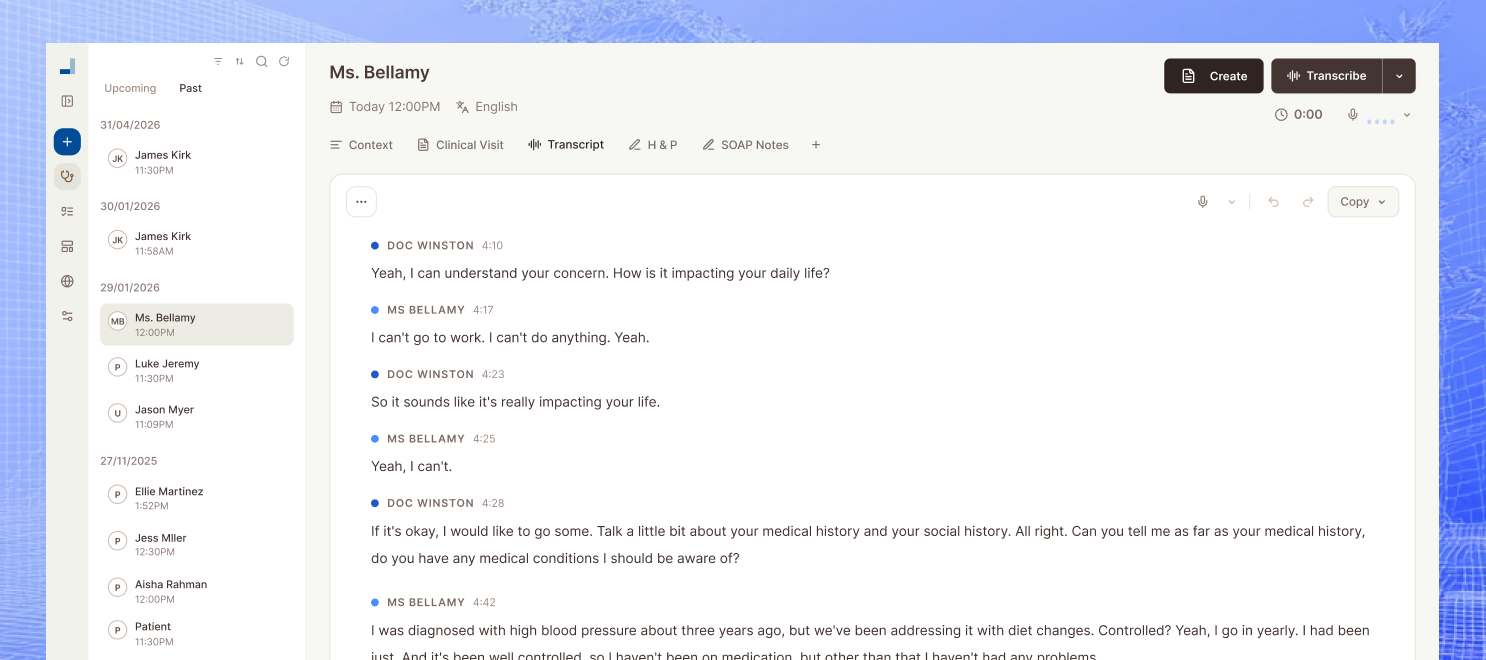
An AI medical scribe acts as an intelligent assistant that captures the dialogue of a clinical encounter in real-time. It is important to remember that these tools are assistive, not autonomous. While the AI handle the heavy lifting of transcription and initial drafting, the clinician remains the final authority and must review and sign off on every document. By removing the burden of the blank page, clinicians can focus entirely on the person sitting across from them.
- Reduces the cognitive load associated with simultaneous typing and listening.
- Eliminates the ‘pajama time’ spent on finishing charts after clinic hours.
- Captures granular details that might be missed in manual retrospective charting.
- Ensures clinical notes are ready for review immediately after the encounter.
Note types you can generate beyond SOAP (H&P and more)
While the SOAP note is a clinical staple, complex patient care requires a much wider variety of documentation. For example, a comprehensive History and Physical (H&P) requires a deep dive into past medical history and systems review that goes far beyond a quick progress note. Similarly, consult notes must clearly communicate specialized findings and recommendations to referring physicians, requiring a different tone and structure than a standard follow-up.
Using an AI scribe allows for the seamless generation of discharge summaries, procedure notes, and referral letters. High-quality documentation is the backbone of audit readiness and continuity of care. When a patient transition occurs—such as moving from an inpatient setting back to a primary care office—the discharge summary serves as the primary bridge. AI ensures these transitions are documented with the necessary detail to prevent medication errors or missed follow-up labs.
- H&P and Consult Notes: Complete, detailed assessments for new or referred patients.
- Procedure and Follow-up Notes: Specific documentation for interventions and ongoing care.
- Discharge Summaries: Condensed but thorough records of a hospital or clinic stay.
- Referral Letters: Professional summaries designed to brief other specialists quickly.
How to implement an AI scribe to create discharge summaries step-by-step
The journey to better documentation starts with a single visit type. Rather than trying to automate every aspect of your practice overnight, select a standard encounter—like a routine follow-up—to test the workflow. This allows you to get comfortable with the device placement and the flow of the conversation before moving on to the more complex task of generating a full discharge summary.
Next, you should configure your templates by specialty. Different departments have different requirements; a pediatric discharge summary looks very different from a surgical one. During the encounter, whether it is in-person or via telehealth, simply conduct the visit naturally. The AI captures the verbal exchange, including the plan discussed with the patient and the results of any physical exams or diagnostic reviews mentioned aloud.
Once the encounter is over, the AI generates a draft. Your role shifts from writer to editor. Review the draft to ensure the clinical reasoning is reflected accurately and that the specific discharge instructions are clear. These outputs are not just for the medical record; they can be instantly repurposed. The AI can use the encounter data to generate a formal referral letter or a patient-facing summary in plain language with minimal extra effort.
- Start small by piloting the AI with one specific encounter type first.
- Select or customize templates that match your specific clinical specialty.
- Conduct the patient visit naturally without worrying about manual note-taking.
- Perform a rapid edit and verify the AI-generated draft before finalization.
How to keep note quality high and reduce mistakes
Even the most advanced technology can face challenges with note bloat or missing specific values like lab results if they weren’t discussed vocally. One of the primary failure points in automated documentation is the inclusion of unnecessary ‘filler’ text that doesn’t add clinical value. To prevent this, clinicians should adopt a lightweight review habit, scanning the generated note for accuracy in medication lists and problem priorities.
Setting team-wide standards for what constitutes a ‘good’ note also helps. If everyone in the clinic agrees on the level of detail required for a discharge summary, the AI can be tuned to meet those expectations. Periodically checking the output against manual notes can help you identify if any specific clinical nuances are being overlooked by the AI’s current configuration.
- Perform a quick reconcile of medications and dosages in every draft.
- Ensure the ‘Assessment and Plan’ clearly reflects your clinical decision-making.
- Avoid note bloat by selecting templates that prioritize concise summaries.
- Establish a standard review protocol for all staff within the clinic.
Privacy, consent, and patient trust (plain English)
Privacy is the cornerstone of the patient-provider relationship. While AI scribes are designed with security in mind, it is vital to follow local regulations and your institution’s specific policies regarding recording. In most regions, obtaining verbal or written consent is a prerequisite. Explaining the technology in plain English helps demystify the process and often increases patient buy-in.
You might say to a patient: ‘I’m using a secure AI assistant today to help me take notes so I can focus entirely on you instead of my computer screen. It records our conversation and turns it into a medical note for your file, then the recording is deleted. Are you comfortable with that?’ This transparency builds trust and shows the patient that their care experience is your priority.
- Always adhere to local and regional healthcare privacy laws (e.g., HIPAA, GDPR).
- Use a simple, transparent script to explain the AI’s role to your patients.
- Verify that your AI provider follows industry-standard data encryption and retention policies.
- Give patients the clear option to opt-out of recording at any time without prejudice.
Rolling it out across a clinic without disruption
A successful rollout requires a structured approach. Start with a two-week pilot involving one or two ‘champion’ doctors who are tech-savvy. This helps identify any local workflow hurdles before a full-scale launch. During this phase, it is helpful to track metrics such as time saved per note and the reduction in after-hours charting to demonstrate the tool’s value to the rest of the team.
Training should focus on template alignment. Ensure that every practitioner knows how to access the specific templates they need, whether they are writing a complex discharge summary or a simple follow-up. By aligning the AI’s output with existing clinical workflows, you minimize the learning curve and ensure that the transition to AI-assisted documentation is seamless and productive.
- Launch a two-week pilot to gather feedback and refine local workflows.
- Track time-savings metrics to provide tangible proof of ROI for the clinic.
- Organize brief training sessions focused on template customization and review.
- Align AI outputs with existing EHR requirements to simplify data transfer.
Mcoy AI is an AI medical scribe that records and transcribes patient encounters, then generates multiple clinical note types (H&P, progress notes, consult notes, follow-up notes, procedure notes, discharge summaries, referral letters, and more). It features 200+ customizable templates and an AI chat to create letters, forms, and documents, helping clinicians reduce the administrative burden while maintaining the highest standards of documentation accuracy and detail.
Frequently Asked Questions
Integrating new technology into a clinical setting often brings up practical questions. Here are the most common inquiries regarding the use of AI for medical documentation.
How accurate are AI medical scribes in real clinics?
In real-world clinical settings, AI scribes are highly accurate at capturing the core of the medical conversation, including diagnoses, symptoms, and plans. They excel at structure and formatting, though they may occasionally miss specific numeric data if it wasn’t clearly spoken. Because they are trained on vast datasets of medical terminology, they handle complex jargon with impressive precision, but they still require a final human review to ensure absolute accuracy.
Do I still need to review every note?
Yes, the clinician is legally and ethically responsible for the contents of the medical record. While the AI creates a very high-quality draft, you must review it to ensure it accurately reflects your clinical judgment and the specific facts of the encounter. Most doctors find that reviewing and editing an AI-generated note takes a fraction of the time required to write one from scratch, often less than 60 seconds.
What note types can an AI scribe generate besides SOAP?
Modern AI scribes are capable of generating a wide array of documentation beyond the standard SOAP format. This includes comprehensive History and Physical (H&P) reports, detailed consultation notes, procedure notes, and even specialized referral letters. Because the AI can reformat the same encounter data into different templates, you can generate a discharge summary and a follow-up letter from the same single recording.
Will this work for telehealth and in-person consults?
Yes, AI scribes are designed to be flexible and work across various settings. For in-person consults, they typically use the microphone on a smartphone or tablet. For telehealth, they can capture audio directly from the computer or through a browser integration. The technology is adept at filtering out background noise and focusing on the dialogue between the provider and the patient regardless of the medium.
How do I explain recording/transcription to patients?
The best approach is to be direct and highlight the benefits to the patient. Explain that using the tool allows you to look at them and listen more closely rather than typing on a computer. Most patients are very supportive when they realize it leads to better eye contact and more focused attention from their doctor. Always emphasize that the data is handled securely and the recording is used only for the note.
How do clinics prevent note bloat?
Note bloat is prevented by using concise templates and setting specific instructions for the AI on what to include. Clinicians can customize their preferences to exclude unnecessary conversational filler or redundant social history if it isn’t relevant to that specific visit. By selecting a ‘concise’ or ‘standard’ template rather than a ‘comprehensive’ one, the AI keeps the documentation focused on relevant clinical facts.
How long does template setup take?
Initial template setup is typically very fast, as most platforms come with a wide library of pre-built templates for different specialties. Customizing a template to fit your specific ‘voice’ or clinic style usually takes just a few minutes. Once a template is saved, it can be used repeatedly across all future encounters, making the long-term time savings significant.
What’s the safest way to start if I’m skeptical?
The safest way to start is by using the AI for your least complex or most repetitive visits, such as routine follow-ups or wellness checks. This allows you to gain confidence in the tool’s accuracy and security without the pressure of a high-acuity case. Most skeptical clinicians find that after 5 to 10 notes, the time-savings become so apparent that they naturally want to expand its use to all parts of their practice.
Conclusion
Adopting an AI-driven workflow is one of the most effective ways to combat the documentation crisis in modern healthcare. By following a structured implementation plan—starting small, using diverse note types, and maintaining a quick review habit—you can significantly increase your efficiency. This guide has shown that documenting complex encounters is no longer a manual chore. Using an AI scribe to create discharge summaries allows you to provide better care transitions while finally leaving the office on time. Take the first step by piloting an AI scribe in your clinic this week and experience the relief of automated documentation.
What a serious review table should cover
| Decision area | Common mistake | Better clinic-ready approach | Metric to watch |
|---|---|---|---|
| Workflow design | Treat how to use an ai scribe for discharge summaries | mcoy as a one-off documentation task | Build a repeatable process with clear ownership and review points |
| Team adoption | Assume every clinician will naturally use the same process | Train for consistency and define exception handling early | Active user adoption |
| Quality review | Only check notes when a problem is reported | Audit a sample of notes weekly and review edge cases | Edit rate per note |
| Operational follow-through | Leave admin actions outside the documentation workflow | Use the same encounter data for referrals, letters, and follow-up tasks | Completion rate for next-step tasks |
Related reading
If you are working through how to use an ai scribe for discharge summaries | mcoy, it helps to read this alongside Admin Management: How to Reduce Admin Errors in Clinical Notes, Admin Management: Medication List Template with Examples, and AI & Medicine: Master Review of Systems Faster With AI [Full Guide]. Those guides cover adjacent workflow, implementation, and evaluation questions so the decision does not sit in isolation.
FAQ
{
“@context”: “https://schema.org”,
“@type”: “FAQPage”,
“mainEntity”: [
{
“@type”: “Question”,
“name”: “How accurate are AI medical scribes in real clinics?”,
“acceptedAnswer”: {
“@type”: “Answer”,
“text”: “AI scribes are highly accurate at capturing clinical sessions, including diagnoses and plans. While they handle medical jargon well, they require human review to ensure specific details like labs are perfectly captured.”
}
},
{
“@type”: “Question”,
“name”: “Do I still need to review every note?”,
“acceptedAnswer”: {
“@type”: “Answer”,
“text”: “Yes, clinicians remain legally responsible for their notes. Reviewing an AI draft is significantly faster than writing from scratch, usually taking under a minute.”
}
},
{
“@type”: “Question”,
“name”: “What note types can an AI scribe generate besides SOAP?”,
“acceptedAnswer”: {
“@type”: “Answer”,
“text”: “Beyond SOAP, AI scribes can produce H&Ps, consult notes, procedure notes, discharge summaries, and referral letters by reformatting encounter data into specialized templates.”
}
}
]
}