Admin Management: How to Use AI Scribe for Care Plans: A Complete Guide
Learn how to use an AI scribe to create care plans efficiently. Streamline clinic workflows, reduce charting time, and improve patient care today.
What a medical scribe solves in modern practice
The transition from manual note-taking to digital documentation was supposed to make life easier for clinicians, but for many, it has led to increased cognitive load and the dreaded ‘pajama time’ spent charting late at night. The real cost of traditional documentation isn’t just time; it is the mental fatigue that comes from trying to recall specific patient details hours after the encounter. When doctors are rushed, notes become fragmented, and critical nuances of a patient’s narrative can be lost in the shuffle of a busy clinic day.
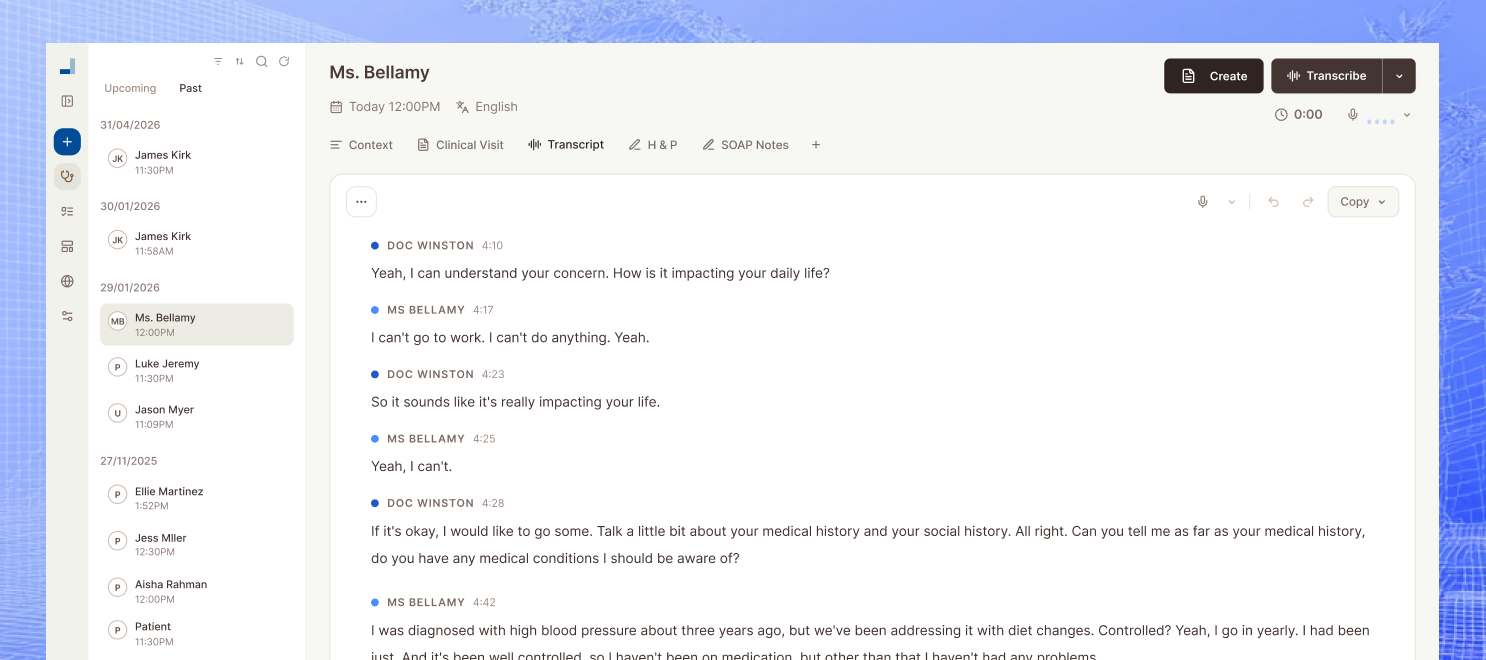
An AI medical scribe acts as an assistive partner rather than a replacement for clinical judgment. It captures the natural dialogue of the exam room, allowing the practitioner to maintain eye contact and build rapport without the barrier of a computer screen. While the AI handles the heavy lifting of transcription and structural formatting, the clinician remains the ultimate authority, reviewing and refining the output to ensure medical accuracy and professional standards.
- Eliminates after-hours charting by generating notes in real-time.
- Reduces cognitive load so doctors can focus on complex diagnostic tasks.
- Captures granular patient details that are often forgotten during manual entry.
- Provides a consistent structure across all patient encounters and providers.
Note types you can generate beyond SOAP (H&P and more)
While the SOAP note is the industry standard, modern medicine requires a wider variety of documentation to ensure continuity of care. Using an AI scribe allows clinics to move beyond basic subjective and objective summaries into comprehensive narratives like History and Physical (H&P) reports, which are vital for new admissions and complex diagnostic workups. These detailed notes provide a baseline for the patient’s status and are essential for multidisciplinary teams.
Beyond the basics, AI tools can generate specialized outputs such as procedure notes, discharge summaries, and referral letters. A well-structured procedure note ensures that every step of a minor surgery or injection is documented for compliance and billing, while a referral letter can be automatically synthesized from the consult notes, saving the physician from writing the same information twice. This versatility ensures that the clinic is always audit-ready and that communication with other specialists remains clear and professional.
Structure matters immensely in university clinics and private practices alike. Having a standardized format for follow-ups and consult notes ensures that any provider stepping into the case can quickly grasp the patient’s history and the current care plan. This level of organization reduces the risk of medical errors during handovers and improves the overall quality of the medical record.
- H&P and Consult Notes for comprehensive initial assessments.
- Procedure Notes and Discharge Summaries for specialized care.
- Referral Letters and Follow-up notes to bridge communication gaps.
- Standardized formatting for better audit compliance and care continuity.
How to implement AI scribe to create care plans step-by-step in a real clinic
Integrating an AI scribe to create care plans starts with a narrow focus to avoid overwhelming the staff. Instead of changing every workflow at once, select a specific visit type—such as chronic disease management or annual wellness visits—where care plans are most intensive. This allows the team to see the immediate value of the tool in a controlled environment before rolling it out for acute or urgent care visits.
Once the visit type is selected, the next step is to align your templates with your specialty’s requirements. Most AI tools offer a variety of presets, but taking the time to customize the ‘Assessment and Plan’ section ensures that the resulting care plan reflects your clinical style. During the encounter, simply let the device record the conversation naturally. There is no need to change how you speak to the patient; the AI is designed to filter out casual small talk and focus on medically relevant facts.
After the encounter, the AI promptly generates a draft. The clinician should review this draft immediately while the conversation is still fresh. This is the time to verify dosages, confirm follow-up dates, and ensure the care plan is actionable. Because the AI has already done the structural work, this review usually takes less than two minutes. Finally, the outputs can be repurposed. The care plan generated in the note can be instantly turned into a patient instruction sheet or a referral letter without additional typing.
- Start with one high-documentation visit type to build confidence.
- Customize assessment and care plan templates to match specialty needs.
- Review the AI-generated draft immediately for maximum accuracy.
- Reuse clinical outputs for patient instructions and specialist letters.
How to keep note quality high and reduce mistakes
Even the most advanced technology requires human oversight to maintain the highest standards of medical documentation. Common failure points in AI-generated notes often include missing specific medication strengths or misinterpreting complex lab values if they weren’t clearly articulated during the visit. ‘Note bloat’—the inclusion of unnecessary or repetitive information—can also be an issue if the AI is not properly calibrated to the clinician’s preferences.
To combat these issues, clinics should implement a lightweight review habit. Instead of reading every word like a proofreader, clinicians can use a ‘scan-and-verify’ approach, focusing on high-risk areas like the medication list, allergy updates, and the specific steps of the care plan. Setting team-wide standards for what constitutes a ‘good note’ helps ensure that all practitioners in a group or university clinic are producing consistent, high-quality documentation.
- Scan for high-risk data points like dosages and allergies.
- Avoid ‘note bloat’ by utilizing concise AI summary settings.
- Establish a regular peer-review process within the clinic.
- Refine templates periodically to match evolving clinical guidelines.
Privacy, consent, and patient trust (plain English)
Patient privacy is the cornerstone of the therapeutic relationship. When introducing an AI scribe to create care plans, it is essential to follow local regulations, such as HIPAA in the US or GDPR in Europe. While many AI tools do not store long-term audio recordings, it is important to communicate the security measures in place to the patient to maintain transparency and trust.
Explaining the technology to a patient doesn’t have to be complicated. A simple script works best: ‘I’m using a secure AI assistant today to capture our conversation so I can focus entirely on you instead of my computer screen. It helps me create a more accurate care plan for you. Is that okay?’ Most patients appreciate the increased eye contact and the feeling that their doctor is truly listening.
- Always secure verbal or written consent based on local policy.
- Use a patient-centric script to explain the benefits of AI.
- Ensure the AI vendor meets high-level encryption standards.
- Maintain transparency about how data is used and stored.
Rolling it out across a clinic without disruption
A successful rollout requires a structured approach. Start with a two-week pilot program involving one or two ‘tech-forward’ providers. This period is used to iron out any workflow kinks and to refine the templates that will be used by the rest of the staff. During this phase, it’s helpful to track metrics like the time spent charting after-hours and the speed of note completion to demonstrate the return on investment to clinic owners.
Training should focus on the ease of use and the immediate benefits to the clinician’s quality of life. Once the pilot is successful, align the entire team on template usage to ensure consistency across the practice. By the end of the first month, most clinics find that the AI scribe has become an indispensable part of their daily routine, significantly reducing the administrative burden on the entire care team.
- Conduct a two-week pilot with a small group of clinicians.
- Measure time savings and after-hours work reduction.
- Standardize templates across the practice for clinical consistency.
- Provide brief, hands-on training for all support staff.
Mcoy AI is an AI medical scribe that records and transcribes patient encounters, then generates multiple clinical note types (H&P, progress notes, consult notes, follow-up notes, procedure notes, discharge summaries, referral letters, and more). With access to over 200 customizable templates, clinicians can ensure their documentation perfectly matches their workflow, while the integrated AI chat allows for the instant creation of custom letters, forms, and administrative documents to streamline the entire practice.
Conclusion
Implementing a modern documentation workflow is no longer just a luxury; it is a necessity for preventing burnout and ensuring high-quality patient outcomes. By following a structured implementation plan, clinicians can move from the burden of manual charting to a streamlined system where a medical scribe handles the administrative heavy lifting. Whether you are a solo practitioner or managing a large university clinic, learning how to use an AI scribe to create care plans will transform your practice, giving you back hours of your day and allowing you to focus on what matters most: your patients. Start with a small pilot today and experience the difference in clinical efficiency.
What a serious review table should cover
| Decision area | Common mistake | Better clinic-ready approach | Metric to watch |
|---|---|---|---|
| Workflow design | Treat how to use ai scribe for care plans: a complete guide as a one-off documentation task | Build a repeatable process with clear ownership and review points | Time to complete documentation |
| Team adoption | Assume every clinician will naturally use the same process | Train for consistency and define exception handling early | Active user adoption |
| Quality review | Only check notes when a problem is reported | Audit a sample of notes weekly and review edge cases | Edit rate per note |
| Operational follow-through | Leave admin actions outside the documentation workflow | Use the same encounter data for referrals, letters, and follow-up tasks | Completion rate for next-step tasks |
Related reading
If you are working through how to use ai scribe for care plans: a complete guide, it helps to read this alongside Admin Management: How to Reduce Admin Errors in Clinical Notes, Admin Management: Medication List Template with Examples, and Specialty Guides: Build a Documentation Checklist for Every Appointment Guide. Those guides cover adjacent workflow, implementation, and evaluation questions so the decision does not sit in isolation.
FAQ
How accurate are AI medical scribes in real clinics?
AI medical scribes currently offer very high levels of accuracy, often capturing over 90% of the relevant clinical dialogue correctly. However, they can occasionally struggle with heavy accents or very technical jargon if it isn’t clearly pronounced. This is why it remains essential for the clinician to review every note for accuracy. The AI is an assistant that handles the drafting, but the final medical responsibility always lies with the licensed provider.
Do I still need to review every note?
Yes, reviewing every note is a fundamental requirement for both clinical safety and legal compliance. While the AI significantly reduces the time spent writing by creating a structured draft, the physician must verify that all facts, such as dosages and diagnoses, are correct. Most clinicians find that this review process takes only a fraction of the time compared to writing a note from scratch. It serves as a final quality check before the note is finalized in the EMR.
What note types can an AI scribe generate besides SOAP?
Modern AI scribes are incredibly versatile and can generate far more than just standard SOAP notes. They can produce History and Physicals (H&P), detailed procedure notes, consult letters, and discharge summaries. Furthermore, they are excellent at creating referral letters and patient education instructions based on the conversation. This range of documentation ensures that every aspect of the patient’s journey is recorded accurately and professionally.
Will this work for telehealth and in-person consults?
Yes, AI scribes are designed to work across multiple environments, including in-person exam rooms and virtual telehealth platforms. For telehealth, the AI can often capture the audio directly from the computer, while in-person visits typically use a mobile device or tablet. The technology is built to filter out background noise and focus on the speakers involved in the medical consultation. This makes it a flexible solution for hybrid practices.
How do I explain recording/transcription to patients?
The best way to explain the technology is to focus on the benefits for the patient, such as improved engagement and more accurate records. You might say, ‘I’m using a secure AI tool to help me document our visit so I can focus on listening to you rather than typing.’ Most patients are very receptive when they realize it means their doctor will be more present. Transparency is key to maintaining the trust inherent in the doctor-patient relationship.
How do clinics prevent note bloat?
Clinics can prevent note bloat by using customizable templates that instruct the AI to be concise and only include medically relevant information. Instead of transcribing every word, the AI focuses on summarizing findings and the care plan. Practitioners can also set preferences for ‘bulleted’ vs. ‘narrative’ styles. Regularly reviewing and updating these template settings ensures that the notes remain high-quality and easy for other providers to read.
How long does template setup take?
Initial template setup usually takes very little time, often less than an hour for the basic specialty-specific presets. Most AI scribes come with a library of pre-built templates that can be used immediately. As you use the tool, you can make minor adjustments over the first few days to better fit your personal writing style or specific clinic requirements. It is a dynamic process that becomes more refined as the AI ‘learns’ your preferences.
What’s the safest way to start if I’m skeptical?
The safest way to start is with a ‘shadow’ pilot program where you use the AI scribe alongside your current documentation method for a few days. Pick low-stakes, routine visits to test how the AI captures the information. Once you see the accuracy and the time saved on those simple cases, you can gradually expand its use to more complex consults. This gradual transition allows you to build trust in the system without disrupting your established clinical workflow.