Specialty Guides: Build a Documentation Checklist for Every Appointment Guide
Learn how to build a documentation checklist for clinic appointments to save time, reduce burnout, and improve note accuracy with AI medical scribes.
What a medical scribe solves in modern practice
The administrative burden of modern medicine has reached a tipping point. For every hour spent with a patient, clinicians often spend two additional hours tethered to their EHR systems. This cognitive load doesn’t just cause fatigue; it leads to delayed notes, missed clinical details, and a profound sense of burnout that drives talented providers away from the bedside. When documentation is deferred until the end of the day, accuracy suffers as memories of specific patient interactions begin to fade.
An AI medical scribe serves as a digital assistant that captures the nuance of the conversation in real-time. It is important to remember that these tools are assistive, not autonomous. The clinician remains the ultimate authority, responsible for verifying the accuracy of the generated text. By offloading the mechanical task of drafting, the provider can maintain eye contact and focus entirely on the patient’s narrative, knowing the documentation is being handled in the background.
- Reduces the ‘pajama time’ spent on charting after clinic hours.
- Captures specific patient phrasing and clinical details often lost in manual dictation.
- Decreases cognitive fatigue by removing the need to multitask during exams.
- Ensures notes are completed same-day, improving billing cycles and care coordination.
Note types you can generate beyond SOAP (H&P and more)
While the SOAP note is the industry standard for daily progress, complex clinical scenarios often require more specialized formats. A comprehensive documentation checklist should account for various visit types to ensure continuity of care. History and Physical (H&P) reports, for instance, require a far more exhaustive deep dive into a patient’s background than a standard follow-up. Using the right structure from the start prevents the fragmentation of the medical record.
Specialists often require consultation notes that clearly communicate findings back to referring physicians, while surgical teams need detailed procedure notes that document every technical aspect of an intervention. Furthermore, discharge summaries and referral letters serve as vital bridges during transitions of care. When these documents are well-structured, they reduce the risk of medical errors during handovers and ensure the clinic is always audit-ready.
High-quality documentation is not just about recording what happened; it’s about making that information accessible for future decision-making. Whether it is a brief progress note for a chronic condition or a detailed consult report, consistency in formatting helps the entire care team find information quickly. Moving beyond a ‘one size fits all’ SOAP approach allows the documentation to reflect the actual complexity of the patient’s journey.
- H&P and Consult Notes: Essential for new patients and specialist referrals.
- Procedure and Follow-up Notes: Detail specific interventions and ongoing management.
- Discharge Summaries: Crucial for ensuring safety during hospital-to-home transitions.
- Referral Letters: Professional summaries that facilitate better inter-provider communication.
How to implement a documentation checklist step-by-step in a real clinic
Starting a new workflow can feel overwhelming, so the best approach is to begin with a single, high-volume visit type. Choose the encounter style you perform most frequently—perhaps routine follow-ups or wellness exams—and use that as your testing ground. This allows you to refine your documentation checklist without the pressure of managing every specialty type simultaneously.
Once you have selected a visit type, set up your templates according to your specific clinical needs. Most providers find success by aligning their templates with the logical flow of their physical exam. During the encounter, whether it is in-person or via telehealth, ensure the capture device is positioned well to pick up both the provider and patient voices clearly. This initial capture is the foundation of the entire note-sharing process.
Immediately following the visit, take sixty seconds to review the generated draft. This ‘review and edit’ phase is much faster than writing from scratch because you are simply verifying facts rather than recalling the entire conversation. Look for specific metrics, medication changes, and the final plan. Once the note is reviewed, the information can be instantly repurposed for other needs.
The final step in the narrative flow is the reuse of outputs. A well-generated clinical note can be the source material for patient instructions, referral letters, or school forms. By using the primary note as a ‘single source of truth,’ you eliminate the need to type the same clinical data into multiple different documents, further streamlining the administrative workload across the entire clinic team.
- Pilot the workflow: Start with one visit type to minimize initial disruption.
- Customize templates: Align documentation structure with your specialty’s unique needs.
- Review quickly: Spend one minute post-visit to verify the draft for immediate completion.
- Multipurpose outputs: Use the primary note to generate letters and forms automatically.
How to keep note quality high and reduce mistakes
Despite the efficiency of automation, note quality can degrade if the process is left entirely unchecked. Common failure points include ‘note bloat,’ where unnecessary information fills the page, or the exclusion of critical updates like medication dosage changes. To prevent these errors, clinicians should establish a lightweight review habit. This involves checking high-risk areas: the medication list, specific numerical values, and the final assessment and plan.
Setting team standards is also vital, especially in larger university clinics. When every provider follows a similar documentation checklist, it becomes easier for colleagues to cover for one another. Standardizing the ‘problem list’ and ‘social history’ sections ensures that the most relevant data is always front and center, rather than buried under paragraphs of non-essential text.
- Verify high-risk data: Always double-check meds, dosages, and lab values.
- Combat note bloat: Prune repetitive templates to keep the record concise.
- Standardize sections: Ensure a uniform look for problem lists across the clinic.
- Audit periodically: Conduct monthly peer reviews of notes to maintain standards.
Privacy, consent, and patient trust (plain English)
Privacy is the cornerstone of the patient-provider relationship. While consent requirements vary significantly by region and local policy, the best practice is always transparency. Patients are generally supportive of technology that allows their doctor to focus more on them and less on a computer screen. Explaining the ‘why’ behind the documentation tool often strengthens the therapeutic bond.
A simple way to explain the process is to say: ‘I’m using an AI assistant to record our conversation so I can focus entirely on you instead of typing. It helps me make sure my notes are perfectly accurate. The system is secure and meets all healthcare privacy standards. Is that okay with you?’ Most patients appreciate the honesty and the professional commitment to accuracy.
- Follow local laws: Check your specific jurisdiction for recording consent rules.
- Be transparent: Use a simple script to explain the benefit to the patient.
- Focus on security: Ensure all data handling follows strict retention principles.
- Offer opt-outs: Always respect a patient’s preference if they decline recording.
Rolling it out across a clinic without disruption
To roll out a new documentation strategy across a full clinic, a two-week pilot program is recommended. Start with a few ‘tech-forward’ providers who can act as internal champions. During this period, track key metrics such as the reduction in after-hours charting and the time elapsed between the patient visit and note finalization. These data points build the case for wider adoption.
Training should focus on template alignment. When every clinician uses the same core library of templates, the quality of documented data becomes predictable and reliable. This alignment is especially helpful for administrative staff who handle referrals and billing, as they will know exactly where to find the necessary information in every file.
- Launch a 14-day pilot: Test the workflow with a small group before full rollout.
- Measure the impact: Track time saved and the decrease in note turnaround time.
- Align templates: Create a centralized library of specialty-specific note formats.
- Provide training: Offer hands-on support for clinicians during the first week.
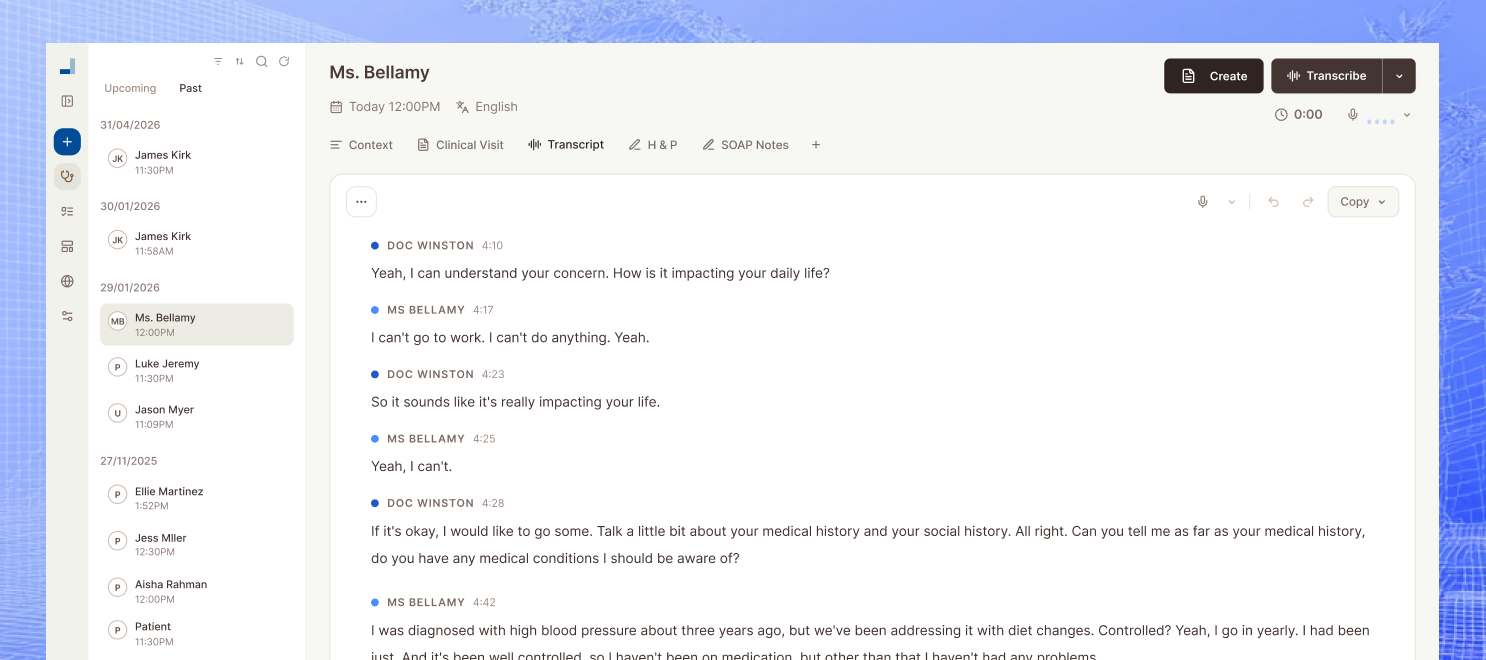
Mcoy AI is an AI medical scribe that records and transcribes patient encounters, then generates multiple clinical note types (H&P, progress notes, consult notes, follow-up notes, procedure notes, discharge summaries, referral letters, and more). With over 200 customizable templates and an interactive AI chat feature, clinicians can easily create letters, forms, and complex documents from their talk-to-text data, significantly reducing the daily administrative burden.
Conclusion
Building a documentation checklist for every appointment is the most effective way to reclaim your time and improve the quality of patient records. By integrating technology with a structured workflow, you move from being a data entry clerk back to being a clinician. The transition from manual charting to a streamlined, assistive process reduces burnout and ensures no detail is lost to time. Implementing a consistent documentation checklist is the first step toward a more sustainable and professional practice. Start your pilot today and experience the difference in your daily workflow.
What a serious review table should cover
| Decision area | Common mistake | Better clinic-ready approach | Metric to watch |
|---|---|---|---|
| Workflow design | Treat build a documentation checklist for every appointment guide as a one-off documentation task | Build a repeatable process with clear ownership and review points | Time to complete documentation |
| Team adoption | Assume every clinician will naturally use the same process | Train for consistency and define exception handling early | Active user adoption |
| Quality review | Only check notes when a problem is reported | Audit a sample of notes weekly and review edge cases | Edit rate per note |
| Operational follow-through | Leave admin actions outside the documentation workflow | Use the same encounter data for referrals, letters, and follow-up tasks | Completion rate for next-step tasks |
Related reading
If you are working through build a documentation checklist for every appointment guide, it helps to read this alongside Specialty Guides: How to Run a More Efficient Medical Practice in 2026, Specialty Guides: How to Improve Patient Encounters, and Compare & Choose: Compare AI Scribe Tools for Clinics: 2024 Buyer Guide. Those guides cover adjacent workflow, implementation, and evaluation questions so the decision does not sit in isolation.
FAQ
How accurate are AI medical scribes in real clinics?
AI medical scribes are remarkably accurate at capturing the dialogue and context of a clinical encounter, often exceeding the detail found in manual notes. However, accuracy depends on the quality of the audio and the clarity of the conversation. Because they are assistive tools, it is necessary for the clinician to perform a final review. This ensures that clinical nuances and specific medical decisions are reflected with 100% accuracy before the note is signed.
Do I still need to review every note?
Yes, reviewing every note is a fundamental requirement for both clinical safety and medico-legal protection. While the AI does the heavy lifting of drafting and formatting, the clinician is the only one who can verify the medical intent and factual correctness. A quick one-minute review is usually all it takes to finalize a note that used to take ten minutes to write. This habit ensures high standards and patient safety remain the top priority.
What note types can an AI scribe generate besides SOAP?
Modern AI scribes go far beyond the standard SOAP format to support the full range of clinical documentation. They can generate detailed History and Physical (H&P) reports, consultation notes for specialists, surgical procedure notes, and even discharge summaries. Additionally, they can help create professional referral letters and follow-up notes. This versatility ensures that every aspect of a patient’s journey is documented in the most appropriate format.
Will this work for telehealth and in-person consults?
Yes, AI medical scribes are designed to work seamlessly in both environment types. For in-person visits, a smartphone or tablet can capture the ambient audio of the room. For telehealth, the system can capture the audio from the virtual call via a computer or browser extension. In both cases, the AI filters out background noise to focus on the conversation between the provider and the patient.
How do I explain recording/transcription to patients?
The best approach is to be direct and highlight the benefit to the patient’s care. You might explain that use of the tool allows you to focus on the conversation rather than the computer screen, leading to better care and more accurate records. Most patients are comfortable with the process once they understand that it improves the doctor’s ability to listen. Always emphasize that the data is handled with the same security as their other medical records.
How do clinics prevent note bloat?
Clinics prevent note bloat by using concise, specialized templates rather than broad, generic ones. By selecting a template that only includes relevant fields for a specific visit type, the AI produces a more focused and readable note. Encouraging clinicians to perform a quick post-draft edit to remove redundant information also keeps the medical record clear and professional. Regular team reviews of documentation standards can further minimize unnecessary bulk.
How long does template setup take?
Setting up a basic set of templates usually takes less than an hour, especially when using pre-built libraries for common specialties. Most clinicians start with a few standard templates and then customize them incrementally as they identify their specific preferences. The goal is to have a documentation checklist that matches your natural clinical workflow. Over time, these templates can be refined to capture even more specific data points automatically.
What’s the safest way to start if I’m skeptical?
The safest way to start is with a ‘shadow pilot’ where you use the AI scribe alongside your traditional charting for a few non-complex cases. This allows you to compare the AI-generated note against your own manual note without any risk to your workflow. Once you see the accuracy and the time saved, you can gradually transition more of your daily schedule to the new system. Starting with routine follow-ups is generally the most comfortable entry point for skeptical users.