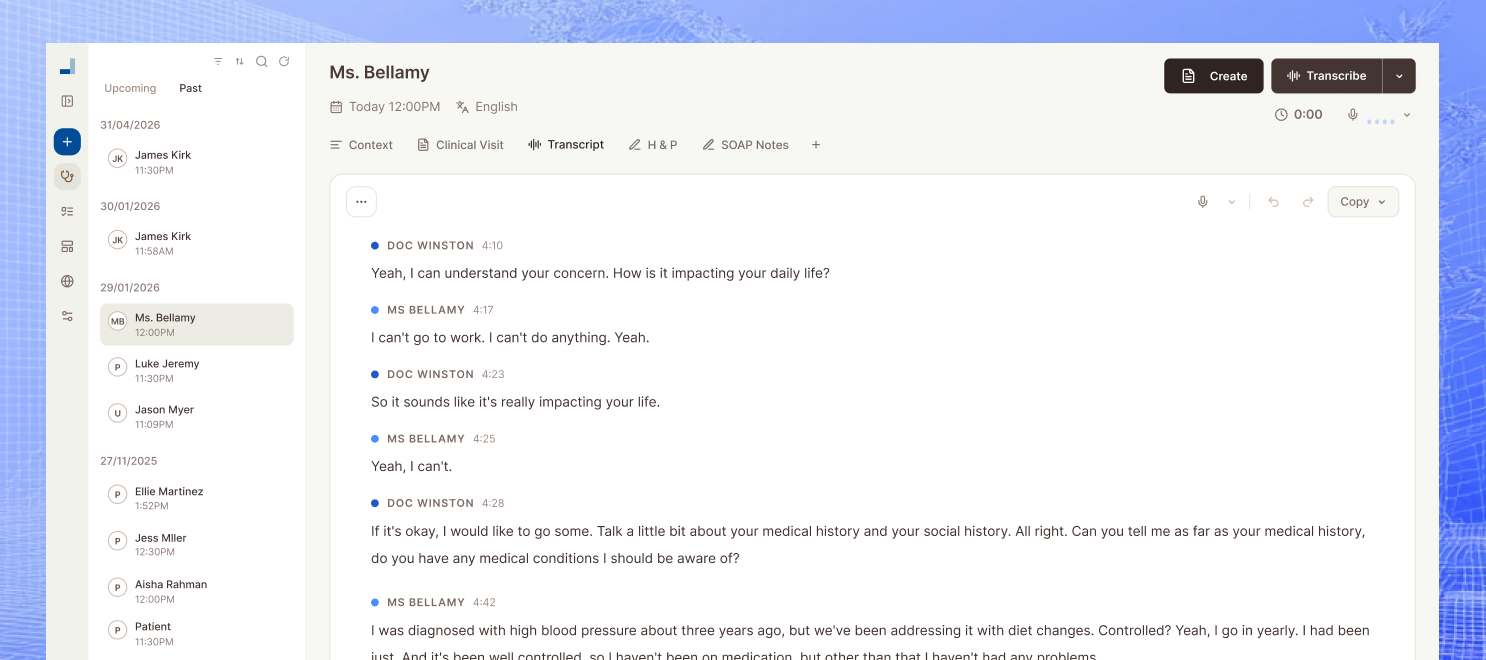
Specialty Guides: How to Use AI Scribe for GP consultations: A Guide
Learn how to implement an AI medical scribe in your GP clinic to reduce burnout, improve documentation quality, and save hours on admin daily.
The Hidden Burden of General Practice Documentation
For most General Practitioners, the workday doesn’t end when the last patient leaves the clinic. Instead, it transitions into hours of ‘pajama time’—that grueling late-night session spent catching up on consultation notes, referral letters, and lab reviews. This constant administrative overhead leads to rapid burnout, rushed patient interactions, and the nagging anxiety that a critical detail might have been missed in a hasty SOAP note.
This guide provides a comprehensive roadmap for integrating an AI scribe into your daily workflow. Whether you are running a solo private practice or managing a busy university health center, mastering this technology will help you reclaim your time while ensuring your clinical records remain gold-standard. We will cover everything from initial setup and note variety to patient privacy and clinic-wide rollout strategies.
What a medical scribe solves in modern practice
The primary cost of traditional documentation isn’t just time; it is the heavy cognitive load of trying to listen to a patient while simultaneously typing or memorizing details for later. An AI medical scribe acts as an intelligent listener, capturing the nuances of the conversation so the GP can maintain eye contact and build rapport. This shift from ‘clerical provider’ back to ‘care provider’ is the most significant benefit of the technology.
It is important to understand that an AI scribe is an assistive tool, not a replacement for clinical judgment. While the AI can organize a complex history of present illness or extract medication dosages mentioned during the visit, the clinician remains the final authority. The AI handles the heavy lifting of formatting and transcription, but the doctor must review and sign off on the accuracy of every entry.
- Eliminates after-hours charting by generating notes in real-time.
- Reduces cognitive load, allowing for deeper patient engagement.
- Captures specific clinical details that might be forgotten by the end of the day.
- Standardizes note quality across a multi-clinician practice.
Note types you can generate beyond SOAP (H&P and more)
While the SOAP format is a staple in general practice, many consultations require more specialized documentation. A complex new patient intake needs a comprehensive History and Physical (H&P), while a surgical follow-up requires a detailed procedure or post-op note. Using a one-size-fits-all template often leads to ‘note bloat’ or, conversely, missing information that is vital for specialist handovers.
Modern AI solutions allow GPs to pivot between various note styles instantly. For instance, a consult note for a specialist requires a different tone and data set than a routine progress note for a chronic condition like hypertension. By generating specific outputs like discharge summaries or referral letters directly from the encounter transcript, GPs can ensure continuity of care and audit readiness without additional typing.
- H&P and Progress Notes: Ideal for new intakes and chronic disease management.
- Consult & Referral Letters: Automatically formatted for external specialists.
- Procedure Notes: Specific templates for minor skin surgeries or injections.
- Discharge & Follow-up: Clear instructions for patients and administrative staff.
How to implement AI scribe for GP consultations step-by-step
Transitioning to an AI-assisted workflow should be done incrementally to avoid disrupting the clinic’s flow. Start by selecting one common visit type—such as simple respiratory infections or routine blood pressure checks—and use the scribe for just those encounters for the first few days. This allows you to get used to the presence of the device and the rhythm of the recording without the pressure of a complex multi-morbidity case.
Next, take advantage of specialty-specific templates. Before the patient enters, ensure your AI tool is set to the correct mode (e.g., General Practice, Pediatrics, or Mental Health). During the encounter, speak naturally. You don’t need to narrate your thoughts to the AI; simply conduct the physical exam and discussion as you normally would. For telehealth, ensure the AI is integrated or listening via your system’s audio output.
Once the consultation ends, the AI will generate a draft almost immediately. Review the draft while the patient’s details are still fresh in your mind. This is the best time to make quick edits or add specific clinical reasoning that wasn’t verbalized. Finally, use the generated text to populate your EMR and trigger any necessary secondary documents like work cover certificates or referral letters.
- Begin with low-complexity visits to build confidence with the tool.
- Select the appropriate template before starting the recording.
- Review and edit the draft immediately after the patient leaves.
- Export the final text into your existing EMR system seamlessly.
How to keep note quality high and reduce mistakes
The biggest risk with automated documentation is ‘hallucination’ or the inclusion of irrelevant information. To maintain high-quality records, GPs should develop a ‘lightweight review habit.’ This involves a quick 30-second scan of the Objective and Plan sections to ensure that dosages, dates, and specific measurements (like BP or BMI) have been captured accurately from the conversation.
Standardization within the clinic also helps. If every doctor in the practice uses the same set of high-quality templates, the resulting data is much easier to navigate during peer reviews or audits. Encourage your team to flag any recurring errors in the AI’s output so that the underlying templates can be refined and improved over time.
- Verify all numerical data, including dosages and vitals.
- Ensure the ‘Plan’ section aligns with your actual verbal instructions.
- Use standardized templates to keep notes concise and relevant.
- Perform periodic peer reviews of AI-generated notes for quality control.
Privacy, consent, and patient trust
Patient privacy is paramount when introducing any recording technology into a clinical setting. While regulations vary by region, the general principle is transparency. Most patients are supportive of the technology when they understand it allows their doctor to focus on them rather than a computer screen. Always follow your local jurisdiction’s guidelines regarding informed consent and data retention.
A simple way to introduce this to a patient is to say: ‘I’m using an AI assistant today to help me capture our conversation so I can focus entirely on you instead of my keyboard. It records the audio to create my medical notes, and then the recording is processed securely. Is that okay with you?’ This approach frames the technology as a benefit to the patient’s care experience.
- Obtain verbal or written consent based on local regulatory requirements.
- Explain the technology as a tool for better patient-doctor engagement.
- Ensure the AI vendor meets high-level security standards (like HIPAA or GDPR).
- Include a note in the patient file that the encounter was scribe-assisted.
Rolling it out across a clinic without disruption
For clinic owners, a phased rollout is more successful than an overnight switch. Start with a two-week pilot involving one or two ‘tech-champion’ doctors. During this time, track key metrics such as the average time spent on documentation per day and the reduction in after-hours work. These ‘wins’ will serve as a powerful motivator for more skeptical staff members.
Training should focus on template alignment. Ensure that all clinicians are using templates that match the clinic’s existing documentation standards. Hold a brief weekly meeting during the pilot phase to share tips on how to verbalize physical exam findings or how to use the AI chat features to generate patient summaries quickly. This collaborative approach ensures that the technology simplifies work rather than adding a new layer of complexity.
- Run a 14-day pilot with a small group of doctors first.
- Monitor time-savings and ‘pajama time’ reduction metrics.
- Host short training sessions to align on template usage.
- Gather feedback to customize the AI’s output to the clinic’s specific needs.
Mcoy AI is an AI medical scribe that records and transcribes patient encounters, then generates multiple clinical note types including H&P, progress notes, consult notes, follow-up notes, procedure notes, discharge summaries, referral letters, and more. With over 200+ customizable templates and an integrated AI chat to create bespoke letters, forms, and documents, it helps clinicians spend less time on administration and more time on patient care.
Frequently Asked Questions
Transitioning to AI-assisted charting is a significant step for any GP clinic. Here are answers to the most common questions from practitioners.
How accurate are AI medical scribes in real clinics?
AI medical scribes generally achieve high levels of accuracy, often capturing over 95% of relevant clinical dialogue. They are particularly adept at transcribing complex medical terminology and structuring it into logical sections. However, the accuracy can be affected by heavy background noise or multiple people speaking at once, which is why clinician review is always the final necessary step.
Do I still need to review every note?
Yes, as the licensed medical professional, you are legally responsible for the accuracy of the medical record. The AI provides a highly advanced draft, but you must verify that the facts, diagnoses, and plans accurately reflect the encounter. Most GPs find that reviewing and editing a pre-generated note takes a fraction of the time it takes to write one from scratch.
What note types can an AI scribe generate besides SOAP?
An advanced AI scribe can generate a wide variety of documentation beyond standard SOAP notes. This includes comprehensive History and Physicals (H&P), specialist consult notes, referral letters, procedure summaries, and discharge instructions. By using different templates, the AI can reformat the same encounter data into multiple different document types depending on your needs.
Will this work for telehealth and in-person consults?
Yes, AI scribes are designed to work across various consultation formats. For in-person visits, the AI typically listens via a smartphone or tablet app placed in the room. For telehealth, it can capture audio directly from the computer or through a browser extension, ensuring that the documentation process remains consistent regardless of how the patient is seen.
How do I explain recording/transcription to patients?
The best approach is to be direct and highlight the benefit to the patient. You can explain that the tool allows you to listen more closely to their concerns without being distracted by typing. Most patients are familiar with AI in other areas of life and are comfortable with it in a medical context if they know their data is handled securely and with their permission.
How do clinics prevent note bloat?
Note bloat is prevented by using concise, well-designed templates that instruct the AI to capture only clinically relevant information. Practitioners can also guide the AI by explicitly stating the most important takeaways during the consultation. Regularly reviewing the output and adjusting the ‘instructions’ within the AI settings helps keep notes focused and professional.
How long does template setup take?
Setting up basic templates usually takes just a few minutes, especially with platforms that offer a library of pre-built options. Most GPs start with standard templates and then spend an extra 10–15 minutes over their first week ‘tweaking’ the settings to match their personal writing style and specific practice requirements.
What’s the safest way to start if I’m skeptical?
The safest way to start is to use the AI for ‘shadow charting.’ Record a few sessions but continue to write your notes as usual. Compare your notes with the AI-generated ones at the end of the day. This low-risk comparison allows you to verify the AI’s accuracy and build trust in its performance before you rely on it for your primary clinical record.
Reclaiming the Joy of General Practice
Implementing an AI scribe for GP consultations is a transformative step toward sustainable medical practice. By automating the most tedious aspect of clinical work—documentation—GPs can focus on the heart of their profession: diagnosing and treating patients. Start with a small pilot, choose the right templates, and follow a consistent review process to ensure your documentation remains high-quality and compliant. Ready to eliminate ‘pajama time’? Begin your pilot today and see how much time you can save.
What a serious review table should cover
| Decision area | Common mistake | Better clinic-ready approach | Metric to watch |
|---|---|---|---|
| Workflow design | Treat how to use ai scribe for gp consultations: a guide as a one-off documentation task | Build a repeatable process with clear ownership and review points | Time to complete documentation |
| Team adoption | Assume every clinician will naturally use the same process | Train for consistency and define exception handling early | Active user adoption |
| Quality review | Only check notes when a problem is reported | Audit a sample of notes weekly and review edge cases | Edit rate per note |
| Operational follow-through | Leave admin actions outside the documentation workflow | Use the same encounter data for referrals, letters, and follow-up tasks | Completion rate for next-step tasks |
Related reading
If you are working through how to use ai scribe for gp consultations: a guide, it helps to read this alongside Specialty Guides: How to Run a More Efficient Medical Practice in 2026, Specialty Guides: How to Improve Patient Encounters, and AI & Medicine: Turn Unstructured Notes Into Structured Notes | Clinician Guide. Those guides cover adjacent workflow, implementation, and evaluation questions so the decision does not sit in isolation.
FAQ
How accurate are AI medical scribes in real clinics?
AI scribes are highly accurate in capturing medical terminology and dialogue, but they require clinician oversight to ensure perfect context. Most users find they capture significantly more detail than manual note-taking.
Do I still need to review every note?
Yes, the clinician remains the legal author of the note. The review process is essential to confirm that all clinical facts and plans are documented correctly before they are finalized in the EMR.
What note types can an AI scribe generate besides SOAP?
Beyond SOAP, AI scribes can produce H&Ps, referral letters, procedure notes, discharge summaries, and consult notes using specialized templates designed for various clinical needs.
Will this work for telehealth and in-person consults?
Yes, the technology is versatile and works for in-person visits via mobile devices as well as telehealth appointments via computer audio capture.
How do I explain recording/transcription to patients?
Frame it as a way to improve the quality of the visit. Let the patient know that by using the tool, you can focus on them instead of the computer screen.
How do clinics prevent note bloat?
By using specific templates and setting parameters for the AI, clinics can ensure that only relevant clinical information is included, keeping notes concise and useful.
How long does template setup take?
Initial setup takes minutes using pre-built templates, with minor adjustments made over the first few days of use to match the clinician’s specific preferences.
What’s the safest way to start if I’m skeptical?
Start with ‘shadow charting’ where you record encounters but continue your manual notes for a few days to compare the results and build confidence in the AI’s accuracy.