AI & Medicine: How to Use an AI Medical Scribe to Build Better Templates
Learn how to optimize clinical documentation using an AI medical scribe. Master custom templates for H&Ps, consults, and procedural notes to save hours daily.
For many clinicians, the end of a long day doesn’t mean heading home; it means sitting down for hours of unpaid administrative work. This ‘after-hours charting’ is a leading cause of burnout among private practitioners and university clinic staff alike. The anxiety of potentially missing a critical detail in a rushed note, or the repetitive nature of crafting consistent documentation, can drain the joy out of practicing medicine. This guide explores a modern solution that moves beyond manual data entry and into the realm of intelligent automation.
In the following sections, we will teach you how to master the clinical workflow using an AI medical scribe to build better templates. You will learn how to move beyond basic SOAP formats, maintain rigorous quality control, and handle patient privacy with transparency. Whether you are a general practitioner looking to streamline daily follow-ups or a specialist at a university clinic needing complex consultation records, this guide provides a clear rollout plan for your practice.
What a medical scribe solves in modern practice
The real cost of traditional documentation isn’t just measured in minutes; it is measured in cognitive load. When a doctor has to memorize several minutes of patient dialogue while simultaneously planning a treatment path, the risk of error increases. Delayed notes often result in ‘memory decay,’ where the nuances of a patient’s specific concerns or physical findings become blurred by the time the clinician finally opens the EHR at 8:00 PM.
An AI medical scribe acts as an intelligent assistant that captures the nuances of the encounter in real-time. It is important to remember that these tools are assistive, not autonomous. The clinician remains the final authority, responsible for reviewing and signing off on every entry. However, by removing the burden of manual transcription, the provider can focus entirely on the patient, leading to better eye contact and improved diagnostic presence.
- Eliminates the ‘pajama time’ spent on after-hours charting.
- Reduces cognitive fatigue by capturing details as they happen.
- Enhances patient satisfaction through better face-to-face engagement.
- Ensures clinicians maintain full oversight and medical responsibility.
Note types you can generate beyond SOAP (H&P and more)
While the SOAP note is the industry standard for daily progress, complex medical practices require much more. A comprehensive History and Physical (H&P) requires a level of detail that covers past medical history, social determinants, and a full review of systems that often feels tedious to type manually. By using an AI medical scribe, these long-form documents can be populated instantly based on a natural conversation.
Specialized documentation like consult notes, procedure notes, and referral letters require specific structures to be effective. A consult note must clearly state the reason for referral and the specialist’s specific recommendations, while a discharge summary needs to be concise enough for the next provider to act upon immediately. Strategic use of these formats ensures better continuity of care across different healthcare settings.
The structure of your notes directly impacts audit readiness and medico-legal safety. When notes are consistent and follow a logical hierarchy—from follow-up notes to complex discharge summaries—the clinic’s risk profile improves. High-quality handover documentation ensures that everyone on the care team, regardless of when they join the patient’s journey, has a clear understanding of the clinical narrative.
- Supports diverse formats like H&P, discharge summaries, and referral letters.
- Improves the quality of handovers between different specialists.
- Ensures audit-ready documentation for insurance and legal compliance.
- Maintains structural consistency across the entire patient record.
How to implement an AI medical scribe step-by-step in a real clinic
The most successful implementations start small rather than attempting to overhaul the entire clinic overnight. Begin by selecting one specific visit type, such as routine follow-ups or new patient intakes, to test your initial templates. This allows you to calibrate how the AI interprets your specific verbal cues and clinical style without the pressure of a full schedule of complex cases. As you become comfortable, you can expand the use to more varied encounters.
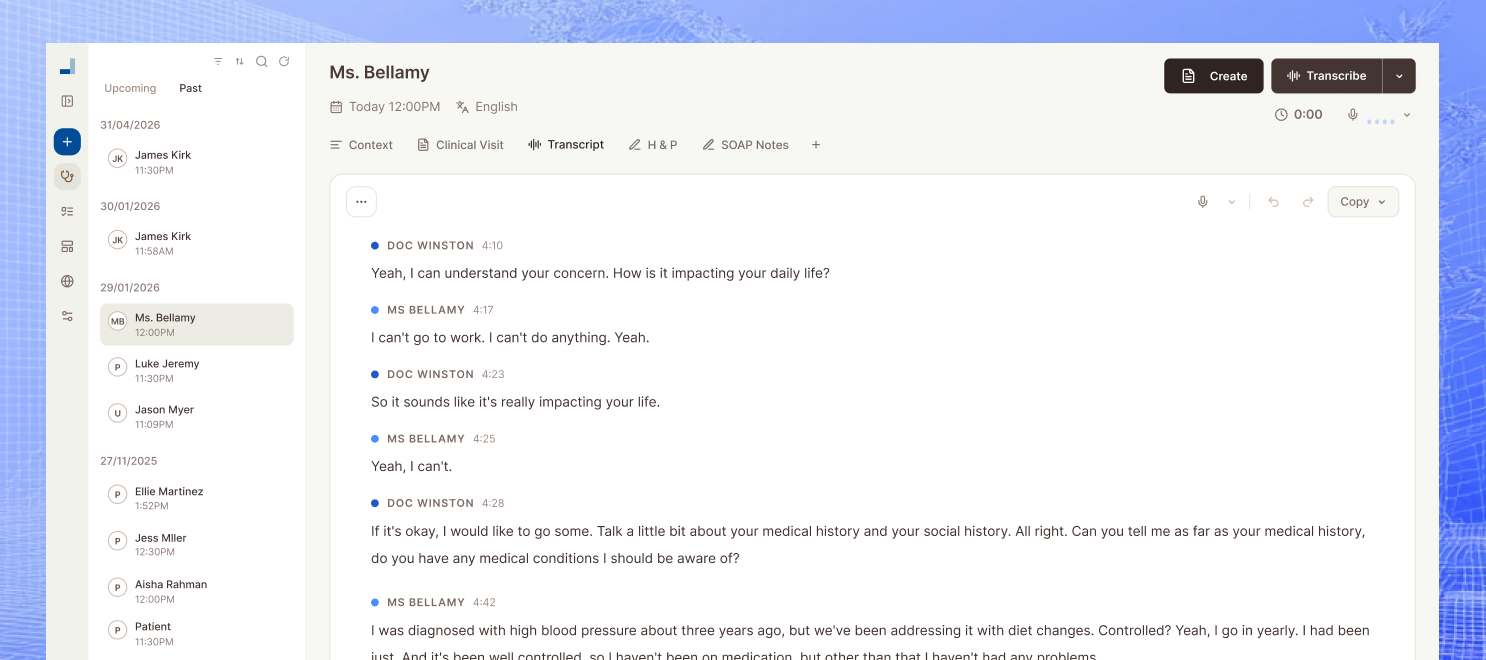
Next, focus on setting up specialty-specific templates. A pediatrician’s workflow looks very different from a surgeon’s, and your templates should reflect that. Once your templates are primed, you simply capture the encounter, whether it happens in-person or via a telehealth platform. The AI works in the background, organizing the dialogue into the pre-defined sections you’ve established, such as ‘Chief Complaint’ or ‘Assessment and Plan’.
After the encounter concludes, the workflow moves to a quick review and edit phase. Instead of writing from scratch, you are now an editor, verifying the AI-generated content for accuracy. This verification step is usually 80% faster than typing. Finally, you can reuse these outputs to instantly generate referral letters or patient instruction forms, ensuring that every piece of documentation stems from a single, accurate source of truth.
- Start with one visit type to build user confidence.
- Customize templates to match your specific specialty’s terminology.
- Transition from a ‘writer’ role to an ‘editor’ role to save time.
- Leverage recorded data to generate secondary documents like referrals.
How to keep note quality high and reduce mistakes
Even with advanced technology, clinical documentation can suffer from common failure points like ‘note bloat’ or missing medication dosages. To prevent this, clinicians should develop a lightweight review habit. This involves scanning for specific ‘must-have’ values, such as vital signs, correct problem lists, and specific procedural details, before the note is finalized in the EHR.
Establishing team standards is also vital for consistency, especially in university clinics where multiple residents or fellows might be treating the same patient. Set clear expectations on how the AI-generated text should be formatted and what level of detail is required for specific billing codes. By treating the AI scribe as a collaborative tool that follows a standard operating procedure, you ensure that the outputs remain high-quality and free of clinical hallucinations.
- Scan notes specifically for medication accuracy and dosages.
- Implement standardized clinic-wide formatting rules.
- Prevent note bloat by keeping templates focused and concise.
- Perform regular peer reviews of AI-assisted notes for quality control.
Privacy, consent, and patient trust (plain English)
Patient trust is the foundation of any clinical encounter. When introducing an AI medical scribe, it is essential to follow local regulations and your clinic’s specific privacy policies regarding recording. In most cases, a simple verbal or written consent is required. Patients are generally very receptive when they realize the technology allows the doctor to listen more and type less.
Using a simple, non-technical script can help ease any patient anxiety. You might say: ‘I’m using a secure digital assistant today to help me capture our conversation so I can focus entirely on your care instead of my computer screen. It transcribes our talk into a medical note for your chart, and the recording is handled according to our strict privacy standards.’ This transparency fosters a collaborative environment.
- Always comply with regional and institutional consent protocols.
- Use a patient-friendly script to explain the technology’s benefits.
- Focus on how the tool improves the doctor-patient connection.
- Prioritize secure data handling and retention principles.
Rolling it out across a clinic without disruption
A two-week pilot plan is the gold standard for clinical rollouts. Use the first week for a single ‘champion’ provider to iron out template issues and the second week to train additional staff. During this time, track key metrics such as the reduction in after-hours charting and the time elapsed between the visit and note completion. These data points help justify the tool’s value to clinic owners and stakeholders.
Training should focus heavily on template alignment. If every doctor in the clinic uses a slightly different format for a consult note, the AI’s efficiency is diminished. Standardizing these templates across the organization ensures that training is easier and that the medical records remain uniform, regardless of which provider the patient sees.
- Execute a 14-day pilot to identify and fix workflow bottlenecks.
- Measure ‘time saved’ and ‘note completion speed’ as key KPIs.
- Standardize templates across the clinic for easier staff training.
- Focus on reducing the total administrative burden on the front-line staff.
Mcoy AI is an AI medical scribe that records and transcribes patient encounters, then generates multiple clinical note types (H&P, progress notes, consult notes, follow-up notes, procedure notes, discharge summaries, referral letters, and more). It features 200+ customizable templates and AI chat capabilities to create letters, forms, and documents, helping clinicians focus more on patient care and less on the keyboard.
Conclusion
Adopting a structured clinical workflow is the most effective way to reclaim your time and improve the quality of your medical records. By moving from manual entry to an automated system, practitioners can ensure that every encounter is documented with precision and consistency. Implementing an AI medical scribe is not just about technology; it’s about restoring the human element to medicine by removing the digital barrier between doctor and patient. Start your pilot today and see how an AI medical scribe can transform your daily practice. Ready to take the next step? Configure your first custom template today and experience the difference in your evening schedule.
What a serious review table should cover
| Decision area | Common mistake | Better clinic-ready approach | Metric to watch |
|---|---|---|---|
| Workflow design | Treat how to use an ai medical scribe to build better templates as a one-off documentation task | Build a repeatable process with clear ownership and review points | Time to complete documentation |
| Team adoption | Assume every clinician will naturally use the same process | Train for consistency and define exception handling early | Active user adoption |
| Quality review | Only check notes when a problem is reported | Audit a sample of notes weekly and review edge cases | Edit rate per note |
| Operational follow-through | Leave admin actions outside the documentation workflow | Use the same encounter data for referrals, letters, and follow-up tasks | Completion rate for next-step tasks |
Related reading
If you are working through how to use an ai medical scribe to build better templates, it helps to read this alongside AI & Medicine: How to Simplify Clinical Notes for Busy Doctors, AI & Medicine: How Doctors Can Improve SOAP Notes, and Physician Wellbeing: Why Doctors Are Burnt Out and What Can Actually Fix It. Those guides cover adjacent workflow, implementation, and evaluation questions so the decision does not sit in isolation.
FAQ
How accurate are AI medical scribes in real clinics?
AI medical scribes are highly accurate at capturing the dialogue of a clinical encounter, often picking up nuances that a tired clinician might miss. They excel at identifying relevant medical terminology and organizing it into a structured format. However, accuracy also depends on clear verbal communication between the doctor and patient, which is why a final clinical review is always necessary.
Do I still need to review every note?
Yes, the clinician is legally and ethically responsible for the accuracy of the medical record. While the AI does the heavy lifting of drafting the note, you should always perform a quick review to ensure specific details like dosages or right/left lateralities are correct. This review process is significantly faster than writing a note from scratch.
What note types can an AI scribe generate besides SOAP?
Advanced AI scribes can generate a wide variety of documentation beyond standard SOAP notes. These include comprehensive History and Physical (H&P) reports, consultation notes, procedure notes, discharge summaries, and referral letters. The AI can adapt the captured dialogue to fit the specific structural requirements of each different document type.
Will this work for telehealth and in-person consults?
Yes, most AI scribe tools are designed to work seamlessly across both environments. For in-person visits, the device captures the room audio, while for telehealth, it can record the digital audio stream from the video call. The AI processes both types of audio with the same level of accuracy and formatting capability.
How do I explain recording/transcription to patients?
The best approach is to be direct and highlight the benefits to the patient experience. Inform them that you are using a digital assistant to help you accurately document the visit so that you can give them your full attention. Most patients appreciate the fact that the doctor isn’t staring at a computer screen during the entire appointment.
How do clinics prevent note bloat?
Preventing note bloat requires setting up concise templates that only target the necessary information for a specific visit type. Clinicians should also be trained to speak clearly about their findings and plans during the encounter. Regularly reviewing and refining the AI’s output instructions helps keep the final notes crisp and professional.
How long does template setup take?
Initial template setup usually takes only a few minutes per specialty, especially if you are using pre-built library templates as a starting point. Customizing these to your specific preferences might take another 30 minutes of refinement. Once set up, these templates apply automatically to all future encounters, providing exponential time savings.
What’s the safest way to start if I’m skeptical?
The safest way to start is by running a pilot with non-complex cases, such as simple follow-up visits. This allows you to see how the AI handles your voice and clinical style without high stakes. As you gain confidence in the AI’s ability to draft accurate assessments, you can gradually roll it out to more complex new patient intakes.