AI & Medicine: How to Use AI Medical Scribe to Reduce Note Errors | Mcoy
Learn how to use an AI medical scribe to improve documentation accuracy, prevent note bloat, and save hours of charting time every single day.
The Hidden Cost of Manual Documentation
For most clinicians, the workday doesn’t end when the last patient leaves the exam room. Instead, it transitions into a second shift of ‘pajama time’—hours spent staring at a screen, trying to recall the nuances of a conversation that happened eight hours prior. This delay between the patient encounter and the documentation leads to more than just burnout; it creates a significant risk for note errors, omitted details, and medico-legal vulnerabilities.
In university clinics and busy private practices, the pressure to maintain high patient volumes often results in rushed notes that lack specificity. When doctors are forced to rely on memory or fragmented shorthand, critical information regarding medication adjustments or subtle symptom changes can fall through the cracks. This guide will teach you how to integrate modern technology into your workflow to ensure your documentation is both comprehensive and clinically accurate.
Whether you are a general practitioner or a specialist, optimizing your workflow with automated assistance can transform your practice. We will explore various note formats beyond the standard SOAP note, quality control strategies, and a step-by-step rollout plan to ensure your clinic remains compliant while significantly reducing administrative fatigue.
What a medical scribe solves in modern practice
The real cost of traditional documentation isn’t just the time spent typing; it is the cognitive load required to switch between active listening and data entry. When a clinician is pre-occupied with navigating an EHR interface, the quality of the patient-doctor relationship suffers. More importantly, delayed notes are inherently less accurate. An AI medical scribe acts as a persistent memory, capturing the objective reality of the encounter as it happens.
It is essential to understand that an AI medical scribe is an assistive tool, not a replacement for clinical judgment. The technology excels at capturing dialogue and structuring it into a readable format, but the clinician remains the final authority. By shifting the burden of transcription to AI, practitioners can maintain eye contact with patients, knowing that every detail is being logged for their later review and verification.
- Eliminates the ‘second shift’ of after-hours charting and administrative burnout.
- Captures specific patient nuances and symptoms that are often forgotten by the end of the day.
- Reduces cognitive load, allowing doctors to focus entirely on diagnosis and patient interaction.
- Provides a structured draft that the clinician reviews and signs, ensuring full medical-legal accountability.
Note types you can generate beyond SOAP (H&P and more)
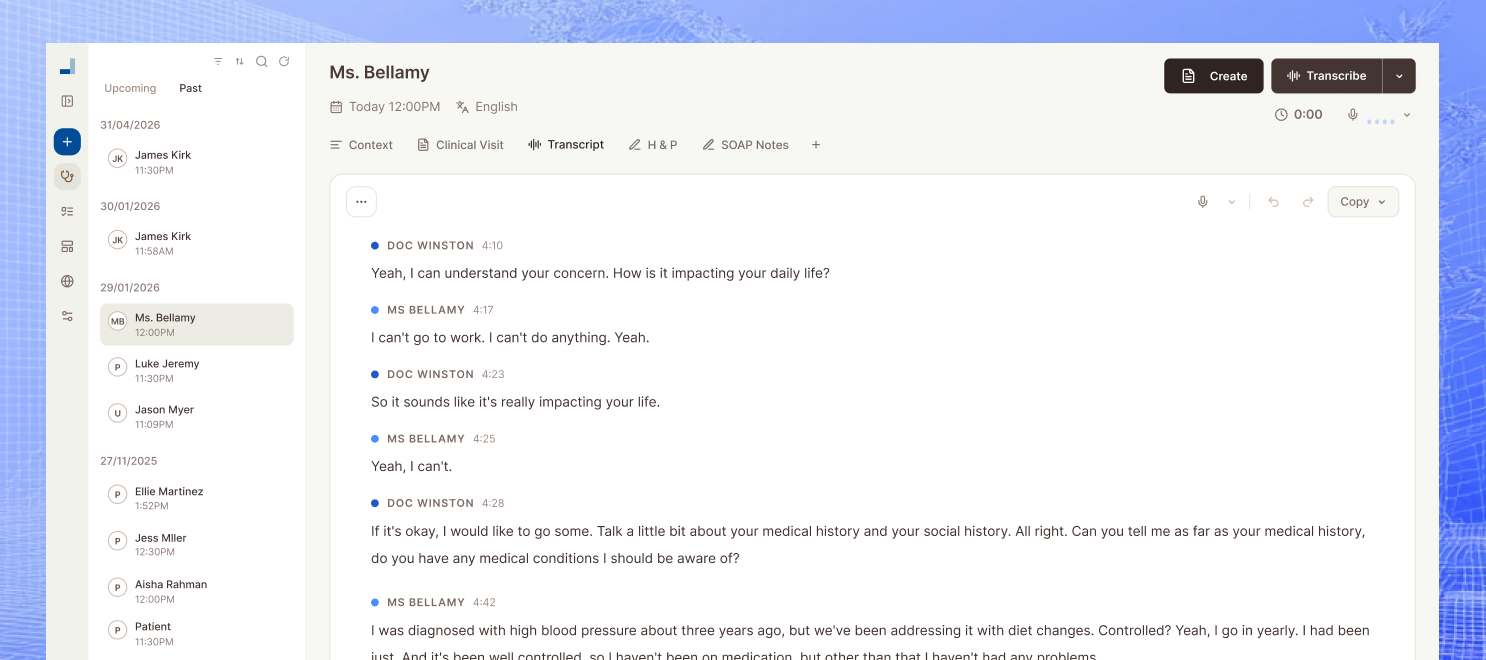
While the SOAP note is the industry standard for daily progress, clinical practice requires a much wider variety of documentation styles. High-quality care relies on the ability to produce detailed History and Physical (H&P) reports, complex consult notes, and concise follow-up summaries. Relying on a ‘one-size-fits-all’ template often leads to note bloat or missing data points that are critical for specialists or surgical clearances.
Structure matters immensely for continuity of care and audit readiness. A well-organized procedure note or a clear referral letter ensures that the next provider in the care chain has exactly what they need without digging through pages of irrelevant text. AI tools can now distinguish between the conversational tone of a mental health check-in and the technical rigors of a surgical discharge summary.
Using diverse templates also improves the quality of clinical handovers. When an AI can automatically format a discharge summary based on the entire hospital stay or a consult note following a specialty referral, it reduces the risk of communication errors. This level of consistency is vital for university clinics where multiple residents and attending physicians may be reviewing the same patient file at different times.
- H&P and Consult Notes: Comprehensive assessments for new patients or specialty referrals.
- Procedure and Progress Notes: Real-time updates on clinical interventions and daily status.
- Discharge Summaries and Referral Letters: Vital documents for care transitions and communication.
- Follow-up Notes: Targeted documentation focusing on treatment response and plan adjustments.
How to implement AI medical scribe step-by-step in a real clinic
Starting with an AI medical scribe should not be an overnight overhaul of your entire operation. Begin by selecting one specific visit type, such as routine follow-ups or standard physicals, to test the workflow. This allows you to get comfortable with the device placement and the transcription accuracy without the pressure of a complex multi-system case. Once you feel confident, you can expand the usage to more complicated encounters.
The next step is setting up specialty-specific templates. A pediatrician needs different data points than an orthopedic surgeon. Configure your system so that the AI knows which clinical elements to prioritize—such as developmental milestones or range-of-motion metrics. During the encounter, simply record the conversation naturally. There is no need to change how you talk to patients; the technology is designed to filter out ‘small talk’ and focus on the clinical substance.
After the encounter ends, take sixty seconds to review and edit the generated draft. This immediate review is the most effective way to prevent errors because the conversation is still fresh in your mind. Finally, leverage the AI to reuse these outputs for auxiliary documents. If you have a solid progress note, the AI can instantly turn that information into a referral letter or a patient instructions sheet, saving you from repetitive data entry across multiple forms.
- Start small with a single visit type to master the recording process.
- Customize templates to match your specific specialty and clinical preferences.
- Perform an immediate ‘flash review’ of the draft to ensure 100% accuracy.
- Repurpose encounter data into letters and forms to maximize time savings.
How to keep note quality high and reduce mistakes
Note quality often degrades when there is no standardized review process. Common failure points include ‘note bloat,’ where irrelevant details are included, or the omission of updated medication dosages. To combat this, clinics should adopt a lightweight review habit. Instead of reviewing notes at the end of the week, aim to verify the AI-generated draft immediately after the patient leaves the room.
Standardization within a team also helps maintain high-quality records. When every practitioner in a clinic uses the same template logic, it becomes much easier for staff to find information. Establishing clear standards for how to handle ‘negative’ findings or patient non-compliance ensures that the notes are not just accurate, but also protective in a legal context. AI excels at consistency, provided it is given the right structural guidance.
- Use a ‘Review and Refine’ workflow immediately after each encounter.
- Establish clinic-wide template standards to ensure documentation consistency.
- Focus on ‘high-yield’ clinical data to prevent the clutter of note bloat.
- Regularly audit a random sample of notes to ensure the AI is meeting clinical standards.
Privacy, consent, and patient trust
Transparency is the foundation of patient trust when using recording technology. While patient consent requirements vary by region, it is a best practice to inform the patient that you are using a digital assistant to ensure their medical record is as accurate as possible. Most patients are supportive of this when they realize it means the doctor will spend more time looking at them and less time looking at the computer.
A simple way to explain this is: ‘I’m using a secure medical tool to help me record our conversation today so I can focus on you instead of taking notes on my keyboard. It helps me make sure I don’t miss any of your concerns. Is that okay with you?’ This plain English approach demystifies the technology. From a security standpoint, ensure your chosen tool follows industry-standard encryption and data retention policies relevant to your jurisdiction.
- Always obtain verbal or written consent based on your local regulatory requirements.
- Explain the benefit to the patient: better focus and more accurate medical records.
- Ensure the technology provider uses enterprise-grade security and HIPAA/GDPR compliance.
- Document the use of an AI assistant within the clinical record itself.
Rolling it out across a clinic without disruption
Successful implementation requires a phased approach. Start with a two-week pilot involving one or two ‘tech-forward’ clinicians. During this period, track specific metrics such as average time spent on notes per day and the reduction in after-hours charting. This data will be crucial for getting buy-in from more skeptical staff members later on.
Training should focus on template alignment rather than just the software itself. Ensure that every doctor knows how to trigger the specific note types they need. By the end of the second week, you can begin rolling the tool out to the rest of the clinic with a clear understanding of the time-saving benefits and best practices discovered during the pilot phase.
- Run a 14-day pilot program to identify specific workflow bottlenecks.
- Measure ‘pajama time’ reduction to prove the value to clinical staff.
- Provide template-specific training to ensure doctors get the exact output they need.
- Scale gradually, allowing for individual adjustments to the clinical workflow.
Mcoy AI is an AI medical scribe that records and transcribes patient encounters, then generates multiple clinical note types (H&P, progress notes, consult notes, follow-up notes, procedure notes, discharge summaries, referral letters, and more). It features 200+ customizable templates and an AI chat to create letters, forms, and documents, allowing clinicians to spend less time on paperwork and more time on high-quality patient care.
What a serious review table should cover
| Decision area | Common mistake | Better clinic-ready approach | Metric to watch |
|---|---|---|---|
| Workflow design | Treat how to use ai medical scribe to reduce note errors | mcoy as a one-off documentation task | Build a repeatable process with clear ownership and review points |
| Team adoption | Assume every clinician will naturally use the same process | Train for consistency and define exception handling early | Active user adoption |
| Quality review | Only check notes when a problem is reported | Audit a sample of notes weekly and review edge cases | Edit rate per note |
| Operational follow-through | Leave admin actions outside the documentation workflow | Use the same encounter data for referrals, letters, and follow-up tasks | Completion rate for next-step tasks |
Related reading
If you are working through how to use ai medical scribe to reduce note errors | mcoy, it helps to read this alongside AI & Medicine: How to Simplify Clinical Notes for Busy Doctors, AI & Medicine: How Doctors Can Improve SOAP Notes, and Physician Wellbeing: How Doctors Can Reduce Paperwork Without Compromising Care. Those guides cover adjacent workflow, implementation, and evaluation questions so the decision does not sit in isolation.
FAQ
How accurate are AI medical scribes in real clinics?
AI medical scribes are remarkably accurate at capturing the dialogue of a clinical encounter, often exceeding the detail found in manual notes. However, accuracy depends on the quality of the ambient recording and the clarity of the conversation. While the AI is excellent at transcription, it is designed as an assistant, meaning it requires the clinician to verify the final output for medical accuracy.
Do I still need to review every note?
Yes, the clinician is always the person of record and must review every note before signing off. This review process is significantly faster than writing a note from scratch, usually taking less than a minute. The goal of using an AI medical scribe is to provide a high-quality 95% complete draft that only needs a quick final verification.
What note types can an AI scribe generate besides SOAP?
Advanced AI scribes can generate a wide range of documentation including History and Physicals (H&P), detailed consultation notes, and procedure summaries. They can also create discharge summaries, referral letters, and follow-up notes. This variety ensures that the documentation fits the specific clinical context rather than forcing everything into a standard SOAP format.
Will this work for telehealth and in-person consults?
Most AI scribes are designed to work seamlessly in both environments. For in-person consults, the device stays in the room to capture ambient audio, while for telehealth, the audio is typically captured via the computer’s system audio or a browser extension. The AI processes the dialogue the same way regardless of the meeting format.
How do I explain recording/transcription to patients?
The best approach is to be transparent and explain the benefit to the patient. Tell them that the digital tool allows you to accurately record their health concerns without needing to look away at a computer screen. Most patients prefer having their doctor’s full attention and appreciate the increased accuracy of their medical records.
How do clinics prevent note bloat?
Clinics prevent note bloat by using structured templates that tell the AI exactly which sections are relevant for a specific visit. By defining clear parameters for what should be included in a ‘History of Present Illness’ or a ‘Physical Exam,’ the AI can filter out irrelevant conversation and focus on the pertinent clinical facts.
How long does template setup take?
Initial template setup usually takes only a few minutes, especially if you start with pre-built templates provided by the software. Fine-tuning a template to match your specific clinical ‘voice’ or specialty requirements might take a few sessions of use as you learn how to prompt the AI for the best results.
What’s the safest way to start if I’m skeptical?
The safest way to start is by using the tool for non-complex, routine visits for a few days without discarding your traditional note-taking method. This ‘shadow’ testing allows you to compare the AI’s output with your manual notes. Once you see the accuracy and time savings firsthand, you can gradually move toward a fully automated workflow.
Conclusion
Integrating technology into the clinical workflow is no longer just a luxury; it is a necessity for reducing the errors that stem from physician burnout and documentation fatigue. By following a structured implementation plan—starting small, using specific templates, and maintaining a consistent review habit—clinics can significantly improve the quality of their medical records. Learning how to use an AI medical scribe to reduce note errors is a transformative step that allows you to reclaim your time and focus on what truly matters: your patients. Start your pilot today and see how automated documentation can revitalize your practice.