Specialty Guides: How to Use an AI Medical Scribe for Better Patient Summaries
Learn how to use an AI medical scribe to automate clinical notes, improve H&P documentation, and reduce burnout. Follow our step-by-step implementation guide.
How to Use an AI Medical Scribe to Create Better Patient Summaries
For many clinicians, the end of the patient day doesn’t signal a break; instead, it marks the start of ‘pajama time,’ those grueling hours spent catching up on documentation. Whether it is a university clinic handling high volumes or a private practice specialist, the pressure to produce accurate, detailed patient summaries often leads to burnout and a feeling of being rushed during actual care. The anxiety of potentially missing a critical detail in a follow-up note or an H&P can weigh heavily on a provider’s mind.
This comprehensive guide will teach you how to integrate modern documentation technology into your clinical workflow. We will explore beyond the basic SOAP note, looking at how to generate comprehensive H&Ps, consult notes, and referral letters while maintaining strict quality control and patient trust. Whether you are a general practitioner or a surgical specialist, this roadmap will show you how to recapture your time without sacrificing the integrity of your medical records.
What a medical scribe solves in modern practice
The financial and emotional cost of manual documentation is staggering. When a doctor spends 50% of their workday staring at a screen instead of the patient, the quality of the therapeutic alliance suffers. Cognitive load increases as clinicians try to memorize specifics of a morning encounter to type up hours later, leading to ‘note bloat’ or, worse, inaccurate recall. Delayed notes also stall the entire care coordination cycle, holding up referrals and insurance authorizations.
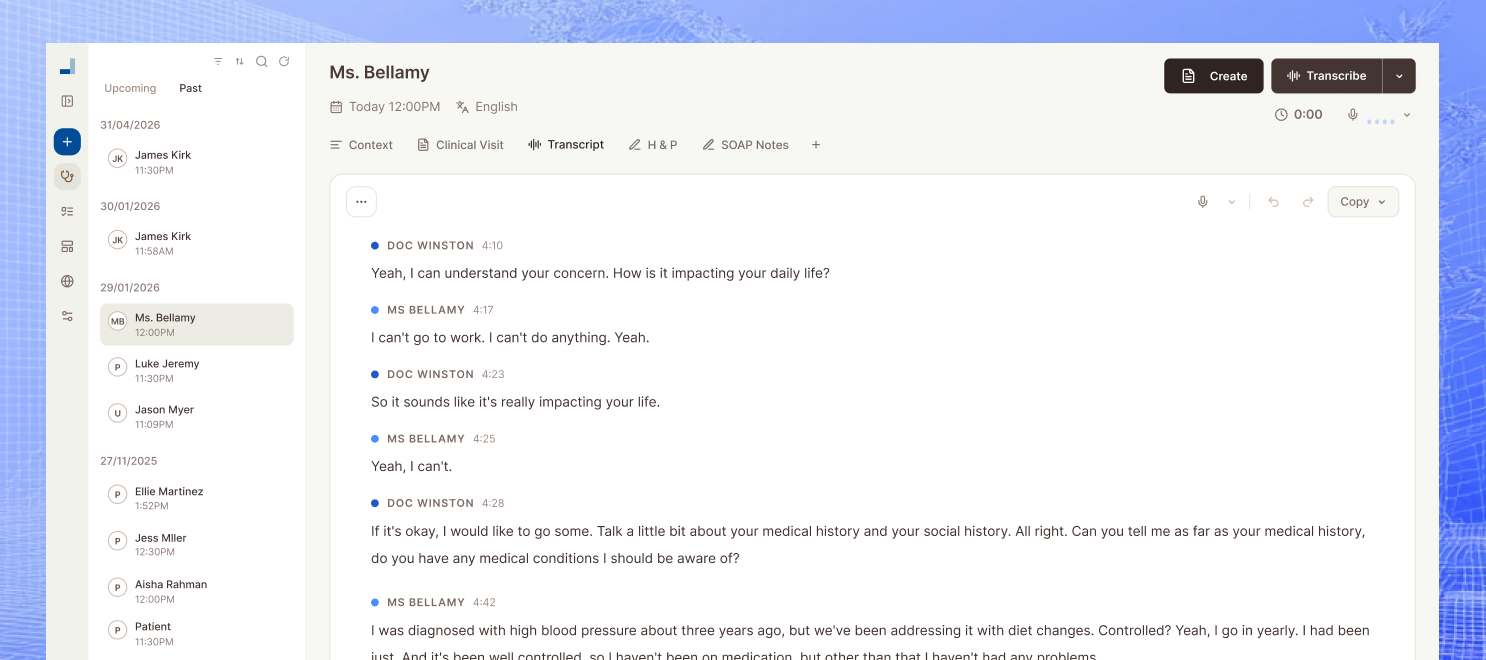
An AI medical scribe acts as a sophisticated assistant that listens, understands, and organizes clinical data in real-time. It is important to remember that these tools are assistive, not autonomous; the clinician remains the ultimate authority and person responsible for the final note. By offloading the mechanical task of drafting, the provider can focus on the nuances of diagnosis and the human element of the physical exam.
- Significantly reduces after-hours documentation and administrative burnout.
- Improves the accuracy of patient summaries by capturing detail at the point of care.
- Allows for more eye contact and engagement during the patient encounter.
- Assists with structured data capture while leaving the clinician in final control.
Note types you can generate beyond SOAP (H&P and more)
While the SOAP format is a staple of clinical practice, modern medicine requires a wider variety of specialized documents. Comprehensive History and Physical (H&P) reports, detailed procedure notes, and complex discharge summaries are essential for continuity of care. Using a one-size-fits-all approach to documentation often leads to missed billing opportunities or insufficient detail for specialists who need to understand a patient’s complex history.
Standardization through technology ensures that every consult note or referral letter meets a high threshold of quality and audit readiness. When a handoff happens between a GP and a surgeon, or a university clinic and a rehabilitation center, the clarity of the documentation can determine the speed of treatment. By using specific templates for different encounter types, you ensure that the right questions are answered every time.
- Generate specialized H&P and consult notes tailored to individual specialties.
- Automate referral letters and discharge summaries to speed up care transitions.
- Ensure procedure and follow-up notes are consistent for audit and legal safety.
- Improve inter-professional communication through standardized handover formats.
How to implement an AI medical scribe step-by-step in a real clinic
To start using an AI medical scribe effectively, begin by selecting just one visit type—perhaps routine follow-ups or standard wellness checks. This allows the clinical team to get used to the presence of the technology without the pressure of a complex multi-system case. Once comfort is established, you can move toward more detailed encounters like new patient intakes or complex specialist consultations.
Next, configure your templates based on your specific specialty requirements. A cardiologist’s needs differ from a pediatrician’s, and the AI should be tuned to the data points you value most. Before the patient enters the room, ensure the hardware is ready, whether it’s a smartphone, tablet, or laptop. Capture the encounter naturally, speaking to the patient as you always would, and let the AI handle the structural heavy lifting in the background.
Once the encounter is over, review the generated draft immediately. Quick editing is much more efficient than writing from scratch. Check for clinical accuracy in the assessment and plan sections, then finalize the note. Finally, utilize the outputs to populate other necessary documents. The same data used for the progress note can often be repurposed for a school note, a work excuse, or a brief referral letter, maximizing the utility of a single interaction.
- Start with one simple visit type to lower the initial learning curve.
- Customize templates to ensure the AI captures specialty-specific metrics.
- Review and edit drafts immediately to maintain high clinical accuracy.
- Repurpose encounter data for letters and forms to save additional time.
How to keep note quality high and reduce mistakes
Even with advanced technology, ‘note bloat’ and inaccuracies like incorrect medication dosages or outdated problem lists can occur. To maintain high standards, clinicians should develop a ‘lightweight review’ habit. This involves a 60-second scan of the AI’s output to ensure that nuances, like a patient’s specific phrasing or a minor physical exam finding, were captured correctly. It is also helpful to set team-wide standards for what a ‘perfect’ note looks like within your practice.
- Implement a brief verification step for all medication and dosage details.
- Develop standardized internal templates to prevent irrelevant data bloat.
- Audit a small percentage of notes monthly for peer-to-peer quality control.
Privacy, consent, and patient trust (plain English)
Patient trust is the foundation of medicine. When introducing an AI scribe, transparency is key. You might say to a patient: ‘I’m using a secure AI tool to help me document our conversation today so I can focus entirely on you instead of my computer screen. It records our talk, turns it into a medical note, and then the recording is handled according to our strict privacy rules.’ Most patients appreciate the extra attention they receive when the doctor isn’t typing.
- Always follow local and regional regulations regarding recording consent.
- Use a simple, transparent script to explain the technology to patients.
- Ensure the tool used adheres to high-level security and data retention standards.
Rolling it out across a clinic without disruption
A successful rollout starts with a two-week pilot involving one or two ‘tech-forward’ providers. During this phase, track metrics like the time spent charting after 5:00 PM and the time taken to close notes after an encounter. Once the pilot proves successful, use those internal champions to train the rest of the staff, ensuring everyone understands how to align the AI templates with the clinic’s existing EMR workflow.
- Run a two-week pilot to identify workflow bottlenecks before full launch.
- Track time-saved metrics to demonstrate ROI to clinic stakeholders.
- Align AI templates with existing EMR fields for seamless integration.
Mcoy AI is an AI medical scribe that records and transcribes patient encounters, then generates multiple clinical note types (H&P, progress notes, consult notes, follow-up notes, procedure notes, discharge summaries, referral letters, and more). It features 200+ customizable templates and an AI chat to create letters, forms, and documents, helping clinicians move through their administrative tasks with greater ease and efficiency.
Conclusion
In conclusion, the transition to automated documentation is no longer a luxury but a necessity for the modern practitioner. By following this guide, you can establish a workflow that prioritizes patient care over paperwork. Implementing an AI medical scribe allows you to create high-quality, comprehensive patient summaries while reclaiming your personal time and reducing the cognitive burden of practice. Start with a small pilot, refine your templates, and experience the transformative impact on your daily clinical life. Use an AI medical scribe today to redefine how your clinic handles documentation.
What a serious review table should cover
| Decision area | Common mistake | Better clinic-ready approach | Metric to watch |
|---|---|---|---|
| Workflow design | Treat how to use an ai medical scribe for better patient summaries as a one-off documentation task | Build a repeatable process with clear ownership and review points | Time to complete documentation |
| Team adoption | Assume every clinician will naturally use the same process | Train for consistency and define exception handling early | Active user adoption |
| Quality review | Only check notes when a problem is reported | Audit a sample of notes weekly and review edge cases | Edit rate per note |
| Operational follow-through | Leave admin actions outside the documentation workflow | Use the same encounter data for referrals, letters, and follow-up tasks | Completion rate for next-step tasks |
Related reading
If you are working through how to use an ai medical scribe for better patient summaries, it helps to read this alongside Specialty Guides: How to Run a More Efficient Medical Practice in 2026, Specialty Guides: How to Improve Patient Encounters, and Physician Wellbeing: Why After-Hours Charting Is Still a Problem for Doctors. Those guides cover adjacent workflow, implementation, and evaluation questions so the decision does not sit in isolation.
FAQ
How accurate are AI medical scribes in real clinics?
Modern AI medical scribes are highly accurate, often capturing more detail than a clinician could from memory. They are trained on vast datasets of medical terminology and can distinguish between different speakers. However, they are designed to be assistive, and it is estimated they reach 95-98% accuracy, necessitating a final review by the clinician for clinical nuances and specific dosages.
Do I still need to review every note?
Yes, the clinician is always the person of record and holds legal responsibility for the clinical note. While the AI does the heavy lifting of drafting and organizing, you should perform a quick review to ensure no critical data points were misinterpreted. This review usually takes less than a minute compared to the ten or fifteen minutes it might take to write a note from scratch.
What note types can an AI scribe generate besides SOAP?
Advanced AI scribes can generate a wide range of documentation including History and Physicals (H&P), detailed consult notes, discharge summaries, and procedure notes. They can also assist in drafting referral letters and patient education materials based on the encounter. By using different templates, the output is tailored to the specific administrative or clinical need of the moment.
Will this work for telehealth and in-person consults?
Yes, most AI scribing tools are designed to work across various platforms. For in-person visits, they typically use a mobile app or a computer microphone to capture the conversation. For telehealth, they can often be integrated with the video platform or simply listen to the audio output of the call, ensuring consistent documentation quality regardless of how the care is delivered.
How do I explain recording/transcription to patients?
The best approach is a direct, benefit-focused explanation. Inform the patient that instead of looking at a computer screen, you are using a secure tool to help capture the conversation so you can focus entirely on their care. Most patients are very supportive when they realize it means they will have your undivided attention and a more accurate medical record.
How do clinics prevent note bloat?
Clinics prevent note bloat by using concise, specialty-specific templates that instruct the AI to focus on relevant clinical findings rather than transcribing every casual word spoken. By setting clear parameters for what should be included in the ‘subjective’ and ‘objective’ sections, the final output remains professional, readable, and medically necessary.
How long does template setup take?
Initial template setup usually takes only a few minutes per note type. Most clinicians start with pre-built industry standards (like a standard SOAP or H&P) and then spend a few minutes tweaking the fields to match their specific workflow. Over time, these can be refined, but a functional setup is typically ready for use on day one.
What’s the safest way to start if I’m skeptical?
The safest way to start is by running a small pilot on a few non-complex cases, such as routine follow-ups. Use the scribe in parallel with your current method for two or three patients to compare the results. Once you see the accuracy and the time saved, you can gradually expand its use to more complex encounters and wider specialty applications.