Physician Wellbeing: Why After-Hours Charting Is Still a Problem for Doctors
Full guide explaining why after-hours charting remains a problem for doctors and how smarter workflows and AI tools can reduce it.
After the last patient leaves, the clinic lights dim, and the waiting room goes quiet, many doctors are still working. Laptops open at kitchen tables. Notes are finished late at night. Weekends become catch-up time for charting. Despite decades of digital health investment, after-hours charting remains one of the most persistent problems in medicine.
For doctors, this hidden workload is more than an inconvenience. It affects mental health, job satisfaction, patient care, and long-term career sustainability. For clinics and healthcare systems, it contributes to burnout, turnover, and reduced capacity.
This guide explores why after-hours charting is still so common, why it has proven so difficult to fix, and what actually helps doctors reclaim their time without compromising care or compliance.
After-hours charting is not a personal failure
Many doctors blame themselves for charting late. They assume they are slow, disorganised, or inefficient. This belief is reinforced by a culture that quietly normalises unpaid after-hours work.
In reality, after-hours charting is a system-level problem. Even highly efficient clinicians struggle when documentation requirements exceed what can reasonably be completed during clinic hours. When systems demand more work than time allows, work inevitably spills over.
Understanding this is important. The solution is not working harder or typing faster. It is changing how documentation is designed and supported.
Why documentation spills into evenings and weekends
After-hours charting exists because documentation expectations have grown while clinical time has not. Appointments are tightly scheduled. Patients present with increasingly complex needs. At the same time, notes must be more detailed, structured, and compliant than ever before.
Doctors face a constant trade-off during the day. Either slow down and document thoroughly between patients, or keep running on time and finish notes later. Most choose the latter to protect patient flow and avoid delays. The cost is paid after hours.
This pattern becomes self-reinforcing. Once charting is postponed, it becomes mentally harder. Reconstructing details from memory takes longer and increases the risk of omissions, which leads to even more cautious documentation.
Electronic records did not eliminate the problem
Electronic health records were meant to solve documentation inefficiency. Instead, for many doctors, they introduced new burdens.
Digital systems often prioritise billing, compliance, and reporting over clinical flow. Notes become checklists of required fields rather than natural clinical narratives. Copy-paste habits emerge as a coping mechanism, which increases note length without reducing effort.
Many systems also create duplication. Information must be entered in multiple places or reformatted for different purposes. Doctors become data entry clerks, bridging gaps between systems that do not communicate well.
As a result, documentation takes longer, not shorter, and spills into personal time.
The cognitive toll of delayed documentation
After-hours charting is not just about time. It is about mental load.
Documenting hours after a consultation requires doctors to recall details, interpret conversations again, and ensure accuracy. This is cognitively demanding work, especially at the end of a long day.
The brain is less sharp at night. Tasks take longer. Errors are more likely. Many doctors respond by over-documenting to compensate, which further increases time spent.
This cognitive drain accumulates. Even when doctors are not actively charting, the knowledge that notes are waiting creates background stress that affects sleep and recovery.
Why quick fixes rarely work
Clinics have tried many strategies to reduce after-hours charting. Some extend appointment times. Others encourage documentation between patients. Some provide typing training or shortcuts.
While these approaches can help marginally, they rarely solve the problem completely. The underlying issue remains the same. Too much documentation is required, and it is not captured efficiently during the consultation.
When fixes focus on individual behaviour rather than system design, results are limited. Doctors may temporarily improve, but old patterns return as pressure builds.
The mismatch between care and documentation
One of the core reasons after-hours charting persists is the mismatch between how care happens and how documentation is expected.
Care is conversational, dynamic, and contextual. Documentation systems often expect structured, linear input after the fact. This mismatch forces doctors to translate lived interactions into rigid formats later.
The more complex the patient, the greater the mismatch. Nuanced discussions, shared decision-making, and emotional context are difficult to reconstruct hours later, increasing documentation time.
Aligning documentation with the actual flow of care is essential to fixing after-hours charting.
Capture information once, at the source
The most effective way to reduce after-hours charting is to capture clinical information during the consultation itself.
When information is captured in real time, it does not need to be recreated later. Notes become a refinement task rather than a reconstruction task.
This does not mean typing constantly during visits. In fact, typing during consultations often worsens the problem by dividing attention. The goal is passive capture that does not interrupt patient interaction.
The role of AI in reducing after-hours charting
This is where AI-assisted documentation has changed what is possible.
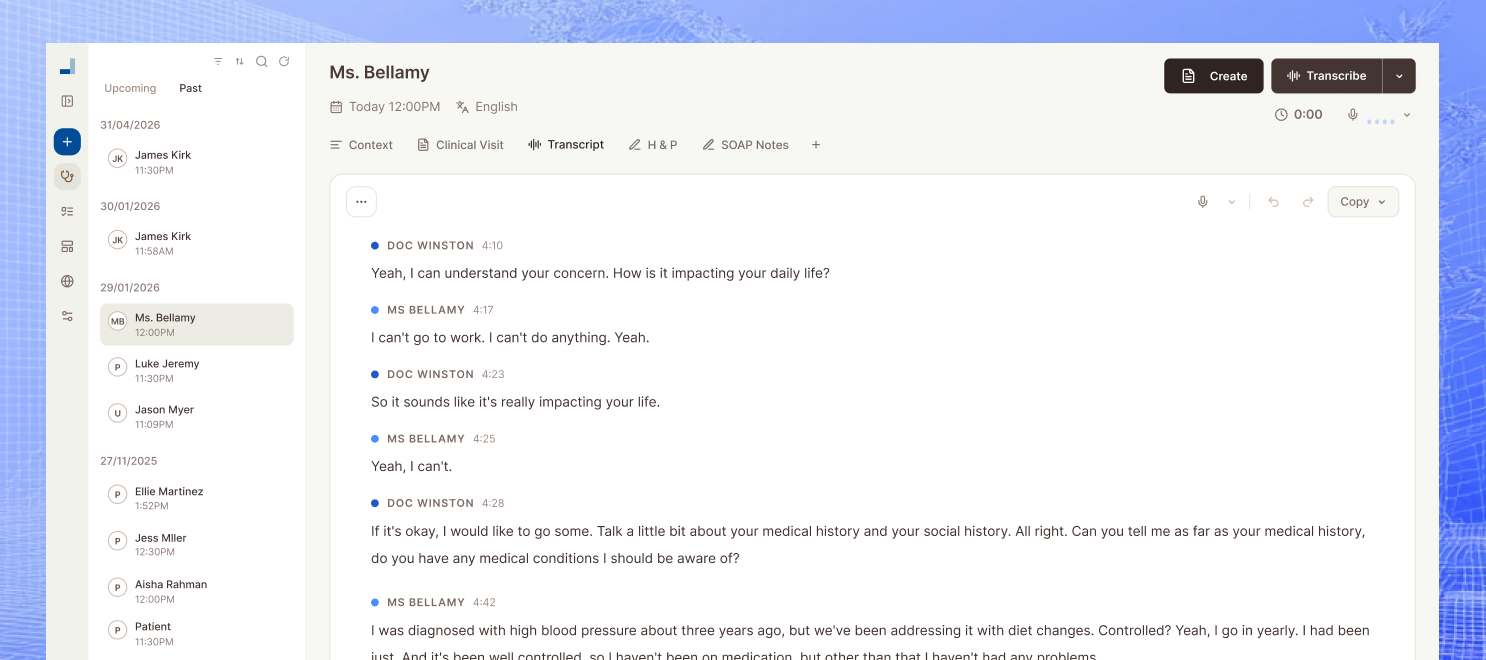
Modern AI medical scribes can listen to consultations, transcribe them accurately, and generate structured clinical notes automatically. Instead of starting from a blank page at night, doctors receive a draft that reflects the actual encounter.
Documentation shifts from writing to reviewing. Reviewing is faster, less cognitively demanding, and can often be completed during clinic hours or in short focused sessions.
This change alone can eliminate large amounts of after-hours charting.
How Mcoy AI addresses after-hours charting
Mcoy AI is an AI medical scribe designed specifically to reduce after-hours documentation for doctors. It can record and transcribe patient encounters, turn conversations into structured SOAP notes, and generate clinical documents using over 200 customisable templates built for different specialties.
Doctors can also chat with their encounters, create referral letters, reports, and forms directly from the same consultation data. This removes the need to retype or rewrite information later.
By capturing documentation at the source and automating structure, Mcoy AI helps clinicians finish notes during the workday instead of at night. The result is fewer late evenings, less weekend charting, and improved work-life balance.
Importantly, doctors remain in control. Notes are reviewed, edited if needed, and approved by the clinician, maintaining clinical responsibility and quality.
Turning one conversation into many documents
Another contributor to after-hours charting is duplication. Information from the consultation is reused for notes, referrals, letters, and patient summaries, often written separately.
Smarter systems allow a single captured conversation to power multiple outputs. When referral letters and follow-up instructions are generated automatically, documentation time drops significantly.
This also improves consistency and reduces errors caused by manual re-entry.
Reducing fear-driven over-documentation
After-hours charting is often worsened by fear. Doctors worry about missing details, audits, or medico-legal risk. This leads to longer notes that take more time to write and review.
Clear documentation standards help. Structured templates and AI-assisted tools ensure required elements are captured without excessive narrative. Concise, well-organised notes are often more defensible than long, unfocused ones.
Reducing uncertainty reduces overwork.
Why finishing notes earlier changes everything
When doctors finish documentation earlier, benefits extend beyond time savings.
Evenings become restorative again. Sleep improves. Cognitive fatigue decreases. Doctors arrive at work more focused and engaged.
Patients benefit as well. Clinicians who are less exhausted listen better, communicate more clearly, and make better decisions.
Reducing after-hours charting is one of the highest-impact changes a clinic can make.
Why the problem persists despite awareness
After-hours charting is widely recognised, yet it persists because fixing it requires changing systems, not habits. System change feels harder, especially in busy practices.
However, the cost of not fixing it is higher. Burnout, reduced hours, early retirement, and turnover all stem from chronic after-hours work.
Clinics that address documentation at the system level often see rapid improvements in morale and retention.
Reframing after-hours charting as optional, not inevitable
After-hours charting is often treated as a fact of life in medicine. It does not have to be.
With better capture, smarter workflows, and AI-assisted documentation, it is possible to finish notes on time most days. This is not about perfection. It is about reducing unnecessary work.
When doctors stop accepting after-hours charting as inevitable, meaningful change becomes possible.
The future of documentation is invisible
The best documentation systems are barely noticeable. They capture what matters, organise it intelligently, and stay out of the way.
Doctors should not have to sacrifice evenings to complete administrative work. Medicine is demanding enough without unpaid after-hours labour.
Fixing after-hours charting is not just about efficiency. It is about sustainability, wellbeing, and respect for clinicians’ time.
What a serious review table should cover
| Decision area | Common mistake | Better clinic-ready approach | Metric to watch |
|---|---|---|---|
| Workflow design | Treat why after-hours charting is still a problem for doctors as a one-off documentation task | Build a repeatable process with clear ownership and review points | Time to complete documentation |
| Team adoption | Assume every clinician will naturally use the same process | Train for consistency and define exception handling early | Active user adoption |
| Quality review | Only check notes when a problem is reported | Audit a sample of notes weekly and review edge cases | Edit rate per note |
| Operational follow-through | Leave admin actions outside the documentation workflow | Use the same encounter data for referrals, letters, and follow-up tasks | Completion rate for next-step tasks |
Related reading
If you are working through why after-hours charting is still a problem for doctors, it helps to read this alongside Physician Wellbeing: Why Documentation Is the Biggest Time Drain for Doctors, Physician Wellbeing: How Doctors Can Reduce Paperwork Without Compromising Care, and Compare & Choose: How to Choose an AI Medical Scribe: 2024 Clinician Guide. Those guides cover adjacent workflow, implementation, and evaluation questions so the decision does not sit in isolation.
FAQ
Frequently Asked Questions
Why do doctors still chart after hours despite digital systems
Because documentation requirements have grown faster than clinical time, and many systems add work instead of removing it.
Is after-hours charting linked to burnout
Yes. After-hours documentation is one of the strongest predictors of clinician burnout and dissatisfaction.
Can AI really eliminate after-hours charting
AI-assisted documentation can significantly reduce it by capturing information during consultations and generating draft notes automatically.
Is it safe to rely on AI for notes
Doctors remain responsible for review and approval. AI assists with drafting, not clinical judgment.
Do small clinics struggle with this too
Often more so. Smaller clinics feel the burden acutely and benefit greatly from workflow improvements.