Specialty Guides: How to Use an AI Medical Scribe for Better Documentation
Learn how to use an AI medical scribe to eliminate charting backlogs, improve note accuracy, and restore work-life balance for clinicians. Read our full guide.
What a medical scribe solves in modern practice
The modern practice of medicine is increasingly defined by the weight of administrative tasks rather than the act of caring for patients. For many doctors, the ‘pajama time’ spent completing charts after hours has become an expected, yet exhausted, part of the workday. This cognitive load doesn’t just lead to burnout; it creates a fertile ground for documentation errors and missed clinical details that can impact patient safety.
An AI medical scribe serves as an assistive layer that captures the nuance of a patient encounter in real-time. By utilizing an AI medical scribe, clinicians can pivot their focus back to the person sitting across from them, knowing that the technical details are being structured in the background. It is important to remember that these tools are assistive; they generate the draft, while the clinician remains the final authority and responsible party for the accuracy of the record.
- Reduces the cognitive burden of memorizing details during a consult.
- Eliminates after-hours charting by generating drafts instantly.
- Saves significant time per patient encounter.
- Allows for improved eye contact and patient engagement.
Note types you can generate beyond SOAP (H&P and more)
While the SOAP note is the industry standard, it often fails to capture the complexity of specialized care or specific transitions in a patient’s journey. Documentation consistency requires a system that can adapt to various clinical scenarios without requiring the practitioner to reinvent the wheel for every encounter. High-quality documentation supports better continuity of care and ensures that the next provider in the chain has a clear, concise picture of the patient’s status.
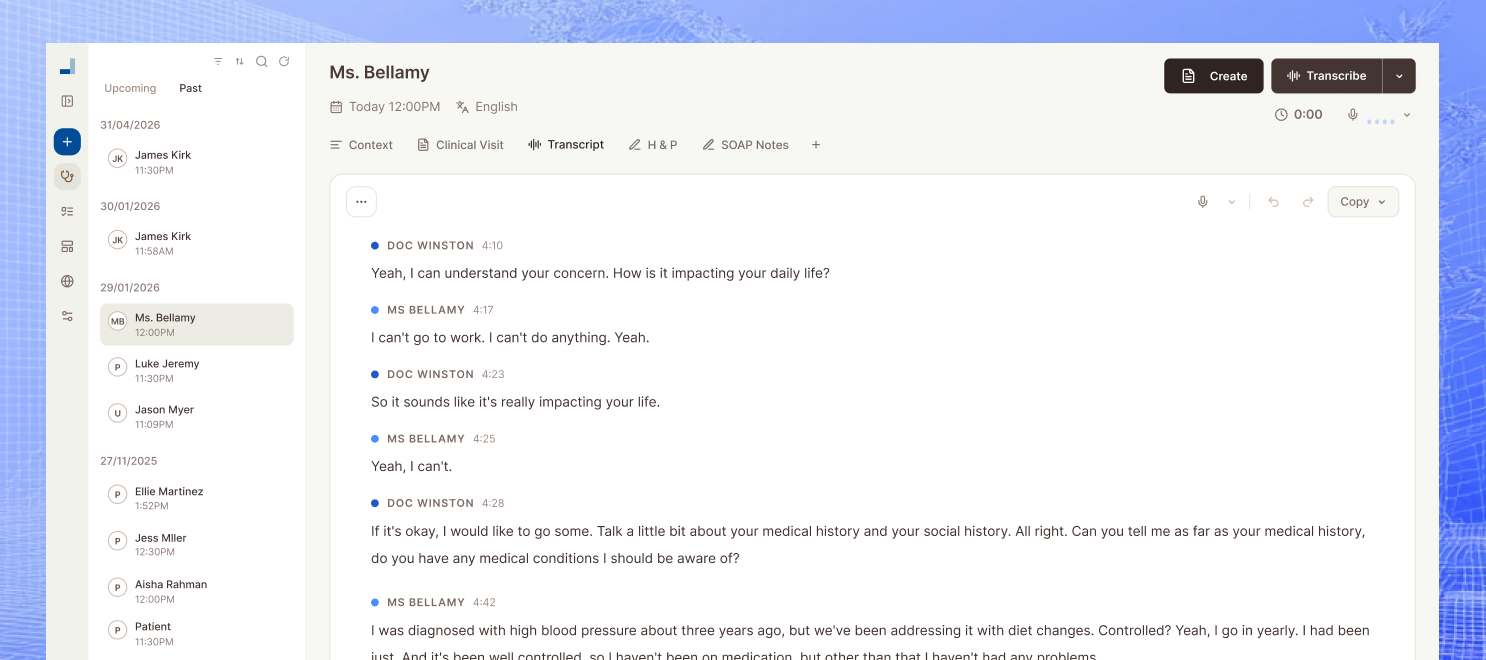
Advanced AI tools can now generate a wide array of document types including comprehensive History and Physical (H&P) reports, detailed progress notes, and specialized consult notes. Whether it is a quick follow-up, a complex procedure note, or a detailed discharge summary, the structure remains consistent across the entire clinic. This uniformity is vital for audit readiness and internal quality control, ensuring every file meets the same professional standard.
Beyond internal records, these tools are highly effective at drafting referral letters and patient instructions. By automating the transition from a spoken conversation to a formal letter, clinics can drastically reduce the time between a consultation and the subsequent specialist referral. This speed directly translates to faster patient care and better outcomes.
- Generates H&P, progress notes, and detailed consult summaries.
- Creates procedure notes and discharge summaries automatically.
- Drafts professional referral letters based on the encounter data.
- Ensures audit-ready documentation across all specialties.
How to implement AI medical scribe step-by-step in a real clinic
To successfully integrate an AI medical scribe into your daily routine, start small to build confidence. Begin by selecting one specific visit type, such as follow-ups or routine health checks, to test the system’s accuracy and your own comfortable flow. This limited scope prevents the feeling of being overwhelmed while you adjust to the presence of a digital assistant.
Next, take the time to set up and refine templates specific to your specialty. Most platforms allow you to dictate the ‘style’ of the note—whether you prefer concise bullet points or detailed narrative paragraphs. Once your templates are aligned with your clinical judgment, the capture process becomes second nature. During the encounter, whether in-person or via telehealth, simply activate the scribe and speak naturally with your patient without worrying about the keyboard.
After the encounter ends, immediately review the generated output. The AI provides a draft that usually requires only minor edits or confirmations of specific values. This habit of ‘review and sign’ immediately following a visit prevents the end-of-day backlog. Finally, reuse these outputs to generate necessary forms or letters, ensuring that the same information is used consistently across all patient documentation.
- Start with one simple visit type to learn the workflow.
- Customize templates to match your specialty’s specific needs.
- Review and edit notes immediately after the encounter.
- Use the captured data to instantly create letters and forms.
How to keep note quality high and reduce mistakes
The primary concern with any automated system is the risk of ‘note bloat’ or the inclusion of irrelevant information. To keep quality high, clinicians must establish a lightweight review habit. This involves scanning for specific data points like medication dosages, lab values, and the ‘Plan’ section to ensure the AI has correctly interpreted the clinical intent. Standardizing what constitutes a ‘good note’ within your team ensures that every practitioner produces similar results.
Failure points often occur when the AI is forced to guess clinical decisions that weren’t clearly stated during the visit. To avoid this, make it a habit to ‘summarize out loud’ at the end of a consult. By telling the patient (and the AI) what you have decided on for the plan and next steps, you provide the scribe with the clear, high-quality data it needs to generate an accurate summary. This also improves patient understanding and adherence.
- Scan for ‘hallucinations’ in dosages or specific numeric values.
- Summarize the plan out loud to ensure the AI captures your intent.
- Establish clinic-wide standards for note length and detail.
- Regularly update templates to reflect changes in clinical guidelines.
Privacy, consent, and patient trust (plain English)
Patient privacy is a cornerstone of modern medicine. When introducing an AI medical scribe, always follow the local regulations and institutional policies relevant to your region. Transparency is the best tool for maintaining trust; most patients are receptive to technology when they understand it helps their doctor focus more on their care and less on a computer screen.
A simple way to explain this to a patient is: “I’m using a digital clinical assistant to help me capture our conversation so I can focus entirely on you instead of typing on my computer. It transcribes our talk into a medical note, and once I’ve reviewed and saved it, the recording is deleted. Are you okay with that?” This approach frames the technology as a benefit to the patient experience.
- Always obtain verbal or written consent based on local policy.
- Explain the technology as an assistant that improves focus.
- Ensure the platform used adheres to strict security standards.
- Remind patients that the final note is reviewed and verified by you.
Rolling it out across a clinic without disruption
Introducing new technology to a group practice or a university clinic requires a structured approach. A two-week pilot program is usually sufficient to identify any friction points in the workflow. During this time, identify ‘super-users’ who can help train other staff and troubleshoot common questions about template alignment or device setup.
Track specific metrics such as time saved on charting and the reduction in after-hours work to demonstrate the value to the entire team. Consistency across the clinic is achieved when everyone uses the same high-standard templates, ensuring that a patient’s file looks professional regardless of which provider they see. This unified front improves the clinic’s reputation and operational efficiency.
- Use a 2-week pilot to find the best workflow for your team.
- Measure time saved to encourage adoption among skeptical staff.
- Standardize templates to maintain professional consistency.
- Provide brief, practical training sessions for all clinicians.
Mcoy AI is an AI medical scribe that records and transcribes patient encounters, then generates multiple clinical note types including H&P, progress notes, consult notes, follow-up notes, procedure notes, discharge summaries, referral letters, and more. With over 200 customizable templates and an interactive AI chat feature, it allows clinicians to create custom letters, forms, and documents effortlessly. This tool is designed to fit seamlessly into any clinical workflow, ensuring that your documentation is both accurate and comprehensive while freeing up time for direct patient care.
Conclusion
In conclusion, learning how to use an AI medical scribe is not just about adopting a new tool; it is about reclaiming the joy of practicing medicine. By following a structured implementation plan—starting with a few templates and scaling up—clinics can significantly improve their documentation consistency and reduce the burnout associated with heavy administrative loads. Whether you are in a small private practice or a large university clinic, the transition to AI-assisted charting is a pivotal step toward a more efficient and patient-centered future. Start your pilot today and see how an AI medical scribe can transform your daily workflow.
What a serious review table should cover
| Decision area | Common mistake | Better clinic-ready approach | Metric to watch |
|---|---|---|---|
| Workflow design | Treat how to use an ai medical scribe for better documentation as a one-off documentation task | Build a repeatable process with clear ownership and review points | Time to complete documentation |
| Team adoption | Assume every clinician will naturally use the same process | Train for consistency and define exception handling early | Active user adoption |
| Quality review | Only check notes when a problem is reported | Audit a sample of notes weekly and review edge cases | Edit rate per note |
| Operational follow-through | Leave admin actions outside the documentation workflow | Use the same encounter data for referrals, letters, and follow-up tasks | Completion rate for next-step tasks |
Related reading
If you are working through how to use an ai medical scribe for better documentation, it helps to read this alongside Specialty Guides: How to Run a More Efficient Medical Practice in 2026, Specialty Guides: How to Improve Patient Encounters, and Practice Operations: How Clinics Can Improve Workflow Without Changing Their EHR. Those guides cover adjacent workflow, implementation, and evaluation questions so the decision does not sit in isolation.
FAQ
How accurate are AI medical scribes in real clinics?
AI medical scribes currently achieve very high accuracy, often capturing over 95% of the relevant clinical information spoken during an encounter. However, accuracy depends heavily on the clarity of the audio and the complexity of the medical jargon used. While the AI is excellent at summarizing and structuring data, it is not a doctor and should never be used without a final human review. High-quality platforms use advanced medical language processing to ensure that even nuanced discussions are captured correctly.
Do I still need to review every note?
Yes, reviewing every note is mandatory and is a critical part of a safe clinical workflow. The AI acts as your assistant, generating a draft based on the conversation, but the clinician remains the legally responsible party for the medical record. It usually takes only a minute or two to scan the generated note, verify dosages, and confirm the plan is accurate. This review ensures that any potential errors are corrected before the note becomes a permanent part of the patient’s history.
What note types can an AI scribe generate besides SOAP?
While SOAP notes are the most common, AI scribes are highly versatile and can generate H&P reports, consult notes, and follow-up summaries. They are also capable of drafting specialized documents like procedure notes, discharge summaries, and even professional referral letters. By using different templates, the AI can format the same conversation into various outputs depending on the clinical need. This flexibility ensures that all aspects of patient documentation are covered by a single tool.
Will this work for telehealth and in-person consults?
Yes, AI medical scribes are designed to work across both telehealth and in-person environments. For in-person visits, the tool typically uses a smartphone or tablet microphone to capture the room audio. For telehealth, it can often be integrated directly with the communication platform or capture audio via the computer’s system sound. This versatility makes it ideal for modern hybrid practices where a doctor might see patients in multiple different formats throughout the day.
How do I explain recording/transcription to patients?
The best way to explain it is to focus on the benefits to the patient experience. You can tell the patient that you are using a digital assistant to help with notes so that you can look at them instead of a screen. Most patients are very supportive when they realize it leads to a more attentive and engaged doctor. Always be transparent about the fact that it is a transcription tool and offer to turn it off if they feel uncomfortable at any point.
How do clinics prevent note bloat?
Note bloat is prevented by using highly specific and concise templates that prioritize quality over quantity. Instead of asking the AI to ‘write everything,’ you can configure your templates to only extract relevant clinical findings and the specific plan. Additionally, a quick post-encounter review allows the clinician to remove any tangential information that isn’t necessary for the medical record. Setting clear standards for your staff regarding note length also helps maintain consistency.
How long does template setup take?
Setting up initial templates usually takes less than an hour, especially if you use pre-built templates provided by the platform. Fine-tuning those templates to match your personal ‘voice’ or your clinic’s specific requirements might take a few days of use as you see the initial results. Once the templates are established, you rarely need to touch them again. They become a permanent framework that ensures every note adheres to your preferred structure and style automatically.
What’s the safest way to start if I’m skeptical?
The safest way to start is with a ‘shadow’ pilot on common, low-risk cases such as routine follow-ups or wellness checks. Use the AI scribe alongside your traditional charting method for a few days to compare the results. Once you see that the AI is capturing the same information you would have typed manually—but doing it much faster—your confidence will naturally grow. This low-pressure approach allows you to learn the software without any risk to your clinical documentation quality.