Compare & Choose: Best Tools Doctors Use to Save Time on Clinical Notes
Full guide on the best tool doctors use to save time on clinical notes in 2026
Clinical notes are essential, but for many doctors they have become one of the biggest drains on time, energy, and focus. Long after the last patient leaves, notes still need to be written, reviewed, and signed. Even during consultations, attention is often split between listening and documenting, which affects both care quality and professional satisfaction.
Over the past few years, doctors have tried many “tools” to speed up clinical notes. Shortcuts, templates, dictation, and macros all help a little, but they rarely solve the problem fully. In 2026, the tools that truly save time are not about typing faster. They are about changing the nature of documentation itself.
This is why more doctors are turning to AI medical scribes, and why Mcoy has become one of the most practical tools clinicians use to save time on clinical notes without compromising care.
Why clinical notes still take so much time
Before looking at solutions, it is important to understand why clinical notes remain such a burden.
Clinical encounters are conversational and complex. Patients describe symptoms in their own words. Doctors ask follow-up questions, explain reasoning, and make shared decisions. Turning this rich interaction into structured, compliant documentation is not trivial.
Most doctors still document after the encounter. This means reconstructing details from memory, choosing wording carefully, and often over-documenting to reduce risk. Each of these steps adds time and mental load.
Even efficient typists struggle because the bottleneck is not speed. It is cognitive effort.
Why traditional note-taking tools fall short
Many doctors already use tools intended to speed up notes. Templates, text expanders, and dictation software are common. While helpful, these tools still rely heavily on manual effort.
Templates reduce structure decisions, but doctors still need to fill everything in. Dictation replaces typing, but editing and formatting still take time. Text expanders save keystrokes, but do not reduce the need to think through documentation.
These tools improve parts of the process, but they do not change the fundamental problem. Doctors are still responsible for creating notes from scratch.
To truly save time, the tool must change documentation from a writing task into a review task.
The shift doctors are making in 2026
In 2026, the most time-saving “tool” doctors use for clinical notes is not a shortcut or a macro. It is AI-assisted documentation.
AI medical scribes capture the clinical encounter itself and turn it into structured documentation automatically. Instead of starting from a blank page, doctors receive a draft note that reflects what actually happened in the consultation.
This is a fundamental shift. Reviewing and approving a note is significantly faster and less mentally draining than writing one from scratch. It also allows doctors to stay present with patients during visits.
This is where Mcoy stands out.
Why Mcoy is the tool doctors rely on for clinical notes
Mcoy is not just another documentation tool layered on top of existing workflows. It is designed specifically to remove the most time-consuming parts of clinical note creation while fitting naturally into how doctors already work.
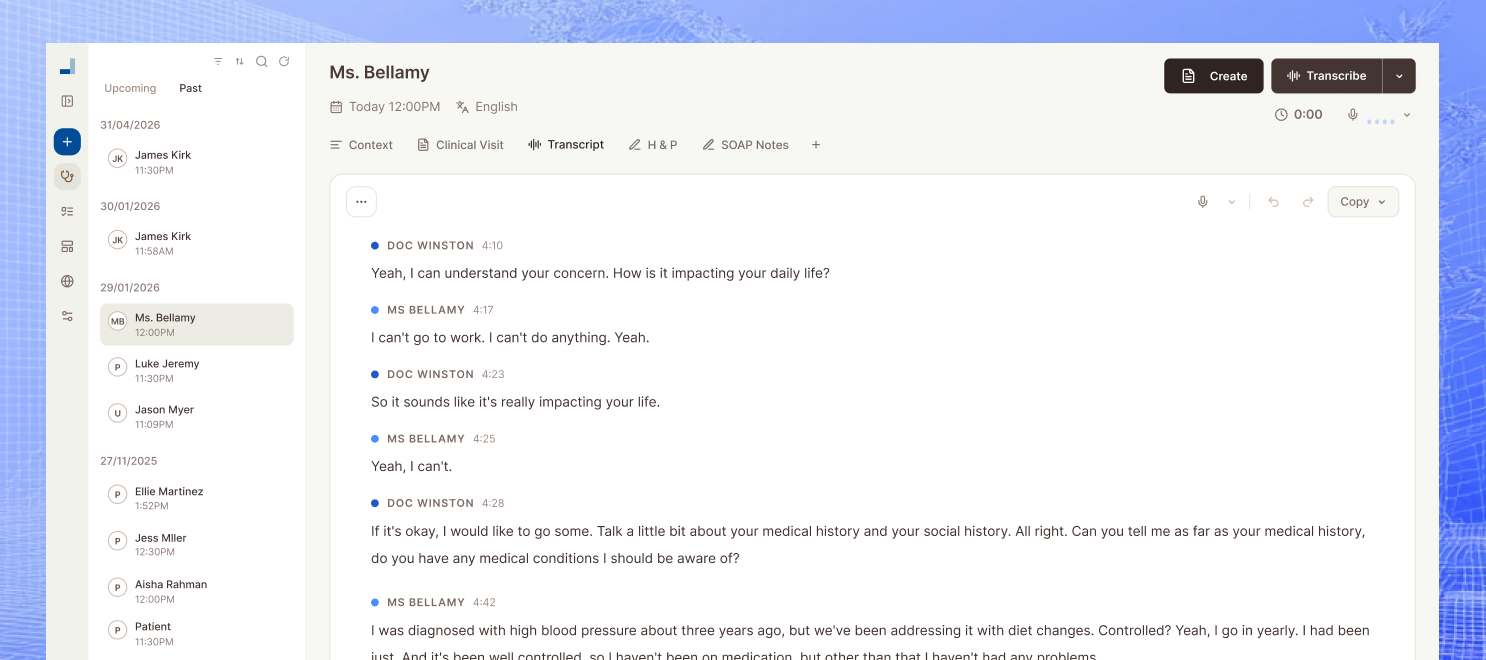
Mcoy records and transcribes patient encounters, then turns those conversations into structured clinical notes automatically. Instead of typing or dictating after the visit, doctors receive a ready-to-review note that follows a clear, clinically relevant structure.
This alone saves significant time, but Mcoy goes further in several key ways that matter to clinicians.
Benefit one: Notes are created from the real conversation
One of the biggest time drains in documentation is reconstruction. Doctors try to remember exactly what was said, what was decided, and how it was phrased.
Mcoy eliminates this step by capturing the encounter itself. The clinical note is generated directly from the conversation, not from memory. This improves accuracy and reduces the need for extensive editing.
Doctors spend less time asking themselves “Did I include everything?” and more time quickly reviewing and confirming what is already there.
Benefit two: Structured notes without rigid templates
Poorly designed templates can slow doctors down. They force unnatural phrasing and extra clicking.
Mcoy uses structured clinical formats, such as SOAP notes, without forcing doctors into rigid workflows. The structure is there to guide clarity, not constrain clinical thinking.
This balance matters. Notes are easier to read, easier to review, and faster to complete. At the same time, clinicians retain flexibility to add nuance where needed.
Benefit three: Massive time savings on every visit
The time savings from Mcoy are not marginal. For many doctors, documentation time drops dramatically because the most time-consuming part, writing, is removed.
Instead of spending several minutes per patient writing notes, doctors spend a fraction of that time reviewing. Across a full clinic day, this can translate into hours saved.
Those hours are often reclaimed in the same day, not pushed to evenings or weekends. Finishing notes during work hours is one of the most meaningful quality-of-life improvements doctors report.
Benefit four: Better focus during patient encounters
One of the most overlooked benefits of Mcoy is what happens during the consultation itself.
When doctors know documentation is being handled in the background, they stop thinking ahead to notes. They maintain eye contact, listen more carefully, and engage more naturally.
Patients notice this immediately. Encounters feel less rushed and more personal. Doctors often report that their job feels more like medicine again.
Saving time on notes is valuable, but improving the quality of patient interactions is equally important.
Benefit five: One encounter, many documents
Clinical notes are rarely the only documentation required. Information from the consultation is often reused for referral letters, reports, forms, and patient summaries.
Mcoy allows doctors to generate these documents from the same captured encounter. Instead of rewriting information multiple times, doctors can create different outputs from one source.
This reduces duplication and further cuts down administrative time. It also improves consistency across documents, reducing errors and follow-up work.
Benefit six: Over 200 customisable templates built for clinicians
Different specialties document differently. A generic tool rarely fits everyone.
Mcoy includes over 200 customisable templates designed for doctors and specialties. This means notes and documents align more closely with real clinical practice rather than generic formats.
Doctors spend less time adapting tools to their workflow because the workflow is already designed with clinicians in mind.
Benefit seven: Reduced cognitive load and burnout
Time savings are only part of the story. Documentation is mentally exhausting, especially after a long clinic day.
By turning documentation into a review task, Mcoy significantly reduces cognitive load. Doctors make fewer micro-decisions about wording, structure, and completeness.
Over time, this reduction in mental fatigue has a real impact on burnout. Doctors feel less drained at the end of the day and more able to sustain their workload.
Benefit eight: Finishing work during the workday
After-hours charting is one of the strongest predictors of burnout. Tools that reduce documentation but still push work into evenings do not fully solve the problem.
Mcoy helps doctors finish notes earlier because documentation starts at the point of care. When the clinic day ends, most of the work is already done.
This restores evenings, improves sleep, and makes clinical work feel more sustainable.
Why focusing on one powerful tool matters
Many clinics try to fix documentation by adding multiple small tools. Shortcuts here, templates there, dictation on top. This often increases complexity.
Doctors who save the most time tend to rely on one tool that removes the biggest chunk of work. In 2026, that chunk is manual note writing.
By focusing on Mcoy as the core documentation tool, clinicians simplify their workflow instead of fragmenting it.
What a serious review table should cover
| Decision area | Common mistake | Better clinic-ready approach | Metric to watch |
|---|---|---|---|
| Workflow design | Treat best tools doctors use to save time on clinical notes as a one-off documentation task | Build a repeatable process with clear ownership and review points | Time to complete documentation |
| Team adoption | Assume every clinician will naturally use the same process | Train for consistency and define exception handling early | Active user adoption |
| Quality review | Only check notes when a problem is reported | Audit a sample of notes weekly and review edge cases | Edit rate per note |
| Operational follow-through | Leave admin actions outside the documentation workflow | Use the same encounter data for referrals, letters, and follow-up tasks | Completion rate for next-step tasks |
Related reading
If you are working through best tools doctors use to save time on clinical notes, it helps to read this alongside Compare & Choose: Medical Scribing Services: Are They Worth It?, Compare & Choose: What is Medical Charting? Definition & Best Practices, and Admin Management: Medication List Template with Examples. Those guides cover adjacent workflow, implementation, and evaluation questions so the decision does not sit in isolation.
FAQ
Efficiency without compromising care
A common concern with time-saving tools is whether they compromise care quality. In practice, the opposite is often true.
Notes generated from real conversations are often more complete and accurate. Structured documentation improves clarity for other providers. Doctors who are less exhausted think more clearly and communicate better.
Mcoy does not replace clinical judgment. Doctors remain responsible for review and approval. The tool simply removes clerical overhead.
Why Mcoy fits modern medical practice
Modern practices need tools that work alongside existing systems, not tools that require major disruption.
Mcoy fits into existing workflows without forcing clinics to change their EHR or retrain staff extensively. This makes adoption easier and benefits quicker.
Doctors can start saving time immediately rather than waiting months for system changes.
The real benefit: time back for what matters
Ultimately, the value of Mcoy is not just measured in minutes saved per note. It is measured in what doctors do with that time.
More attention during consultations. Fewer late nights charting. More energy for complex cases, teaching, or family. Less burnout.
In 2026, the best tool doctors use to save time on clinical notes is the one that removes the work entirely, not the one that makes it slightly faster.
For many clinicians, that tool is Mcoy.