Compare & Choose: Medical Scribing Services: Are They Worth It?
Full guide on medical scribing for doctors and clinics. Learn how scribes, AI tools, and workflows improve documentation, reduce admin, and enhance patient care.
Medical scribing services have grown from a niche support option into a mainstream solution for doctors who feel overwhelmed by the rising administrative load of modern medicine. Whether you run a private clinic, operate in a university health setting, or manage a team of clinicians, documentation sits at the center of your workflow. It must be accurate, complete, legally defensible, and timely. Yet these demands also take a huge toll on clinicians who are already stretched thin. This has pushed many healthcare organizations to explore whether hiring medical scribes or using AI-powered scribing solutions can genuinely reduce workload while improving documentation quality.
Medical scribing services were originally designed to help physicians keep up with electronic health records without sacrificing patient interaction. A medical scribe typically sits in on the encounter, observes the conversation, handles the documentation, and prepares structured notes for the clinician to review. In recent years, scribes have also taken on roles like retrieving past labs, populating historical sections, and preparing visit summaries. With the rise of remote and AI scribes, the question clinicians ask today is less about what scribes do and more about whether the investment actually pays off.
Why Medical Scribing Became Essential
Documentation demands have increased dramatically over the past decade. Electronic health records promised efficiency but often introduced more complexity, longer workflows, and extra clicks. Many doctors report spending upwards of two hours charting for every one hour of direct patient care. This imbalance leads to burnout, reduced clinic throughput, and frustration for both clinicians and patients.
Medical scribing emerged as an antidote. The idea is simple: let someone else handle the typing, formatting, and structuring, so the doctor can stay fully focused on the patient. For many practices, scribes became essential because they restored eye contact, improved patient satisfaction, increased visit capacity, and reduced after-hours charting. As clinics began to see the impact on productivity and revenue, scribing became common not only in emergency departments but also in family medicine, cardiology, orthopedics, psychiatry, dermatology, and urgent care.
Types of Medical Scribing Services Available Today
Medical scribing has evolved far beyond the traditional in-room scribe model. Today, clinicians can choose from several types of scribing services depending on their workflow, specialty, and budget.
In-person scribes physically accompany the doctor during visits, either in the exam room or nearby. This approach offers real-time, highly tailored documentation with minimal lag. Remote scribes listen through audio or video and document the encounter from another location. This has become particularly popular for clinics that want the benefits of real-time documentation without having another person in the room.
Virtual scribes are a hybrid of human and technology assistance. They often combine speech recognition tools with human editors who ensure accuracy. And most recently, AI-powered medical scribes have become one of the fastest-growing categories. These systems automatically record and transcribe encounters, generate SOAP notes, and create documentation without needing a human observer. The evolution of scribe types has widened the accessibility of documentation assistance, especially for small practices that previously could not afford traditional scribing.
Does Hiring a Medical Scribe Improve Workflow?
For most clinicians, the impact of a scribe is immediate and noticeable. The biggest improvement is in time savings. Doctors spend less time typing and more time engaging with patients. Clinics often report seeing more patients per day without increasing stress. Reduced after-hours charting—what many refer to as “pajama time”—is another major benefit. Instead of staying up late finishing notes, clinicians can end their day with documentation already completed.
Scribes also improve documentation completeness. Because their only job is to observe and document, they catch details doctors may overlook when multitasking. The quality of notes tends to increase, coding becomes more accurate, and the risk of missing important clinical details decreases. These improvements trickle down into billing accuracy and revenue optimization.
Patient experience also improves when the doctor is not distracted by typing. Many patients notice the difference immediately when the clinician maintains full attention during the encounter. For clinics focused on communication, patient relationships, or high-touch care, this alone can make a scribe worth the investment.
The Downsides of Traditional Medical Scribing
While beneficial, traditional scribing also comes with challenges. Hiring, training, and retaining scribes can be expensive. Many scribes use the role as a stepping stone to medical school, meaning turnover is high. Practices often spend months training someone only to lose them within a year. This turnover disrupts workflow and requires repeated onboarding.
Confidentiality is another concern. Allowing another person into the exam room raises privacy and HIPAA compliance questions. Although trained scribes follow protocols, some patients feel uncomfortable with a third person present.
Cost is often the biggest barrier. Traditional scribe services can range from $2,000 to $4,000 per month per doctor depending on the model. For many private practices, that level of expense is difficult to sustain unless the increased patient throughput clearly offsets it.
AI Medical Scribing: Lower Cost, Higher Scalability
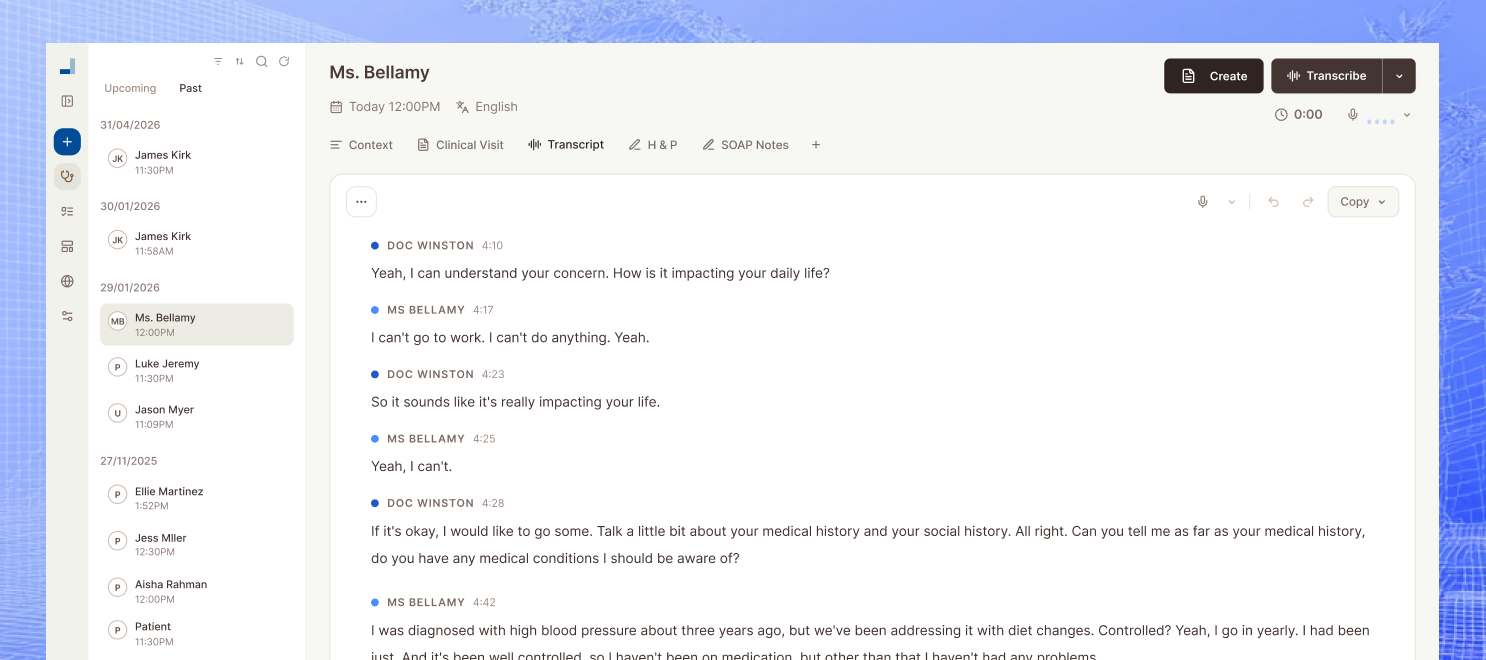
AI medical scribes have emerged as a more affordable and scalable alternative. Instead of a human listening to every encounter, AI tools automatically record the visit, transcribe the audio, extract clinical context, and produce structured notes. Modern systems use templates to create SOAP notes, referral letters, patient instructions, and more.
The biggest advantage is cost. AI scribes are significantly cheaper than human scribes—often more than ten times lower in price—while offering round-the-clock reliability. They can also adapt quickly to new workflows without the need for retraining. For doctors who prefer privacy in the exam room, AI scribes eliminate the discomfort of having a third person present.
AI scribes also produce a consistent level of documentation quality. There is no risk of fatigue, distraction, or missing details due to rushed typing. And because AI works in real time and can process large amounts of data instantly, notes are often ready immediately after the encounter.
How Mcoy AI Enhances Documentation for Clinics
For clinics looking to reduce documentation time without hiring additional staff, Mcoy AI offers an advanced solution designed specifically for medical professionals. It serves as a fully capable AI medical scribe that records and transcribes patient encounters, generates complete SOAP notes, and creates clinical documents such as referral letters, forms, and patient instructions.
With over 200 customizable templates built for doctors and specialties, clinicians can instantly produce any document they need. Mcoy AI also allows doctors to chat with their encounters to extract details, generate letters, or refine notes. This eliminates late-night charting and reduces administrative pressure so clinicians can devote more energy to patient care instead of paperwork.
Are Scribing Services Worth the Cost?
Whether scribing services are worth it depends on the structure of your practice, patient volume, and your personal workflow. For busy clinics or clinicians seeing fifteen to thirty patients per day, the time saved by a scribe often translates into increased revenue, improved patient satisfaction, and better work-life balance. If the presence of a scribe allows you to see even a few more patients per day, the service may pay for itself quickly.
However, small practices with lower patient volume may struggle to justify the cost of a full-time scribe. For these settings, AI scribes offer a more cost-effective way to achieve similar benefits. They eliminate the need to hire, train, and retain additional staff, and they scale easily as the practice grows.
Ultimately, the value lies in what documentation time costs you. If charting consumes hours of your day, if your notes consistently run behind, or if patients receive less attention because of typing, then a scribe—human or AI—can drastically improve your daily workflow and quality of care.
What Should a Clinic Consider Before Choosing a Scribing Service?
Choosing the right scribing service requires thinking about your specialty, documentation style, and budget. Certain specialties like cardiology, orthopedics, psychiatry, and endocrinology have complex documentation needs. These practices may benefit more from a dedicated scribe familiar with their terminology. Others, such as primary care or urgent care, may thrive with an AI-driven solution that auto-transcribes and structures notes.
You should also consider whether you want real-time documentation or post-visit transcription. Some doctors prefer live scribing so notes are ready immediately. Others are comfortable with after-visit summaries as long as they are accurate. Privacy is another consideration. If you feel patients may be uncomfortable with a human scribe present, AI tools provide a more private option.
Cost transparency is crucial. Some services charge by the hour, some by encounter, and some by provider. Make sure the pricing model aligns with your daily workflow. And finally, think about long-term scalability. A solution that grows with your clinic will reduce future operational friction.
What a serious review table should cover
| Decision area | Common mistake | Better clinic-ready approach | Metric to watch |
|---|---|---|---|
| Workflow design | Treat medical scribing services: are they worth it? as a one-off documentation task | Build a repeatable process with clear ownership and review points | Time to complete documentation |
| Team adoption | Assume every clinician will naturally use the same process | Train for consistency and define exception handling early | Active user adoption |
| Quality review | Only check notes when a problem is reported | Audit a sample of notes weekly and review edge cases | Edit rate per note |
| Operational follow-through | Leave admin actions outside the documentation workflow | Use the same encounter data for referrals, letters, and follow-up tasks | Completion rate for next-step tasks |
Related reading
If you are working through medical scribing services: are they worth it?, it helps to read this alongside Compare & Choose: Best Tools Doctors Use to Save Time on Clinical Notes, Compare & Choose: What is Medical Charting? Definition & Best Practices, and Specialty Guides: Clinic Documentation Workflow That Scales | Expert Guide. Those guides cover adjacent workflow, implementation, and evaluation questions so the decision does not sit in isolation.
FAQ
Are medical scribes worth it for small clinics?
Small clinics often benefit most from AI scribes because they avoid the cost and turnover of hiring a full-time human scribe. If documentation consumes too much time, a more affordable AI option may deliver most of the value at a fraction of the cost.
Do scribes improve patient satisfaction?
Yes. When clinicians focus fully on the patient instead of typing, visits feel more personal. Patients often report higher satisfaction when eye contact and active listening improve during appointments.
Are AI medical scribes accurate enough for clinical documentation?
Modern AI scribes have become highly accurate, especially when designed specifically for medical workflows. They can capture conversations, extract clinical insights, and generate structured notes with minimal correction needed, though the provider still reviews and signs off.
How much do traditional scribing services cost?
In-person or remote scribing usually costs between $2,000 and $4,000 per month per clinician. Costs can rise depending on specialty complexity or after-hours requirements.
Can scribing help with burnout?
Many clinicians report reduced burnout after adopting scribing services because the burden of after-hours charting decreases. When documentation no longer bleeds into personal time, work-life balance improves significantly.
Is AI scribing HIPAA compliant?
Most AI medical scribing platforms are designed with strict HIPAA compliance measures, including encryption, access controls, and secure data handling. Clinics should always verify certifications before adoption.
Should I choose a human scribe or an AI scribe?
Human scribes offer personalized, real-time support but come with higher costs and privacy concerns. AI scribes offer affordability, instant scalability, and full privacy but require clinicians to review output. Choosing depends on your budget, workflow, and documentation style.