AI & Medicine: Convert Medical Transcripts to Clinical Summaries | Guide
Learn how to transform raw patient transcripts into structured clinical notes. Improve workflow, reduce burnout, and master medical documentation today.
What a medical scribe solves in modern practice
The modern healthcare landscape is increasingly defined by the weight of documentation. For many practitioners, the real cost of clinical care isn’t just the time spent with the patient, but the hours of cognitive labor required to document that encounter afterward. This ‘pajama time’ directly contributes to burnout, leading to delayed notes and the potential for missing critical clinical details that were discussed in the moment but forgotten by the end of the day.
An AI medical scribe serves as a sophisticated assistive tool designed to capture the raw data of a patient encounter and filter it into a usable format. It is important to remember that these tools are not replacements for clinical judgment; the clinician remains the final authority and is responsible for the accuracy of every recorded word. By handling the heavy lifting of transcription and initial drafting, these systems allow doctors to focus on the human element of medicine.
- Significantly reduces the cognitive load associated with dual-tasking during examinations.
- Eliminates late-night charting by providing real-time draft generation.
- Captures nuanced patient details that are often lost in manual note-taking.
- Functions as a digital assistant, requiring clinician oversight for final validation.
Note types you can generate beyond SOAP (H&P and more)
While the SOAP note is the industry standard, it often lacks the specificity required for complex medical interactions. Moving beyond a simple subjective/objective split allows for more specialized documentation such as History and Physicals (H&P), which provide a comprehensive baseline for new admissions. Using various structures ensures that the documentation fits the clinical context, whether it is a routine follow-up or a complex surgical procedure.
Consult notes and referral letters require a different tone and level of detail compared to daily progress notes. A consult note must clearly communicate findings to a requesting physician, while a referral letter needs to summarize the necessity for specialized care concisely. Having the ability to pivot between these formats ensures that the communication remains professional and effective across the healthcare continuum.
Properly structured notes are the backbone of audit readiness and continuity of care. When a note is well-organized, it becomes a reliable legal document and a helpful tool for any peer who might take over the patient’s care in the future. Moving into diverse note types helps clinics maintain high standards of professional communication and regulatory compliance.
- H&P and Progress notes offer longitudinal views of patient health.
- Consult and Referral letters streamline communication between specialists.
- Procedure notes and Discharge summaries provide critical records of interventions and transitions.
- Structured formatting improves audit performance and legal defensibility.
How to implement How to Turn a Transcript Into a Clinically Useful Summary step-by-step in a real clinic
To begin implementing the process of how to turn a transcript into a clinically useful summary, you should start small. Choose one specific visit type, such as routine follow-ups or standard wellness checks, to pilot the workflow. This allows your team to get comfortable with the technology without the pressure of complex, multi-system cases.
Next, you should set up templates that align with your specific specialty. A cardiologist will need different data points highlighted than a psychiatrist. By pre-defining what a ‘useful summary’ looks like for your field, you guide the AI to focus on the most relevant vital signs, symptoms, or lab values.
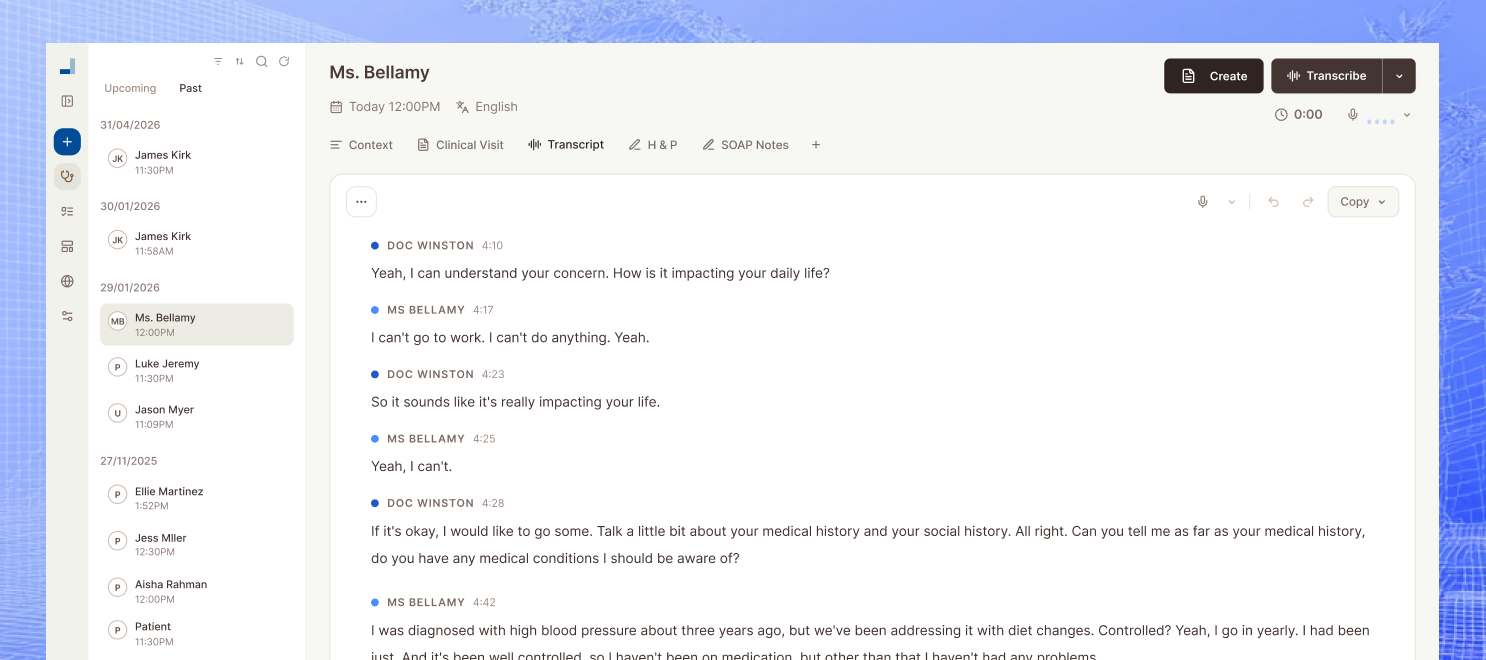
During the encounter, whether it is in-person or via telehealth, simply focus on the patient. Ensure the recording device is placed centrally so it captures both voices clearly. You don’t need to change how you speak; modern systems are designed to parse natural conversation into medical terminology.
Once the visit ends, your first task is a quick review and edit. Skim the generated text to ensure the AI didn’t misinterpret a medication name or a specific value. This step usually takes less than two minutes but is vital for maintaining the record’s integrity and clinical accuracy.
Finally, utilize the output for more than just a chart entry. If the summary is high-quality, you can easily repurpose that data to generate referral letters or patient instruction sheets. This creates a highly efficient cycle where one conversation generates multiple necessary documents with minimal extra effort.
- Pilot the workflow with one visit type to build staff confidence.
- Customize templates to match the specific needs of your medical specialty.
- Focus on the patient interaction while the system captures the raw transcript.
- Review and refine the output immediately to ensure 100% clinical accuracy.
How to keep note quality high and reduce mistakes
The primary failure points in medical documentation often involve ‘note bloat’ or the inclusion of irrelevant information that obscures the actual clinical narrative. Sometimes AI can include redundant pleasantries or fail to update a problem list correctly if the conversation was non-linear. Monitoring for these specific errors is essential for a high-quality medical record.
Establishing a lightweight review habit is the best way to maintain standards. Practitioners should treat the AI-generated note as a first draft that requires a professional ‘sign-off.’ By setting a standard for the team—such as verifying all medication dosages and confirming the final assessment—you ensure the clinic’s data remains pristine.
- Watch for ‘note bloat’ to keep the clinical narrative clear and concise.
- Always verify medication names and dosages against the actual transcript.
- Implement a consistent team-wide standard for final note approval.
- Regularly prune the problem list to reflect the current patient status accurately.
Privacy, consent, and patient trust (plain English)
Consent is the foundation of the patient-provider relationship, especially when recording technology is involved. While specific legal requirements for recording vary significantly by region, a transparent approach is always the best policy. Always follow your local healthcare privacy laws and clinic-specific guidelines regarding data retention.
Explaining the process to a patient doesn’t have to be complicated. You might say: ‘I’m using a secure digital assistant to help me capture our conversation today so I can focus entirely on you instead of my computer screen. It helps me make sure my notes are perfectly accurate. Is that alright with you?’ Most patients appreciate the extra attention they receive when the doctor isn’t typing.
Security and data retention should be handled with the same rigor as any other Protected Health Information (PHI). Ensure the tools you use meet industry standards for encryption and that data is only stored as long as necessary to generate the clinical record.
- Always obtain verbal or written consent based on local regulatory requirements.
- Focus on how the technology improves the patient’s experience and care quality.
- Ensure all data handling complies with modern security and encryption standards.
- Maintain transparency about where data is stored and who has access to it.
Rolling it out across a clinic without disruption
A successful rollout starts with a two-week pilot program involving a small group of ‘super-users’ or early adopters. These clinicians can identify potential friction points and develop ‘best practices’ specific to your clinic’s physical layout or telehealth software. This prevents a mass-scale failure and allows for departmental adjustments.
It is crucial to track specific metrics during this period to justify the transition. Look at the reduction in ‘after-hours’ charting time, the speed of note completion, and the overall completeness of the clinical records. These data points help convince more skeptical staff members of the tool’s practical utility.
- Start with a 14-day pilot to iron out workflow kinks.
- Track time saved and the reduction in documentation backlog.
- Align templates across the clinic to ensure a uniform ‘voice’ in records.
- Provide hands-on training for all support staff involved in the workflow.
Mcoy AI is an AI medical scribe that records and transcribes patient encounters, then generates multiple clinical note types including H&P, progress notes, consult notes, follow-up notes, procedure notes, discharge summaries, referral letters, and more. With over 200+ customizable templates and an interactive AI chat, clinicians can easily create letters, forms, and documents from their conversations. It is designed to be a helpful assistant that integrates into your existing routine, allowing you to spend more time with patients and less time on administrative tasks.
Transitioning to a modern documentation workflow is the most effective way to reclaim your time and improve the quality of patient care. By understanding how to Turn a Transcript Into a Clinically Useful Summary, you can eliminate the stress of manual entry and ensure your notes are comprehensive, accurate, and professional. Start with a small pilot today and see how structured, AI-assisted notes can transform your daily practice.
What a serious review table should cover
| Decision area | Common mistake | Better clinic-ready approach | Metric to watch |
|---|---|---|---|
| Workflow design | Treat convert medical transcripts to clinical summaries | guide as a one-off documentation task | Build a repeatable process with clear ownership and review points |
| Team adoption | Assume every clinician will naturally use the same process | Train for consistency and define exception handling early | Active user adoption |
| Quality review | Only check notes when a problem is reported | Audit a sample of notes weekly and review edge cases | Edit rate per note |
| Operational follow-through | Leave admin actions outside the documentation workflow | Use the same encounter data for referrals, letters, and follow-up tasks | Completion rate for next-step tasks |
Related reading
If you are working through convert medical transcripts to clinical summaries | guide, it helps to read this alongside AI & Medicine: How to Simplify Clinical Notes for Busy Doctors, AI & Medicine: How Doctors Can Improve SOAP Notes, and Practice Operations: Create EHR-Friendly AI Note Templates | Full Guide. Those guides cover adjacent workflow, implementation, and evaluation questions so the decision does not sit in isolation.
FAQ
How accurate are AI medical scribes in real clinics?
In most clinical settings, AI medical scribes are extremely accurate at capturing the dialogue and medical terminology used during a visit. However, their accuracy depends heavily on the audio quality and the clarity of the speakers. They are excellent at summarizing, but they can occasionally misinterpret specific nuances, which is why clinician review is always required. Most users find that they only need to make minor clinical adjustments to the final draft.
Do I still need to review every note?
Yes, reviewing every note is a fundamental requirement for both clinical safety and legal responsibility. The AI acts as a sophisticated drafter, but the clinician must verify that the facts, diagnoses, and plans are 100% accurate. This review typically takes only a fraction of the time it would take to write the note from scratch. It is the final checkpoint to ensure that the medical record is a perfect reflection of the encounter.
What note types can an AI scribe generate besides SOAP?
Beyond the standard SOAP format, AI scribes can generate a wide array of documents including History and Physicals (H&P), detailed progress notes, and specialized consult notes. They are also highly effective at creating procedure notes, discharge summaries, and referral letters. By using different templates, the AI can reorganize the same transcript data to suit the specific requirements of each document type.
Will this work for telehealth and in-person consults?
Most AI scribing solutions are designed to work seamlessly for both in-person and telehealth consultations. For in-person visits, the system usually records via a mobile device or desktop microphone. For telehealth, it can often integrate directly with the video platform or capture the audio from the computer’s output. The resulting transcript quality remains high regardless of the medium, provided the audio is clear.
How do I explain recording/transcription to patients?
Patients are generally very receptive when you explain that the technology allows you to focus on them rather than your computer. A simple explanation that you are using a secure tool to ensure their medical record is accurate and complete is usually sufficient. Emphasize that it helps you be a better doctor by letting you maintain eye contact and listen more effectively. Transparency builds trust and usually leads to a positive patient response.
How do clinics prevent note bloat?
To prevent note bloat, clinics should utilize concise templates that prioritize essential information over verbatim transcription. Clinicians should be trained to perform a quick ‘pruning’ during their review process to remove any non-clinical conversation. Setting clear standards for what should and should not be included in the final chart helps maintain a crisp, professional narrative. Proper template selection is the most effective way to keep notes focused.
How long does template setup take?
Initial template setup is usually very fast, often taking only a few minutes if you are using pre-built industry standards. Customizing a template to perfectly match a specific niche or personal style might take 10 to 15 minutes of tweaking. Once a template is set, it can be used indefinitely for all similar visit types. Most clinics find that they can be fully configured and ready to go within a single afternoon.
What’s the safest way to start if I’m skeptical?
The safest way to start is by running a small-scale pilot with just a few non-complex cases each day. You can continue to take your usual notes manually while the AI generates a parallel draft. This allows you to compare the two and see the accuracy of the AI without any risk to your current workflow. As your confidence grows, you can gradually transition more of your caseload to the AI-assisted model.