Practice Operations: Create EHR-Friendly AI Note Templates | Full Guide
Learn how to build EHR-friendly templates for AI medical notes. Improve documentation speed, accuracy, and workflow for private practices and clinics.
What a medical scribe solves in modern practice
The modern clinical environment is often defined by the ‘pajama time’ phenomenon, where doctors spend hours after clinic finishing charts. This administrative burden leads to cognitive exhaustion, rushed patient interactions, and a growing anxiety regarding medico-legal compliance. When documentation becomes a chore, the quality of the patient-provider relationship inevitably suffers, and critical details can be lost in the haste to finish a long queue of notes.
An AI medical scribe serves as a sophisticated assistive tool designed to capture the nuance of a conversation and restructure it into a professional format. It does not replace the physician’s judgment; rather, it acts as a high-fidelity drafting service. By handling the heavy lifting of transcription and initial synthesis, it allows the clinician to remain the final editor and signatory, ensuring that the final output is both accurate and reflective of their clinical reasoning.
- Reduces administrative burnout by automating the drafting process.
- Captures specific patient nuances that are often missed in manual typing.
- Allows for improved eye contact and engagement during the encounter.
- Provides a consistent structure that simplifies future chart reviews.
Note types you can generate beyond SOAP (H&P and more)
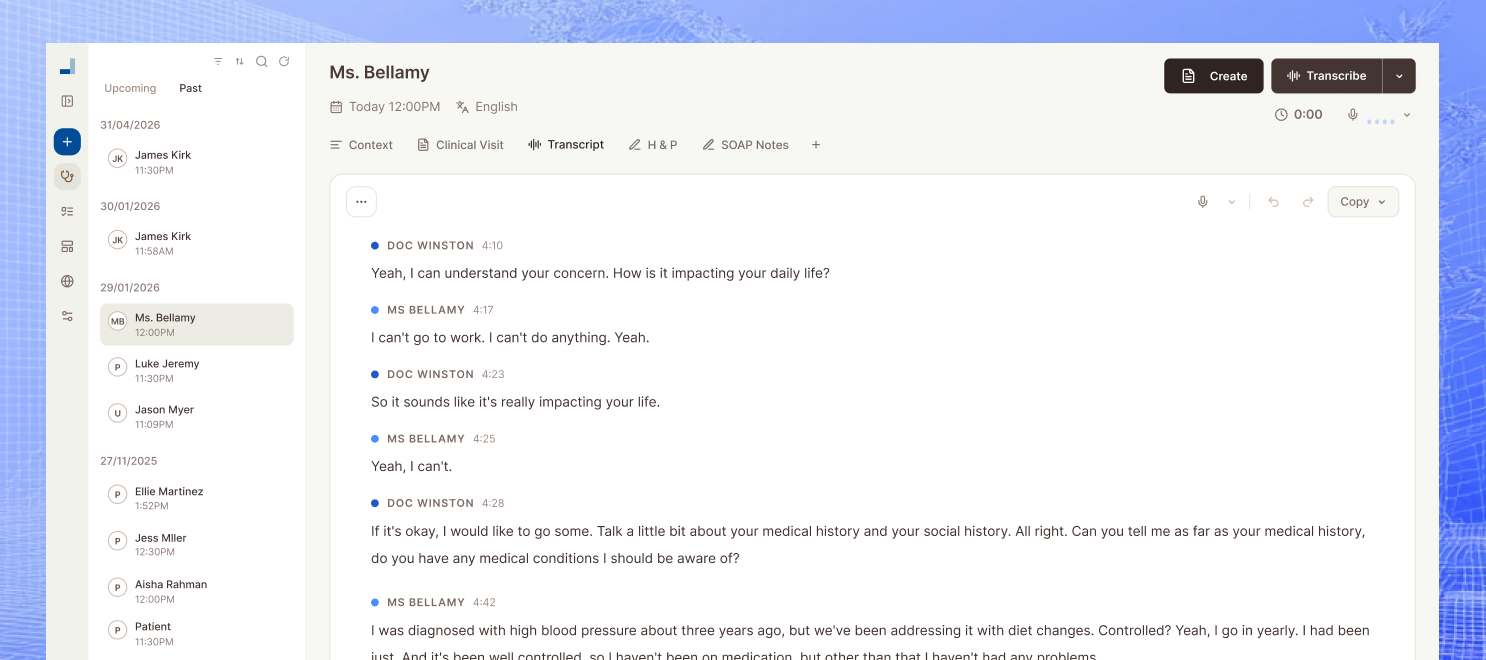
While the SOAP note is the industry standard for daily progress, complex cases and specific billing requirements often demand more specialized formats. A History and Physical (H&P) requires a level of detail and chronological organization that differs significantly from a routine follow-up. Using templates for consult notes ensures that the referring physician receives a concise summary of the assessment and plan, while procedure notes focus on the granular steps of an intervention.
Structure is not just about aesthetics; it is vital for continuity of care and audit readiness. When notes move beyond a basic narrative and into structured formats like discharge summaries or referral letters, the risk of communication gaps during handovers is drastically reduced. Having a library of templates allows a practice to adapt the documentation to the specific clinical context, whether it is a preoperative assessment or a longitudinal chronic disease management visit.
- H&P and Progress Notes for comprehensive inpatient and outpatient tracking.
- Consultation and Referral Letters to streamline specialist communication.
- Procedure Notes and Discharge Summaries for high-stakes clinical transitions.
- Customized follow-up templates to track specific chronic disease metrics.
How to implement EHR-friendly templates for AI notes step-by-step in a real clinic
To begin implementing EHR-friendly templates for AI notes, start by selecting a single, high-volume visit type. This allows the team to master the workflow without feeling overwhelmed by global changes. For example, a GP might start with routine hypertension follow-ups, while a specialist might choose a standard initial consultation format.
Next, you should configure your templates by specialty to align with your EHR’s specific fields. This ensures that the AI-generated text can be easily copied or mapped into your existing software. During the encounter, focus entirely on the patient while the AI captures the dialogue, whether the visit is happening in-person or via a telehealth platform.
Once the encounter is finished, the AI will present a draft that follows your chosen structure. Review and edit this draft quickly to catch any minor stylistic preferences. Finally, reuse these outputs to generate secondary documents, like school notes or referral letters, which saves the office staff from redundant data entry throughout the day.
- Start small with one common visit type to build team confidence.
- Align AI output structures with specific EHR data fields for easy pasting.
- Review drafts immediately after the visit while the details are fresh.
- Leverage the clinical narrative to auto-populate multiple document types.
How to keep note quality high and reduce mistakes
The primary concern with any automated documentation is the risk of note bloat or the inclusion of ‘hallucinated’ details that weren’t discussed. To maintain high quality, clinicians should develop a lightweight review habit. This involves scanning for critical values, medication dosages, and the ‘A/P’ section to ensure it reflects the actual shared decision-making that occurred during the visit.
Standardizing what a ‘good’ note looks like across the clinic helps reduce variability. If everyone agrees on the level of detail required for a physical exam or a social history, the AI can be tuned to meet those specific standards. This team-wide alignment ensures that whether a patient sees a senior partner or a resident, the documentation remains consistently high-quality and audit-proof.
- Perform a focused review of medication names and dosages for accuracy.
- Avoid note bloat by excluding redundant template text that isn’t relevant.
- Establish clinic-wide standards for documentation length and detail.
- Use the AI’s ability to summarize to keep the Assessment/Plan concise.
Privacy, consent, and patient trust (plain English)
Patient trust is the foundation of any clinical practice, and introducing recording technology requires transparency. Consent requirements vary by jurisdiction, so it is essential to follow your local healthcare regulations and hospital policies. Generally, most patients are receptive to the technology when they realize it means their doctor will be looking at them instead of a computer screen.
You can explain the process to a patient by saying: ‘To make sure I capture everything we discuss today without being stuck behind my keyboard, I’m using a secure AI assistant to help me with my notes. It records our talk so I can focus on you, and then I review everything it writes.’ This simple script demystifies the technology and emphasizes the personal benefit to the patient.
- Always adhere to local and regional consent laws for audio recording.
- Framing the technology as a way to improve ‘face time’ increases acceptance.
- Ensure the solution uses high-level encryption and secure data handling.
- Maintain a clear policy on how long recordings are kept before deletion.
Rolling it out across a clinic without disruption
Successfully rolling out EHR-friendly templates for AI notes across a university clinic or private practice requires a pilot phase. Start with a two-week period involving a small group of ‘early adopters’ who can provide feedback on template accuracy and workflow snags. This allows for troubleshooting before a full-scale deployment.
During this pilot, track specific metrics such as time saved per day and the reduction in after-hours charting. If the data shows that doctors are leaving the clinic thirty minutes earlier, it becomes much easier to gain buy-in from the rest of the staff. Finally, align the training sessions so that everyone understands how to use the AI to generate the specific letters and forms they need most.
- Conduct a 14-day pilot with 2–3 clinicians to test workflow friction.
- Monitor ‘time-to-complete’ notes to quantify the return on investment.
- Provide a library of pre-approved templates tailored to each department.
- Schedule brief weekly check-ins to share tips and refine prompt styles.
Mcoy AI is an AI medical scribe that records and transcribes patient encounters, then generates multiple clinical note types (H&P, progress notes, consult notes, follow-up notes, procedure notes, discharge summaries, referral letters, and more). It features 200+ customizable templates and an AI chat function to help you create specific letters, forms, and documents instantly. This helps clinicians stay ahead of their documentation while maintaining the highest standard of patient care.
Conclusion
Transitioning to an AI-driven documentation workflow doesn’t have to be a technical hurdle. By focusing on EHR-friendly templates and a structured rollout plan, clinics can significantly reclaim their time and improve the quality of their medical records. The key is to start small, prioritize accuracy, and use the technology as a partner in care. When you learn how to create EHR-friendly templates for AI notes, you aren’t just saving time—you are restoring the human element to medicine. Start your pilot today and see how much your clinical workflow can improve.
What a serious review table should cover
| Decision area | Common mistake | Better clinic-ready approach | Metric to watch |
|---|---|---|---|
| Workflow design | Treat create ehr-friendly ai note templates | full guide as a one-off documentation task | Build a repeatable process with clear ownership and review points |
| Team adoption | Assume every clinician will naturally use the same process | Train for consistency and define exception handling early | Active user adoption |
| Quality review | Only check notes when a problem is reported | Audit a sample of notes weekly and review edge cases | Edit rate per note |
| Operational follow-through | Leave admin actions outside the documentation workflow | Use the same encounter data for referrals, letters, and follow-up tasks | Completion rate for next-step tasks |
Related reading
If you are working through create ehr-friendly ai note templates | full guide, it helps to read this alongside Practice Operations: How Clinics Can Streamline Daily Operations, Practice Operations: How Clinics Can Improve Workflow Without Changing Their EHR, and Physician Wellbeing: Sustainable AI Documentation Routine: A Full Clinic Guide. Those guides cover adjacent workflow, implementation, and evaluation questions so the decision does not sit in isolation.
FAQ
How accurate are AI medical scribes in real clinics?
In modern clinical settings, AI scribes are remarkably accurate at capturing the core narrative and medical terminology of an encounter. However, they are assistive tools, not replacements for clinical judgment. Most practitioners find the drafts are 90-95% accurate, requiring only minor edits for personal style or specific nuances. Constant updates in medical LLMs mean these systems stay current with the latest terminology and guidelines.
Do I still need to review every note?
Yes, reviewing every note is a professional and legal requirement for any practicing clinician. While the AI does the heavy lifting of drafting the text, you remain the responsible party for the accuracy of the medical record. Most doctors find that reviewing an AI-generated note takes less than 60 seconds, which is a fraction of the time spent typing a note from scratch. Think of it as being an editor rather than a writer.
What note types can an AI scribe generate besides SOAP?
AI scribes are highly versatile and can generate a wide array of documentation beyond the standard SOAP format. This includes comprehensive History and Physical (H&P) reports, detailed consultation letters, and procedure notes. They are also effective at creating discharge summaries and referral letters by extracting relevant data from the conversation. Many systems offer specialty-specific templates for areas like orthopedics, psychiatry, or pediatrics.
Will this work for telehealth and in-person consults?
Most AI medical scribe solutions are designed to work seamlessly in both environments. For in-person visits, a mobile app or desktop microphone captures the ambient audio. For telehealth, the system can often integrate with the video platform or record the audio from the computer speakers. The underlying technology processes the conversation in the same way, ensuring high-quality documentation regardless of whether the patient is in the room or on a screen.
How do I explain recording/transcription to patients?
Transparency is the best approach when introducing AI recording to patients. You should briefly explain that the tool is being used to ensure more accurate notes and to allow you to focus more on the conversation than the computer. Mention that the recording is secure and used strictly for documentation purposes. Most patients appreciate the extra attention they receive when the doctor isn’t preoccupied with typing.
How do clinics prevent note bloat?
To prevent note bloat, it is important to choose or customize templates that prioritize concise summaries over exhaustive transcripts. Training the AI to follow specific length guidelines for different sections (like the ‘Review of Systems’) helps keep the notes readable. Clinicians should also get into the habit of deleting any redundant or irrelevant template text during their final review. Using a ‘concise’ mode in your AI settings can also minimize unnecessary fluff.
How long does template setup take?
Initial template setup usually takes very little time, often just a few minutes per clinician. Most high-quality AI scribes come with a library of pre-built templates for various specialties that can be used immediately. Customizing these existing formats to match your specific EHR fields or personal preferences might take an additional 15 to 30 minutes. Once set, these templates automate the documentation process for all future visits.
What’s the safest way to start if I’m skeptical?
The safest and most effective way to start is by running a ‘shadow pilot’ on a handful of cases. Choose 3–5 non-complex patient visits where you record the session but still take your usual notes. At the end of the day, compare your manual notes to the AI-generated drafts. This allows you to witness the accuracy and time-saving potential firsthand without any pressure or risk to your workflow before you fully commit to the change.