Specialty Guides: Convert Patient Conversations into SOAP Notes | Full Guide
Learn how to efficiently convert patient conversations into SOAP notes. Optimize clinic workflow, reduce burnout, and improve note accuracy with this guide.
What a medical scribe solves in modern practice
The modern healthcare landscape is often defined by the ‘pajama time’ phenomenon, where clinicians spend hours after their final appointment catching up on documentation. This administrative burden leads to significant cognitive load, where the focus shifts from the patient’s narrative to the mechanics of data entry. Delayed notes often result in lost clinical nuances, potentially impacting the quality of care and increasing medico-legal risks for private practitioners and university clinics alike.
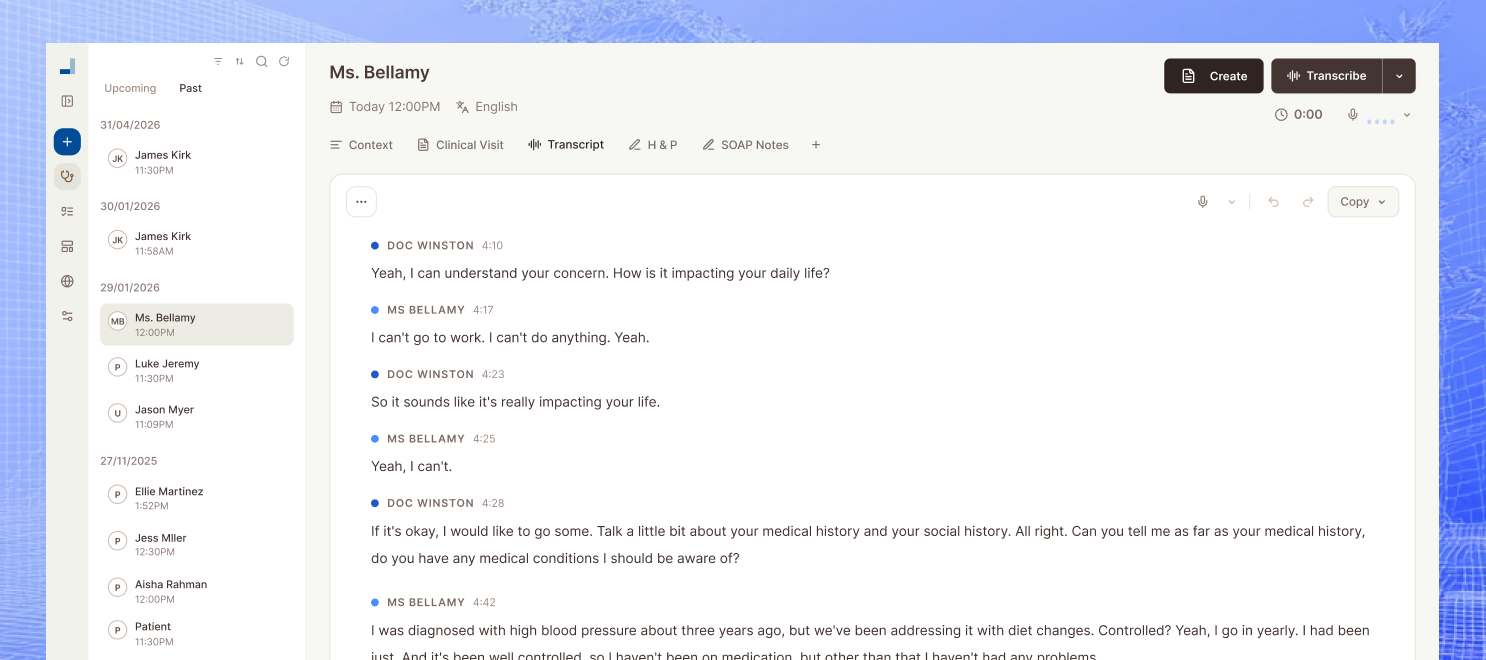
An AI medical scribe serves as an assistive bridge between the patient encounter and the electronic health record. It is designed to capture the natural flow of conversation, identifying key medical facts without requiring the doctor to stop and type. While the technology handles the heavy lifting of transcription and formatting, the clinician remains the essential pilot, ensuring all generated data is accurate and fits the clinical context before finalization.
- Eliminates hours of manual data entry after clinic hours.
- Reduces cognitive fatigue by allowing natural patient interaction.
- Captures specific clinical details that might be forgotten later.
- Acts as an assistive tool while keeping the clinician in total control.
Note types you can generate beyond SOAP (H&P and more)
While the SOAP format is a staple in medical documentation, a modern clinic requires a much more diverse array of outputs to function effectively. History and Physical (H&P) notes are essential for new admissions or comprehensive evaluations, requiring a more narrative and expansive structure than a standard progress note. Similarly, consult notes must synthesize specific specialist recommendations for the referring provider, focusing on high-impact insights and clear action plans.
Specialized encounters often demand bespoke documentation styles, such as detailed procedure notes that document every step of an intervention or discharge summaries that facilitate safe transitions of care. Follow-up notes need to track progress over time against established benchmarks, whereas referral letters must distill complex history into a concise argument for why advanced care is necessary. Having a system that can toggle between these formats ensures that your documentation remains fit-for-purpose.
The structure of these notes isn’t just about tradition; it is about audit readiness and continuity of care. High-quality documentation ensures that any member of a care team can pick up a chart and immediately understand the trajectory of a patient’s health. By standardizing these formats across a practice, clinic owners can ensure a high level of professional consistency that protects both the patient and the provider.
- H&P and progress notes facilitate daily clinical tracking.
- Consult and referral letters ensure seamless professional communication.
- Procedure notes and discharge summaries improve audit compliance.
- Customizable templates allow for specialty-specific documentation styles.
How to implement SOAP notes conversion step-by-step in a real clinic
To successfully integrate this workflow, start by identifying a single, high-volume visit type where the documentation feels most repetitive. This could be a routine follow-up or a standard physical exam. By focusing on one area, you can calibrate your expectations and see immediate time savings without overwhelming your entire staff. Once you have seen the system work for these routine visits, you can begin expanding to more complex cases.
The next step involves tailoring templates to your specific specialty. Whether you are in a university clinic or a private GP practice, each specialty has unique requirements for what must be documented. Set up your environment so that your chosen tool knows exactly which headers to prioritize. When the patient encounter begins, whether in person or via a telehealth platform, focus entirely on the conversation while the tool captures the audio in the background.
Immediately after the patient leaves, review the generated draft. This is the most critical phase where you verify that the tool correctly interpreted the Subjective complaints and Objective findings. Because the software has done the writing, your task shifts from creator to editor, which is significantly faster. Finally, you can use these finalized notes to automatically generate secondary documents like work school notes or referral letters, maximizing the utility of a single recording session.
- Start with one specific visit type to build trust in the workflow.
- Tailor documentation templates to meet specialty-specific standards.
- Focus on the patient while the audio capture handles the data.
- Review and finalize notes immediately to ensure 100% clinical accuracy.
How to keep note quality high and reduce mistakes
Quality control in clinical documentation is about more than just grammar; it is about accuracy in medication dosages, lab values, and history. A common failure point in modern charting is ‘note bloat,’ where unnecessary information is pulled into the record, making the actual plan hard to find. To prevent this, practitioners should maintain a consistent habit of reviewing the ‘Assessment and Plan’ section first, ensuring it directly addresses the ‘Subjective’ complaints gathered during the visit.
Establishing a lightweight review habit is essential for team-wide success. In a clinic setting, this means setting clear standards for what a ‘gold standard’ note looks like. If a note incorrectly identifies a side of the body or a medication strength, it must be caught during the editing phase. Modern tools are highly advanced, but they lack the clinical judgment of a licensed practitioner, so no note should ever enter a permanent record without a final human check.
- Prioritize the Assessment and Plan for clarity and actionability.
- Prune unnecessary filler to prevent administrative note bloat.
- Always verify medication names, dosages, and vital signs manually.
- Set clear quality standards for all providers in the practice.
Privacy, consent, and patient trust (plain English)
Patient privacy is the foundation of the clinical relationship. When introducing new technology that involves recording or transcription, it is vital to follow local regulations, such as HIPAA or GDPR, depending on your region. Most patients are receptive to technology if they understand that it allows their doctor to focus on them rather than a computer screen. Transparency is key to maintaining the trust that is essential for effective care.
Explain the process to the patient in simple terms: “To make sure I’m giving you my full attention, I’m using a tool that helps me take notes so I don’t have to type while we talk. It transcribes our conversation into my medical records securely. Is that okay with you?” This approach frames the technology as a benefit to the patient’s experience rather than an administrative convenience. Always ensure your practice has a written policy regarding data retention and security protocols.
- Follow local privacy laws and obtain verbal or written consent.
- Explain the technology as a way to improve face-to-face focus.
- Ensure all data is handled with enterprise-level encryption.
- Maintain clear documentation of your practice’s privacy policies.
Rolling it out across a clinic without disruption
Changing documentation habits can be disruptive if not handled strategically. A two-week pilot program is generally the best approach for most clinics. During this time, one or two ‘champion’ providers use the tool and report back on their experience. This allows the clinic to troubleshoot template issues and workflow bottlenecks before a full-scale deployment across a larger university clinic or multi-provider site.
During the pilot, track specific metrics to measure success. Monitor the reduction in after-hours charting time and the speed of note completion. If providers find they are finishing their charts before the next patient is even in the room, the ROI of the transition becomes self-evident. Training sessions should focus on those who are less tech-savvy to ensure no team member is left behind during the transition.
- Run a two-week pilot with selected providers before a full rollout.
- Track time saved and the reduction in documentation backlog.
- Align templates across the clinic to ensure record consistency.
- Provide hands-on training for staff to ensure smooth adoption.
Mcoy AI is an AI medical scribe that records and transcribes patient encounters, then generates multiple clinical note types (H&P, progress notes, consult notes, follow-up notes, procedure notes, discharge summaries, referral letters, and more). With more than 200+ customizable templates and an AI chat feature to create letters, forms, and other documents, it helps clinicians focus more on the patient and less on the keyboard.
Conclusion
Transforming the way you create medical documentation doesn’t have to be a source of stress. By moving from manual typing to an intelligent capture workflow, you can reclaim your time and improve the quality of your records. Implementing a system to turn patient conversations into SOAP notes allows you to focus on the human side of medicine while the technical side is handled efficiently. Start by piloting a new documentation workflow in your practice today and experience how streamlined clinical notes can truly be.
What a serious review table should cover
| Decision area | Common mistake | Better clinic-ready approach | Metric to watch |
|---|---|---|---|
| Workflow design | Treat convert patient conversations into soap notes | full guide as a one-off documentation task | Build a repeatable process with clear ownership and review points |
| Team adoption | Assume every clinician will naturally use the same process | Train for consistency and define exception handling early | Active user adoption |
| Quality review | Only check notes when a problem is reported | Audit a sample of notes weekly and review edge cases | Edit rate per note |
| Operational follow-through | Leave admin actions outside the documentation workflow | Use the same encounter data for referrals, letters, and follow-up tasks | Completion rate for next-step tasks |
Related reading
If you are working through convert patient conversations into soap notes | full guide, it helps to read this alongside Specialty Guides: How to Run a More Efficient Medical Practice in 2026, Specialty Guides: How to Improve Patient Encounters, and Specialty Guides: Create Patient Letters Faster with AI Medical Scribes. Those guides cover adjacent workflow, implementation, and evaluation questions so the decision does not sit in isolation.
FAQ
How accurate are AI medical scribes in real clinics?
AI medical scribes are remarkably accurate, often capturing over 98% of relevant clinical information from a natural conversation. They are trained on vast datasets of medical terminology, allowing them to distinguish between clinical jargon and casual speech. However, they are designed to be assistive, and the final clinical responsibility always rests with the physician to ensure the nuances are correct.
Do I still need to review every note?
Yes, reviewing every note is a mandatory clinical and legal requirement. While the AI does the heavy lifting of transcribing and formatting, only a trained clinician can verify that the medical logic and plan are sound. Most providers find that reviewing and editing a generated note takes significantly less time than writing one from scratch.
What note types can an AI scribe generate besides SOAP?
Beyond the standard SOAP format, an AI scribe can generate History and Physical (H&P) reports, consult notes, and progress notes. They are also capable of drafting specialized documents like procedure notes, discharge summaries, and referral letters. This flexibility ensures that clinicians have the right document for every type of patient interaction.
Will this work for telehealth and in-person consults?
Yes, the technology is designed to work seamlessly in both environments. For in-person visits, the device captures room audio, while for telehealth, it integrates with the audio output of your computer. This makes it an ideal solution for modern practices that offer hybrid care models.
How do I explain recording/transcription to patients?
The best way to explain it is to focus on the benefit to the patient: better eye contact and more focused attention. Simply stating that you are using a digital assistant to help with note-taking so you can focus on them is usually well-received. Most patients appreciate that their doctor is trying to be more present during the visit.
How do clinics prevent note bloat?
Clinics prevent note bloat by using concise templates and setting parameters for what the AI should prioritize. By focusing on relevant positives and significant negatives rather than transcribing every single word, the system provides a succinct summary. Peer reviews and periodic template adjustments also help keep documentation lean and professional.
How long does template setup take?
Setting up initial templates usually takes less than an hour, as most systems come with pre-built options for various specialties. Fine-tuning those templates to your specific shorthand or clinic style might take another few days of use. Once established, these templates save hours of manual entry every day.
What’s the safest way to start if I’m skeptical?
The safest way to start is to run a one-week trial on a small subset of your patients, such as routine follow-ups. This allows you to see the output quality without the pressure of documenting complex new-patient visits. Once you see the accuracy and time savings on simple cases, you can naturally scale up to the rest of your practice.