AI & Medicine: Standardize Clinical Notes Between Supervisors & Trainees
Learn how to bridge the gap between supervisors and trainees using an AI medical scribe to standardize clinical notes and improve supervision efficiency.
Medical documentation remains one of the most significant hurdles for clinicians today. For university clinics and private practices, the challenge is doubled by the need to balance high-quality patient care with the educational requirements of trainees. Often, supervisors find themselves spending hours correcting inconsistent notes, while trainees feel rushed and overwhelmed by the administrative burden of charting during their learning years.
This guide serves as a comprehensive roadmap for medical directors, private practitioners, and university clinic coordinators. We will explore how to move beyond the friction of manual charting toward a system that ensures quality, consistency, and medico-legal safety. You will learn how to implement an AI medical scribe workflow, utilize diverse note formats beyond the traditional SOAP structure, and develop a rollout plan that minimizes disruption to your clinic’s daily operations.
What a medical scribe solves in modern practice
The traditional model of clinical documentation often leads to cognitive overload. When a supervisor or trainee is preoccupied with capturing every word of a patient’s history, the therapeutic alliance suffers. The real cost isn’t just time; it is the mental exhaustion that leads to ‘pajama time’—hours spent charting after the clinic has closed. This delay often results in forgotten details and a higher risk of diagnostic error.
Using an AI medical scribe changes this dynamic by acting as an invisible assistant that listens to the encounter. It is important to remember that these tools are assistive, not autonomous. The clinician remains the final authority, reviewing and validating the note to ensure accuracy. By outsourcing the transcription and initial structuring of the note, doctors can focus on the patient while ensuring the documentation meets the necessary clinical and billing standards.
- Reduces the cognitive load on both trainees and seasoned clinicians.
- Eliminates late-night charting by ensuring notes are ready for review immediately.
- Ensures no critical patient detail is lost during the heat of the encounter.
- Provides a standardized baseline for every note, regardless of who saw the patient.
Note types you can generate beyond SOAP (H&P and more)
While the SOAP note is a staple in medical training, it is often insufficient for the complexities of modern specialty care or hospital handovers. Relying solely on one format can lead to gaps in information, especially when transitioning care between a trainee and a supervisor. Standardizing diverse note types—such as History and Physical (H&P), procedure notes, and referral letters—is essential for maintaining continuity of care.
Specialized notes like consultation summaries or discharge summaries require specific data points that a generic SOAP format might overlook. For instance, a procedure note must capture specific technical steps and patient reactions, while a referral letter needs to synthesize complex histories into a concise narrative for the receiving specialist. Having these formats ready ensures that the practice is always audit-ready and that communication with other healthcare providers remains professional and precise.
- H&P and progress notes provide a detailed longitudinal view of patient health.
- Procedure and consult notes ensure surgical and specialty data are accurately logged.
- Discharge summaries and referral letters facilitate safer patient transitions.
- Standardized formatting improves the speed of supervisor audits and reviews.
How to implement AI medical scribe step-by-step in a real clinic
Beginning your journey toward standardized notes starts by selecting a single visit type to pilot. Rather than overhauling every department at once, focus on a high-volume, repetitive visit where consistency is most needed. This allows trainees to get comfortable with the technology without the pressure of complex, multi-system cases. Once the baseline is established, you can begin setting up templates tailored specifically to your specialty, whether that is pediatrics, orthopedics, or psychiatry.
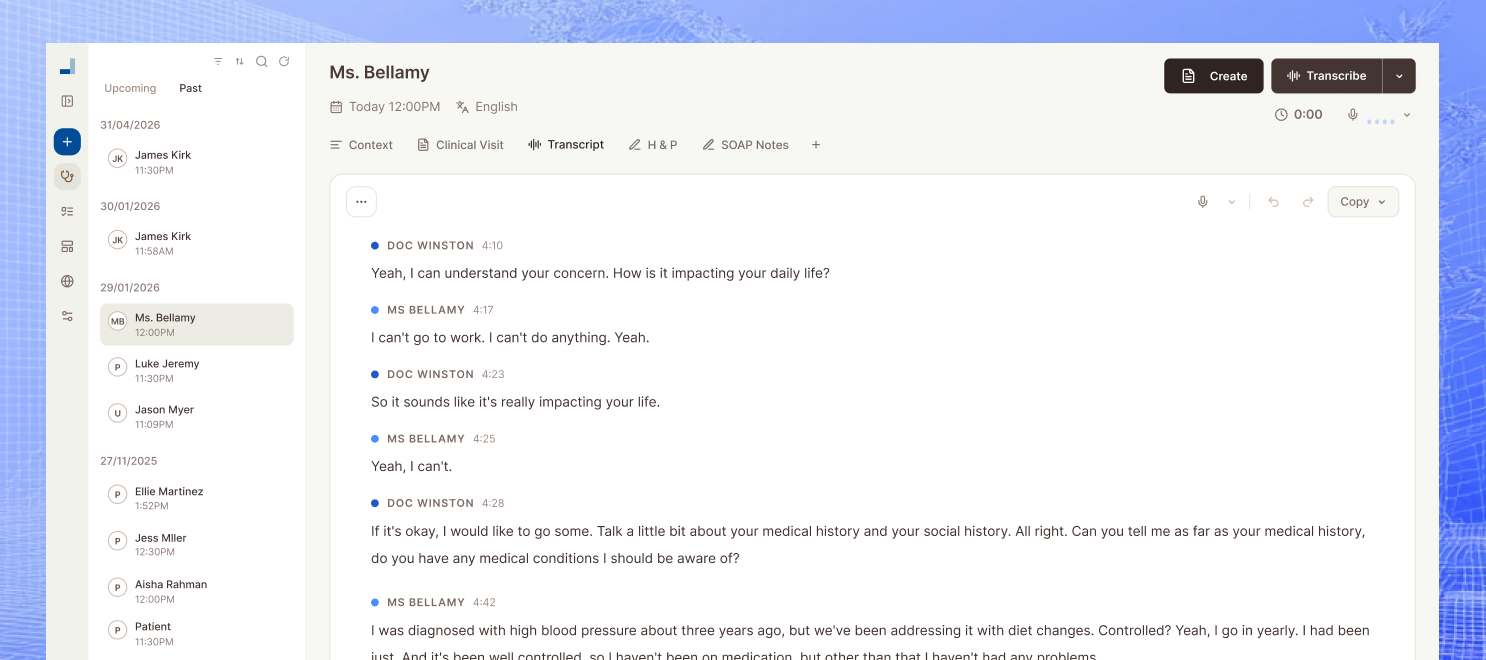
During the encounter, the clinician or trainee simply captures the conversation—whether in-person or via telehealth. The AI then processes the natural dialogue into a structured clinical draft. The supervisor then reviews this draft alongside the trainee, making quick edits to ensure clinical judgment is correctly reflected. This review process becomes a teaching moment where the supervisor can provide feedback on the note’s content rather than its formatting. Finally, these outputs are reused to generate patient letters or insurance forms, maximizing the utility of a single recording sessions.
- Start with one specific visit type to build staff confidence and competence.
- Customize templates to match the specific clinical requirements of your specialty.
- Use the AI-generated draft as a teaching tool for supervisor-trainee reviews.
- Repurpose documented data into referral letters and forms to save administrative time.
How to keep note quality high and reduce mistakes
The primary failure points in clinical documentation usually involve missing medications, incorrect lab values, or ‘note bloat’—the inclusion of irrelevant information that hides important facts. To combat this, clinics should adopt a lightweight review habit. Supervisors should check that the AI has correctly interpreted the assessment and plan, ensuring that the trainee’s clinical reasoning is clearly articulated and not buried under template filler.
Creating team standards is also vital. This includes defining which sections of a note are mandatory and how certain values should be recorded. When everyone knows the ‘house style,’ reviewing a trainee’s note becomes a 30-second task rather than a 5-minute investigation. Consistent quality control not only protects the practice legally but also ensures that any clinician stepping in to see the patient next has a clear, concise record of past care.
- Focus on the accuracy of medications and the assessment/plan section.
- Implement a ‘house style’ to prevent irrelevant information from cluttering notes.
- Use the review period as a quality check for both the AI and the trainee.
- Ensure the problem list is updated and prioritized in every progress note.
Privacy, consent, and patient trust (plain English)
Navigating patient consent is simpler than most clinicians fear. While regulations vary by region, the core principle is transparency. Most patients are supportive of technology that helps their doctor spend more time looking at them and less time looking at a screen. It is important to follow your local healthcare privacy laws and clinic policies regarding data retention and recording.
In practice, explaining the process can be handled with a brief, friendly script. For example: ‘To help me focus entirely on our conversation, I’m using a tool that securely transcribes our visit into my clinical notes. It doesn’t store the audio, just the medical facts for your chart. Is that alright with you?’ This approach builds trust by showing the patient that their care and data security are both top priorities.
- Always follow local regional regulations regarding patient recording and data.
- Use a simple, transparent script to explain the benefits of the technology to patients.
- Reassure patients that the data is treated with the same security as their chart.
- Ensure your selected tool meets industry-standard encryption and privacy protocols.
Rolling it out across a clinic without disruption
To roll out a standardized system successfully, begin with a two-week pilot program involving a small group of tech-forward trainees and supervisors. This allows you to iron out any workflow kinks before a full-scale launch. During this period, track specific metrics like time saved per note, the reduction in after-hours charting, and the overall completeness of the notes as rated by the supervisors.
Once the pilot is complete, align your templates across the entire clinic. Conducting a short group training session ensures that everyone, from the front desk to the senior partners, understands how the system works. By standardizing the input—the captured encounter—and the output—the clinical note—you create a seamless environment where trainees can learn efficiently and supervisors can maintain high oversight standards without the burnout.
- Run a two-week pilot to identify and solve workflow bottlenecks early.
- Track time-saving metrics to prove the value to skeptical staff members.
- Align templates across the practice for maximum consistency and ease of review.
- Provide brief, targeted training to ensure all staff use the system correctly.
Mcoy AI is an AI medical scribe that records and transcribes patient encounters, then generates multiple clinical note types (H&P, progress notes, consult notes, follow-up notes, procedure notes, discharge summaries, referral letters, and more). It features 200+ customizable templates and an AI chat function to help clinicians instantly create letters, forms, and other essential documents. By streamlining the documentation process, Mcoy AI allows healthcare providers to maintain high standards of record-keeping while significantly reducing the time spent on administrative tasks.
Conclusion
Standardizing documentation between supervisors and trainees is more than an administrative fix; it’s a commitment to clinical excellence and staff well-being. By moving away from manual, inconsistent charting and toward a structured, AI-assisted workflow, clinics can ensure that every encounter is documented with precision. Whether you are leading a university clinic or running a private practice, using an AI medical scribe simplifies the supervision process and allows trainees to focus on what matters most: learning to provide exceptional patient care. Start your pilot today and reclaim your clinic’s time.
SEO description: Master how to standardize notes between supervisors and trainees using an AI medical scribe to improve clinic workflow and reduce educator burnout.
What a serious review table should cover
| Decision area | Common mistake | Better clinic-ready approach | Metric to watch |
|---|---|---|---|
| Workflow design | Treat standardize clinical notes between supervisors & trainees as a one-off documentation task | Build a repeatable process with clear ownership and review points | Time to complete documentation |
| Team adoption | Assume every clinician will naturally use the same process | Train for consistency and define exception handling early | Active user adoption |
| Quality review | Only check notes when a problem is reported | Audit a sample of notes weekly and review edge cases | Edit rate per note |
| Operational follow-through | Leave admin actions outside the documentation workflow | Use the same encounter data for referrals, letters, and follow-up tasks | Completion rate for next-step tasks |
Related reading
If you are working through standardize clinical notes between supervisors & trainees, it helps to read this alongside AI & Medicine: How to Simplify Clinical Notes for Busy Doctors, AI & Medicine: How Doctors Can Improve SOAP Notes, and Specialty Guides: How to Build a Template Pack for GP SOAP Notes | Mcoy. Those guides cover adjacent workflow, implementation, and evaluation questions so the decision does not sit in isolation.
FAQ
How accurate are AI medical scribes in real clinics?
AI medical scribes are highly accurate in capturing clinical dialogue and transcribing medical terminology, often exceeding the speed and detail of manual note-taking. However, they are designed as assistive tools, meaning they require a clinician to review the output for accuracy and context. In most clinic settings, they reduce errors related to omitted details while maintaining a high level of factual reliability.
Do I still need to review every note?
Yes, the clinician or trainee remains legally and professionally responsible for the medical record. While the AI does the heavy lifting of structure and transcription, the human provider must verify the assessment and plan. This review process is significantly faster than writing a note from scratch, typically taking only a minute or two.
What note types can an AI scribe generate besides SOAP?
Modern AI scribes can generate a wide array of documentation including History and Physicals (H&P), procedure notes, consult notes, and discharge summaries. They can also create referral letters and follow-up notes based on the same encounter data. This flexibility allows different specialties to maintain their unique standards of documentation.
Will this work for telehealth and in-person consults?
AI medical scribes are designed to work seamlessly in both environments. For in-person visits, a smartphone or tablet can capture the audio, while for telehealth, the software can integrate with the video platform. The quality of the transcription remains high as long as the audio is clear, making it a versatile solution for modern hybrid practices.
How do I explain recording/transcription to patients?
The best approach is to be brief and focus on the benefit to the patient. You can explain that the tool allows you to focus on them rather than a screen and that it securely processes medical notes without storing permanent audio. Most patients appreciate the extra attention and are comfortable with the process once they understand it is secure.
How do clinics prevent note bloat?
Clinics can prevent note bloat by using concise, specialty-specific templates that prioritize necessary information. By setting clear standards for what should be included in the ‘Assessment and Plan’ versus the ‘Subjective’ sections, supervisors can ensure that the AI focuses on relevant data. Regular template audits also help keep the notes focused and professional.
How long does template setup take?
Setting up basic templates usually takes only a few minutes, especially when using pre-built libraries designed for specific specialties. Fine-tuning a template to match a specific ‘house style’ or supervisor’s preference might take an additional hour of testing. Once established, these templates can be reused infinitely across the entire practice.
What’s the safest way to start if I’m skeptical?
The safest way to start is with a small, low-risk pilot program using just one or two providers. Focus on routine follow-up visits or standard screenings to see how the software handles your specific workflow. This ‘test run’ allows you to evaluate the accuracy and time savings without committing the entire clinic until you are confident in the results.