AI & Medicine: How to Reduce Copy-Paste AI Note Structure | Mcoy Health
Stop tedious copy-pasting. Learn how to optimize your AI medical scribe workflow to generate clinical notes that are ready for your EHR instantly.
The Hidden Burden of the Digital Scribe
Many clinicians transition to AI tools hoping for a magic wand, only to find themselves stuck in a cycle of heavy editing and constant copy-pasting between windows. After-hours charting remains a reality when the AI output doesn’t quite match the specific requirements of a specialist’s EHR or a university clinic’s strict formatting rules. This frustration often leads to burnout and a sense that technology is just adding another layer of administrative friction rather than solving it.
This guide provides a comprehensive roadmap for doctors and private practitioners to eliminate that friction. We will explore how to move beyond basic summaries to high-quality outputs, covering advanced note formats, privacy protocols, and a practical rollout plan. Whether you are a GP managing complex chronic care or a specialist handling high-volume consults, mastering your note structure is the key to reclaiming your personal time and ensuring medico-legal security.
What a medical scribe solves in modern practice
The real cost of medical documentation isn’t just the minutes spent typing; it is the cognitive load of trying to remember subtle patient cues while simultaneously navigating a dropdown menu. When notes are delayed, accuracy suffers. Small but critical details can be missed, creating a ripple effect that impacts patient safety and increases medico-legal anxiety. An AI medical scribe acts as a cognitive assistant that captures the raw data of an encounter in real-time, allowing the clinician to stay present with the patient.
It is important to understand that AI is assistive, not autonomous. While the technology handles the heavy lifting of transcription and organization, the clinician remains the final authority on the note’s accuracy. By offloading the mechanical task of writing, practitioners can focus on clinical reasoning and diagnostic synthesis. This shift doesn’t just save time; it improves the quality of the therapeutic relationship by removing the screen as a barrier between doctor and patient.
- Reduces the cognitive burden of remembering every detail during back-to-back appointments.
- Eliminates ‘pajama time’ by allowing notes to be finalized immediately after the encounter.
- Provides a reliable record that captures more nuance than manual shorthand.
- Supports clinician oversight by presenting a structured draft for quick validation.
Note types you can generate beyond SOAP (H&P and more)
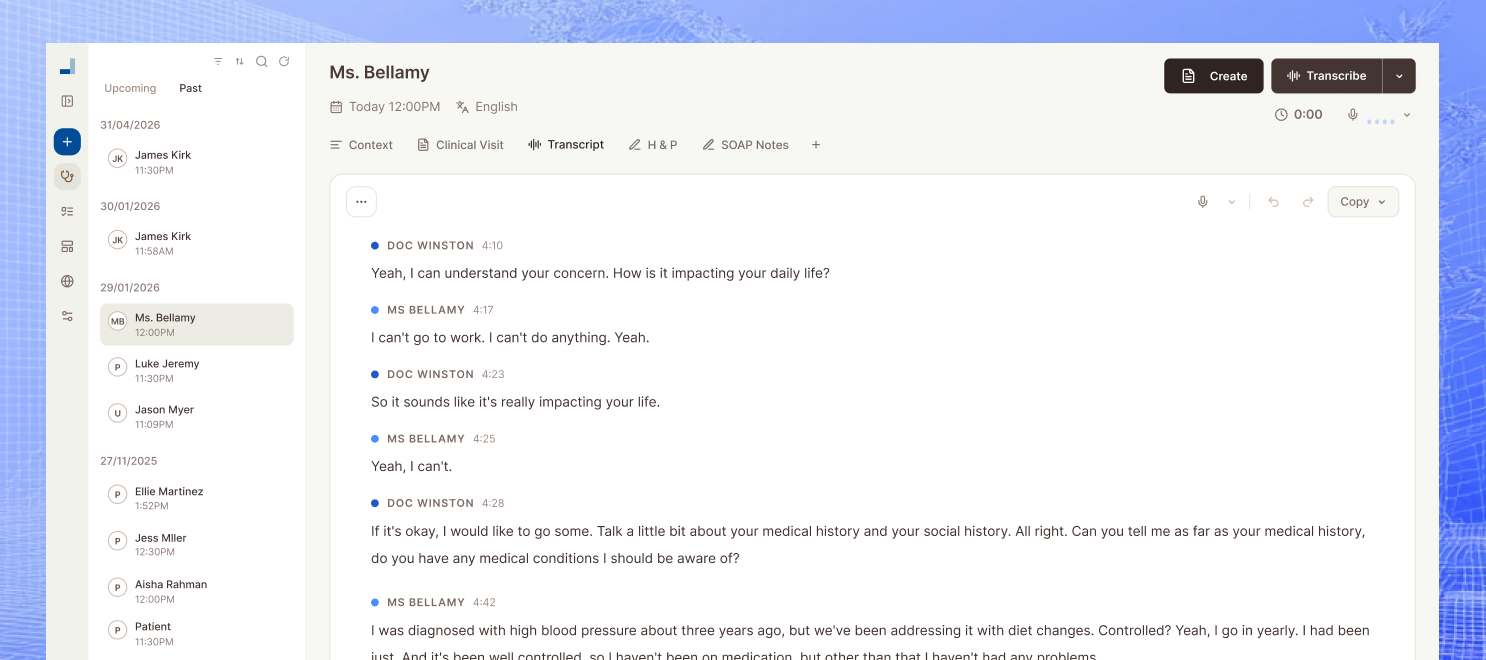
While the SOAP format is a staple of medical education, it is often insufficient for the diverse needs of modern practice. Comprehensive documentation requires various formats depending on the context of the visit. For instance, a new patient intake requires a thorough History and Physical (H&P), while a surgical case needs an detailed procedure note that captures specific technical nuances that a generic template might skip.
Structure matters immensely for continuity of care and audit readiness. A consult note needs to clearly articulate the specialist’s findings and recommendations back to the referring physician, whereas a discharge summary must prioritize clarity for both the patient and the next care provider. By utilizing diverse templates, clinicians ensure that the most relevant information is prominent and that the note meets the specific billing and legal requirements of their specialty.
Using structured outputs beyond SOAP also makes it easier to hand over cases to colleagues. When everyone on a care team follows the same high-quality structural standards, the risk of miscommunication drops significantly. This consistent formatting is also a lifesaver during external audits or when preparing documentation for insurance reimbursement, as it demonstrates a methodical and thorough approach to patient care.
- H&P and Progress Notes: Essential for tracking the evolution of chronic conditions.
- Consultation and Referral Letters: Bridge the gap between primary care and specialty services.
- Procedure Notes: Document technical interventions with high precision and clarity.
- Discharge Summaries: Provide clear instructions and summaries for post-visit care.
How to implement AI medical scribe workflows step-by-step
Transitioning to an automated workflow starts with a focused approach using a single visit type, such as follow-up appointments or routine screenings. By narrowing the scope initially, you can observe how the AI interprets your natural speaking style and specific clinical jargon. This allows you to fine-tune your templates by specialty before scaling the process to more complex consultations.
During the encounter, whether it is in-person or via telehealth, simply capturing the natural conversation provides the best raw data. You don’t need to change how you speak to the patient; the AI is designed to filter out the small talk and focus on the clinical substance. Once the encounter concludes, the draft is ready for a quick review. Instead of writing from scratch, you are simply verifying the work already done.
The final step in a streamlined workflow is the immediate reuse of these outputs. A high-quality progress note can be instantly adapted into a referral letter or a patient summary form. This ‘one-input, multiple-output’ strategy is what truly eliminates the need for copy-pasting. By the time the patient leaves the office, the documentation, the billing codes, and the follow-up letters can essentially be complete.
- Start with one common visit type to build trust in the automated workflow.
- Organize library templates by specialty to ensure specific clinical data is captured.
- Review drafts immediately to maintain high accuracy and reduce end-of-day workload.
- Leverage AI-generated drafts to create secondary documents like forms and letters.
How to keep note quality high and reduce mistakes
Even the most advanced AI can occasionally miss a medication dosage or misinterpret a complex family history if the input is cluttered. Quality control starts with a lightweight review habit. Clinicians should establish a ‘scan and sign’ standard, where they check the problem list and medication sections specifically. Setting these team-wide standards ensuring that every note across the clinic maintains a professional and accurate tone.
To prevent note bloat, avoid templates that include unnecessary ‘filler’ text. Focus on concise descriptors and objective data. If an AI consistently misses a specific type of information, it’s usually a sign that the underlying template needs a slight adjustment. Regular audits of the AI outputs against the original encounter recordings can help identify these trends early and keep the documentation crisp and actionable.
- Implement a ‘scan and sign’ habit focused on medications and specific values.
- Refine templates regularly to avoid ‘note bloat’ and redundant information.
- Train staff on standardizing the input of objective data for better AI interpretation.
Privacy, consent, and patient trust (plain English)
Patient privacy is paramount, and the rules governing consent vary by region. It is essential to follow your local healthcare regulations and clinic policies regarding recording. Generally, transparency is the best policy. When patients understand that the recording is used solely to ensure the doctor can focus on them rather than a keyboard, they are usually very supportive and appreciative of the undivided attention.
A simple script can help: “I’m using a secure digital assistant today to take notes for us. It records our conversation so I can focus entirely on you instead of typing on my computer. The recording is encrypted and is only used to generate your medical record. Is that okay with you?” Most patients find this comforting rather than intrusive. Ensuring that patients know their data is handled with the same security as their other medical records builds long-term trust.
- Always follow local legal requirements and institutional policies regarding recording.
- Use a simple, transparent script to explain the benefits of the technology to patients.
- Maintain clear security and retention protocols to safeguard all captured data.
Rolling it out across a clinic without disruption
A successful rollout involves a two-week pilot program involving one or two early-adopter clinicians. During this phase, you should track specific metrics like time saved per note and the reduction in after-hours charting. This data provides the ‘proof of concept’ needed to gain buy-in from more skeptical staff members. It also allows you to identify any technical hurdles, such as Wi-Fi dead zones in certain exam rooms, before a full-scale launch.
Training should focus on template alignment. When every clinician uses a similar structure, it becomes much easier for administrative staff to handle referrals and billing. By the end of the pilot, you can refine your training materials based on real-world feedback, ensuring that the full rollout is smooth, organized, and provides immediate value to everyone in the clinic.
- Launch a 14-day pilot with power users to identify workflow bottlenecks.
- Identify and track key performance indicators like ‘time to sign’ and time saved.
- Standardize templates across the clinic to ensure consistency in communication.
Mcoy AI is an AI medical scribe that records and transcribes patient encounters, then generates multiple clinical note types (H&P, progress notes, consult notes, follow-up notes, procedure notes, discharge summaries, referral letters, and more). With over 200+ customizable templates and an integrated AI chat to create letters, forms, and documents, it allows clinicians to focus on care rather than the mechanics of documentation. It is designed to fit naturally into the workflow of any private practice or university clinic, ensuring every encounter is documented accurately and efficiently.
Efficiently managing clinical documentation doesn’t have to be a source of stress. By mastering your AI medical scribe workflow, you can eliminate the repetitive tasks that lead to burnout. Start by refining your templates and implementing a structured review process, and you will see immediate improvements in your daily efficiency.
What a serious review table should cover
| Decision area | Common mistake | Better clinic-ready approach | Metric to watch |
|---|---|---|---|
| Workflow design | Treat how to reduce copy-paste ai note structure | mcoy health as a one-off documentation task | Build a repeatable process with clear ownership and review points |
| Team adoption | Assume every clinician will naturally use the same process | Train for consistency and define exception handling early | Active user adoption |
| Quality review | Only check notes when a problem is reported | Audit a sample of notes weekly and review edge cases | Edit rate per note |
| Operational follow-through | Leave admin actions outside the documentation workflow | Use the same encounter data for referrals, letters, and follow-up tasks | Completion rate for next-step tasks |
Related reading
If you are working through how to reduce copy-paste ai note structure | mcoy health, it helps to read this alongside AI & Medicine: How to Simplify Clinical Notes for Busy Doctors, AI & Medicine: How Doctors Can Improve SOAP Notes, and AI & Medicine: How to Use Mcoy AI as Your Medical Scribe [Full Guide]. Those guides cover adjacent workflow, implementation, and evaluation questions so the decision does not sit in isolation.
FAQ
How accurate are AI medical scribes in real clinics?
In most clinical settings, AI medical scribes are exceptionally accurate at capturing the core clinical facts of an encounter. Their ability to distinguish between medical symptoms and casual conversation has improved significantly, though they still require clinician oversight. Accuracy is highest when the clinician speaks clearly and summarizes key findings during the visit.
Do I still need to review every note?
Yes, the clinician is legally and ethically responsible for the accuracy of the medical record. While the AI does the heavy lifting, a brief review is necessary to ensure specific values or nuances are correct. Most clinicians find that reviewing and editing takes a fraction of the time required to write a note from scratch.
What note types can an AI scribe generate besides SOAP?
Advanced AI scribes can generate a wide range of documents including History and Physicals (H&P), procedure notes, consult letters, and discharge summaries. They can also be used to create referral letters and follow-up instructions. This variety ensures that the documentation fits the specific clinical scenario rather than forcing everything into a SOAP format.
Will this work for telehealth and in-person consults?
Yes, most AI scribing solutions are designed to work across multiple platforms. Whether you are using a mobile device for an in-person visit or a web-based interface for a virtual consult, the AI captures the audio and generates the note accordingly. This flexibility is vital for modern clinics that offer hybrid care models.
How do I explain recording/transcription to patients?
The key is to focus on the benefit to the patient. You can explain that by using a digital assistant to record the visit, you can spend our time looking at them rather than the computer screen. Most patients respond positively when they realize it leads to a more attentive and personalized consultation experience.
How do clinics prevent note bloat?
Clinics prevent note bloat by using concise templates and setting clear expectations for what should be included. AI tools can be instructed to summarize specific sections rather than providing a verbatim transcript. Regularly reviewing and refining the templates helps maintain a crisp, professional standard for all clinical documentation.
How long does template setup take?
Initial template setup usually takes about 30 to 60 minutes. Most clinicians start with a few standard templates and then refine them over the first week of use. Once the initial library is established, adjustments take only seconds, allowing for a highly customized documentation experience without a large time investment.
What’s the safest way to start if I’m skeptical?
The safest way to start is with a small pilot program. Choose your most common or straightforward visit type and use the AI for just those encounters for one week. This low-risk approach allows you to see the quality of the output and the time savings firsthand without disrupting your entire practice’s workflow.