Admin Management: Reduce Clinic Admin Work with AI Scribes | Mcoy Health
Learn how to use an AI medical scribe to automate clinical documentation, reduce burnout, and reclaim hours of your time every single day.
The Burden of the Digital Ledger
For many doctors and clinic owners, the end of the patient day is rarely the end of the work day. After-hours charting has become a pervasive source of burnout, stealing hours from personal lives and contributing to cognitive fatigue. Whether you are managing a busy private practice or a high-volume university clinic, the pressure to produce accurate, timely, and medico-legally sound notes often leads to rushed documentation or a backlog of ‘ghost notes’ that haunt your weekends.
This guide provides a comprehensive roadmap for transforming your clinical workflow. We will explore how to transition from traditional manual entry to a high-efficiency model using an AI medical scribe. You will learn about the variety of note formats available beyond the standard SOAP model, how to ensure quality control, and the most effective way to roll out this technology across your entire team without disturbing patient care.
What a medical scribe solves in modern practice
The real cost of documentation isn’t just the time spent typing; it is the secondary cognitive load that distracts a clinician from the human being sitting across from them. When a doctor is focused on capturing every word of a patient’s history in real-time, they often miss subtle non-verbal cues. An AI medical scribe acts as a cognitive bridge, handling the heavy lifting of data capture so the practitioner can return to the art of medicine.
It is important to understand that these tools are assistive, not autonomous. An AI scribe listens, organizes, and drafts, but the final clinical responsibility always rests with the human provider. By automating the transcription and initial drafting process, clinics can virtually eliminate the ‘pajama time’ spent on EHR entries, ensuring that notes are completed immediately after the encounter while the details are still fresh in the mind.
- Reclaims up to 2-3 hours of administrative time per day.
- Reduces cognitive load and allows for better eye contact with patients.
- Ensures clinical notes are consistently detailed and evidence-based.
- Acts as an assistant that drafts documentation for clinician review.
Note types you can generate beyond SOAP (H&P and more)
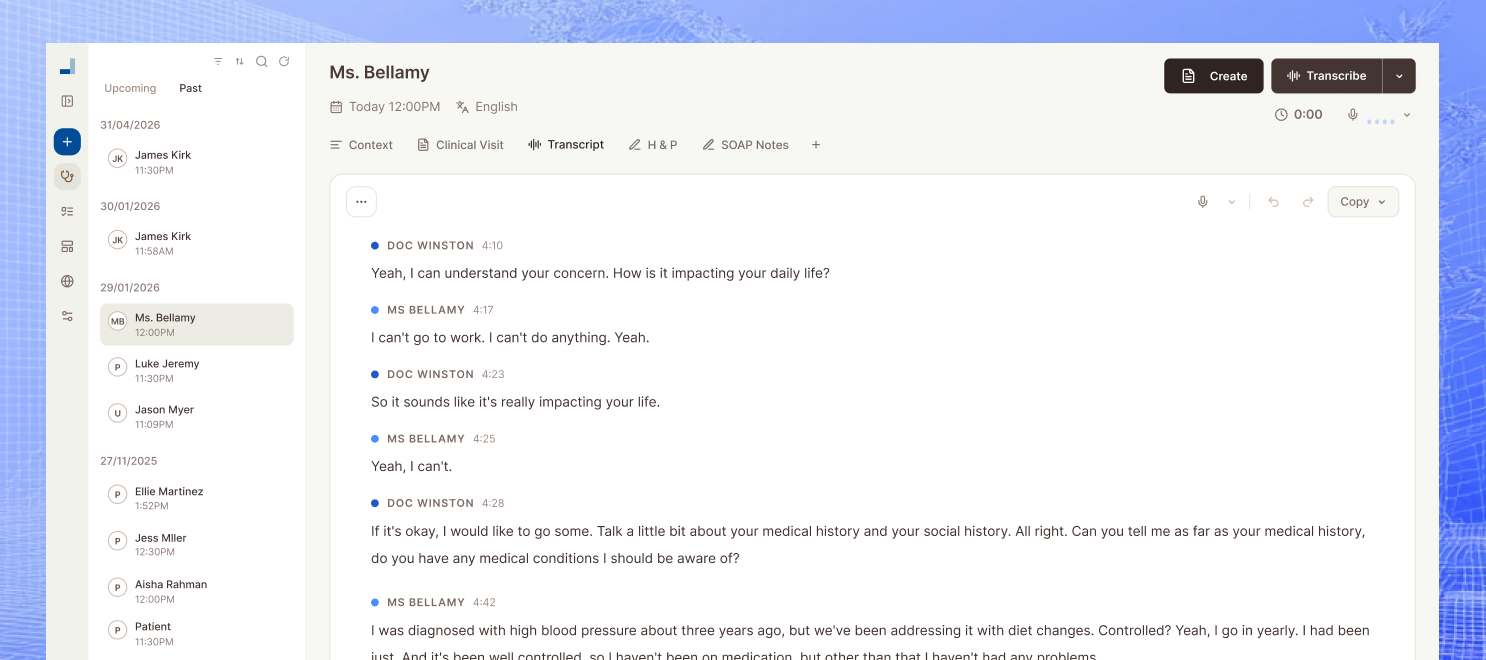
While the SOAP note is the industry standard, modern medicine requires a much broader range of documentation. From History and Physical (H&P) reports for new admissions to complex procedure notes, the structure of your documentation dictates the quality of the patient’s longitudinal record. High-quality documentation is the backbone of continuity of care, ensuring that the next provider in the chain of care has a clear, actionable picture of the case.
Using advanced AI, clinics can now instantly generate consult notes, follow-up summaries, and even referral letters based on the same encounter data. This versatility is crucial for specialty clinics that require specific data points often omitted in a generic SOAP template. By using structured formats, you also improve audit readiness and ensure that billing codes are supported by clear, comprehensive clinical narratives.
- H&P and Progress Notes: Essential for tracking patient evolution and admissions.
- Procedure and Consult Notes: Detailed records of interventions and specialist advice.
- Referral Letters: Automatically generated summaries to bridge care gaps.
- Discharge and Follow-up: Clear instructions for patients and primary care teams.
How to implement Mcoy AI step-by-step in a real clinic
Successfully integrating an AI medical scribe begins with a narrow focus rather than a total overhaul. Start by selecting one specific visit type—perhaps routine follow-ups or standard physical exams—to get a feel for how the AI mirrors your natural speech and clinical logic. During these initial sessions, you may find that you narrate your physical exam findings slightly more clearly, which helps the AI capture objective data with higher precision.
Next, take advantage of specialty-specific templates. A pediatrician’s note looks very different from a surgeon’s consult; ensuring your AI tool is calibrated for your specific jargon and documentation style is key to a smooth transition. Once the encounter is captured, the review process becomes a matter of skimming for accuracy rather than typing from scratch. You can quickly edit any discrepancies and approve the note in a fraction of the time it used to take.
The final step in the workflow is the reuse of data. Once a note is generated, the same information can be repurposed for patient instructions or referral letters. This ‘enter once, use many’ approach is the secret to drastic admin reduction. As you become more comfortable, you can expand the use to all visit types, including complex telehealth consultations and multisystem evaluations.
- Start small with a single visit type to build trust in the system.
- Utilize specialty templates to ensure relevant clinical data is prioritized.
- Review and edit drafts immediately to maintain high momentum.
- Leverage AI outputs to create patient summaries and outbound letters.
How to keep note quality high and reduce mistakes
While AI is remarkably accurate, failure points such as incorrect medication dosages or misidentified’right vs left’ can still occur. To maintain high standards, clinicians should develop a lightweight review habit—a ‘30-second scan’—of every generated note. Establishing team-wide standards for what must be included in the ‘Assessment and Plan’ section ensures that the AI’s output aligns with your practice’s specific protocols.
- Perform a quick accuracy check on medications and lateralities.
- Standardize templates across the practice for consistency in reporting.
- Focus on the Assessment and Plan as the core of the clinical review.
Privacy, consent, and patient trust
Introducing a recording device into the exam room requires transparency. Most patients are supportive once they realize the technology allows their doctor to focus on them rather than a screen. A simple approach is to say: ‘I use a secure AI assistant to help me take notes today so I can focus entirely on you. It transcribes our conversation into my clinical record, and then the recording is deleted. Is that okay with you?’
- Always obtain verbal or written consent based on local regulations.
- Explain the benefit to the patient: more eye contact and better care.
- Ensure your technology partner follows strict security and retention laws.
Rolling it out across a clinic without disruption
A phased rollout is the most effective way to avoid administrative friction. Start with a 2-week pilot involving one or two ‘tech-forward’ clinicians. During this phase, track metrics such as time saved per note and the reduction in after-hours work. Once the pilot group has refined the templates and workflow, they can act as internal champions to train the rest of the staff, ensuring a smooth transition for the whole organization.
- Launch a 14-day pilot to identify workflow bottlenecks early.
- Track time savings to demonstrate value to stakeholders.
- Align templates across the team to ensure uniform documentation.
Mcoy AI is an AI medical scribe that records and transcribes patient encounters, then generates multiple clinical note types (H&P, progress notes, consult notes, follow-up notes, procedure notes, discharge summaries, referral letters, and more). It features 200+ customizable templates and an integrated AI chat that helps you create letters, forms, and other documents instantly, allowing you to spend more time with patients and less time on administrative tasks.
Conclusion
Adopting a modern clinical workflow is no longer just a luxury; it is a necessity for professional longevity. By following this guide, you can successfully implement an AI medical scribe to manage your documentation burden. When you reduce admin work in clinics using Mcoy AI, you aren’t just saving time—you are restoring the human connection that lies at the heart of medicine. Start your pilot program today and see how much time you can reclaim for yourself and your patients.
What a serious review table should cover
| Decision area | Common mistake | Better clinic-ready approach | Metric to watch |
|---|---|---|---|
| Workflow design | Treat reduce clinic admin work with ai scribes | mcoy health as a one-off documentation task | Build a repeatable process with clear ownership and review points |
| Team adoption | Assume every clinician will naturally use the same process | Train for consistency and define exception handling early | Active user adoption |
| Quality review | Only check notes when a problem is reported | Audit a sample of notes weekly and review edge cases | Edit rate per note |
| Operational follow-through | Leave admin actions outside the documentation workflow | Use the same encounter data for referrals, letters, and follow-up tasks | Completion rate for next-step tasks |
Related reading
If you are working through reduce clinic admin work with ai scribes | mcoy health, it helps to read this alongside Admin Management: How to Reduce Admin Errors in Clinical Notes, Admin Management: Medication List Template with Examples, and Specialty Guides: Build a Template-First Documentation System: A Full Guide. Those guides cover adjacent workflow, implementation, and evaluation questions so the decision does not sit in isolation.
FAQ
How accurate are AI medical scribes in real clinics?
AI medical scribes currently achieve very high accuracy, often capturing nuances that manual typing might miss. However, the accuracy depends on the clarity of the audio and the complexity of the medical jargon used. Most clinicians find that the drafts require only minor adjustments to be perfectly accurate for the final record.
Do I still need to review every note?
Yes, as a licensed clinician, the legal and ethical responsibility for the medical record remains yours. The AI provides a comprehensive draft, but you must review it to ensure clinical accuracy and sign off on the findings. Think of it as having a highly efficient junior resident drafting your notes.
What note types can an AI scribe generate besides SOAP?
Beyond standard SOAP notes, AI scribes can generate History and Physicals, Consult Notes, Procedure Notes, and Discharge Summaries. They can also create referral letters and follow-up instructions for patients. The flexibility of the tool allows it to adapt to almost any clinical documentation requirement.
Will this work for telehealth and in-person consults?
Absolutely. Most AI scribing tools are designed to capture audio from a variety of sources, including direct spoken conversation in an exam room or audio from a computer during a telehealth session. This makes it a versatile solution for multi-modal practices.
How do I explain recording/transcription to patients?
The best approach is total transparency. Explain that the tool is a secure assistant that helps you stay present with them rather than typing into a computer. Most patients value the extra attention and are happy to consent when they understand it improves the quality of their care.
How do clinics prevent note bloat?
Note bloat is prevented by using customizable templates that instruct the AI to be concise and focused on relevant clinical data. Clinicians can set preferences for how much detail they want in the history of present illness or physical exam sections to keep notes readable and professional.
How long does template setup take?
Basic template setup can take as little as a few minutes per clinician. You can often start with pre-built specialty templates and then tweak them over your first few days of use to match your specific way of speaking and documenting.
What’s the safest way to start if I’m skeptical?
The safest approach is to run a small pilot with non-complex cases, such as routine check-ups. This allows you to witness the technology’s capability in a low-stakes environment. Once you see the time savings and accuracy firsthand, you can gradually expand its use to more complex encounters.