Specialty Guides: Patient Consent for Recording Consultations: A Full Guide
Learn how to obtain patient consent for recording consultations effectively. Improve medical documentation while maintaining trust and legal compliance.
For many clinicians, the end of the patient day doesn’t signal rest; it marks the beginning of several hours of grueling documentation. Whether it’s the anxiety of missing a critical detail from a complex consultation or the physical fatigue of back-to-back typing, after-hours charting has become a primary driver of physician burnout. Traditional note-taking often results in rushed, inconsistent records that may not fully capture the clinical nuance required for complex cases or medicolegal protection.
This guide provides a comprehensive framework for navigating the transition to recorded encounters. We will explore how to establish a workflow that respects patient privacy, how to choose the right documentation formats beyond the standard SOAP note, and how to maintain rigorous quality control. From general practitioners to university clinic directors, understanding how to obtain patient consent for recording consultations is the first step toward a more sustainable and accurate practice environment.
What a medical scribe solves in modern practice
The true cost of manual documentation extends far beyond the time spent typing. It encompasses the heavy cognitive load of trying to remember specific patient phrases while simultaneously making a diagnosis. When clinicians are distracted by a screen, the therapeutic alliance suffers, and subtle non-verbal cues from the patient can be missed. Delayed notes also pose a risk to patient safety, as details can become blurred or forgotten by the time the clinician finally sits down to document the encounter at 8:00 PM.
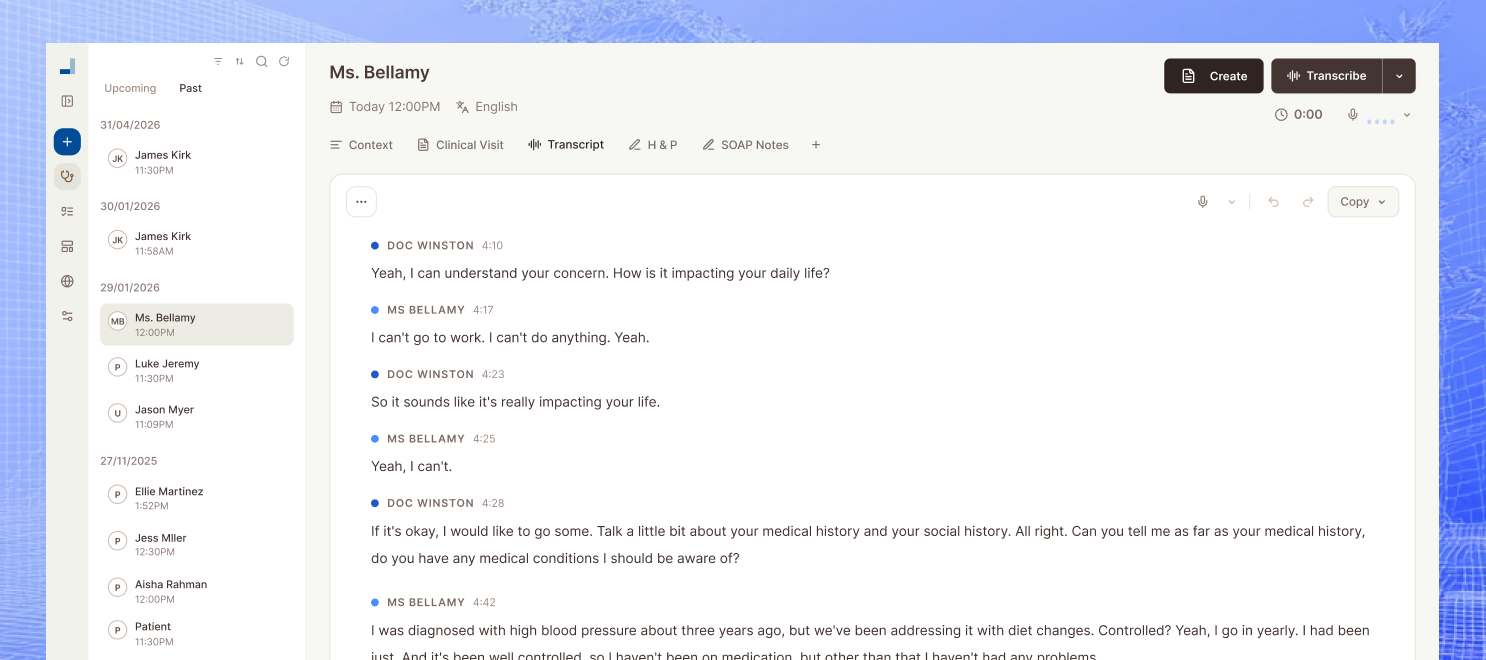
A modern AI medical scribe acts as an assistive layer, capturing the conversation in real-time so the clinician can focus entirely on the person sitting across from them. It is important to remember that these tools are supportive, not autonomous; the clinician remains the final authority and must review and verify all outputs. By offloading the transcription and initial drafting, practitioners can ensure that notes are completed immediately after the visit, while the clinical context is fresh.
- Reduces cognitive load by allowing clinicians to focus on eye contact and active listening.
- Eliminates the ‘pajama time’ spent on finishing clinical notes after hours.
- Ensures higher accuracy by capturing the specific dialogue and patient concerns directly.
- Provides a structured draft that only requires a quick final review for clinical accuracy.
Note types you can generate beyond SOAP (H&P and more)
While the SOAP note is a staple of medical education, modern practice often requires a more diverse range of documentation styles. High-quality care relies on specific formats for different scenarios, such as the comprehensive History and Physical (H&P) for new admissions or complex consultations. Using the right structure ensures that follow-up care is seamless and that any future clinician reading the file can quickly grasp the patient’s trajectory without digging through irrelevant data.
Beyond the basics, clinics frequently need procedure notes, follow-up assessments, and discharge summaries that adhere to specific institutional or insurance standards. For university clinics and specialists, consult notes and referral letters are vital for maintaining the continuity of care between primary providers and specialty teams. Having a system that can automatically adapt the captured dialogue into these various formats saves hours of manual re-formatting and ensures audit readiness.
- H&P and Consult Notes: Essential for deep-dive assessments and new patient intakes.
- Procedure and Discharge Summaries: Standardized records for interventions and transitions of care.
- Referral Letters: Professional communication generated directly from the encounter data.
- Follow-up Notes: Concise updates focusing on progress and changes in treatment plans.
How to implement patient consent for recording consultations step-by-step
Starting with recorded consultations should not be a massive overhaul. Begin by selecting one specific visit type, such as routine follow-ups, to test your process. This allows your team to get comfortable with the technology and the conversation around consent without the pressure of a high-acuity crisis. Once the workflow feels natural, you can gradually expand to more complex new-patient intakes or specialized procedures.
Set up your documentation templates by specialty before you start. Whether you are in pediatrics or orthopedics, having your AI configured to recognize the specific language of your field ensures the first draft is highly relevant. During the encounter, whether in-person or via telehealth, simply inform the patient that you are using a tool to help you stay focused on them rather than the computer screen. Most patients value the increased eye contact and attention.
After the encounter, the captured dialogue is processed into the clinical note of your choice. Take two minutes to review the output for accuracy, modify any nuances, and sign off. Because the AI captures the nuances of the conversation, you can also leverage the output to automatically generate referral letters or patient instruction forms, essentially performing five tasks with the effort of one. This streamlined approach makes learning how to obtain patient consent for recording consultations a high-ROI activity for any clinic.
- Phase in recording with low-complexity visits to build team confidence.
- Use specialty-specific templates to maximize the relevance of the initial draft.
- Explain the tool to patients as a way to improve the quality of the face-to-face time.
- Review, edit, and repurpose the draft for letters and forms to maximize efficiency.
How to keep note quality high and reduce mistakes
Even with advanced technology, clinical documentation requires a human touch to avoid common pitfalls like ‘note bloat’ or the inclusion of irrelevant data. One failure point in automated systems can be the carry-over of outdated problem lists or the misinterpretation of specific laboratory values if they weren’t discussed clearly. Maintaining a lightweight review habit—spending 60 to 90 seconds per note—is the best way to ensure the final record is precise and professional.
- Establish a standard ‘review checklist’ for the team to catch discrepancies.
- Keep the dictation or conversation focused to avoid unnecessary ‘bloat’ in the note.
- Regularly update your templates to reflect changing clinical standards or audit requirements.
Privacy, consent, and patient trust (plain English)
Patient trust is built on transparency. While specific consent laws vary by state or country, the general principle is to ensure the patient knows they are being recorded for documentation purposes and how that data is handled. Most patients are supportive when they understand that the recording leads to better care and a doctor who isn’t staring at a keyboard for the entire visit.
A simple way to phrase this is: ‘I’m using a secure digital assistant today to record our conversation so I can give you my full attention instead of typing. It helps me make sure your chart is perfectly accurate. Is that okay with you?’ This puts the focus on the benefit to the patient. Always ensure your clinic’s privacy policy is updated to reflect these digital tools and that all data is stored according to local security standards.
- Use clear, benefit-driven language when asking for verbal or written consent.
- Maintain a record of consent according to your local regional requirements.
- Ensure the technology used adheres to high-level encryption and data security protocols.
Rolling it out across a clinic without disruption
To successfully roll out this technology across a multi-provider practice or university clinic, a structured two-week pilot is recommended. Assign a ‘champion’—a clinician who is tech-savvy—to lead the transition. During this time, track key metrics such as the time spent on notes after 5:00 PM and the level of detail captured in complex consults. This data helps prove the value to skeptical staff members.
- Run a 14-day pilot with a small group of providers to refine the workflow.
- Monitor ‘time-to-completion’ for clinical notes as a primary success metric.
- Hold a weekly check-in to align on template preferences and best practices.
Mcoy AI is an AI medical scribe that records and transcribes patient encounters, then generates multiple clinical note types including H&P, progress notes, consult notes, follow-up notes, procedure notes, discharge summaries, referral letters, and more. With over 200 customizable templates and an interactive AI chat, it allows clinicians to create professional letters, forms, and secondary documents instantly. This tool is designed to integrate seamlessly into a doctor’s workflow, helping to reduce administrative burden while ensuring high-quality, accurate clinical documentation.
Transitioning to a modern documentation workflow is a journey that begins with a simple shift in communication. By learning how to obtain patient consent for recording consultations, you unlock a more efficient way of practicing medicine where the focus remains on the patient, not the paperwork. Start your pilot today and experience how streamlined charting can revitalize your clinical practice.
What a serious review table should cover
| Decision area | Common mistake | Better clinic-ready approach | Metric to watch |
|---|---|---|---|
| Workflow design | Treat patient consent for recording consultations: a full guide as a one-off documentation task | Build a repeatable process with clear ownership and review points | Time to complete documentation |
| Team adoption | Assume every clinician will naturally use the same process | Train for consistency and define exception handling early | Active user adoption |
| Quality review | Only check notes when a problem is reported | Audit a sample of notes weekly and review edge cases | Edit rate per note |
| Operational follow-through | Leave admin actions outside the documentation workflow | Use the same encounter data for referrals, letters, and follow-up tasks | Completion rate for next-step tasks |
Related reading
If you are working through patient consent for recording consultations: a full guide, it helps to read this alongside Specialty Guides: How to Run a More Efficient Medical Practice in 2026, Specialty Guides: How to Improve Patient Encounters, and Specialty Guides: How to Use an AI Scribe for ENT Consult Notes | Guide. Those guides cover adjacent workflow, implementation, and evaluation questions so the decision does not sit in isolation.
FAQ
How accurate are AI medical scribes in real clinics?
AI medical scribes are highly accurate at capturing the dialogue of a clinical encounter, often picking up details that a tired clinician might miss. However, they are designed as assistive tools rather than autonomous replacements for medical judgment. Accuracy depends on clear communication during the visit, and the output should always be reviewed by the provider.
Do I still need to review every note?
Yes, reviewing every note is a fundamental requirement for clinical safety and legal compliance. While the AI generates the heavy lifting of the draft, the clinician is the only one who can verify the medical intent and the accuracy of the findings. Most clinicians find that this review takes less than two minutes compared to twenty minutes of manual typing.
What note types can an AI scribe generate besides SOAP?
Modern AI scribes are capable of generating a wide array of documentation beyond just SOAP notes. This includes comprehensive H&P (History and Physical) reports, specialist consult notes, procedure descriptions, and discharge summaries. They can also use the captured data to draft referral letters and patient instruction sheets.
Will this work for telehealth and in-person consults?
Yes, AI scribes are generally designed to work across multiple platforms, including in-person exam rooms and remote telehealth sessions. As long as the audio can be captured via a microphone, the AI can process the conversation into a structured clinical note. This flexibility is essential for modern hybrid practices.
How do I explain recording/transcription to patients?
The best approach is to be direct and highlight the benefit to the patient’s care. You might say, ‘I use an AI assistant to take notes so I can focus 100% on you rather than my computer screen.’ Most patients appreciate the extra attention and are happy to consent when they see the doctor is more engaged.
How do clinics prevent note bloat?
Clinics prevent note bloat by using concise, specialty-specific templates and setting clear standards for what should be included. Providers should also be mindful of their verbal summaries at the end of a visit, as the AI uses this summary to refine the most important points of the clinical plan.
How long does template setup take?
Setting up basic templates usually takes less than an hour, especially if the system comes with pre-built options for your specialty. Fine-tuning these templates to your specific ‘voice’ or clinic requirements may take a few days of use as you observe the initial outputs and adjust your preferences.
What’s the safest way to start if I’m skeptical?
The safest way to start is with a ‘shadow’ trial on a few low-stakes follow-up appointments. Record the encounter alongside your usual note-taking method and compare the results. Once you see the accuracy and time saved, you can gradually transition to full implementation with confidence.