Practice Operations: Measure ROI of an AI Medical Scribe: The Complete Guide
Learn how to measure ROI of an AI medical scribe. Discover metrics for time savings, revenue growth, and staff burnout for your private or university clinic.
The Hidden Costs of Traditional Medical Documentation
For most clinicians, the workday doesn’t end when the last patient leaves. Instead, it transitions into a second shift of documentation that often stretches late into the night. This ‘pajama time’ is more than just a nuisance; it is a primary driver of professional burnout, leading to rushed notes, clerical errors, and a constant sense of medico-legal anxiety. Whether you are running a solo private practice or managing a busy university clinic, the administrative burden of charting has likely become a significant bottleneck in your operations.
This guide provides a comprehensive framework to transition from manual charting to an automated workflow. We will explore how to measure ROI of an AI medical scribe by looking beyond simple time savings to include note quality, patient satisfaction, and financial sustainability. You will learn about various note formats, privacy protocols, and a step-by-step rollout plan designed to modernize your clinic without disrupting care delivery.
What a medical scribe solves in modern practice
The real cost of documentation is measured in cognitive load. Every minute spent typing is a minute taken away from active listening or clinical reasoning. When doctors are forced to multitask—balancing patient interaction with data entry—the risk of missing subtle clinical cues increases. An AI medical scribe acts as an assistive layer, capturing the conversation in real-time so the clinician can focus entirely on the person sitting across from them.
It is important to understand that these tools are assistive, not autonomous. While they significantly reduce the manual labor of drafting a note, the clinician remains the final authority and must review and sign off on all documentation. By automating the heavy lifting of transcription and summarization, clinics can significantly reduce delayed notes and ensure that the digital record accurately reflects the human encounter.
- Eliminates ‘pajama time’ by completing notes during or immediately after the visit.
- Reduces cognitive fatigue, allowing for better clinical decision-making.
- Ensures more detailed and accurate patient records through real-time capture.
- Allows clinicians to maintain eye contact, improving the patient-provider bond.
Note types you can generate beyond SOAP (H&P and more)
While the SOAP note is the industry standard, modern medicine requires a much broader range of documentation types to ensure continuity of care. Using an AI scribe allows practitioners to quickly generate complex documents like History & Physical (H&P) reports, which are essential for hospital admissions and preoperative assessments. These notes require a structured narrative that captures the patient’s entire medical trajectory, not just a single complaint.
Furthermore, specialty practices often require specific outputs such as procedure notes, discharge summaries, and formal referral letters. In a university setting, where documentation is frequently audited for research or educational purposes, having a consistent and structured format is vital. Automated systems can adapt to these needs, ensuring that handovers are seamless and that the practice is always audit-ready.
- H&P and Consult Notes: Comprehensive overviews for new patients or specialist referrals.
- Procedure and Follow-up Notes: Detailed records of interventions and longitudinal care.
- Discharge Summaries: Clear, concise instructions and summaries for transitions of care.
- Referral Letters: Professional correspondence generated automatically from the encounter.
How to implement measure ROI of an AI medical scribe step-by-step in a real clinic
To accurately measure ROI of an AI medical scribe, start by introducing the technology to a single visit type, such as routine follow-ups. This allows the staff to get comfortable with the recording process without the pressure of complex new-patient intakes. During this initial phase, establish a baseline for how long manual charting takes versus the automated process.
Next, configure your templates according to your specialty. Whether you are in orthopedics, psychiatry, or general practice, the way you want information presented will vary. Once the templates are set, begin capturing encounters during both in-person and telehealth visits. The fluidity of the AI allows it to work across different settings, ensuring no data is lost regardless of where the care happens.
After the encounter, the clinician should move into a rapid review and edit phase. Instead of writing from scratch, you are now an editor, which is significantly faster. Finally, use the generated outputs to fill out necessary forms or referral letters immediately. This closed-loop system ensures that the ROI is felt not just in time saved, but in the speed of administrative completion.
- Start small with one visit type to establish a measurable time baseline.
- Customize templates to match the specific documentation needs of your specialty.
- Review and edit AI-generated drafts immediately to maintain high clinical accuracy.
- Leverage outputs for secondary tasks like letters and insurance authorizations.
How to keep note quality high and reduce mistakes
The primary failure points in medical documentation—such as missing medications, incorrect lab values, or ‘note bloat’—often stem from human error due to fatigue. While AI helps mitigate this, it can occasionally include irrelevant conversational fillers. To maintain high standards, clinics should implement a lightweight review habit where clinicians verify the problem list and plan against their own clinical judgment.
Creating team-wide standards for what a ‘good note’ looks like in your practice will help the AI learn your preferences over time. By focusing on concise, high-value information rather than sheer volume, you ensure that the documentation remains useful for other providers and insurance payers alike.
- Perform a 60-second rapid review of every AI-generated note before signing.
- Focus on the ‘Assessment and Plan’ sections to ensure clinical intent is clear.
- Avoid note bloat by selecting templates that prioritize high-impact data.
- Standardize documentation preferences across the clinic for consistent quality.
Privacy, consent, and patient trust
Privacy is the cornerstone of the patient-provider relationship. While AI scribes are designed to be secure, clinicians must stay informed about local regulations regarding recording and data storage. Generally, patients are receptive to the technology when it is explained as a tool that allows the doctor to listen better rather than staring at a computer screen.
A simple script can ease any concerns: ‘To make sure I’m giving you my full attention, I’m using an AI assistant to help me with my notes today. It records our conversation so I don’t have to type while we talk. Is that okay with you?’ Most patients appreciate the transparency and the improved eye contact that follows.
- Always obtain verbal consent before starting a recording during a consult.
- Explain the technology as a way to prioritize the patient over the computer.
- Ensure the chosen platform adheres to HIPAA or local equivalent standards.
- Develop a clear internal policy for data retention and patient opt-outs.
Rolling it out across a clinic without disruption
A successful rollout requires a structured pilot plan, typically spanning two weeks. During the first week, focus on technical setup and template alignment. In the second week, begin tracking metrics such as hours saved per week and the reduction in after-hours work. This data is essential for proving the clinical and financial value of the tool to stakeholders or practice owners.
Training should be focused on the transition from ‘writer’ to ‘editor.’ Once the core team is comfortable, the workflow can be scaled to other providers. Standardizing templates across the clinic ensures that no matter which doctor a patient sees, the documentation quality remains uniform and professional.
- Run a 14-day pilot to gather data on time savings and staff sentiment.
- Monitor the reduction in ‘pajama time’ as a primary indicator of ROI.
- Ensure all clinicians are trained on editing workflows to maximize efficiency.
- Align templates across the organization to standardize care documentation.
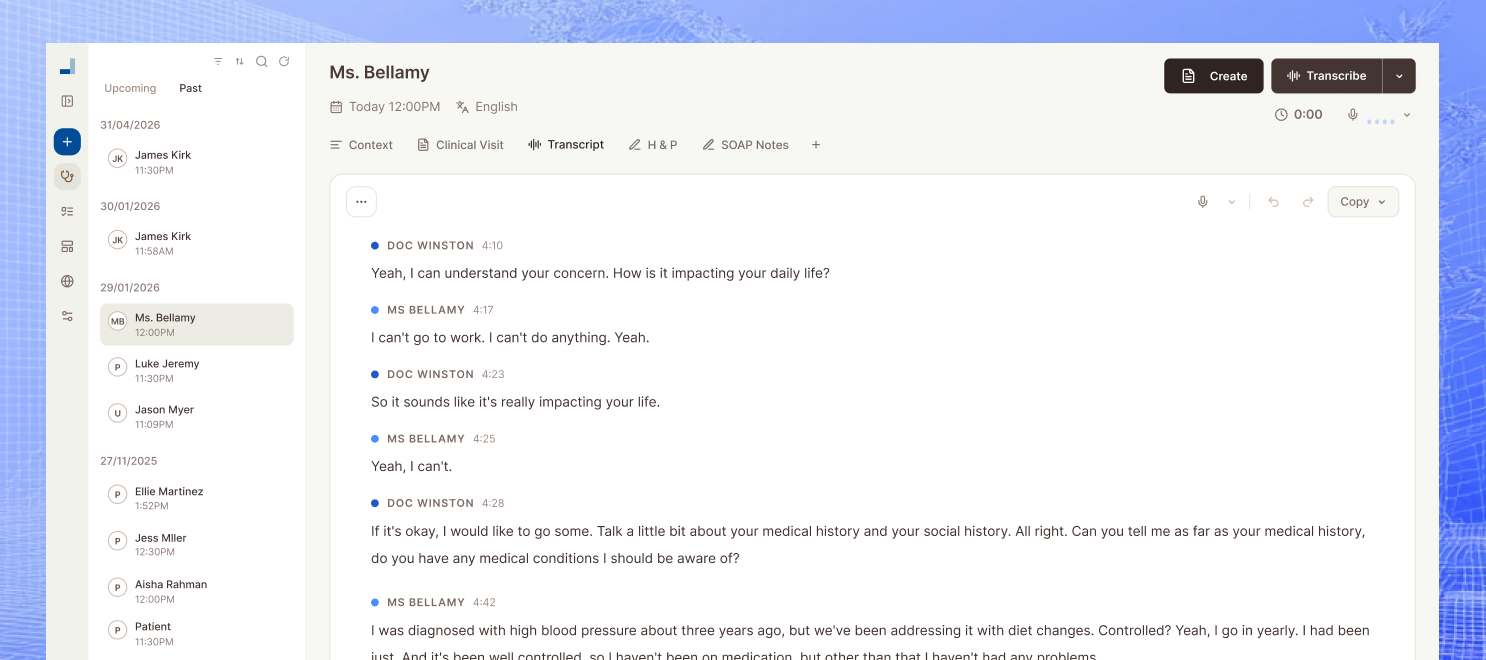
Mcoy AI is an AI medical scribe that records and transcribes patient encounters, then generates multiple clinical note types (H&P, progress notes, consult notes, follow-up notes, procedure notes, discharge summaries, referral letters, and more). With over 200+ customizable templates and an interactive AI chat, clinicians can easily create letters, forms, and complex documents tailored to their specific needs, reducing the administrative load and returning the focus to patient care.
Conclusion
Mastering the modern clinical workflow requires a shift toward automation that respects the complexity of medicine. By understanding how to measure ROI of an AI medical scribe, you can transform your practice from a place of administrative burnout to one of clinical excellence. The journey starts with a simple pilot and a commitment to quality documentation. Take the first step toward reclaiming your time and improving patient outcomes today.
What a serious review table should cover
| Decision area | Common mistake | Better clinic-ready approach | Metric to watch |
|---|---|---|---|
| Workflow design | Treat measure roi of an ai medical scribe: the complete guide as a one-off documentation task | Build a repeatable process with clear ownership and review points | Time to complete documentation |
| Team adoption | Assume every clinician will naturally use the same process | Train for consistency and define exception handling early | Active user adoption |
| Quality review | Only check notes when a problem is reported | Audit a sample of notes weekly and review edge cases | Edit rate per note |
| Operational follow-through | Leave admin actions outside the documentation workflow | Use the same encounter data for referrals, letters, and follow-up tasks | Completion rate for next-step tasks |
Related reading
If you are working through measure roi of an ai medical scribe: the complete guide, it helps to read this alongside Practice Operations: How Clinics Can Streamline Daily Operations, Practice Operations: How Clinics Can Improve Workflow Without Changing Their EHR, and Specialty Guides: How to Use an AI Scribe for Orthopedics Notes: Full Guide. Those guides cover adjacent workflow, implementation, and evaluation questions so the decision does not sit in isolation.
FAQ
How accurate are AI medical scribes in real clinics?
AI medical scribes are highly accurate in capturing the nuances of clinical dialogue, often outperforming manual human transcription in speed. However, they are designed as assistive tools, meaning they capture the raw data which the clinician then refines. Accuracies typically exceed 95% for standard medical terminology, but nuance is always added by the physician’s review. Most clinics find that the summaries are remarkably faithful to the actual encounter.
Do I still need to review every note?
Yes, clinical responsibility always rests with the licensed provider. While the AI does the heavy lifting of drafting the note, you should spend a minute or two reviewing the output for accuracy and clinical intent. This ensures that the final record is a true representation of your medical judgment. The review process is still significantly faster than writing a note from scratch.
What note types can an AI scribe generate besides SOAP?
Beyond the standard SOAP format, advanced AI scribes can generate History & Physicals (H&P), detailed consult notes, and specialty-specific procedure notes. They can also create discharge summaries and referral letters by synthesizing the encounter data. This versatility makes them useful for everything from primary care to complex surgical specialties. Having multiple formats ensures you have the right document for every clinical scenario.
Will this work for telehealth and in-person consults?
Most AI medical scribes are platform-agnostic, meaning they can record audio through a smartphone, tablet, or web browser. This makes them equally effective for in-person exams and virtual telehealth appointments. For telehealth, the AI typically captures the audio stream from the computer, while for in-person visits, it uses the device’s microphone. This flexibility allows for a consistent documentation workflow across all patient touchpoints.
How do I explain recording/transcription to patients?
The best approach is to be direct and highlight the benefit to the patient. You might say, ‘I’m using a digital scribe so I can look at you instead of my keyboard.’ Most patients respond positively when they realize the technology allows for a more personal and engaged consultation. Once they see you are more present during the visit, any initial hesitation usually disappears.
How do clinics prevent note bloat?
Note bloat is prevented by using concise templates that prompt the AI to focus on relevant clinical information rather than transcribing every ‘um’ and ‘ah.’ Clinicians can also set preferences for how much detail they want in various sections of the note. By choosing templates that mirror the necessary billing and clinical requirements, the AI produces structured, professional summaries. Regular template audits within the clinic also help maintain brevity.
How long does template setup take?
Initial setup for basic templates is often immediate, as many tools come pre-loaded with industry standards. Customizing these to your specific specialty or personal style usually takes about 15 to 30 minutes of tweaking. Because the AI learns from your edits, the templates actually become more ‘yours’ over time without significant manual effort. It is a one-time investment that saves hours every week.
What’s the safest way to start if I’m skeptical?
The safest way to start is with a ‘shadow’ pilot on 5-10 patients where you don’t rely on the AI for your primary record. Use it alongside your current method to compare the quality and find where it saves you time. This low-pressure environment allows you to build trust in the technology and refine your workflow. Once you see the accuracy and time savings firsthand, you can comfortably transition to using it as your primary drafting tool.