AI & Medicine: How to Improve Transcription Accuracy in Consultations
Learn how to improve transcription accuracy in real consultations. Our guide covers AI scribe workflows, note quality, and clinic implementation steps.
The Hidden Burden of Clinical Documentation
For many healthcare providers, the most exhausting part of the day isn’t the patient care itself, but the hours of charting that follow. After-hours charting has become a primary driver of clinician burnout, leading to rushed notes and a constant state of medico-legal anxiety. When clinicians are forced to document from memory hours after a visit, the risk of omission or inaccuracy increases significantly, impacting both care quality and practice revenue.
This guide provides a comprehensive roadmap for providers—from general practitioners and specialists to those managing university clinics—on how to improve transcription accuracy in real consultations. We will explore more than just basic SOAP notes, diving into specialized formats, quality control protocols, and the practical steps needed to roll out an automated documentation workflow without disrupting patient care.
What a medical scribe solves in modern practice
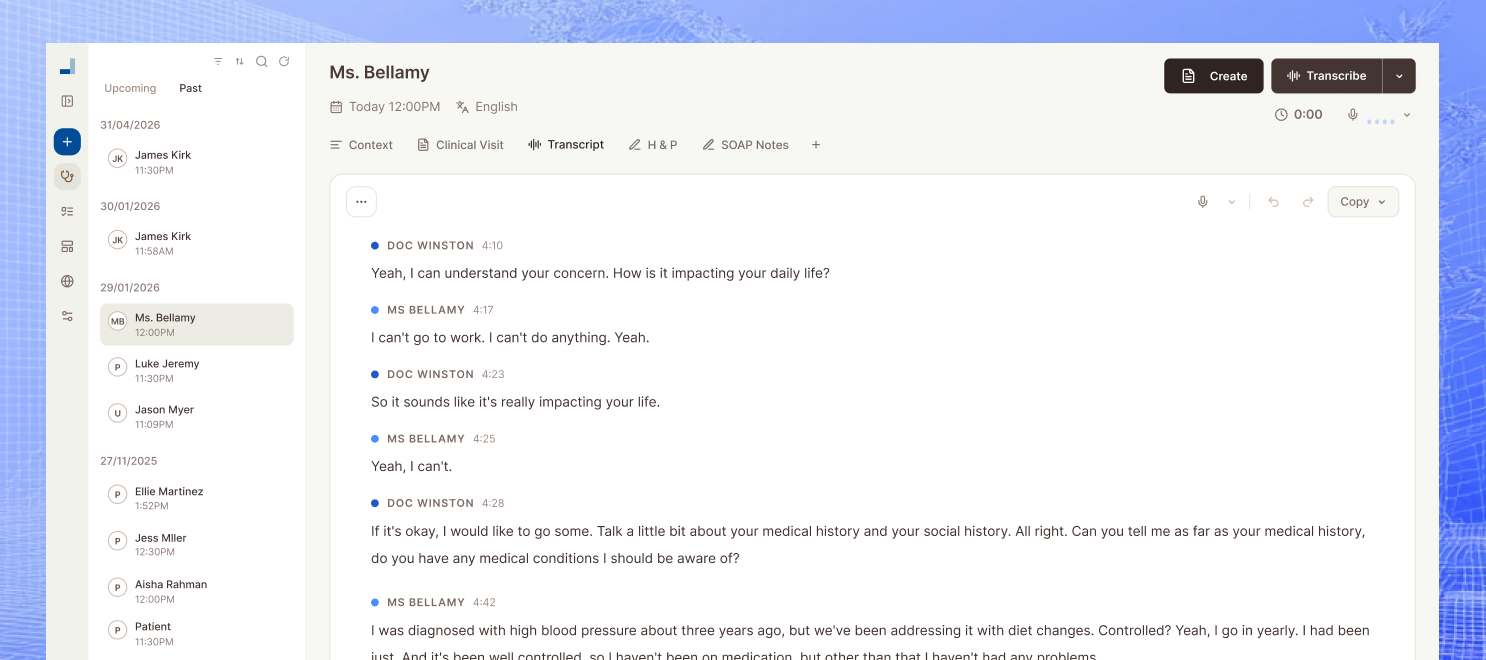
The real cost of documentation is measured in cognitive load and time. When a doctor has to split their attention between a screen and a patient, the quality of both the interaction and the subsequent note can suffer. Delayed documentation often leads to ‘note bloat’ or the omission of subtle clinical details that are crucial for long-term patient management. An AI-driven approach minimizes this burden by acting as a digital assistant that listens in the background.
It is important to understand that while modern tools significantly enhance efficiency, they are assistive in nature. The clinician remains the final authority and must review all outputs for clinical accuracy. By shifting the heavy lifting of drafting to an automated system, practitioners can return their focus to the human element of medicine—observing the patient, performing physical exams, and making complex diagnostic decisions.
- Reduces the cognitive burden of trying to remember every detail for later.
- Eliminates late-night charting by providing drafts immediately after the encounter.
- Allows for more eye contact and engagement during the patient visit.
- Acts as a supportive tool while the clinician maintains final oversight.
Note types you can generate beyond SOAP (H&P and more)
While the SOAP format is a staple of clinical practice, modern medicine requires a diverse array of documentation types. Comprehensive History and Physical (H&P) notes are essential for new patient intakes or hospital admissions, requiring a level of detail that goes far beyond a standard follow-up. Using high-fidelity transcription allows these complex notes to be built naturally from the conversation, ensuring that the review of systems and family history are captured accurately.
Beyond the standard progress note, clinicians frequently require consult notes, procedure notes, and discharge summaries. Each serves a specific purpose in the continuum of care. For example, a procedure note must document specific technical steps and patient responses, while a referral letter needs to synthesize clinical findings into a persuasive and informative document for a colleague. Having a system that can toggle between these formats ensures audit readiness and high-quality handovers.
Consistent structure across all note types is vital for safety. When every member of a clinical team uses standardized formats for follow-up notes and referral letters, the risk of communication errors during transitions of care is significantly reduced. This level of organization also simplifies the process of reviewing a patient’s longitudinal record, as the information is always where the reader expects it to be.
- H&P and Consult Notes: Comprehensive overviews for new or complex cases.
- Procedure and Follow-up Notes: Specific documentation for interventions and monitoring.
- Discharge Summaries and Referral Letters: Vital documents for care transitions.
- Standardized Templates: Ensures audit compliance and better team communication.
How to implement how to improve transcription accuracy in real consultations step-by-step
To begin improving your documentation workflow, start by identifying one specific visit type to pilot. Rather than trying to automate every consultation at once, choose a standard encounter, such as a routine follow-up or a specific physical exam, to test the accuracy of the transcription system in a controlled manner.
The next step involves setting up templates tailored to your specialty. A cardiologist and a pediatrician have different documentation needs; ensuring your system is pre-configured with the right headings and clinical logic will yield much higher quality drafts. Once the templates are ready, you can begin capturing encounters, whether they are in-person or via telehealth, ensuring the microphone is positioned to catch both the provider and patient clearly.
After the encounter, the review and edit phase should be brief. Since the draft is generated almost instantly, you can quickly verify the clinical findings while the conversation is still fresh in your mind. This immediate feedback loop is the most effective way to maintain high standards of accuracy. Finally, the outputs should be reused efficiently. A well-transcribed note can easily be converted into a referral letter or a patient instruction form without requiring the clinician to type the same information twice.
- Start with one visit type to master the workflow.
- Configure templates specific to your medical specialty.
- Review drafts immediately while the encounter is fresh.
- Repurpose note data for letters and forms to save administrative time.
How to keep note quality high and reduce mistakes
Common failure points in clinical notes include missing medications, incorrect dosage values, or the inclusion of irrelevant information—often called note bloat. These errors usually occur when a system lacks context or when the clinician doesn’t provide enough verbal cues during the exam. To avoid this, it is helpful to verbalize findings aloud during the physical examination, which ensures the system captures specific data points like ‘tympanic membrane is pearly gray’ rather than a generic ‘normal’ result.
Developing a lightweight review habit is the best defense against errors. Clinicians should establish a standard ‘look-back’ procedure, where they verify the problem list and the plan section of the generated note before finalization. In a clinic setting, having shared team standards for what constitutes a ‘high-quality note’ ensures that all practitioners are held to the same level of medico-legal and clinical excellence.
- Verbalize physical exam findings to ensure precise data capture.
- Verify medications and dosages against the patient’s existing record.
- Keep plan sections concise to avoid unnecessary note bloat.
- Establish clinic-wide documentation standards for consistency.
Privacy, consent, and patient trust (plain English)
Patient trust is the foundation of the clinical relationship. When introducing transcription technology, it is essential to follow local regulations and your clinic’s specific privacy policies regarding data retention and consent. Most patients are comfortable with technology that improves their doctor’s ability to focus on them, provided they understand it is a secure tool rather than a public recording.
A simple way to explain this to a patient is: ‘To help me focus entirely on you today and not on my computer, I’m using a secure medical tool that captures our conversation and drafts my clinical note. Is that okay with you?’ This transparent approach usually leads to high acceptance rates. It’s also important to emphasize that the data is handled following strict security principles, ensuring that their private health information remains protected according to industry standards.
- Always follow local policy and institutional guidelines for consent.
- Use a simple, transparent script to introduce the tool to patients.
- Explain that the technology allows for better one-on-one attention.
- Maintain clear standards for data security and privacy.
Rolling it out across a clinic without disruption
Rolling out a new documentation strategy should be handled in phases. A two-week pilot with a small group of ‘super-users’ allows the clinic to identify any technical hurdles, such as Wi-Fi dead zones or microphone placement issues, before a full-scale launch. During this period, track key metrics like time saved per day and the reduction in after-hours charting to demonstrate the value to the rest of the staff.
Training should focus on template alignment. When every clinician in a university clinic or private practice uses the same foundational templates, it makes peer review and billing much more efficient. By the end of the pilot, the goal is to have a seamless transition where the technology feels like a natural extension of the stethoscope—a tool that is always there but never gets in the way of care.
- Launch with a 2-week pilot to iron out technical details.
- Track time savings and note completion rates to measure success.
- Standardize templates across the team for better administrative flow.
- Align training with existing clinical workflows to minimize friction.
Mcoy AI is an AI medical scribe that records and transcribes patient encounters, then generates multiple clinical note types (H&P, progress notes, consult notes, follow-up notes, procedure notes, discharge summaries, referral letters, and more). With over 200 customizable templates and an AI chat feature to help create letters, forms, and other documents, it streamlines the administrative work that often leads to burnout. By focusing on how to improve transcription accuracy in real consultations, Mcoy AI ensures that the resulting documentation is high-quality and reflects the true nature of the patient visit.
Conclusion
In conclusion, the path to better documentation lies in choosing the right workflow and being consistent with review habits. By understanding how to improve transcription accuracy in real consultations, clinicians can reclaim their time and provide better care for their patients. The shift from manual typing to an AI-assisted workflow is not just about speed; it’s about the quality of the record and the longevity of the medical profession. Start small, use specialized templates, and watch your clinic’s efficiency transform.
What a serious review table should cover
| Decision area | Common mistake | Better clinic-ready approach | Metric to watch |
|---|---|---|---|
| Workflow design | Treat how to improve transcription accuracy in consultations as a one-off documentation task | Build a repeatable process with clear ownership and review points | Time to complete documentation |
| Team adoption | Assume every clinician will naturally use the same process | Train for consistency and define exception handling early | Active user adoption |
| Quality review | Only check notes when a problem is reported | Audit a sample of notes weekly and review edge cases | Edit rate per note |
| Operational follow-through | Leave admin actions outside the documentation workflow | Use the same encounter data for referrals, letters, and follow-up tasks | Completion rate for next-step tasks |
Related reading
If you are working through how to improve transcription accuracy in consultations, it helps to read this alongside AI & Medicine: How to Simplify Clinical Notes for Busy Doctors, AI & Medicine: How Doctors Can Improve SOAP Notes, and Practice Operations: Set Note Quality Standards for Clinic Teams | Guide. Those guides cover adjacent workflow, implementation, and evaluation questions so the decision does not sit in isolation.
FAQ
How accurate are AI medical scribes in real clinics?
AI medical scribes are exceptionally accurate at capturing the dialogue of a consultation, often exceeding 95% accuracy in clear environments. However, the quality of the final note depends on the clarity of the audio and the clinician’s verbalization of exam findings. It is designed to be an assistant, so the clinician should always perform a final check of the clinical details.
Do I still need to review every note?
Yes, medical and legal responsibility for the clinical record always rests with the licensed provider. While the AI does the heavy lifting of drafting and formatting, a quick review ensures that specific medical nuances are captured correctly and that no errors were introduced during the transcription process. This habit keeps the record safe and accurate.
What note types can an AI scribe generate besides SOAP?
Modern AI scribes are highly versatile and can generate Complete H&Ps, Consult Notes, Procedure Notes, Referral Letters, and Discharge Summaries. By using different templates, the system reorganizes the transcribed data to fit the specific requirements of the document type, ensuring it is ready for billing or handover.
Will this work for telehealth and in-person consults?
Yes, most AI transcription tools are designed to work across both settings. For in-person visits, a mobile device or tablet is used to capture the conversation, while for telehealth, the system can often integrate with the audio output of the video call. Both methods provide high-quality documentation if the audio is clear.
How do I explain recording/transcription to patients?
Transparency is key to maintaining trust. Simply tell the patient that you are using a secure tool to help you focus on them instead of the computer screen. Most patients appreciate the extra attention they receive when their doctor isn’t typing, and they are usually very comfortable with the technology once they understand it is secure.
How do clinics prevent note bloat?
Clinics can prevent note bloat by selecting succinct templates and training the AI to focus on ‘exception-based’ reporting. Rather than documenting every word spoken, the system should be configured to summarize the narrative into a concise clinical format that highlights the most relevant findings and the plan of care.
How long does template setup take?
Basic template setup can take as little as a few minutes if using pre-made specialty templates. Customizing them to fit your specific clinic workflow might take an hour or two of refinement during the first week of use. Once set, these templates automate the formatting for every subsequent visit.
What’s the safest way to start if I’m skeptical?
The safest way to start is with a ‘shadow’ trial. Run the transcription during a few non-complex consultations while still taking your usual brief notes. Compare the AI-generated draft to your own notes at the end of the day. This allows you to see the accuracy and quality firsthand without any risk to your current workflow.