Specialty Guides: How to Implement AI Scribing: A Guide for New Practices
Learn how to implement AI scribing to eliminate burnout and streamline clinical notes. Follow our step-by-step guide for new practices and clinics.
Opening a new practice or managing a busy university clinic brings a mountain of administrative challenges, but none are as persistent as the burden of documentation. Many clinicians find themselves spending hours after clinics close just to catch up on after-hours charting. This leads to rapid burnout, rushed notes that lack detail, and a constant state of medico-legal anxiety. When your focus is split between the patient in front of you and the keyboard, the quality of care and the clinician-patient bond inevitably suffer.
This guide will teach you the exact workflow required to successfully integrate AI scribing into your daily routine. We will move beyond basic SOAP notes to explore specialty-specific formats, quality control measures, and patient privacy protocols. Whether you are a solo practitioner, part of a large telehealth group, or managing a university health center, a structured rollout plan is the key to reclaiming your time and ensuring clinical accuracy from day one.
What a medical scribe solves in modern practice
The real cost of documentation isn’t just measured in minutes; it is measured in cognitive load. When a doctor has to memorize every detail of a complex encounter while simultaneously navigating an EHR, they lose the ability to be fully present. This ‘pajama time’ spent on clerical tasks results in delayed notes and missed nuances that could be vital for long-term patient outcomes. An AI medical scribe effectively removes the barrier between the clinician and the patient by handling the listening and recording tasks.
It is important to understand that an AI scribe is an assistive tool, not a replacement for clinical judgment. The technology acts as a highly trained digital assistant that captures the conversation and structures it into a draft. The clinician remains the final authority, responsible for reviewing and authenticating every entry. By offloading the manual typing, practitioners can focus on diagnostic reasoning and patient empathy, knowing the documentation is being handled in the background.
- Eliminates late-night charting by providing real-time note drafts.
- Reduces cognitive fatigue, allowing for more focused patient interactions.
- Captures granular details that are often forgotten during manual entry.
- Serves as a supportive documentation assistant while leaving the clinician in full control.
Note types you can generate beyond SOAP (H&P and more)
While the SOAP note is the standard for many, clinical practice often requires a much broader range of documentation styles. In a new practice, you might need detailed History and Physical (H&P) reports for new admissions, concise progress notes for daily rounds, or specialized procedure notes after a minor surgery. Each of these formats serves a specific purpose in the continuity of care, ensuring that the next provider or a reviewing auditor has a clear picture of the patient’s status.
Using a structured approach for different encounter types improves handover quality and audit readiness. For example, a consult note needs to clearly articulate the specialist’s findings and recommendations, whereas a referral letter must be formatted to provide the receiving physician with actionable data quickly. Relying on a single template for every encounter often leads to ‘note bloat,’ where irrelevant information obscures the important clinical facts.
- H&P and progress notes for comprehensive inpatient and outpatient tracking.
- Specialized consult notes and referral letters to improve inter-provider communication.
- Procedure notes and discharge summaries to ensure medico-legal compliance.
- Customizable structures that adapt to the specific needs of different medical specialties.
How to implement AI scribing step-by-step in a real clinic
Starting with your entire patient load on day one can be overwhelming, so the best approach is to begin with one specific visit type. Choose a standard encounter, such as routine follow-ups or wellness exams, to get a feel for how the AI captures your specific dialogue style. This low-pressure start allows you to calibrate the system without the stress of a complex diagnostic case.
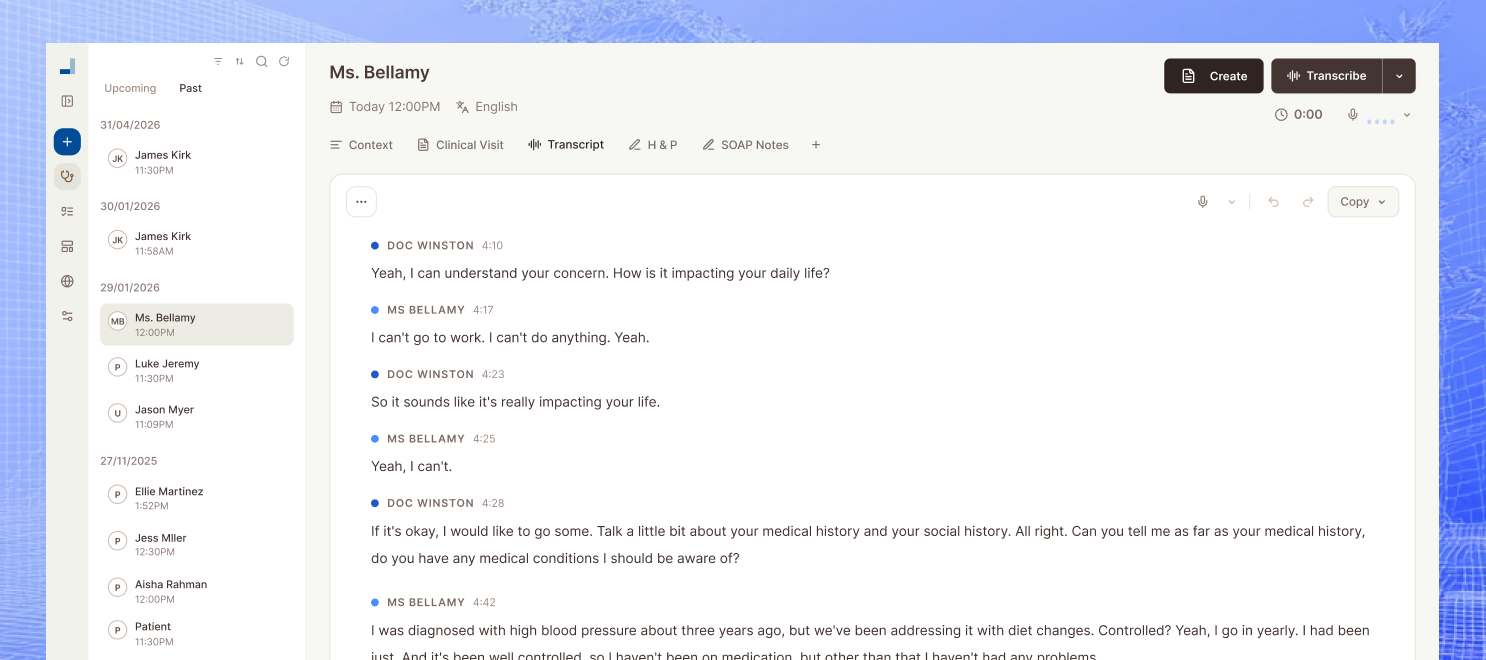
Next, take the time to set up templates by specialty. Most modern workflows allow you to define how you want your data organized, whether you prefer bulleted lists for symptoms or narrative paragraphs for the physical exam. Once your templates are ready, you can begin capturing encounters in real-time, whether they are in-person or conducted via telehealth. The AI works in the background, listening to the natural conversation between you and the patient.
After the encounter wraps up, you should move immediately to a quick review and edit phase. Because the AI generates the draft almost instantly, you can verify the details while the conversation is still fresh in your mind. This prevents the ‘memory decay’ that happens when you wait until the end of the day to document. Finally, once the note is finalized, you can reuse those outputs to generate the secondary paperwork, such as school notes, work excuses, or referral letters, without typing a single extra word.
- Start with one simple visit type to master the initial workflow.
- Pre-configure specialty-specific templates to ensure the output matches your style.
- Review notes immediately after the encounter while the details are fresh.
- Leverage AI-generated drafts to quickly create letters and forms.
How to keep note quality high and reduce mistakes
The most common failure points in clinical documentation often involve missing medications, incorrect lab values, or general ‘note bloat’ where the important findings are buried under repetitive text. Even with advanced technology, a review habit is essential. Clinicians should adopt a ‘scan and verify’ approach, checking that the AI hasn’t hallucinated specific dosages or misattributed a symptom to the wrong family member in the history section.
Developing a team standard for note-checking is another helpful strategy for larger clinics or university settings. Ensure that all users understand how to prompt the AI for corrections and how to manually intervene when a clinical nuance requires specific wording. By maintaining a lightweight but consistent review process, you can ensure that your records remain both accurate and highly professional.
- Check for accuracy in dosages, dates, and specific laboratory values.
- Avoid note bloat by selecting templates that prioritize concise communication.
- Establish a consistent review protocol to ensure high-quality documentation.
Privacy, consent, and patient trust (plain English)
Patient privacy is the cornerstone of any medical practice. While AI tools are designed with high security, it is vital to follow the local policies of your region regarding recording and data retention. Generally, patients are very receptive to AI scribing when they realize it means their doctor will be looking at them instead of a computer screen. Transparency is always the best policy when introducing new technology into the exam room.
A simple way to explain the process is to say: ‘I am using a digital assistant today to help me take accurate notes so I can focus entirely on your care. It records our conversation, turns it into a medical note, and then the recording is deleted. Is that okay with you?’ Most patients appreciate the honesty and the fact that you are prioritizing their experience over data entry tasks. Keeping security and retention principles at the forefront will help maintain long-term trust.
- Always obtain verbal or written consent based on your local regulatory requirements.
- Explain the benefit to the patient: more eye contact and better focus on their health.
- Ensure the chosen technology adheres to strict data encryption and privacy standards.
Rolling it out across a clinic without disruption
Successful implementation requires a structured rollout, typically starting with a two-week pilot involving one or two ‘champion’ providers. During this phase, you can identify any workflow bottlenecks and refine your template settings. This pilot period serves as a proof of concept, showing the rest of the staff the tangible benefits of the system before a full-scale launch.
During the rollout, it is helpful to track metrics such as time saved per day and the reduction in after-hours charting. If clinicians see that their peers are leaving the office an hour earlier with better-completed notes, the adoption rate will skyrocket. Regular training sessions and template alignment meetings ensure that the entire clinic is using the tool efficiently and consistently, leading to a much smoother transition for everyone involved.
- Run a two-week pilot to iron out workflow issues before a full launch.
- Track time-saving metrics to demonstrate the value to hesitant staff members.
- Align templates across the team for consistent clinical documentation.
Mcoy AI is an AI medical scribe that records and transcribes patient encounters, then generates multiple clinical note types including H&P, progress notes, consult notes, follow-up notes, procedure notes, discharge summaries, referral letters, and more. With over 200 customizable templates and an interactive AI chat to help create letters, forms, and documents, it allows clinicians to focus on patient care rather than the nuances of administrative paperwork.
Frequently Asked Questions
Implementing a new technology can lead to many questions. Here are the most common inquiries regarding the use of AI scribing in a clinical setting.
How accurate are AI medical scribes in real clinics?
AI medical scribes have become remarkably accurate, often capturing details that a human scribe might miss. However, they are not perfect and can occasionally misinterpret complex medical terminology or background noise. This is why the clinician’s role in reviewing and editing the final note is essential for maintaining total accuracy in the medical record.
Do I still need to review every note?
Yes, medical and legal standards require that the clinician remains responsible for the contents of the medical record. While the AI does the heavy lifting by drafting the note, you must perform a final review to ensure all details are correct. Most clinicians find that this review process takes only a minute or two compared to the ten or twenty minutes required for manual typing.
What note types can an AI scribe generate besides SOAP?
A high-quality AI scribe can generate almost any document used in a clinical setting. This includes H&P notes, detailed consult reports, procedure summaries, discharge instructions, and even referral letters. By using different templates, the AI can structure the same conversation into various formats depending on who the final reader of the document will be.
Will this work for telehealth and in-person consults?
Yes, most AI scribing solutions are designed to work across various platforms. For telehealth, the AI can often join the digital meeting or record via the computer’s audio. For in-person visits, a simple mobile app or a dedicated microphone in the exam room is usually sufficient to capture the conversation and generate a high-quality note.
How do I explain recording/transcription to patients?
The best approach is to be direct and highlight the benefits of the patient-doctor relationship. Inform them that the tool allows you to look at them and listen more carefully rather than typing. Most patients are familiar with AI in other areas of life and are happy to support a technology that improves the quality of their visit.
How do clinics prevent note bloat?
Note bloat is prevented by using concise templates and setting specific instructions for the AI. You can customize the AI to prioritize relevant clinical findings while filtering out small talk or redundant information. Regularly updating your templates based on your specific documentation style also helps keep notes brief and actionable.
How long does template setup take?
Initial template setup for AI scribing is usually very fast. Most systems come with pre-built templates for common specialties that can be used immediately. Customizing these to your specific preferences typically takes a few minutes per template, and once they are set, they can be used for every future encounter without additional work.
What’s the safest way to start if I’m skeptical?
The safest way to start is with a small pilot program. Use the AI scribe for just three to five patients a day during your least busy hours. This allows you to see the results and gain confidence in the system’s ability to capture your clinical intent without the pressure of a full patient load.
Conclusion
Transitioning to an automated documentation workflow is one of the most effective ways to modernize a new practice. By following a structured implementation plan—starting small, using diverse templates, and maintaining a strict review habit—you can significantly reduce the burden of paperwork. The goal of using an AI medical scribe is to return your focus to where it belongs: the patient. When you implement AI scribing correctly, you don’t just save time; you improve the quality of care and protect your own well-being. Start your pilot today and see how much the right technology can transform your daily practice.
What a serious review table should cover
| Decision area | Common mistake | Better clinic-ready approach | Metric to watch |
|---|---|---|---|
| Workflow design | Treat how to implement ai scribing: a guide for new practices as a one-off documentation task | Build a repeatable process with clear ownership and review points | Time to complete documentation |
| Team adoption | Assume every clinician will naturally use the same process | Train for consistency and define exception handling early | Active user adoption |
| Quality review | Only check notes when a problem is reported | Audit a sample of notes weekly and review edge cases | Edit rate per note |
| Operational follow-through | Leave admin actions outside the documentation workflow | Use the same encounter data for referrals, letters, and follow-up tasks | Completion rate for next-step tasks |
Related reading
If you are working through how to implement ai scribing: a guide for new practices, it helps to read this alongside Specialty Guides: How to Run a More Efficient Medical Practice in 2026, Specialty Guides: How to Improve Patient Encounters, and Admin Management: Build a Referral Letter Template Pack: Guide for Clinics. Those guides cover adjacent workflow, implementation, and evaluation questions so the decision does not sit in isolation.
FAQ
How accurate are AI medical scribes? Do I still need to review notes? What note types can be generated? Learn all this and more in our FAQ section.