Specialty Guides: How to Document Skin Checks With an AI Scribe | Mcoy AI
Improve your dermatology workflow. Learn how to document skin checks with an AI scribe to save time, reduce burnout, and ensure accurate clinical notes.
What a medical scribe solves in modern practice
The administrative burden of dermatology is uniquely demanding. Between identifying complex lesions and documenting specific anatomical locations, the time spent at the keyboard often rivals the time spent with the patient. This constant documentation cycle leads to significant after-hours charting, clinician burnout, and the risk of ‘note bloat’ where essential findings are buried under templates.
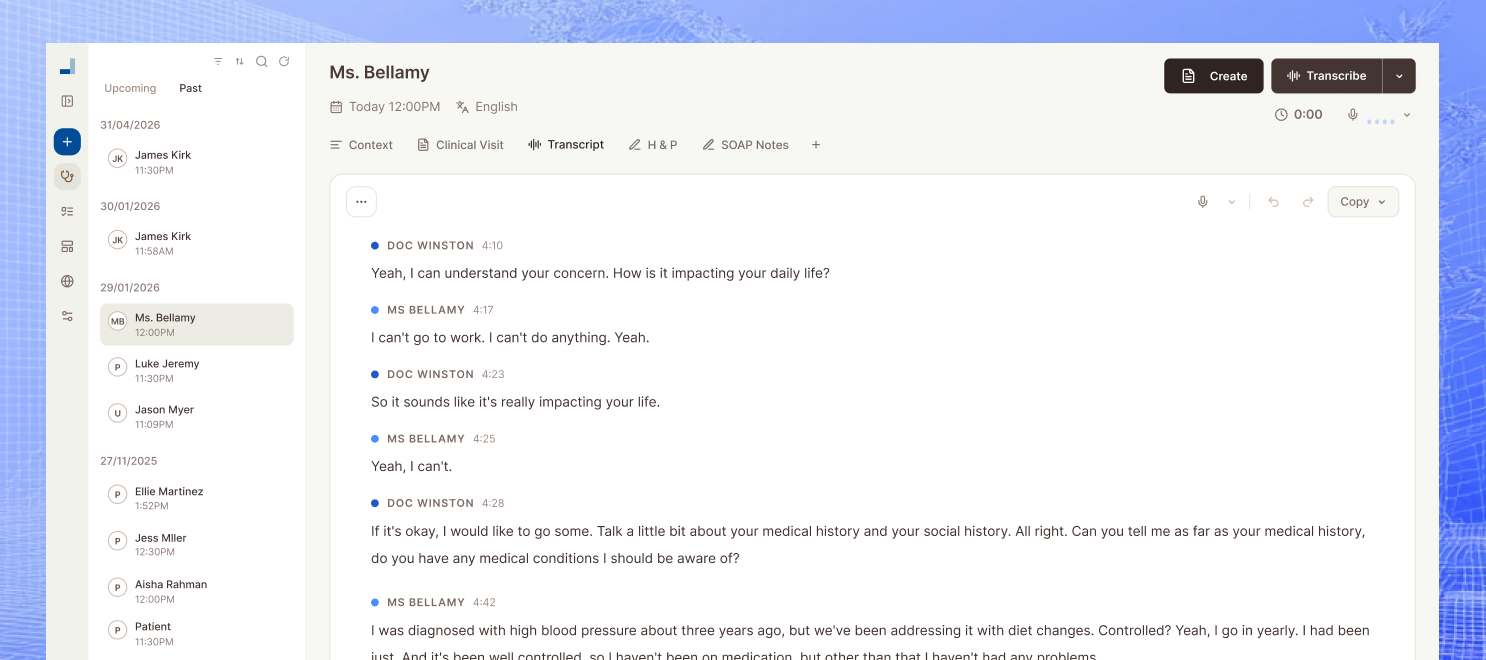
An AI medical scribe serves as an assistive partner in this high-volume environment. By capturing the natural dialogue between doctor and patient, it allows the clinician to remain hands-on during the physical exam rather than tethered to a screen. It is important to remember that these tools are assistive; they identify data points, but the clinician remains the final authority on the accuracy and clinical relevance of the note.
- Eliminates the cognitive load of memorizing lesion details during the exam.
- Reduces time spent on post-clinic charting by up to 50%.
- Ensures consistently high-quality notes across various patient types.
- Allows for improved eye contact and patient rapport during skin cancer screenings.
Note types you can generate beyond SOAP (H&P and more)
While the SOAP format is a staple in general practice, specialized skin clinics require much more. A comprehensive skin cancer screening often necessitates a detailed History and Physical (H&P) that accounts for sun exposure history, family history of melanoma, and previous biopsies. Simply recording subjective and objective data isn’t enough when complex surgical interventions or specialist referrals are on the horizon.
Using an AI scribe allows for the seamless generation of progress notes for chronic condition management, such as psoriasis or eczema, as well as detailed procedure notes for biopsies, cryotherapy, or excisions. When a patient requires Mohs surgery or advanced dermatological care, the ability to instantly generate a professional referral letter or a consult note ensures continuity of care and audit readiness.
- H&P and Progress Notes for comprehensive longitudinal tracking.
- Specialized Procedure Notes for biopsies and surgical excisions.
- High-quality Referral Letters and Consult Notes for inter-specialty communication.
- Discharge Summaries and Follow-up notes for post-procedural care.
How to implement document skin checks with an AI scribe step-by-step in a real clinic
Starting with an AI tool doesn’t require a total overhaul of your workflow. Begin by selecting one visit type, such as routine skin checks, to pilot the technology. This allows you to get comfortable with the capture process without the pressure of complex surgical cases. Ensure you have selected a template that aligns with your specific specialty needs, whether that is a standard dermatological exam or a focused lesion assessment.
During the encounter, simply let the AI capture the conversation as you speak your findings aloud. Instead of silent examination, narrating your findings—such as ‘3mm pigmented macule on the left deltoid with irregular borders’—ensures the AI picks up the precise data needed for the note. After the patient leaves, you can review the generated text in seconds, making any necessary edits to the anatomical descriptions or biopsy plans.
p>The final step involves reusing the structured data for ancillary documents. Once the note is finalized, the system can help you generate patient instructions or referral forms based on the discussed plan. This integrated workflow turns a single recorded encounter into a suite of necessary clinical documents, significantly reducing manual data entry.
- Start with one session type to build confidence in the AI outputs.
- Narrate your physical findings aloud during the exam for better data capture.
- Perform a rapid review and edit post-encounter to maintain high accuracy.
- Leveraging captured data for secondary forms and referral letters.
How to keep note quality high and reduce mistakes
The most common failure point in automated documentation is ‘hallucination’ or the omission of specific medication dosages and anatomical laterality. To prevent these mistakes, clinicians should adopt a lightweight review habit. Taking 30 seconds to verify that the ‘left’ arm wasn’t transcribed as the ‘right’ arm is critical for medico-legal safety. Quality control should be a collaborative effort where the team agrees on standard terminology for lesion descriptions.
- Verify anatomical laterality and specific measurements for every lesion.
- Standardize clinical terminology within the team for consistent reporting.
- Double-check medication names and dosages against the patient’s record.
- Use a consistent narration style to improve transcription clarity.
Privacy, consent, and patient trust (plain English)
Privacy is a paramount concern for both clinicians and patients, especially when sensitive skin examinations are involved. It is essential to follow local privacy regulations and your clinic’s specific policy regarding digital recordings. A simple, transparent approach is usually best. You might say: ‘To help me focus on your skin and stay off the computer, I use an AI assistant that securely transcribes our conversation into my clinical notes. Is that okay with you?’
- Always obtain verbal or written consent based on local jurisdictional requirements.
- Explain the benefit to the patient (better eye contact, more focus on care).
- Ensure the technology provider adheres to high security and encryption standards.
Rolling it out across a clinic without disruption
A successful rollout involves a two-week pilot phase. During the first week, have one ‘champion’ doctor use the tool to identify the best templates. In the second week, introduce it to the wider team. Track metrics such as the reduction in after-hours charting and the time taken from patient exit to note completion to measure the return on investment. Training should focus on template alignment so that every doctor’s notes remain professional and uniform.
- Use a 2-week pilot plan to refine templates before a full rollout.
- Monitor time saved and clinician satisfaction as key success metrics.
- Align templates across the clinic for standardized audit-ready documentation.
Mcoy AI is an AI medical scribe that records and transcribes patient encounters, then generates multiple clinical note types (H&P, progress notes, consult notes, follow-up notes, procedure notes, discharge summaries, referral letters, and more). It features over 200+ customizable templates and an AI chat function to help you create various letters, forms, and clinical documents. This flexible system ensures that practitioners spend less time on manual entry and more time providing high-quality patient care.
Conclusion
In conclusion, learning how to document skin checks with an AI scribe is a transformative step for any modern dermatology or general practice. By moving away from manual typing and toward a narrative capture model, clinicians can reclaim their time and focus on early detection and patient outcomes. The key to success lies in a structured rollout, diligent review habits, and choosing a tool that supports diverse clinical formats. As you look to optimize your workflow, consider how an AI scribe can eliminate the documentation bottleneck in your clinic today.
What a serious review table should cover
| Decision area | Common mistake | Better clinic-ready approach | Metric to watch |
|---|---|---|---|
| Workflow design | Treat how to document skin checks with an ai scribe | mcoy ai as a one-off documentation task | Build a repeatable process with clear ownership and review points |
| Team adoption | Assume every clinician will naturally use the same process | Train for consistency and define exception handling early | Active user adoption |
| Quality review | Only check notes when a problem is reported | Audit a sample of notes weekly and review edge cases | Edit rate per note |
| Operational follow-through | Leave admin actions outside the documentation workflow | Use the same encounter data for referrals, letters, and follow-up tasks | Completion rate for next-step tasks |
Related reading
If you are working through how to document skin checks with an ai scribe | mcoy ai, it helps to read this alongside Specialty Guides: How to Run a More Efficient Medical Practice in 2026, Specialty Guides: How to Improve Patient Encounters, and Admin Management: How to Use AI Scribe for Forms & Certificates | Mcoy Health. Those guides cover adjacent workflow, implementation, and evaluation questions so the decision does not sit in isolation.
FAQ
How accurate are AI medical scribes in real clinics?
In modern clinical settings, AI scribes are remarkably accurate at capturing the dialogue between a doctor and patient. They excel at identifying medical terminology and structured data points. However, the clinician must always review the output to ensure the nuances of the exam and specific measurements are perfectly recorded before finalizing the note.
Do I still need to review every note?
Yes, reviewing every note is a professional and medico-legal requirement. While the AI does the heavy lifting of transcribing and formatting, the clinician is responsible for confirming the clinical accuracy of the findings. Most doctors find that this review process takes less than a minute, which is still significantly faster than typing a note from scratch.
What note types can an AI scribe generate besides SOAP?
Modern AI scribes go far beyond the standard SOAP format. They can generate comprehensive History and Physical (H&P) reports, detailed procedure notes for biopsies or excisive surgeries, follow-up notes, and even discharge summaries. They can also assist in drafting referral letters to specialists based on the encounter data.
Will this work for telehealth and in-person consults?
AI scribes are highly versatile and work effectively for both in-person and telehealth consultations. For in-person visits, the device captures the ambient room audio. For telehealth, the system can usually integrate with the communication platform or capture audio directly from the computer, ensuring consistent documentation regardless of the visit type.
How do I explain recording/transcription to patients?
Most patients are very receptive when the benefit is explained as a way to improve care. A simple explanation such as, ‘I use a secure AI tool to transcribe our notes so I can focus entirely on your exam instead of my screen,’ is usually sufficient. Always respect patient wishes if they prefer not to be recorded.
How do clinics prevent note bloat?
Clinics prevent note bloat by using concise, specialized templates instead of generic ones. By selecting a template specifically for ‘Skin Checks’ or ‘Biopsies,’ the AI knows to focus on relevant findings rather than including unnecessary filler text. Regularly refining these templates based on clinican feedback helps keep notes brief and useful.
How long does template setup take?
Setting up a basic template usually takes a few minutes, as many AI scribes come with pre-built options for various specialties. Fine-tuning a template to match your specific clinical voice or clinic requirements might involve a few days of testing during your pilot phase to ensure the output meets your exact standards.
What’s the safest way to start if I’m skeptical?
The safest way to start is by running a pilot with non-complex cases, such as routine follow-ups or standard skin screenings. Use the AI alongside your current method for a day or two to compare the results. This allows you to verify the accuracy and see the time-saving benefits firsthand without any risk to your clinical workflow.