Specialty Guides: Master Hypertension Follow-Ups with an AI Medical Scribe
Learn how to streamline hypertension follow-up documentation using AI. Improve note accuracy, reduce burnout, and master H&P and progress notes with ease.
The Documentation Burden in Chronic Disease Management
Managing hypertension is a cornerstone of primary care, yet the documentation requirements for a standard follow-up can feel overwhelming. Clinicians often find themselves trapped in a cycle of after-hours charting, struggling to keep up with the volume of blood pressure readings, medication adjustments, and lifestyle counseling details. This administrative weight leads to burnout and, more dangerously, rushed notes that may lack the nuance required for high-quality longitudinal care.
This guide provides a comprehensive roadmap for integrating an AI medical scribe into your hypertension management workflow. We will explore various note formats beyond the standard SOAP note, quality control measures to ensure clinical accuracy, and a practical rollout plan for private practices and university clinics. Whether you are a GP, an internal medicine specialist, or a telehealth provider, mastering hypertension follow-up documentation is the first step toward reclaiming your time and focus.
What a medical scribe solves in modern practice
The real cost of documentation extends far beyond the time spent typing; it involves a significant cognitive load that distracts from the patient sitting right in front of you. When you are preoccupied with capturing every numerical value and medication dosage, the patient-provider connection suffers. Delayed notes often lead to missed details or ‘note bloat,’ where irrelevant history is carried forward simply because it is easier than drafting a fresh, concise assessment.
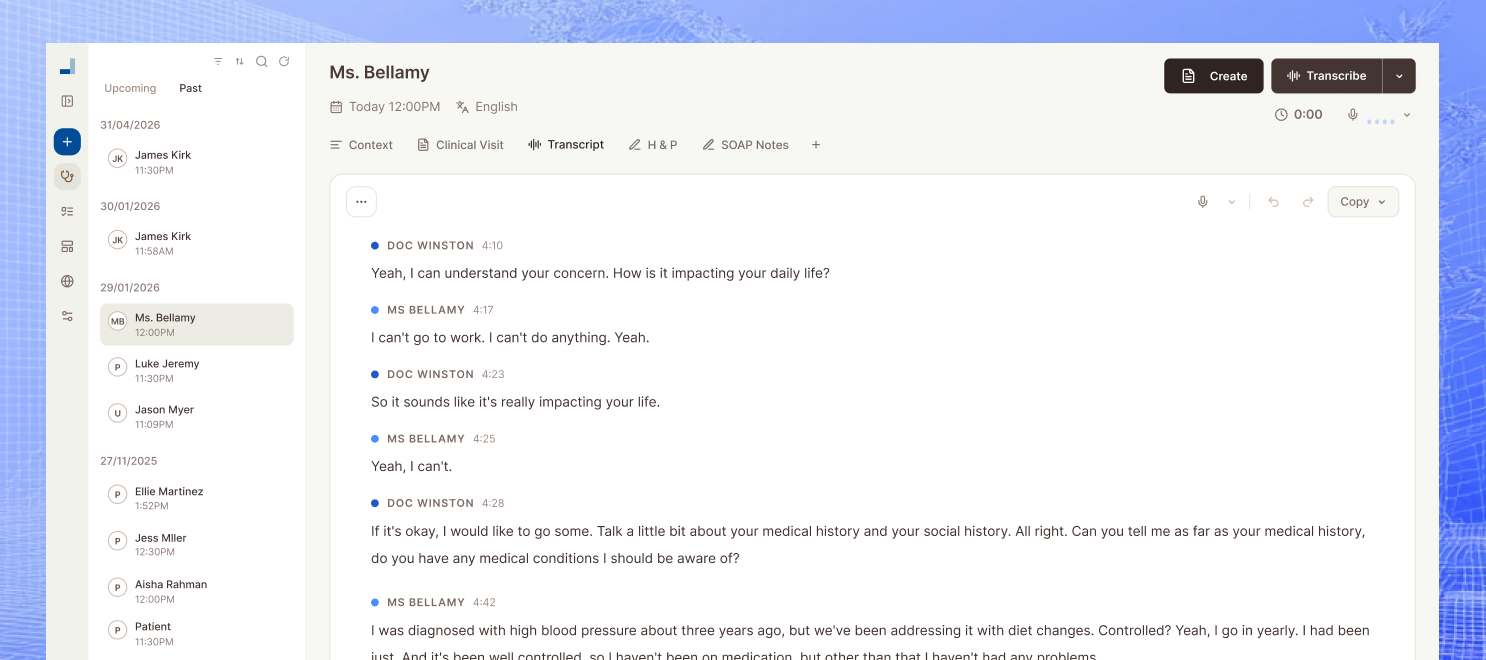
An AI medical scribe serves as an assistive partner, not a replacement for clinical judgment. It works by capturing the organic conversation between the doctor and patient, filtering out the small talk, and synthesizing the medical data into a structured format. While the AI handles the heavy lifting of transcription and organization, the clinician remains the final authority, responsible for reviewing and authenticating the clinical record for medico-legal and billing purposes.
- Eliminates after-hours charting by generating drafts in real-time.
- Reduces cognitive load, allowing doctors to maintain better eye contact.
- Ensures all mentioned vitals and medication changes are captured accurately.
- Standardizes note quality across a multi-provider practice or clinic.
Note types you can generate beyond SOAP
While the SOAP note is the industry standard for daily progress, hypertension follow-ups often require more specialized documentation to ensure continuity of care. Using an AI scribe allows you to easily generate Comprehensive History and Physical (H&P) reports for new hypertensive patients or detailed Consultation Notes when referring a patient to a cardiologist. These diverse formats ensure that your documentation meets the specific needs of the encounter without adding extra work.
Structure matters significantly for audit readiness and seamless handovers. For example, a Procedure Note might be necessary if you are performing an EKG in-office, while a detailed Referral Letter can be automatically drafted based on the encounter summary. By utilizing these varying formats, you create a robust medical record that clearly communicates the clinical rationale for treatment escalations or diagnostic testing to other members of the care team.
- H&P and Progress Notes for routine blood pressure monitoring.
- Consultation and Referral Letters for multi-specialty coordination.
- Discharge Summaries for patients transitioning from acute cardiac care.
- Follow-up Notes that specifically track trended vitals and adherence.
How to implement hypertension follow-up documentation step-by-step
Transitioning to an AI-assisted workflow is most successful when approached in a structured narrative. Start by selecting one specific visit type—such as your routine hypertension follow-ups—to act as your testing ground. This allows you to calibrate the AI to your specific verbal style and the way you typically discuss medication side effects like ACE inhibitor-induced cough or diuretic-related electrolyte issues.
Next, set up templates tailored to your specialty. If you are in a university clinic, your templates might require more academic detail than a solo private practice. During the encounter, simply let the AI capture the conversation as you discuss the patient’s home blood pressure logs and current regimen. The AI works in the background, whether you are conducting the visit in-person or via a telehealth platform.
Once the visit concludes, take a quick sixty seconds to review and edit the generated draft. Because the AI has already structured the HPI, Physical Exam, and Plan, your role shifts from ‘author’ to ‘editor.’ Finally, reuse these outputs to generate patient instructions or cardiology referral letters with the click of a button, ensuring the entire administrative loop is closed before the patient even leaves the office.
- Select one visit type to pilot for consistent data benchmarking.
- Customize specialty-specific templates for hypertension and metabolic health.
- Capture encounters naturally without changing your bedside manner.
- Review, edit, and finalize notes immediately after the patient encounter.
How to keep note quality high and reduce mistakes
The most common failure points in chronic disease documentation include missing specific medication dosages, failing to update the problem list, or creating ‘note bloat’ with redundant information. AI scribes are highly proficient, but they can occasionally misinterpret complex brand names or specific numerical values if the audio is muffled. Maintaining a lightweight review habit is essential to ensure these small errors do not become part of the permanent record.
Establishing team standards for note review can significantly enhance safety. Have a consistent checklist: check the blood pressure readings, verify the medication changes, and ensure the follow-up interval is clearly stated. By creating a culture of accuracy rather than just speed, your clinic can leverage AI to its full potential without compromising the integrity of patient data.
- Verify all numerical vitals and medication dosages for precision.
- Remove redundant ‘auto-filled’ data that doesn’t apply to the current visit.
- Establish a standard ‘Review and Sign’ workflow within your EHR.
- Use structured prompts to focus the AI on specific clinical goals.
Privacy, consent, and patient trust
In the era of digital health, patients are often concerned about how their data is recorded and stored. While consent requirements vary by region, it is best practice to follow your local healthcare privacy regulations. Transparent communication is the best way to handle these concerns. Most patients are supportive once they realize the technology allows their doctor to listen more and type less.
A simple way to explain this to a patient is: “I’m using a digital assistant today to help me capture our conversation. It allows me to focus entirely on you instead of the computer screen, and the recording is processed securely to create your medical note.” This plain-English approach demystifies the technology and builds trust, making the AI a welcome part of the care team.
- Check local healthcare privacy laws regarding audio recording.
- Use a standard, reassuring script to introduce the AI to patients.
- Ensure your AI provider uses industry-standard encryption and security.
- Document that verbal consent was obtained for the use of the scribe.
Rolling it out across a clinic without disruption
Introducing new technology to a busy clinic can be daunting, but a two-week pilot program usually suffices to iron out any procedural issues. Start with a ‘super-user’—a physician who is tech-savvy—and let them refine the templates before rolling the tool out to the rest of the staff. This phased approach minimizes downtime and prevents the staff from feeling overwhelmed by sudden changes.
Track specific metrics during the rollout to prove the value of the tool, such as the number of hours saved per week or the reduction in ‘pajama time’ spent on charting. Aligning templates across the practice ensures that every hypertension follow-up documentation is consistent, regardless of which provider the patient sees, which is particularly vital for university clinics and large group practices.
- Start with a 2-week pilot to refine templates and workflows.
- Identify a lead clinician to act as an internal product champion.
- Measure ‘time-to-complete’ for notes before and after implementation.
- Hold weekly 15-minute syncs to share best practices among providers.
Mcoy AI is an AI medical scribe that records and transcribes patient encounters, then generates multiple clinical note types including H&P, progress notes, consult notes, follow-up notes, procedure notes, discharge summaries, referral letters, and more. With over 200+ customizable templates and an interactive AI chat, doctors can quickly create letters, forms, and complex documents based on the session transcript, making it easier than ever to manage the admin side of medicine without sacrificing care quality.
Conclusion
Implementing a streamlined workflow for hypertension follow-up documentation doesn’t just save time; it improves the quality of the patient-doctor relationship. By letting an AI scribe handle the transcription and formatting of H&P and progress notes, clinicians can return to the heart of medicine. The roadmap for success involves a phased rollout, a focus on privacy, and a commitment to reviewing notes for accuracy. Start your pilot today and see how hypertension follow-up documentation can become the easiest part of your day.
What a serious review table should cover
| Decision area | Common mistake | Better clinic-ready approach | Metric to watch |
|---|---|---|---|
| Workflow design | Treat master hypertension follow-ups with an ai medical scribe as a one-off documentation task | Build a repeatable process with clear ownership and review points | Time to complete documentation |
| Team adoption | Assume every clinician will naturally use the same process | Train for consistency and define exception handling early | Active user adoption |
| Quality review | Only check notes when a problem is reported | Audit a sample of notes weekly and review edge cases | Edit rate per note |
| Operational follow-through | Leave admin actions outside the documentation workflow | Use the same encounter data for referrals, letters, and follow-up tasks | Completion rate for next-step tasks |
Related reading
If you are working through master hypertension follow-ups with an ai medical scribe, it helps to read this alongside Specialty Guides: How to Run a More Efficient Medical Practice in 2026, Specialty Guides: How to Improve Patient Encounters, and Admin Management: How to Use an AI Scribe to Create Referrals in Minutes. Those guides cover adjacent workflow, implementation, and evaluation questions so the decision does not sit in isolation.
FAQ
How accurate are AI medical scribes in real clinics?
AI medical scribes are exceptionally accurate at capturing the nuances of clinical conversations, often reaching over 95% accuracy in medical terminology. However, they rely on the quality of the audio and the clarity of the clinician’s speech. While they excel at structuring data, they function best as a high-level assistant that produces a draft for your final expert approval.
Do I still need to review every note?
Yes, clinicians are legally and ethically responsible for the content of their medical records. You should always perform a quick review to ensure that specific dosages, vital signs, and the final assessment accurately reflect your clinical findings. Most users find that reviewing a pre-written note takes less than 60 seconds, which is a fraction of the time it takes to type one from scratch.
What note types can an AI scribe generate besides SOAP?
Beyond the standard SOAP format, advanced AI scribes can generate History and Physical (H&P) reports, follow-up notes, consultation letters, and procedure summaries. They can also assist in drafting referral letters or discharge instructions by pulling relevant data directly from the recorded encounter. This versatility makes them ideal for complex chronic disease management like hypertension.
Will this work for telehealth and in-person consults?
Absolutely. AI scribes are designed to be platform-agnostic, meaning they can capture audio from a physical device in an exam room or directly from a computer during a telehealth session. The technology focuses on the audio stream, ensuring that regardless of how you meet the patient, the documentation process remains seamless and consistent.
How do I explain recording/transcription to patients?
The best approach is transparency and focusing on the benefit to the patient. You can explain that the tool allows you to look at them rather than a screen, ensuring better care and more accurate records. Most patients appreciate the extra attention and are comfortable with the technology once they understand it is a secure medical tool.
How do clinics prevent note bloat?
Clinics prevent note bloat by using customizable templates that instruct the AI to only include relevant information for the specific encounter. By setting parameters on what should be captured—such as focusing only on changes in symptoms or vitals—the AI generates concise notes rather than long-winded transcripts that include irrelevant historical data.
How long does template setup take?
Setting up basic templates usually takes less than 30 minutes. Most systems come with pre-built specialty templates that you can quickly tweak to match your specific workflow or terminology. Once a template is saved, it can be used for all future encounters of that type, providing immediate time savings for the entire practice.
What’s the safest way to start if I’m skeptical?
The safest way to start is with a ‘shadow’ pilot. Use the AI scribe during a few routine follow-up visits but continue your normal charting method alongside it. This allows you to compare the AI-generated note against your own and build confidence in the tool’s accuracy and formatting without any risk to your clinical workflow.