Specialty Guides: Document Chronic Disease Reviews Faster With AI
Learn how to streamline chronic disease management notes and save hours on clinical documentation using AI medical scribes. Expert guide for busy clinics.
What a medical scribe solves in modern practice
The burden of chronic disease management often falls on the shoulders of clinicians who are already stretched thin. Between monitoring blood pressure trends, reviewing lab results, and adjusting complex medication regimens, the administrative weight of documenting these frequent reviews can lead to significant after-hours charting. For many practitioners, this translates to ‘pajama time’ spent finishing notes long after the last patient has left the clinic, contributing to rapid burnout and clinical fatigue.
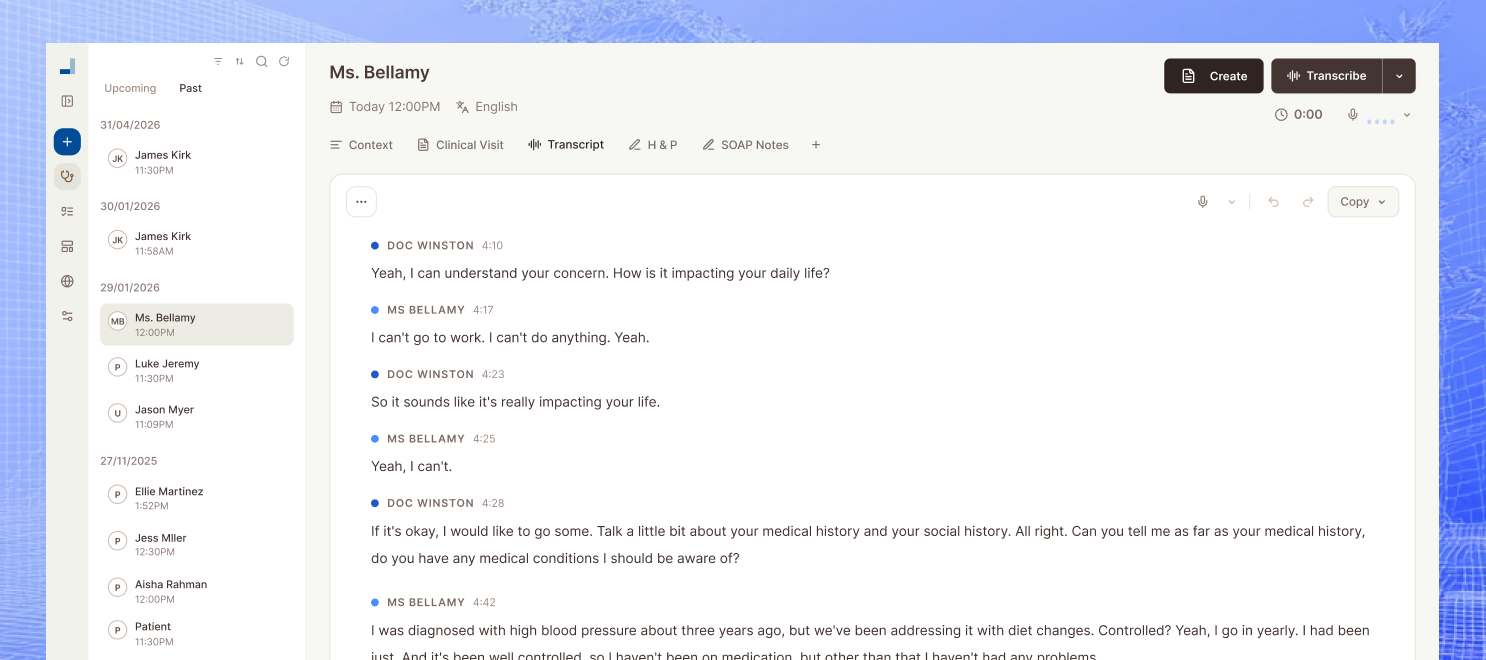
An AI medical scribe serves as an assistive partner in the exam room, focusing on the heavy lifting of data capture so the clinician can focus on the patient. It transforms natural conversation into structured data in real-time. It is important to remember that these tools are assistive; while they capture the nuances of the encounter, the clinician remains the final authority and must review and verify all clinical details before finalizing the record.
- Eliminates the cognitive load of multitasking between active listening and typing.
- Reduces the time spent on manual documentation by 50% or more.
- Ensures clinical notes are completed promptly, preventing a backlog of work.
- Maintains high detail levels without lengthening the patient visit.
Note types you can generate beyond SOAP (H&P and more)
While the SOAP format is a staple in general practice, chronic disease reviews often require more specialized documentation to ensure continuity of care. Using AI, clinicians can effortlessly generate History and Physical (H&P) reports for new referrals or complex annual reviews. These comprehensive notes provide a baseline that is essential for tracking long-term progression in conditions like diabetes, COPD, or heart failure.
Beyond standard follow-ups, AI tools can produce detailed consult notes for specialists and complex discharge summaries that bridge the gap between hospital and outpatient care. Procedure notes can be generated instantly for minor in-office interventions, while referral letters can be drafted based on the conversation held during the visit. This variety ensures that every piece of paperwork accurately reflects the clinical decision-making process without requiring redundant data entry.
Consistency in these note types is vital for audit readiness and high-quality handovers. When a patient sees different members of a multidisciplinary team, having a standardized, highly detailed output across all document types prevents information silos. This structured approach not only helps in day-to-day care but also protects the practice in the event of a medico-legal review by providing a clear, chronological narrative of the patient’s health journey.
- H&P and Annual Reviews for comprehensive baseline assessments.
- Specialized Consult and Referral letters for clear professional communication.
- Procedure and Follow-up notes tailored to chronic care pathways.
- Discharge summaries that ensure safe transitions of care.
How to implement AI medical scribe step-by-step in a real clinic
To begin implementing an AI medical scribe, start with a single visit type to avoid overwhelming your staff. Choose a common chronic review, such as a routine hypertensive check-in. In the morning, ensure your AI tool is open and ready. When the patient enters, simply inform them you are using an assistive tool to capture the conversation so you can give them your full attention. This small adjustment sets the stage for a more personal encounter while the AI works in the background.
As you move through the appointment, speak naturally. You don’t need to narrate your actions, but mentioning specific measurements like blood pressure readings or medication dosages aloud can help ensure the AI captures the precise data. Once the encounter ends, the transcription and initial note generation happen almost instantaneously. You will likely find that the draft is 90% complete by the time the patient is walking out the door.
Reviewing the output should be a quick, focused task. Scan the note for accuracy, specifically checking that the plan of care reflects your final clinical decisions. Because the AI has done the drafting, you are now an editor rather than a writer. After the review, you can immediately reuse the information to populate referral forms or patient education summaries, streamlining the entire administrative flow for that specific patient case.
Over time, you can expand this workflow to all appointment types, from complex multi-morbidity reviews to simple acute visits. By following this habit, the documentation is finished within minutes of the encounter, leaving no ‘debt’ of unwritten notes at the end of the day. This systematic approach ensures that the transition to an AI-enhanced workflow is smooth, sustainable, and immediately beneficial to the clinic’s efficiency.
- Start small by piloting the tool with one specific appointment type.
- Mention key clinical data aloud during the visit for better capture.
- Shift your role from author to editor to save significant time.
- Immediately utilize the generated text for secondary administrative tasks.
How to keep note quality high and reduce mistakes
Quality control in medical documentation is non-negotiable, particularly when dealing with the complexities of chronic disease. A common failure point in manual charting—and sometimes in AI-assisted notes—is ‘note bloat,’ where irrelevant details obscure the critical clinical data. To prevent this, clinicians should adopt a lightweight review habit: after each encounter, spend 60 seconds verifying that the medications, problem list, and vital signs are accurate and that the plan is clearly articulated.
Setting team standards for documentation is also essential. If your clinic uses specific phrasing or priorities for chronic disease reviews, ensure these are reflected in your AI settings. By standardizing what a ‘good’ note looks like across the practice, you reduce the risk of missed details and ensure that every practitioner who opens the patient’s chart sees a consistent, high-quality narrative of their health status.
- Verify medication lists and dosages for every single review.
- Remove redundant information to prevent clinical ‘note bloat.’
- Establish practice-wide standards for documentation quality.
- Conduct periodic spot-checks to ensure the AI is meeting expectations.
Privacy, consent, and patient trust (plain English)
Protecting patient privacy is at the heart of any technological implementation in healthcare. While consent requirements vary by region, the best approach is transparency. Most patients are supportive of technologies that allow their doctor to look at them rather than a screen. It is important to follow your local healthcare regulations and institutional policies regarding recording and data retention, ensuring all systems used are compliant with standards like HIPAA or GDPR.
A simple way to explain this to a patient is: “I’m using a secure AI assistant today to record our conversation. It helps me create your medical notes so I can focus on listening to you instead of typing on my computer. The recording is encrypted and handled with the same privacy as your regular medical record. Are you okay with that?” This approach builds trust and ensures the patient feels involved in the process.
- Always follow local legal and institutional guidelines for patient consent.
- Use a simple, transparent script to explain the technology to patients.
- Verify that the AI solution uses high-level encryption and secure storage.
- Involve the patient by explaining the benefits of better engagement.
Rolling it out across a clinic without disruption
A successful rollout of an AI medical scribe requires a structured 2-week pilot plan. During the first week, select a few ‘tech-champion’ providers to test the workflow. This allows you to identify any unique needs for your clinic, such as specific template adjustments for specialized chronic diseases. In the second week, these champions can help train the rest of the team, sharing their best practices and tips for efficient review.
Track your success during this period using clear metrics. Monitor the reduction in after-hours documentation time and the speed of note completion. You may also find that note completeness improves, as the AI often captures small details that a busy clinician might omit. This data provides the evidence needed to encourage full adoption across the university clinic or private practice.
- Run a 2-week pilot with a small group before a full clinic rollout.
- Match AI templates to the specific needs of your specialties.
- Measure time saved and note completeness to quantify the impact.
- Provide brief, practical training sessions to align the whole team.
Mcoy AI is an AI medical scribe that records and transcribes patient encounters, then generates multiple clinical note types (H&P, progress notes, consult notes, follow-up notes, procedure notes, discharge summaries, referral letters, and more). With over 200+ customizable templates and an integrated AI chat to create letters, forms, and documents, it allows clinicians to focus on the human side of medicine while the AI handles the documentation load.
FAQ
Find answers to common questions about using AI for clinical documentation below.
How accurate are AI medical scribes in real clinics?
In real-world clinical settings, modern AI scribes are remarkably accurate at capturing the dialogue between a clinician and a patient. They are designed to filter out background noise and focus on the medical context, though they still require a clinician’s review. Most users find that the draft produced is about 90-95% accurate, requiring only minor edits to the final plan or specific clinical terminology. This high level of accuracy significantly reduces the time spent on manual transcription and drafting.
Do I still need to review every note?
Yes, the clinician is legally and ethically responsible for the accuracy of the medical record. AI should be viewed as a powerful drafting tool, but it cannot replace the clinical judgment of a trained professional. A quick review ensures that all medications, diagnoses, and treatment plans are correct before the note is signed. This habit not only ensures patient safety but also maintains the integrity of the clinical documentation in the long term.
What note types can an AI scribe generate besides SOAP?
Modern AI tools are capable of much more than just the standard SOAP format. You can generate comprehensive History and Physical (H&P) reports, detailed procedure notes, consult letters for specialists, and discharge summaries. Additionally, some tools allow you to create follow-up notes and referral letters based on the dialogue from the visit. This versatility makes it much easier to handle the varied administrative requirements of chronic disease management.
Will this work for telehealth and in-person consults?
Yes, AI medical scribes are designed to be flexible and can be used across both in-person and telehealth platforms. For in-person visits, the device usually records via a smartphone or tablet in the room. For telehealth, the AI can often be integrated into the computer’s audio to capture the digital conversation. Regardless of the format, the goal remains the same: ensuring a high-quality, accurate clinical record is generated from the conversation.
How do I explain recording/transcription to patients?
The best method is to be direct and highlight the benefit to the patient. You can explain that using the tool allows you to look at them and listen more closely rather than focusing on the keyboard. Most patients appreciate the increased eye contact and personal attention. A simple script explaining that the recording is secure and used only for documentation purposes is usually sufficient to gain patient consent and maintain trust.
How do clinics prevent note bloat?
Clinics can prevent note bloat by using AI tools that have customizable templates and ‘conciseness’ settings. It is helpful to define exactly what information is necessary for a specific type of chronic disease review. During the review process, clinicians should proactively remove any extraneous information that does not add clinical value. Training the team on what constitutes a concise and effective note is the best way to maintain quality over time.
How long does template setup take?
Setting up templates is usually a very fast process, often taking only a few minutes. Many AI tools come with a library of pre-built templates for common chronic conditions like diabetes or hypertension. You can then quickly tweak these to match your specific workflow or phrasing. Once a template is set, it can be applied to all future visits of that type, providing immediate time savings for the entire practice.
What’s the safest way to start if I’m skeptical?
If you are skeptical, the safest and most effective way to start is with a ‘shadow’ pilot. Use the AI tool for a few visits that you were already planning to document manually. This allows you to compare the AI’s output with your own notes without any pressure. You will quickly see how much detail the AI captures and how much time it actually saves you, allowing you to build confidence in the technology at your own pace.
Conclusion
Streamlining patient documentation is no longer just a luxury; it is a necessity for the modern clinician. By following a structured workflow—starting small, capturing encounters naturally, and using specialized templates—you can significantly reduce the administrative burden of chronic care. Implementing an AI medical scribe allows you to reclaim your time, reduce the risk of burnout, and focus on providing the highest standard of care. Start your pilot today and discover how much faster you can complete your documentation while maintaining the highest quality standards with an AI medical scribe.
What a serious review table should cover
| Decision area | Common mistake | Better clinic-ready approach | Metric to watch |
|---|---|---|---|
| Workflow design | Treat document chronic disease reviews faster with ai as a one-off documentation task | Build a repeatable process with clear ownership and review points | Time to complete documentation |
| Team adoption | Assume every clinician will naturally use the same process | Train for consistency and define exception handling early | Active user adoption |
| Quality review | Only check notes when a problem is reported | Audit a sample of notes weekly and review edge cases | Edit rate per note |
| Operational follow-through | Leave admin actions outside the documentation workflow | Use the same encounter data for referrals, letters, and follow-up tasks | Completion rate for next-step tasks |
Related reading
If you are working through document chronic disease reviews faster with ai, it helps to read this alongside Specialty Guides: How to Run a More Efficient Medical Practice in 2026, Specialty Guides: How to Improve Patient Encounters, and Practice Operations: Consistency Across Locums Using AI | Clinical Workflow Guide. Those guides cover adjacent workflow, implementation, and evaluation questions so the decision does not sit in isolation.