Practice Operations: Consistency Across Locums Using AI | Clinical Workflow Guide
Learn how AI medical scribes ensure clinical consistency across locum staff. Streamline handovers, H&P notes, and documentation for your clinic today.
What a medical scribe solves in modern practice
The financial and operational costs of documentation are staggering, particularly when managing a revolving door of locum tenens. Inconsistency in note-taking often leads to a high cognitive load for the permanent staff who must later decipher these notes. When documentation is delayed or lacks detail, the quality of care drops, and the risk of medical error increases significantly for university clinics and private practices alike.
An AI medical scribe serves as a digital assistant that bridges the gap between different clinical styles. It is important to remember that these tools are assistive in nature; while they automate the heavy lifting of transcription and summarization, the clinician remains the ultimate authority responsible for the accuracy of the record. By providing a standardized baseline, AI prevents the ‘information decay’ that usually occurs during staff transitions.
- Reduces the administrative burden and burnout associated with after-hours charting.
- Ensures a standardized level of detail regardless of which locum is seeing the patient.
- Minimizes cognitive load by capturing real-time dialogue accurately.
- Acts as a supportive documentation layer that keeps the clinician in control.
Note types you can generate beyond SOAP (H&P and more)
Standardized documentation is the backbone of continuity. While most clinicians are familiar with the SOAP format, modern practice requires a much broader spectrum of documentation to ensure smooth handovers. History and Physical (H&P) notes are essential for new admissions, providing a comprehensive baseline that locums can rely on. Without these, follow-up care becomes a guessing game based on fragmented data.
Beyond basics, clinics benefit from specialized formats like consult notes, procedure notes, and discharge summaries. These structured outputs ensure that the next provider—whether another locum or the primary physician—understands exactly what occurred. Referral letters and follow-up notes further bridge the gap between primary and secondary care settings, ensuring no detail is lost in the shuffle.
Maintaining a high standard for these various note types is crucial for audit readiness and medico-legal protection. When every clinician uses a consistent output format, the medical record becomes a cohesive narrative rather than a disjointed collection of individual observations. This structure is particularly vital in university clinics where multiple residents and attending physicians may be involved in a single case.
- H&P and progress notes provide high-level history and daily updates.
- Consult and procedure notes capture specialty-specific details and interventions.
- Discharge summaries and referral letters facilitate safe patient transitions.
- Standardized templates ensure audit compliance and medico-legal safety.
How to implement consistency across locums step-by-step in a real clinic
Successfully introducing an AI-driven workflow starts with a gradual approach. Begin by implementing the tool for one specific visit type, such as routine follow-ups or standard wellness checks. This allows the locum staff to get a feel for the technology without the pressure of complex cases. By starting small, you can identify any friction points in the recording process before a full-scale rollout.
The next step is to set up specialty-specific templates. Whether it is cardiology, pediatrics, or general practice, having pre-defined structures ensures that the AI knows exactly which data points to prioritize. During the patient encounter, the clinician simply captures the conversation—whether in-person or via telehealth—letting the AI handle the structural synthesis.
Once the encounter is over, the locum performs a quick review and edit of the generated draft. This step is critical for quality control but takes a fraction of the time compared to manual entry. Finally, the outputs can be easily repurposed for letters or forms, ensuring that the administrative cycle is completed immediately after the patient leaves the room.
- Start with one visit type to build confidence in the automated workflow.
- Deploy specialty-specific templates to maintain clinical standards across the board.
- Capture audio seamlessly in both in-person and telehealth environments.
- Review, edit, and reuse documentation to finish admin tasks in real-time.
How to keep note quality high and reduce mistakes
Clinical documentation is prone to several common failure points, such as missing medications, incorrect lab values, or ‘note bloat’ where irrelevant information masks critical data. When locums are moving quickly, these errors tend to compound. Establishing a lightweight review habit is the most effective way to combat this. Each note should be scanned for ‘hallucinations’ or misheard dosage instructions before being finalized.
Team-wide standards are equally important. By agreeing on what constitutes a ‘good’ note, a clinic can program its AI tools to mirror those expectations. This might include specific instructions on how to handle the problem list or how to document patient non-compliance. Consistent standards mean that even if the doctor changes, the quality of the data remains static.
- Conduct rapid validation checks focusing on medications and dosages.
- Implement team-wide standards for problem lists and clinical assessments.
- Use AI to prune unnecessary fluff and prevent common note bloat.
- Establish a culture of final review to ensure medico-legal accuracy.
Privacy, consent, and patient trust (plain English)
Patient trust is built on transparency. While consent requirements vary by region, the best practice is always to inform the patient that an ambient recording tool is being used to enhance their care. Most patients are supportive when they realize the doctor will be looking at them instead of a computer screen. It is important to follow your local healthcare privacy laws and institutional policies strictly.
A simple script can ease any patient anxiety: ‘To make sure I capture everything we discuss today without being distracted by my computer, I use a secure AI assistant to help me with my notes. Is that okay with you?’ This approach frames the technology as a tool for better listening and care quality rather than a surveillance device.
- Always secure verbal or written consent based on local regulatory standards.
- Frame the AI tool as a way to prioritize the doctor-patient connection.
- Maintain clear data retention and security protocols within the clinic.
- Ensure locums are trained on the specific privacy script used by the facility.
Rolling it out across a clinic without disruption
To avoid operational chaos, a two-week pilot plan is the gold standard for rollouts. During the first week, select a ‘champion’ clinician—perhaps a permanent staff member—to master the tool. In the second week, introduce it to the locum staff with a brief orientation. This phased approach prevents the technical learning curve from interfering with patient volume.
Tracking specific metrics is essential to prove the value of the transition. Monitor the reduction in after-hours charting time and the speed of note completion. If locums are finishing their documentation before their shift ends, it is a clear sign that the system is working. Use these insights to refine templates and alignment further.
- Execute a 14-day pilot to iron out technical and workflow kinks.
- Track time saved and the reduction in ‘pajama time’ charting.
- Provide locums with a one-page reference guide for template selection.
- Regularly update templates based on feedback from the rotating staff.
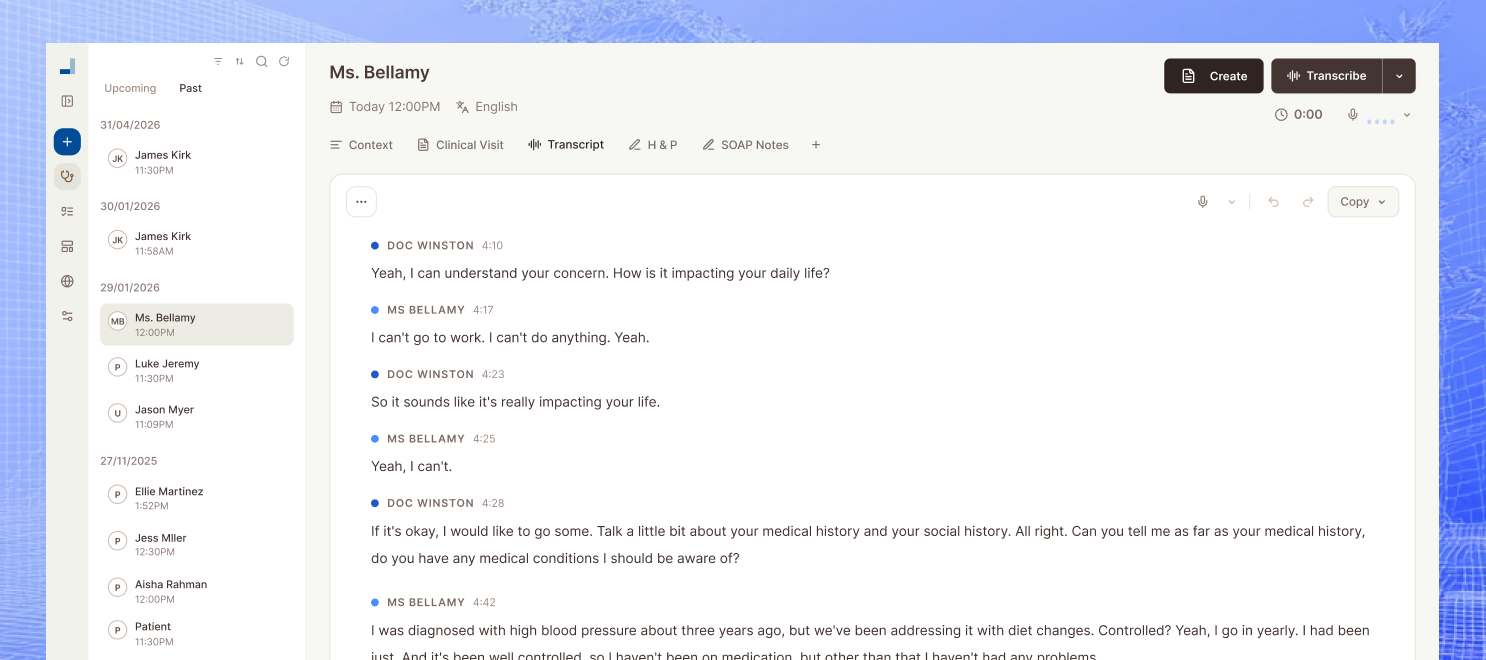
Mcoy AI is an AI medical scribe that records and transcribes patient encounters, then generates multiple clinical note types (H&P, progress notes, consult notes, follow-up notes, procedure notes, discharge summaries, referral letters, and more). With over 200 customizable templates and a built-in AI chat, it allows clinicians to create custom letters, forms, and documents effortlessly, ensuring that every encounter is documented accurately and instantly.
FAQ
Managing a rotating medical staff can be complex, but AI tools can simplify the administrative burden. Here are some common questions about implementing these systems.
How accurate are AI medical scribes in real clinics?
In modern clinical settings, AI scribes are remarkably accurate at capturing the nuances of medical dialogue, including complex terminology. However, they are designed to be assistive, meaning they may occasionally misinterpret context or specific accents. It is essential for the clinician to perform a quick review to ensure 100% accuracy before signing off. Over time, as the system learns specific clinician preferences, the need for deep editing typically decreases.
Do I still need to review every note?
Yes, reviewing every note is a fundamental requirement for both patient safety and medico-legal reasons. While the AI does the heavy lifting by organizing and drafting the content, the doctor must verify that all clinical findings and plans are represented correctly. Most providers find that this review process takes less than a minute, which is still significantly faster than typing a note from scratch. The goal is to shift from ‘content creator’ to ‘content editor.‘
What note types can an AI scribe generate besides SOAP?
Modern AI systems are highly versatile and can generate a wide range of documents including History and Physical (H&P) reports, consult notes, and procedure summaries. They are also capable of drafting discharge summaries and referral letters to other specialists. This variety ensures that every aspect of the patient journey is documented in the appropriate format. Custom templates allow clinics to tailor these outputs to their specific departmental needs.
Will this work for telehealth and in-person consults?
Yes, AI medical scribes are designed to function effectively in both environments. For in-person visits, the device captures ambient audio from the room, while for telehealth, it integrates with the digital audio stream of the call. In both cases, the AI filters out background noise to focus on the conversation between the provider and the patient. This flexibility is a major advantage for modern practices that utilize hybrid care models.
How do I explain recording/transcription to patients?
Transparency is the best approach when introducing recording technology to patients. Explain that the tool allows you to focus entirely on them rather than on your keyboard. Most patients appreciate the increased eye contact and the feeling that they are being heard more clearly. Using a standardized, friendly script ensures that the explanation is consistent across all rooms and providers.
How do clinics prevent note bloat?
Note bloat occurs when redundant or irrelevant information is pulled into the medical record, often through ‘copy-paste’ habits. AI scribes help prevent this by synthesizing the conversation and pulling out only the pertinent clinical facts. By selecting specific templates and setting parameters for brevity, clinics can ensure that the resulting notes are concise, focused, and easy for other providers to read. This results in a much higher quality medical record.
How long does template setup take?
Setting up initial templates usually takes very little time, as most high-quality systems come with a library of pre-built options for various specialties. Fine-tuning these to match a specific clinic’s workflow might take an hour or two of initial effort. Once the templates are established, they can be used by any incoming locum or permanent staff member immediately. This ‘set it and forget it’ approach is key to maintaining consistency.
What’s the safest way to start if I’m skeptical?
The safest way to begin is with a small pilot program involving a single trusted clinician or a specific, low-risk visit type. This allows you to witness the technology’s impact on workflow and note quality firsthand without committing your entire practice. Monitoring the time saved and the feedback from the pilot clinician will provide the data needed to make an informed decision. Starting small minimizes risk while highlighting the tangible benefits of reduced administrative labor.
Conclusion
Maintaining a consistent standard of care across a rotating team of locums is one of the toughest challenges in clinic management. By adopting a structured workflow and leveraging an AI medical scribe, you can ensure that every patient encounter is documented with precision and clarity. This not only protects the clinic legally but also ensures that permanent staff have the data they need to provide seamless follow-up care. If you are ready to eliminate the chaos of inconsistent charting, the best next step is to initiate a pilot and see the results for yourself.
SEO description: Learn how to maintain consistency across locums using AI to standardize clinic notes, improve handovers, and reduce documentation time effectively.
What a serious review table should cover
| Decision area | Common mistake | Better clinic-ready approach | Metric to watch |
|---|---|---|---|
| Workflow design | Treat consistency across locums using ai | clinical workflow guide as a one-off documentation task | Build a repeatable process with clear ownership and review points |
| Team adoption | Assume every clinician will naturally use the same process | Train for consistency and define exception handling early | Active user adoption |
| Quality review | Only check notes when a problem is reported | Audit a sample of notes weekly and review edge cases | Edit rate per note |
| Operational follow-through | Leave admin actions outside the documentation workflow | Use the same encounter data for referrals, letters, and follow-up tasks | Completion rate for next-step tasks |
Related reading
If you are working through consistency across locums using ai | clinical workflow guide, it helps to read this alongside Practice Operations: How Clinics Can Streamline Daily Operations, Practice Operations: How Clinics Can Improve Workflow Without Changing Their EHR, and AI & Medicine: Build Procedure Note Templates: Free Guide & Resources. Those guides cover adjacent workflow, implementation, and evaluation questions so the decision does not sit in isolation.