AI & Medicine: Customize Mcoy AI Templates: Specialty Guide for Doctors
Learn how to optimize Mcoy AI templates for your medical specialty. Streamline H&Ps, consult notes, and specialty-specific documentation today.
The Hidden Burden of Generic Documentation
For many clinicians, the end of the patient day doesn’t signal rest—it signals the start of ‘pajama time,’ those grueling hours spent catching up on documentation. Whether it’s GPs managing complex chronic conditions or specialists dealing with high-volume procedural notes, the friction of templates that don’t quite fit your workflow causes significant burnout. Rushed notes lead to inconsistency, and the anxiety of potential medico-legal gaps often results in over-charting and mental fatigue.
This guide will teach you the exact workflow for customizing medical documentation to your specific needs. We will explore note formats beyond the standard SOAP note, quality control measures to ensure accuracy, and a clear rollout plan for your private practice or university clinic. By the end of this article, you will know how to turn an AI assistant into a specialized clinical tool that mirrors your unique style of practice.
What a medical scribe solves in modern practice
The real cost of traditional documentation isn’t just time; it’s cognitive load. When a doctor is focused on typing or clicking through rigid EHR boxes, the patient-doctor connection suffers. Studies suggest that for every hour of patient care, clinicians spend nearly two hours on administrative tasks. Delayed notes often result in missed nuances or the ‘cloning’ of previous entries, which degrades the quality of the medical record over time.
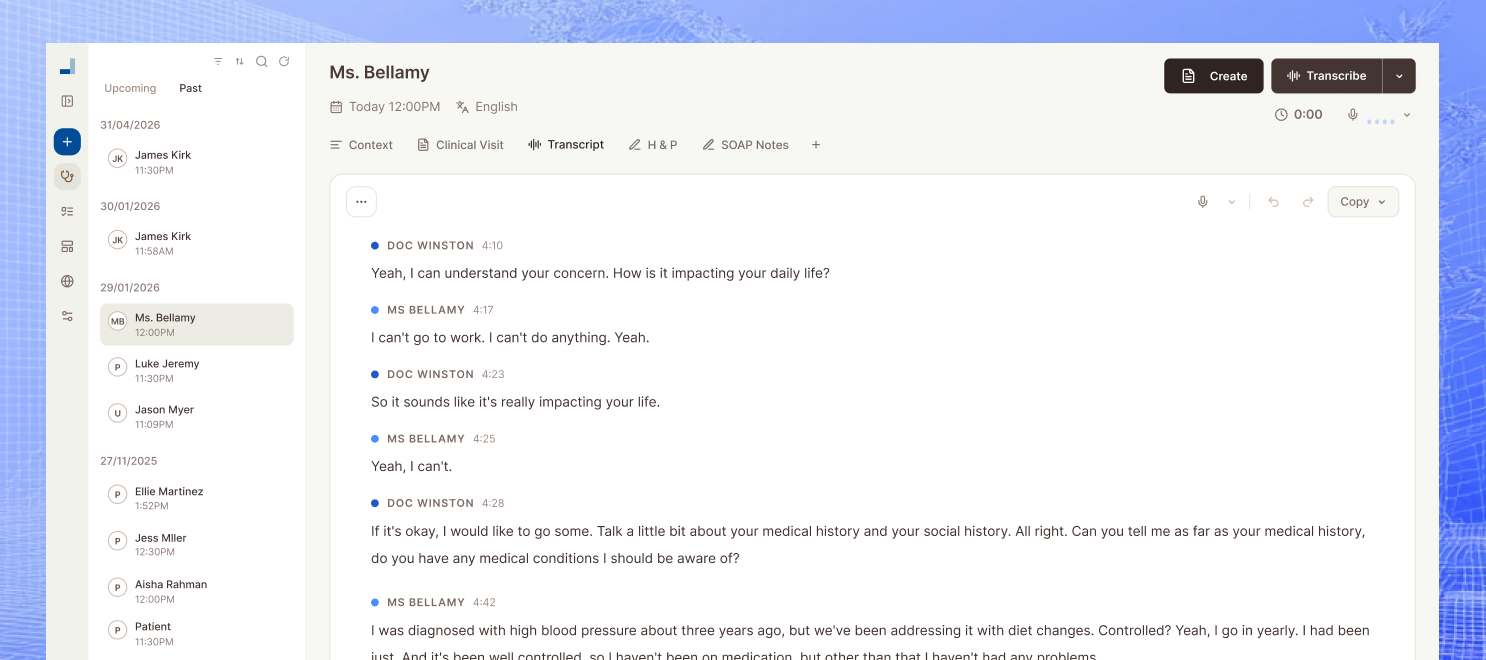
An AI medical scribe acts as an assistive layer, capturing the natural dialogue of an encounter and filtering it into structured medical logic. It is important to remember that these tools are assistive—the clinician remains the ultimate authority and is responsible for the final verification of every document. By offloading the mechanical task of transcribing and formatting, practitioners can return their focus to the human side of medicine.
- Eliminates the ‘pajama time’ documentation backlog.
- Captures granular details that might be forgotten hours later.
- Reduces cognitive load during the patient encounter.
- Provides a structured draft for clinician review and signing.
Note types you can generate beyond SOAP (H&P and more)
While the SOAP note is a healthcare staple, it often fails to capture the complexity of specialized care. A History and Physical (H&P) requires a more narrative depth, while a procedure note must follow strict sequential logic to meet billing and safety standards. Using the same structure for a routine follow-up that you use for a first-time consultation leads to inefficient records and buried information.
Advanced documentation systems now allow for the generation of consult notes, discharge summaries, and even complex referral letters. This variety ensures that the information is formatted specifically for its recipient—whether that is an insurance auditor, a fellow specialist, or a primary care physician. High-quality structure is the backbone of audit readiness and seamless handover quality within a clinic.
- H&Ps and consult notes for comprehensive initial evaluations.
- Procedure and progress notes for ongoing tracking and surgical interventions.
- Follow-up notes focusing on interval changes and medication titration.
- Referral letters and discharge summaries for continuity of care.
How to implement How to Customize Mcoy AI Templates for Your Specialty [Full Guide] step-by-step
To begin the process of tailoring your documentation, start by selecting one specific visit type rather than trying to overhaul your entire workflow at once. Most practitioners find success starting with their most repetitive visit—perhaps a standard follow-up or a common routine screening. By perfecting the template for this single encounter type, you build confidence in the system’s ability to capture your specific phrasing and clinical preferences.
Once you have selected a visit type, set up your templates based on your specialty’s specific requirements. An orthopedist will need a physical exam section focused on range of motion and provocative testing, whereas a psychiatrist will prioritize the mental status examination and behavioral observations. Setting these parameters ensures the AI knows exactly which headers to populate during the transcription process.
Next, focus on capturing the encounter naturally. Whether you are conducting an in-person physical or a telehealth session, the goal is to keep the conversation fluid. As you speak with the patient, verbalize your findings—this ‘thinking out loud’ not only engages the patient but provides the AI with the specific data points needed to fill out your specialized template accurately.
After the encounter, the review and edit phase should be lightning-fast. Because you have already customized the template, the output should already be in your preferred style. Spend sixty seconds reviewing the draft for accuracy, ensuring medications and dosages are exact. Finally, reuse these outputs to instantly generate referral letters or patient instruction forms, maximizing the utility of a single captured encounter.
- Pilot the system with one common visit type first.
- Configure specialty-specific headers for H&Ps and consults.
- Verbalize findings during the exam to enhance data capture.
- Review, edit, and repurpose clinical notes for letters and forms.
How to keep note quality high and reduce mistakes
The transition to AI-assisted documentation requires a shift in how we approach quality control. Typical failure points in electronic records include ‘note bloat,’ where unnecessary information is pulled in, or errors in medication names and specific values like blood pressure. A common pitfall is failing to update the ‘problem list,’ leading to the carryover of resolved issues in every subsequent note.
Establishing a lightweight review habit is essential. Every member of the clinical team should understand that while the AI does the heavy lifting, the human eye is the final safeguard against error. Setting team standards for how notes should look and what must be included prevents the ‘Wild West’ of varying note quality within the same practice, ensuring a unified professional standard for the medical group.
- Perform a 60-second ‘sanity check’ on every generated note.
- Verify all numeric values and medication dosages manually.
- Prune unnecessary text to prevent clinical note bloat.
- Standardize specialty templates across the entire clinic team.
Privacy, consent, and patient trust
Discussing the use of AI in the exam room requires transparency and simplicity. While consent laws vary significantly by region, best practices suggest always informing the patient that a digital scribe is being used to help you focus more on their care. Patients are generally very supportive when they realize the technology means the doctor won’t be staring at a computer screen the whole time.
You might explain it like this: ‘To help me focus entirely on you during our visit, I’m using a secure clinical tool that records our conversation and helps me write my notes. It’s private, secure, and ensures I don’t miss a single detail of your care. Is that okay with you?’ This approach builds trust by framing the technology as a benefit to the patient experience.
- Follow local and regional guidelines for patient recording consent.
- Frame the tool as a way to prioritize the patient-doctor relationship.
- Ensure the system uses high-level encryption for data retention.
- Maintain a clear policy on how long recordings are stored.
Rolling it out across a clinic without disruption
A successful rollout starts with a two-week pilot involving one or two ‘tech-forward’ clinicians. During this period, track specific metrics such as time saved per day, the reduction in after-hours charting, and the perceived completeness of the notes. Using these data points helps win over skeptical staff and demonstrates the tangible ROI of the transition.
Training should focus heavily on template alignment. When every clinician uses the same high-quality templates for similar visit types, it creates a cohesive medical record that is easy for specialists and insurance providers to read. Group training sessions can help practitioners share ‘prompts’ or verbal shortcuts that help the AI generate even more accurate documentation for their specific specialty.
- Start with a 14-day small-group pilot to gather data.
- Track time-savings and note-completion efficiency.
- Conduct cross-specialty template alignment workshops.
- Gradually scale to all providers once workflow is optimized.
Mcoy AI is an AI medical scribe that records and transcribes patient encounters, then generates multiple clinical note types (H&P, progress notes, consult notes, follow-up notes, procedure notes, discharge summaries, referral letters, and more). It offers 200+ customizable templates and features an AI chat to create letters, forms, and other documents directly from the encounter data, allowing clinicians to focus on patients while the software handles the complex formatting and administrative requirements of modern medicine.
Conclusion
Optimizing your clinical workflow doesn’t have to be a daunting task. By moving toward a specialty-focused documentation model, you can significantly reduce the hours spent on administrative tasks. The key is to start small, customize your templates carefully, and maintain a consistent review process to ensure the highest quality of patient care. Following this guide on How to Customize Mcoy AI Templates for Your Specialty [Full Guide] will allow you to regain control of your schedule. Modern technology is here to assist you—take the first step by piloting a specialized template in your next clinic session.
What a serious review table should cover
| Decision area | Common mistake | Better clinic-ready approach | Metric to watch |
|---|---|---|---|
| Workflow design | Treat customize mcoy ai templates: specialty guide for doctors as a one-off documentation task | Build a repeatable process with clear ownership and review points | Time to complete documentation |
| Team adoption | Assume every clinician will naturally use the same process | Train for consistency and define exception handling early | Active user adoption |
| Quality review | Only check notes when a problem is reported | Audit a sample of notes weekly and review edge cases | Edit rate per note |
| Operational follow-through | Leave admin actions outside the documentation workflow | Use the same encounter data for referrals, letters, and follow-up tasks | Completion rate for next-step tasks |
Related reading
If you are working through customize mcoy ai templates: specialty guide for doctors, it helps to read this alongside AI & Medicine: How to Simplify Clinical Notes for Busy Doctors, AI & Medicine: How Doctors Can Improve SOAP Notes, and Compare & Choose: Best AI Scribe Workflow Guide for Provider Teams [2024]. Those guides cover adjacent workflow, implementation, and evaluation questions so the decision does not sit in isolation.
FAQ
How accurate are AI medical scribes in real clinics?
AI medical scribes currently offer high levels of accuracy in capturing clinical dialogue and translating it into medical terminology. However, they are most effective when clinicians speak clearly and verbalize their physical exam findings. Even with high accuracy, it is vital to remember that these are assistive tools meant to provide a draft that the clinician must always review and verify before finalizing.
Do I still need to review every note?
Yes, reviewing every note is a fundamental requirement for clinical safety and professional responsibility. While the AI can do 90% of the work by transcribing and formatting, the clinician must ensure that the assessments, plans, and medication dosages are 100% correct. This review process usually takes only a minute when using a well-tailored template.
What note types can an AI scribe generate besides SOAP?
Modern AI scribes are capable of generating a wide variety of documentation beyond standard SOAP notes. This includes comprehensive History and Physical (H&P) reports, consultation notes for specialists, detailed procedure notes, and discharge summaries. They can also be used to generate referral letters and patient-facing instructions based on the encounter data.
Will this work for telehealth and in-person consults?
Yes, AI medical scribes are designed to be versatile across different types of patient interactions. For in-person visits, the device usually records via a smartphone or tablet in the room. For telehealth, the scribe can often integrate with the audio output of the video call to capture the same level of detail as a physical visit.
How do I explain recording/transcription to patients?
The best way to explain this to patients is to focus on the benefit to them. You might say that the tool allows you to listen more closely and give them your full attention instead of typing on a computer. Most patients are very understanding and appreciative when they see that the technology improves the human connection during their appointment.
How do clinics prevent note bloat?
Clinics prevent note bloat by using highly specific templates that only include relevant headers for the visit type. By customizing the ‘instructions’ given to the AI, you can tell it to be concise and only include pertinent positives and negatives. Regular team reviews of documentation standards also help keep the notes focused and professional.
How long does template setup take?
Setting up a basic template usually takes only a few minutes. However, fine-tuning a template to perfectly match your personal clinical style or a specific sub-specialty might take a few trial encounters. Most clinicians find that within 3 to 5 visits, they have tweaked their templates to a point where very little editing is required thereafter.
What’s the safest way to start if I’m skeptical?
The safest way to start is with a ‘shadow’ pilot. Use the AI scribe during a few encounters but continue your traditional charting method as a backup. Compare the AI-generated note to your own note to see how much detail it caught and where it saved you time. This low-pressure approach allows you to build trust in the system before fully switching over.