Compare & Choose: Best AI Scribe Workflow Guide for Provider Teams [2024]
Learn how to implement an AI scribe workflow for clinics. Reduce burnout with structured medical documentation, H&P, and custom templates for your team.
What a medical scribe solves in modern practice
The burden of administrative documentation is a leading contributor to clinician burnout across private practices and university clinics. When providers spend their evenings catching up on charts, the cognitive load doesn’t just impact their personal life; it degrades the quality of patient care. Delayed notes lead to missed details, and the rush to finish documentation often results in generic, low-value entries that fail to capture the nuance of a complex patient encounter.
An AI medical scribe serves as an assistive layer, capturing the dialogue of the visit in real-time so the clinician can focus entirely on the patient. It is important to remember that these tools are supportive rather than autonomous. The provider remains the clinical authority, responsible for reviewing and finalizing every note, ensuring that the AI has accurately reflected the medical decision-making process without the friction of manual typing.
- Eliminates late-night charting by completing notes immediately after visits.
- Enhances patient engagement by removing the screen as a barrier during consults.
- Standardizes documentation quality across a multi-provider team or department.
- Reduces the cognitive fatigue associated with repetitive data entry.
Note types you can generate beyond SOAP (H&P and more)
While the SOAP note is a clinical staple, modern healthcare requires a much broader range of documentation to support continuity of care. University clinics and specialist groups often need comprehensive History and Physical (H&P) reports for new admissions, detailed consult notes for referring physicians, and specific procedure notes for billing and compliance. Relying on a single format for every interaction often leads to data gaps or unnecessary clutter.
Effective clinical workflows leverage diverse outputs such as progress notes for chronic care management, follow-up notes that highlight changes since the last visit, and professional referral letters that summarize the patient’s journey for the next provider. Using structured formats for discharge summaries ensures that transitions of care are safe and that the next team has a clear roadmap of the hospital course and pending labs.
Consistency in these formats is vital for audit readiness and medico-legal protection. When a clinic adopts a standardized approach to various note types, it ensures that every provider in the group is speaking the same clinical language. This level of organization not only streamlines internal reviews but also enhances the professional reputation of the clinic among its peers.
- H&P and Consult Notes for comprehensive initial evaluations.
- Procedure Notes and Discharge Summaries for surgical or hospital workflows.
- Follow-up Notes and Progress Notes for longitudinal care tracking.
- Professional Referral Letters to maintain high-quality communication with specialists.
How to implement an AI scribe workflow step-by-step in a real clinic
Transitioning a whole team to an AI scribe workflow requires a phased approach to prevent operational friction. Start by selecting a single visit type—such as routine follow-ups or simple acute visits—for the first week. This allows the providers to become comfortable with the technology in a low-stakes environment. During this initial phase, clinicians should focus on finding their natural rhythm of speaking and documenting without worrying about complex cases.
Once the initial comfort is established, the next step involves configuring templates tailored to specific specialties. For example, a dermatology provider will require a different structural emphasis than a psychiatrist. By setting up these preferences early, the team ensures that the outputs align with their existing clinical standards. Providers can then begin capturing both in-person and telehealth encounters, testing the AI’s ability to filter out ambient noise or connection artifacts.
The workflow truly becomes efficient when clinicians adopt a ‘review and edit’ habit. Instead of writing from scratch, the provider scans the AI-generated draft for accuracy, making minor adjustments to the plan or physical exam findings. This review shouldn’t take more than sixty seconds if the capture was clean. Finally, the team should leverage the generated content to populate other required documents, such as school notes or work excuses, ensuring no effort is duplicated.
- Start with one common visit type to build provider confidence quickly.
- Customize templates by specialty to ensure high-quality, relevant outputs.
- Implement a rapid review process where edits are made immediately after the visit.
- Repurpose encounter data into letters and forms to maximize time savings.
How to keep note quality high and reduce mistakes
Even the most advanced technology can fall prey to ‘note bloat’ or the inclusion of irrelevant information if not managed correctly. Common failure points often include the AI misinterpreting lab values mentioned during the chat or missing subtle medication adjustments. To combat this, clinics should establish a lightweight review habit where the physician checks the ‘Assessment and Plan’ section first, as this is the most critical area for clinical accuracy.
Setting team standards is equally important. If one provider likes verbose descriptions while another prefers concise bullet points, the AI should be trained via templates to accommodate both while maintaining a baseline of professional quality. Periodic peer reviews of notes can also help identify if the AI is consistently missing specific types of data, allowing the clinic to adjust their dictation style or template settings accordingly.
- Focus review on the Assessment and Plan to ensure clinical safety.
- Use specific templates to prevent irrelevant data from cluttering the note.
- Establish team-wide documentation standards for consistency.
- Ensure subjective patient complaints are accurately captured and contextually relevant.
Privacy, consent, and patient trust (plain English)
Patient trust is the foundation of any successful medical practice. When introducing an AI scribe workflow, it is essential to follow local regulations regarding consent and data storage. While legal requirements vary by region, transparency is almost always the best policy. Patients are generally supportive of technology that allows their doctor to look them in the eye rather than at a keyboard, provided they know their data is secure.
A simple way to explain the process is to say: ‘To make sure I’m giving you my full attention, I’m using an AI assistant to help me take accurate notes of our conversation today. It records our talk and deletes the audio after the note is finished. Is that okay with you?’ This approach is direct and addresses the primary concern of privacy without being overly technical.
- Verify and follow local data privacy laws and institutional policies.
- Use a simple, conversational script to obtain verbal patient consent.
- Explain the benefits of better eye contact and more accurate records.
- Ensure the chosen tool adheres to high security and encryption standards.
Rolling it out across a clinic without disruption
Success in a group setting depends on a structured rollout. A two-week pilot with a small group of ‘super-users’ is often the best way to identify potential hurdles before the entire clinic adopts the tool. During this time, the team should track specific metrics like time saved per day, the reduction in after-hours charting, and the speed of note completion.
Training should be hands-on and focused on template alignment. If the clinic uses a specific EHR, the team should practice the best way to transfer AI-generated notes into the patient’s permanent record. By showing providers the tangible benefits—specifically the return of their personal time—you create the buy-in necessary for long-term adoption across the university or private clinic setting.
- Launch a 14-day pilot with a small group of early adopters.
- Track time-savings metrics to demonstrate ROI to the whole team.
- Conduct brief training sessions focused on template customization.
- Align the workflow with existing EHR documentation processes.
Mcoy AI: Your Clinical Documentation Partner
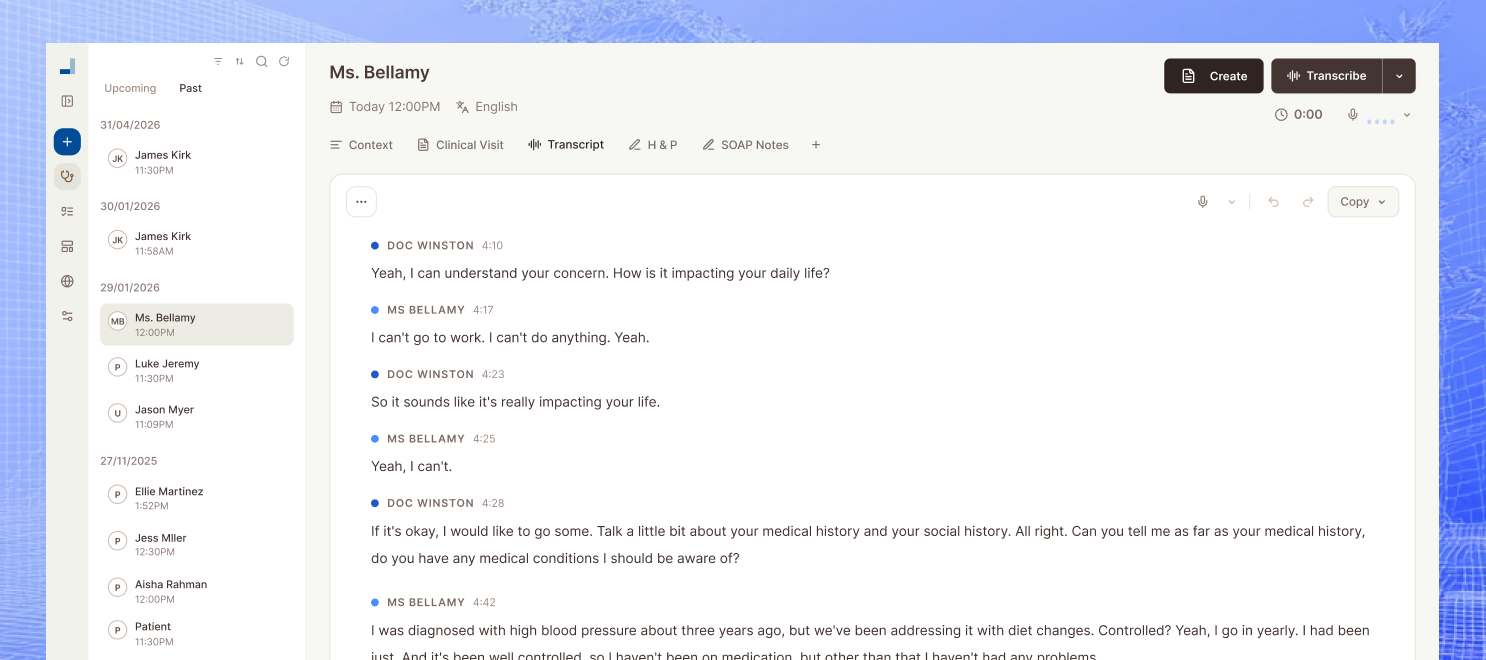
Mcoy AI is an AI medical scribe that records and transcribes patient encounters, then generates multiple clinical note types (H&P, progress notes, consult notes, follow-up notes, procedure notes, discharge summaries, referral letters, and more). With over 200+ customizable templates and an interactive AI chat to create letters, forms, and custom documents, it allows clinicians to spend less time on administration and more time on patient care. The platform is designed to fit seamlessly into diverse clinical environments, providing the flexibility needed for both primary care and specialized medicine through its intuitive interface.
By following this guide, you can successfully implement an AI scribe workflow that supports your team’s clinical excellence. Transitioning away from manual documentation isn’t just a technical upgrade; it’s an investment in the longevity of your providers and the quality of your patient interactions. Focusing on a structured pilot and clear communication will ensure that your AI scribe workflow becomes a permanent, positive part of your practice’s daily operations.
What a serious review table should cover
| Decision area | Common mistake | Better clinic-ready approach | Metric to watch |
|---|---|---|---|
| Workflow design | Treat best ai scribe workflow guide for provider teams [2024] as a one-off documentation task | Build a repeatable process with clear ownership and review points | Time to complete documentation |
| Team adoption | Assume every clinician will naturally use the same process | Train for consistency and define exception handling early | Active user adoption |
| Quality review | Only check notes when a problem is reported | Audit a sample of notes weekly and review edge cases | Edit rate per note |
| Operational follow-through | Leave admin actions outside the documentation workflow | Use the same encounter data for referrals, letters, and follow-up tasks | Completion rate for next-step tasks |
Related reading
If you are working through best ai scribe workflow guide for provider teams [2024], it helps to read this alongside Compare & Choose: Best Tools Doctors Use to Save Time on Clinical Notes, Compare & Choose: Medical Scribing Services: Are They Worth It?, and Admin Management: How to Reduce Admin Errors in Clinical Notes. Those guides cover adjacent workflow, implementation, and evaluation questions so the decision does not sit in isolation.
FAQ
How accurate are AI medical scribes in real clinics?
In most real-world clinical settings, AI scribes are remarkably accurate at capturing the core dialogue and clinical facts of an encounter. They excel at organizing conversation into structured medical formats, though they may occasionally struggle with very heavy accents or multiple people speaking at once. Because they are assistive tools, their accuracy is perfected when the clinician performs a final brief review to ensure all nuances are captured correctly.
Do I still need to review every note?
Yes, the clinician is always the person of record and holds the ultimate responsibility for the medical accuracy of the documentation. While the AI does the heavy lifting of drafting the note, a quick review is necessary to verify lab values, medication dosages, and the final assessment. Most providers find that this review takes less than a minute, which is still a massive time reduction compared to manual typing.
What note types can an AI scribe generate besides SOAP?
Advanced AI scribes can generate a wide variety of documentation beyond the standard SOAP format. These include comprehensive History and Physical (H&P) reports, consultation letters for specialists, detailed procedure notes, and even discharge summaries. By using different templates, the AI can tailor the output to the specific needs of the encounter, whether it’s a routine follow-up or a complex new patient evaluation.
Will this work for telehealth and in-person consults?
Yes, most AI scribe workflows are designed to be flexible enough for both environments. For in-person visits, the device usually sits on the desk to capture the room’s audio, while for telehealth, the system can often capture the audio directly from the computer or mobile device. The quality of the transcription remains high as long as the audio input is clear on both ends of the conversation.
How do I explain recording/transcription to patients?
The best approach is a simple, transparent explanation focusing on the benefit to the patient. You might say that you are using an AI assistant to help you take better notes so you can focus on them instead of the computer screen. Most patients are very understanding once they realize it leads to better eye contact and more thorough attention during their visit.
How do clinics prevent note bloat?
Note bloat is prevented by using highly specific templates that tell the AI exactly which sections to include and which to ignore. Clinics can set rules for conciseness and ensure the AI only captures relevant clinical data rather than a verbatim transcript of the entire social chat. Regularly refining these templates based on provider feedback is the most effective way to keep notes lean and professional.
How long does template setup take?
Basic template setup can be done in minutes using pre-built library options tailored to your specialty. However, for a team of providers, it might take a few days of ‘tweaking’ during the pilot phase to perfectly align the outputs with the group’s preferred style. Once these templates are set, they automatically apply to all future notes, requiring no further manual effort.
What’s the safest way to start if I’m skeptical?
The safest way to start is by running a pilot with just one or two providers on non-complex cases for a week. This allows the team to see the quality of the outputs without any pressure. Starting slow helps the clinic understand the security features, the consent process, and the editing workflow before scaling the tool to the entire provider group.