Specialty Guides: How to Create Treatment Plans From a Transcript | Full Guide
Learn how to create treatment plans from a transcript efficiently. Master clinical workflows, note types beyond SOAP, and AI implementation for your clinic.
The Hidden Burden of Modern Clinical Documentation
For most physicians and private practitioners, the end of the patient encounter marks the beginning of a second, more exhausting shift: the documentation marathon. After-hours charting has become a primary driver of clinician burnout, leading to rushed notes that may lack the nuance required for complex cases. When you are focused on typing, the human connection with the patient suffers, and the risk of medico-legal anxiety increases as practitioners worry whether they captured every critical detail of the care plan.
This guide provides a comprehensive roadmap for transforming clinical workflows by learning how to create treatment plans from a transcript. We will explore various note formats beyond the standard SOAP method, discuss quality control strategies, and address privacy concerns. Whether you are a general practitioner, a specialist in a high-volume clinic, or managing a university health center, mastering this transition will help you reclaim your time while improving the accuracy of your medical records.
What a medical scribe solves in modern practice
The real cost of traditional documentation isn’t just time; it is the cognitive load of trying to remember specific patient phrases while simultaneously navigating an EHR. Delayed notes often lead to missed details, which can compromise the continuity of care. An AI medical scribe acts as a digital first-responder, capturing the raw dialogue of the encounter so the clinician can remain fully present with the patient. This technology bridges the gap between the conversation and the final medical record.
It is important to understand that an AI scribe is an assistive tool, not a replacement for clinical judgment. While it can accurately record and organize data, the clinician remains the final authority and is legally responsible for the accuracy of every entry. By offloading the mechanical task of transcribing and formatting, the scribe allows the doctor to focus on synthesis and diagnosis rather than data entry.
- Reduces the cognitive load of multitasking during patient visits.
- Minimizes “pajama time” spent on charting after clinic hours.
- Ensures that patient concerns are captured in their own words.
- Maintains clinician oversight as the final validator of all notes.
Note types you can generate beyond SOAP (H&P and more)
While the SOAP note is the industry standard, many clinical encounters require more specialized documentation. Understanding how to create treatment plans from a transcript allows you to generate History and Physical (H&P) reports, which offer a more comprehensive overview of a patient’s status than a standard progress note. These are essential for new admissions or complex initial consultations where a deep dive into the patient’s background is necessary.
Beyond H&P, practitioners frequently need consult notes, follow-up summaries, and procedure notes. Each of these serves a specific purpose in the healthcare ecosystem. For example, a consult note must communicate specific recommendations back to a referring provider, while a discharge summary focuses on the transition of care and post-visit instructions. Having a system that can toggle between these formats ensures high-quality handovers and audit readiness.
Effective documentation structure is not just about compliance; it is about patient safety. When notes are organized logically—covering everything from referral letters to detailed follow-up plans—it ensures that every member of the care team is aligned. This consistency is particularly vital in university clinics where multiple residents or specialists may be involved in a single patient’s longitudinal care.
- H&P and comprehensive consult notes for complex cases.
- Rapid progress notes and follow-up summaries for routine visits.
- Detailed procedure notes and discharge instructions for clarity.
- Referral letters generated directly from the encounter transcript.
How to implement how to create treatment plans from a transcript step-by-step
Starting the implementation process begins with selecting a single visit type to pilot. Rather than trying to automate every encounter on day one, choose something high-frequency and relatively predictable, such as routine follow-ups or wellness exams. This allows the clinical team to get comfortable with the recording process without the pressure of a high-acuity situation. Once the flow feels natural, you can expand to more complex consultations.
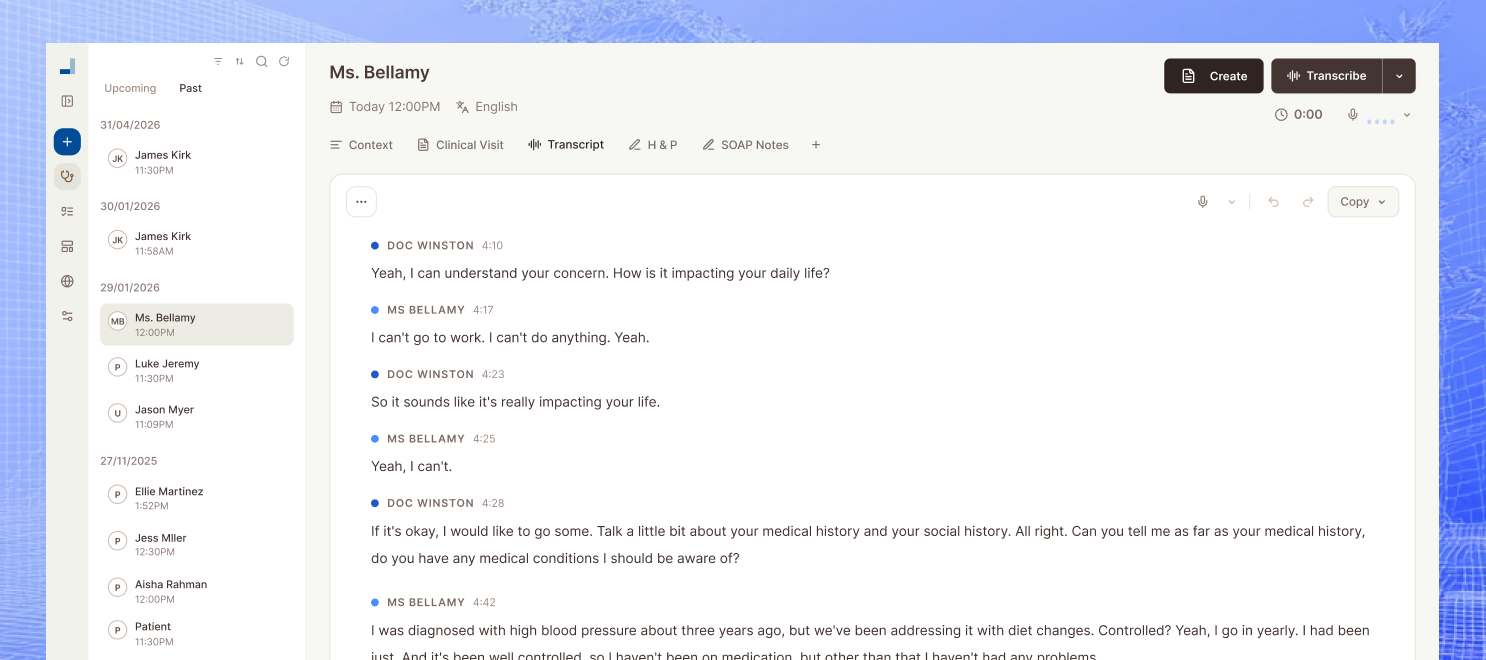
Next, you should set up templates tailored to your specific specialty. A cardiologist and a pediatrician have different documentation needs; ensuring your system knows which data points to prioritize is key. During the encounter, whether it is in-person or via telehealth, simply focus on the patient and let the transcript capture the dialogue. You don’t need to change how you speak; the best results often come from natural, transparent conversations.
After the encounter, the system will provide a draft. This is where the clinician’s role is most active: review and edit the output quickly. Because the transcript provides the foundation, you are merely refining the clinical narrative rather than building it from scratch. Finally, utilize these outputs beyond the EHR. The same data used for the treatment plan can be instantly repurposed to generate referral letters or patient education forms, significantly reducing administrative overhead.
- Select one frequent visit type to pilot the new workflow.
- Customize templates to match your specialty’s specific requirements.
- Capture the encounter naturally through the audio transcript.
- Review, edit, and repurpose the data for letters and forms.
How to keep note quality high and reduce mistakes
Standardizing documentation quality is essential to prevent common pitfalls such as “note bloat” or the omission of key medications. One of the primary failure points in manual or automated charting is the inclusion of irrelevant information that obscures the actual care plan. To prevent this, clinicians should adopt a lightweight review habit, spending sixty seconds at the end of each draft to ensure the problem list and medication changes are perfectly characterized.
Team standards also play a role in maintaining high-quality records. Establishing a set of internal benchmarks for what constitutes a complete note helps ensure consistency across the practice. By focusing on clarity and brevity, you can avoid the trap of overly long documents that are difficult for other providers to scan and understand during future visits.
- Check the problem list and medication dosages for absolute accuracy.
- Avoid note bloat by focusing on relevant clinical findings.
- Implement a standard review process for every generated note.
- Maintain consistent formatting across the entire clinical team.
Privacy, consent, and patient trust
Patient trust is the foundation of any successful clinical documentation strategy. While laws regarding recording vary significantly by region, the best practice is always to be transparent. Ensure your clinic follows local guidelines for patient consent and that your privacy policy is clearly displayed. Most patients are supportive of technology that allows their doctor to look at them instead of a computer screen.
To explain the process, use a simple, patient-friendly script: “To make sure I capture everything we discuss today correctly, I use a secure assistant that transcribes our conversation into my clinical notes. This allows me to focus entirely on you instead of my keyboard. Is that alright with you?” Most patients appreciate the extra attention and the commitment to accuracy.
- Always follow local regulations regarding medical recording and consent.
- Use a transparent script to explain the benefit of the technology to patients.
- Ensure the system used meets industry-standard security and retention principles.
- Make documentation a collaborative part of the patient experience.
Rolling it out across a clinic without disruption
A successful rollout requires a structured approach. Start with a two-week pilot involving one or two “tech-forward” clinicians. Use this period to identify any friction points in the workflow and to refine the templates. This small-scale start prevents widespread frustration and allows you to gather real-world data on time savings before a full-facility launch.
During the pilot, track specific metrics such as the reduction in after-hours charting time and the speed of note completion. Comparing these results to previous manual workflows provides the evidence needed to get buy-in from the rest of the staff. When the time comes for full implementation, align the training sessions with existing meeting times to minimize disruption to patient care.
- Start with a 2-week pilot featuring a small group of users.
- Track time-savings and note quality to measure success.
- Refine templates based on real-world feedback before scaling.
- Conduct brief, focused training sessions for the final rollout.
Mcoy AI is an AI medical scribe that records and transcribes patient encounters, then generates multiple clinical note types (H&P, progress notes, consult notes, follow-up notes, procedure notes, discharge summaries, referral letters, and more). With over 200 customizable templates and an AI chat feature, it allows clinicians to create professional letters, forms, and documents instantly based on the session transcript. This tool is designed to integrate seamlessly into your workflow, ensuring that your documentation is both comprehensive and efficient.
FAQ
The following questions address common inquiries from practitioners looking to modernize their documentation workflow through transcript-based planning.
How accurate are AI medical scribes in real clinics?
AI medical scribes have reached a high level of accuracy, particularly in capturing medical terminology and patient narratives. They are excellent at transcribing the literal conversation, which the AI then parses into structured clinical data. However, accuracy also depends on the quality of the audio and the clarity of the dialogue. Clinicians should always perform a quick final review to ensure that the medical nuances are correctly interpreted.
Do I still need to review every note?
Yes, reviewing every note is a mandatory clinical and legal requirement. The AI serves as a powerful assistant that does the “heavy lifting” by drafting the content, but the clinician must verify the details. This review typically takes only a fraction of the time it would take to write a note from scratch. Think of it as being the editor of a document rather than the primary author.
What note types can an AI scribe generate besides SOAP?
Modern systems are incredibly versatile and can generate a wide range of documents including History and Physicals (H&P), procedure notes, and consult letters. They can also create discharge summaries and referral documents by pulling relevant data from the encounter transcript. This flexibility ensures that you have the right format for every clinical scenario you encounter. Most systems allow you to choose your preferred template before the note is processed.
Will this work for telehealth and in-person consults?
Most AI scribing solutions are designed to work across both telehealth platforms and in-person visits. For telehealth, the system captures audio via the computer, while in-person visits usually utilize a smartphone or tablet app. The core logic of converting the transcript into a treatment plan remains the same regardless of how the patient is appearing. This makes it an ideal solution for hybrid practices.
How do I explain recording/transcription to patients?
Transparency is key to maintaining patient trust. Simply explain that the tool is being used to ensure their medical record is as accurate as possible and to allow you to focus on the conversation. Most patients are very receptive when they realize it means their doctor won’t be staring at a screen for the entire visit. Always respect a patient’s preference if they choose to opt-out of the recording.
How do clinics prevent note bloat?
Note bloat is prevented by using smart templates that prioritize relevant information over exhaustive transcription. Instead of including every single word spoken, the AI is trained to extract clinical facts and organize them into the appropriate sections. Practitioners can further customize these templates to ensure that the outputs are concise and focus only on what is necessary for high-quality care. Setting clear internal standards for your clinic also helps keep notes brief.
How long does template setup take?
Initial template setup is usually very quick, often taking just a few minutes per type. Most systems come with pre-built templates for various specialties that can be used immediately or tweaked to fit your specific needs. As you use the system, you can refine your templates over time to better capture your unique charting style. The goal is to create a seamless “set it and forget it” workflow.
What’s the safest way to start if I’m skeptical?
The safest way to start is by trialing the system on a few non-complex cases or routine follow-up visits. This allows you to see the quality of the output without the risk of a high-pressure situation. You can compare the AI-generated note against your traditional manual note to see the difference in detail and time spent. Most providers find that once they see the results for simple cases, they quickly gain the confidence to use it for their entire schedule.
The Future of Documentation
Transitioning to a transcript-based documentation workflow is one of the most effective ways to combat clinician burnout. By following the steps outlined in this guide, you can create a more sustainable practice that prioritizes both patient care and provider well-being. Knowing how to create treatment plans from a transcript is not just a technical skill; it is a fundamental shift toward a more human-centric model of medicine. Start with a small pilot today and experience how streamlined clinical documentation can transform your daily routine.
What a serious review table should cover
| Decision area | Common mistake | Better clinic-ready approach | Metric to watch |
|---|---|---|---|
| Workflow design | Treat how to create treatment plans from a transcript | full guide as a one-off documentation task | Build a repeatable process with clear ownership and review points |
| Team adoption | Assume every clinician will naturally use the same process | Train for consistency and define exception handling early | Active user adoption |
| Quality review | Only check notes when a problem is reported | Audit a sample of notes weekly and review edge cases | Edit rate per note |
| Operational follow-through | Leave admin actions outside the documentation workflow | Use the same encounter data for referrals, letters, and follow-up tasks | Completion rate for next-step tasks |
Related reading
If you are working through how to create treatment plans from a transcript | full guide, it helps to read this alongside Specialty Guides: How to Run a More Efficient Medical Practice in 2026, Specialty Guides: How to Improve Patient Encounters, and Specialty Guides: Patient Consent Script for AI Scribing: Guide & Templates. Those guides cover adjacent workflow, implementation, and evaluation questions so the decision does not sit in isolation.
FAQ
How accurate are AI medical scribes in real clinics?
AI medical scribes are highly accurate in capturing clinical terms and dialogue, but they require clinician oversight to ensure medical nuances are correctly interpreted.
Do I still need to review every note?
Yes, clinicians are legally and professionally responsible for their notes. The AI drafts the content, but the doctor must provide the final validation and edits.
What note types can an AI scribe generate besides SOAP?
Beyond SOAP, AI can generate H&Ps, consult notes, referral letters, and procedure notes by extracting data from the session transcript.
Will this work for telehealth and in-person consults?
Yes, most AI scribes are compatible with both telehealth platforms and in-person visits via mobile apps or computer audio.
How do I explain recording/transcription to patients?
Use a transparent, friendly script explaining that the tool helps you focus on the patient instead of the computer, ensuring a more accurate record.
How do clinics prevent note bloat?
Clinics prevent bloat by using concise templates and training the AI to prioritize the most relevant clinical facts rather than a verbatim transcript.
How long does template setup take?
Initial setup is rapid, often taking only minutes with pre-built specialty templates that can be further customized over time.
What’s the safest way to start if I’m skeptical?
Start with a small pilot on routine follow-up cases to build confidence and compare the AI output against your manual notes.