Admin Management: How to Create Medical Certificates: A Clinician's Guide
Learn how to create medical certificates efficiently using AI medical scribes. Streamline workflow, ensure accuracy, and save time on clinical documentation.
The Hidden Burden of Clinical Administrative Work
For many doctors and private practitioners, the consultation doesn’t end when the patient leaves the room. Instead, it marks the beginning of a second shift: the administrative struggle of creating medical certificates, filling out forms, and catching up on clinical notes. This after-hours charting is a primary driver of clinician burnout, leading to rushed sessions and the constant anxiety that a crucial medico-legal detail might have been missed in the rush.
This guide provides a comprehensive roadmap for optimizing your workflow. We will explore how to create medical certificates from consultations more effectively, examine various note formats beyond the standard SOAP method, and discuss quality control and privacy protocols. Whether you manage a university clinic, a fast-paced GP practice, or a specialized telehealth service, these strategies are designed to reclaim your time without compromising patient care.
What a medical scribe solves in modern practice
The real cost of documentation isn’t just measured in minutes; it is measured in cognitive load. When a clinician is preoccupied with capturing every word for a certificate or progress note, they lose the ability to focus entirely on the patient’s non-verbal cues and complex symptoms. The result is often delayed notes that are finished late at night, when the nuances of the encounter are no longer fresh in the mind.
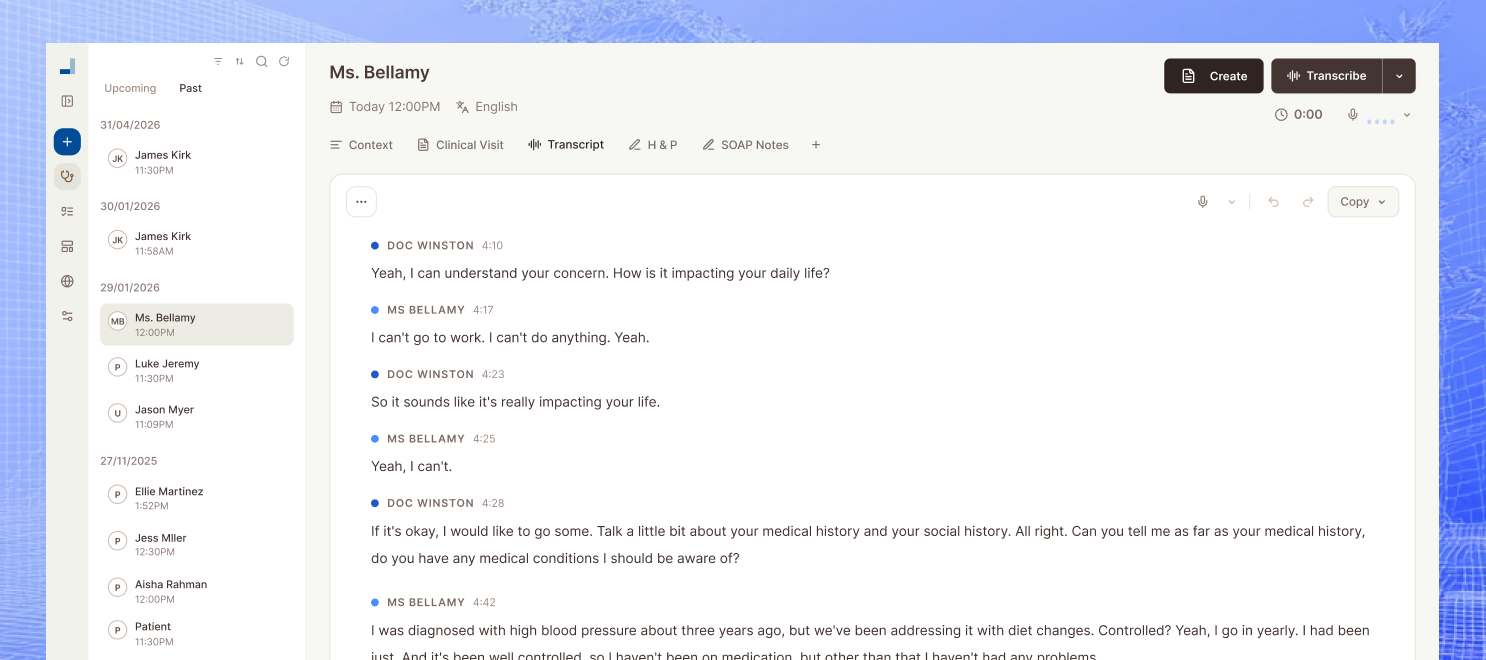
An AI medical scribe acts as an intelligent assistant that captures the dialogue of a visit in real-time. It is important to understand that these tools are assistive—they do not replace the clinician’s judgment. The doctor remains the ultimate authority, reviewing and finalizing every document. By automating the transcription and initial drafting of medical certificates and notes, the scribe allows the provider to return to the heart of medicine: the patient-physician relationship.
- Reduces administrative burnout by eliminating manual data entry.
- Improves note accuracy by capturing details in real-time.
- Allows for more eye contact and engagement during consultations.
- Accelerates the turnaround time for patient documentation.
Note types you can generate beyond SOAP (H&P and more)
While the SOAP note is a staple of medical training, modern practice requires a much broader array of documentation. Comprehensive care often demands History and Physical (H&P) reports, detailed procedure notes, and complex referral letters. Using a rigid format for every encounter can actually lead to less clear communication between providers, especially during handovers or consults.
Structuring these notes correctly is vital for audit readiness and continuity of care. A well-formatted discharge summary or a specific follow-up note ensures that the next provider in the care chain has a clear, concise picture of the patient’s status. When you understand how to create medical certificates from consultations within a broader documentation framework, you improve the professional standard of your entire practice.
- H&P and Progress Notes for comprehensive inpatient or outpatient tracking.
- Consult and Referral letters to ensure seamless specialist communication.
- Procedure Notes and Discharge Summaries for legal and clinical clarity.
- Customizable templates that fit specific specialty requirements.
How to implement how to create medical certificates from consultations step-by-step
Starting with a new digital workflow can feel overwhelming, so the best approach is to begin with one specific visit type. Choose your most common consultation—perhaps a standard sick leave request or a routine follow-up—and use that as your testing ground. This allows you to get a feel for how the AI captures your specific phrasing and clinical style without the pressure of a complex multi-system case.
Next, you should set up templates by specialty. A pediatrician needs different data points than an orthopedic surgeon. By pre-configuring your AI scribe with your preferred headings and certificate formats, you ensure the output matches your existing standards. Once the encounter begins, whether it is in-person or via a telehealth platform, simply let the technology capture the conversation naturally.
After the patient leaves, the review and edit phase should take less than a minute. You check the generated text for accuracy, make any minor adjustments, and finalize the document. The final step is where the real efficiency lies: reusing these outputs. The data captured during the transcription can be instantly repurposed into medical certificates, employer letters, or insurance forms, preventing you from having to type the same information multiple times.
- Start small by piloting the workflow with one common visit type.
- Use specialty-specific templates to maintain clinical standards.
- Review and finalize notes immediately while the visit is fresh.
- Repurpose captured data for various administrative documents.
How to keep note quality high and reduce mistakes
Even with advanced technology, clinical documentation can suffer from common failure points like missing medications, incorrect lab values, or “note bloat.” Note bloat occurs when irrelevant details are included, making it harder for other clinicians to find the necessary information. Maintaining high quality requires a disciplined approach to the review process.
Establish a lightweight review habit where you verify the problem list and the plan of care before signing off. Setting team standards for what should be included in a medical certificate ensures consistency across your clinic. By treating the AI output as a highly sophisticated draft rather than a finished product, you maintain the highest level of medico-legal safety.
- Audit your notes periodically to ensure they remain concise and relevant.
- Verify critical data like dosages and dates during the review.
- Standardize documentation expectations across all clinic staff.
- Focus on the clinical plan to ensure it is actionable and clear.
Privacy, consent, and patient trust
Patient privacy is the cornerstone of the medical profession. When introducing recording or transcription technology, it is essential to follow your local regional policies and healthcare regulations. While consent requirements vary, transparency is always the best policy. Most patients are supportive of new technology when they understand it helps their doctor focus more on their health and less on a computer screen.
You can use a simple script to explain the process: “I’m using an AI assistant today to help me take accurate notes so I can focus entirely on our conversation. It records our discussion and turns it into a medical record for me to review. Is that okay with you?” This approach builds trust and ensures the patient feels involved in the process.
- Stay compliant with local privacy laws and institutional policies.
- Use a clear, simple script to obtain patient consent.
- Ensure data is handled with enterprise-grade security and encryption.
- Maintain transparency about how patient data is stored and used.
Rolling it out across a clinic without disruption
A successful rollout involves more than just software; it requires a change management plan. Start with a two-week pilot involving one or two “champion” clinicians who are tech-savvy. They can iron out any workflow kinks and provide feedback on template alignment before the rest of the team joins.
During this period, track specific metrics such as time saved on charting and the reduction in after-hours work. Seeing tangible evidence of a better work-life balance is the fastest way to gain buy-in from skeptical staff. Training sessions should focus on how to edit efficiently rather than how to type, reflecting the shift from creator to editor.
- Launch with a small pilot group to refine the workflow.
- Monitor time-saving metrics to prove the value of the tool.
- Align templates across the organization for uniform documentation.
- Focus training on high-level review and editing skills.
Mcoy AI is an AI medical scribe that records and transcribes patient encounters, then generates multiple clinical note types including H&P, progress notes, consult notes, follow-up notes, procedure notes, discharge summaries, referral letters, and more. With over 200 customizable templates and an interactive AI chat feature, clinicians can easily create medical certificates, forms, and complex documents tailored to their specific practice needs.
Conclusion
Mastering how to create medical certificates from consultations using modern tools is a game-changer for the modern practitioner. By shifting the burden of transcription to an intelligent system, you can reduce burnout and focus on delivering high-quality care. Start your pilot today and experience the difference that a streamlined charting process makes for your practice and your patients.
What a serious review table should cover
| Decision area | Common mistake | Better clinic-ready approach | Metric to watch |
|---|---|---|---|
| Workflow design | Treat how to create medical certificates: a clinician’s guide as a one-off documentation task | Build a repeatable process with clear ownership and review points | Time to complete documentation |
| Team adoption | Assume every clinician will naturally use the same process | Train for consistency and define exception handling early | Active user adoption |
| Quality review | Only check notes when a problem is reported | Audit a sample of notes weekly and review edge cases | Edit rate per note |
| Operational follow-through | Leave admin actions outside the documentation workflow | Use the same encounter data for referrals, letters, and follow-up tasks | Completion rate for next-step tasks |
Related reading
If you are working through how to create medical certificates: a clinician’s guide, it helps to read this alongside Admin Management: How to Reduce Admin Errors in Clinical Notes, Admin Management: Medication List Template with Examples, and Practice Operations: Run a 2-Week AI Medical Scribe Pilot: The Full Guide. Those guides cover adjacent workflow, implementation, and evaluation questions so the decision does not sit in isolation.
FAQ
How accurate are AI medical scribes in real clinics?
AI medical scribes are highly accurate in capturing clinical dialogue, often reaching levels of 95% or higher. However, they can occasionally misinterpret complex terminology or background noise. This is why the clinician’s review is a mandatory and vital part of the workflow to ensure every detail is correct.
Do I still need to review every note?
Yes, you must review every note and certificate generated. As the licensed clinician, you are legally responsible for the accuracy of your clinical documentation. The AI provides a comprehensive draft, but your professional sign-off ensures the document meets medical and legal standards.
What note types can an AI scribe generate besides SOAP?
Advanced scribes can generate a wide variety of formats including History and Physicals (H&P), procedure notes, consult letters, and discharge summaries. They are designed to adapt to the specific needs of different specialties, going far beyond the basic SOAP structure.
Will this work for telehealth and in-person consults?
Yes, AI scribes are designed to work across multiple modalities. For telehealth, the system captures audio directly from the computer, while for in-person visits, a mobile device or room microphone is used. The quality of the transcription remains high regardless of the setting.
How do I explain recording/transcription to patients?
The best approach is to be brief and honest. Inform the patient that you are using a digital tool to capture notes so you can pend more time looking at them and less time typing. Most patients appreciate the increased attention and are happy to provide consent.
How do clinics prevent note bloat?
Clinics can prevent note bloat by using specific templates that prompt the AI to focus only on relevant clinical data. Setting internal standards for note length and training clinicians to edit out redundant information during the review stage also helps maintain concise records.
How long does template setup take?
Basic template setup usually takes only a few minutes if you are using pre-built library options. Customizing a template to match your specific specialty or regional certificate requirements might take 10 to 15 minutes, but this time is quickly recovered through daily use.
What’s the safest way to start if I’m skeptical?
The safest way to start is by trying the tool on a few simple, routine cases where the clinical risk is low. This allows you to build confidence in the technology and refine your review process without the pressure of a complex or high-stakes patient encounter.