Physician Wellbeing: Sustainable AI Documentation Routine: A Full Clinic Guide
Learn how to build a sustainable documentation routine using AI medical scribes. Reduce burnout and improve note accuracy in your clinic today.
The Crisis of Documentation Burnout
For many clinicians, the workday doesn’t end when the last patient leaves; it ends hours later after a grueling session of ‘pajama time’ spent catching up on charts. This administrative burden is a primary driver of burnout, leading to rushed notes, potential medico-legal risks, and a significant decrease in job satisfaction. Whether you are running a private practice or managing a busy university clinic, the pressure to maintain high-quality documentation while seeing a full schedule of patients is often overwhelming.
This guide provides a comprehensive roadmap for building a sustainable documentation routine. We will explore how to transition from traditional manual charting to an AI-assisted workflow. You will learn about various note formats beyond the standard SOAP note, quality control measures to ensure clinical accuracy, and a step-by-step rollout plan that ensures your clinic stays compliant and efficient without disrupting the patient experience.
What a medical scribe solves in modern practice
The real cost of documentation isn’t just the minutes spent typing; it is the cognitive load and the ‘split attention’ effect. When a doctor is focused on a screen instead of the patient, the quality of the therapeutic alliance suffers. Manual notes are also prone to delay, which can lead to missed clinical details or errors in the plan of care as memory fades over time. An AI medical scribe addresses these issues by capturing the conversation in real-time, allowing the clinician to stay present and engaged.
It is important to understand that an AI medical scribe is an assistive tool, not a replacement for clinical judgment. The AI handles the heavy lifting of transcribing and organizing the narrative, but the clinician remains the final authority. The doctor must review, edit, and sign off on every note to ensure it reflects the actual encounter and the intended medical reasoning. By automating the drafting process, the AI removes the ‘blank page’ anxiety and shortens the path to a completed chart.
- Reduces administrative ‘pajama time’ significantly.
- Improves patient-provider eye contact and engagement.
- Ensures more detailed and accurate capture of the patient’s narrative.
- Acts as an intelligent assistant while the clinician maintains oversight.
Note types you can generate beyond SOAP (H&P and more)
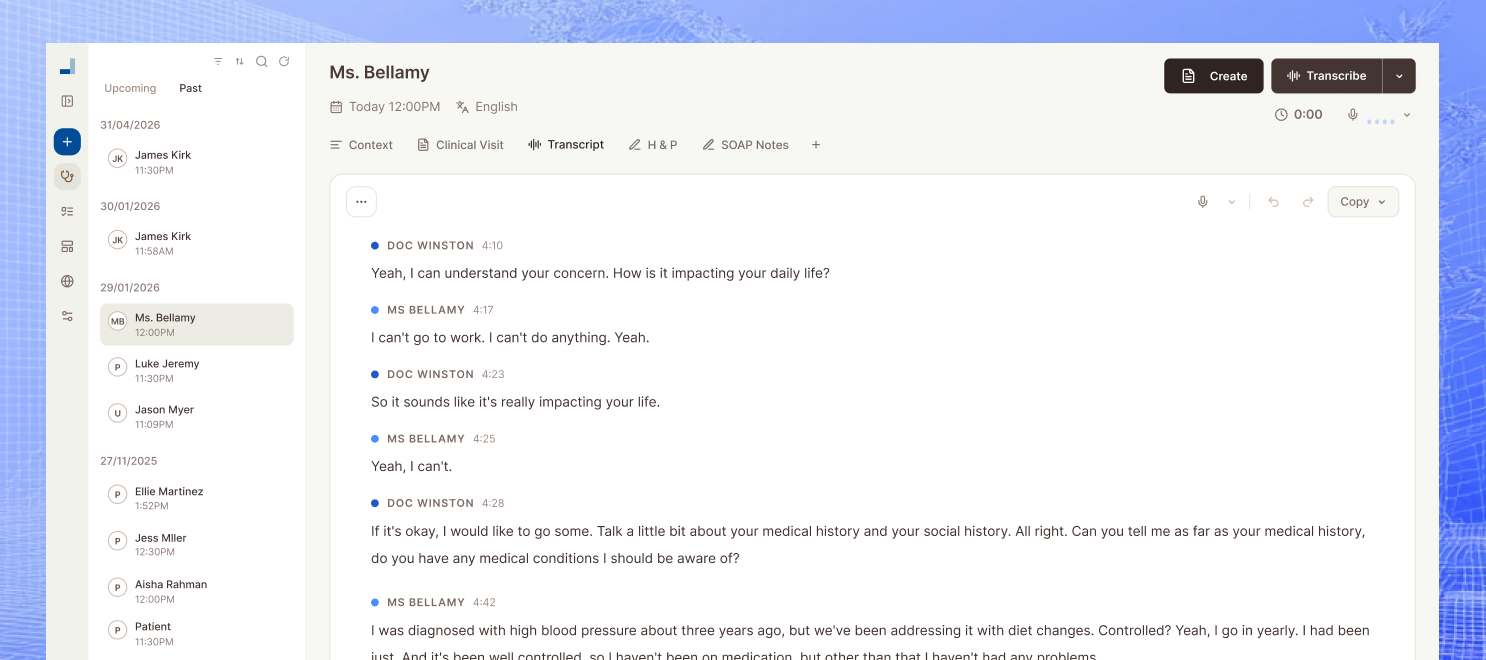
While the SOAP (Subjective, Objective, Assessment, Plan) format is the industry standard for daily progress notes, it isn’t always the best fit for every clinical scenario. A sustainable documentation routine requires flexibility. For new patient intakes, a full History and Physical (H&P) is essential, requiring a deeper dive into past medical history, social history, and a comprehensive review of systems. Specialized notes like consult notes or referral letters serve different audiences and require different focuses.
Modern AI tools can now generate a wide array of documentation types including procedure notes, discharge summaries, and follow-up notes. This variety is crucial for continuity of care and audit readiness. When a specialist receives a clear, structured consult note rather than a messy data dump, the quality of the handover improves, leading to better patient outcomes. Having a system that can toggle between these formats based on the visit type ensures that your records are always fit for purpose.
- Access specialized formats like H&P, Consult, and Procedure notes.
- Improve the quality of handovers and referrals to other specialists.
- Maintain audit-ready records for all encounter types.
- Reduce the time spent re-formatting notes for different stakeholders.
How to implement a sustainable documentation routine step-by-step in a real clinic
Transitioning to an AI-assisted workflow should be a gradual, iterative process. Start by selecting one common visit type, such as follow-up appointments for chronic disease management, to test the system. This allows you to normalize the presence of the tool without the pressure of a complex new patient workup. During this initial phase, focus on finding the right ‘voice’ for your templates and ensuring the AI aligns with your preferred shorthand and clinical logic.
Next, set up your templates by specialty or encounter type. Most clinics find success by creating a library of 10-15 core templates that cover the majority of their daily volume. Once the templates are ready, begin capturing the encounter. Whether it is an in-person visit or a telehealth session, the goal is to let the conversation flow naturally. After the patient leaves, you should spend 60 to 90 seconds reviewing the AI-generated draft, making minor adjustments to the plan or objective findings as needed.
The final step in a sustainable documentation routine is the reuse of outputs. A high-quality note shouldn’t just sit in the EHR; it should serve as the foundation for other administrative requirements. Use the generated text to quickly populate referral letters, work excuse forms, or patient summary instructions. By treating the AI note as a ‘single source of truth,’ you eliminate the need to type the same information multiple times across different documents.
- Start with one visit type to build confidence and refine the flow.
- Customize templates to match your specialty’s specific requirements.
- Capture encounters naturally and review drafts immediately after the visit.
- Leverage note content for letters and forms to maximize time savings.
How to keep note quality high and reduce mistakes
Even the most advanced AI can occasionally miss a specific medication dosage or misinterpret a complex family history if the audio is muffled. Typical failure points include ‘note bloat,’ where the AI includes too much irrelevant conversation, or a failure to update the problem list correctly. To maintain high standards, clinicians should adopt a ‘lightweight review’ habit. This involves scanning the Assessment and Plan first to ensure the core clinical logic is sound, then checking the Subjective section for factual accuracy.
Establishing team standards is also vital, especially in larger clinics or university settings. Ensure that all providers use a consistent approach to reviewing AI-generated content. If the AI consistently makes a specific error, it usually indicates that the prompt or template needs a slight adjustment. By treating documentation quality as a team-wide metric, you can ensure that the AI continues to save time without compromising the integrity of the medical record.
- Review the Assessment and Plan as the priority for clinical safety.
- Perform a quick factual check on dosages, dates, and names.
- Standardize review processes across the entire clinical team.
- Fine-tune templates if repetitive errors are identified.
Privacy, consent, and patient trust (plain English)
Patient trust is the foundation of any clinical encounter. When introducing an AI scribe, transparency is key. While specific consent requirements vary significantly by region and local policy, it is always best practice to inform the patient that you are using a digital assistant to help document the visit so you can focus entirely on them. Most patients appreciate the extra attention and are happy to support a process that reduces their doctor’s screen time.
A simple, patient-friendly explanation might sound like this: ‘I’m using a secure AI tool today to help me capture our conversation. This allows me to look at you instead of my computer, ensuring my notes are accurate while I focus on your care. Is that okay with you?’ Once consent is obtained, ensure that your chosen tool adheres to industry-standard security and retention principles, such as end-to-end encryption and compliance with relevant healthcare privacy laws in your jurisdiction.
- Always prioritize transparency and follow local regulatory consent rules.
- Explain the ‘why’ (better care) to patients to build trust.
- Use a standardized script for a consistent patient experience.
- Verify the security credentials of your documentation partners.
Rolling it out across a clinic without disruption
A successful rollout starts with a two-week pilot program involving 1-2 ‘champion’ clinicians. These individuals test the software in real-world conditions, identify potential workflow bottlenecks, and refine the templates before the rest of the staff joins. During the pilot, track metrics such as time spent on charts after hours and the time taken to close notes. These data points are powerful motivators for the rest of the team who may be skeptical of yet another digital tool.
After the pilot, hold a brief training session to align the entire clinic on template usage and review standards. Aligning templates across the practice ensures that notes look consistent regardless of which provider saw the patient. This consistency is invaluable for administrative staff and for colleagues who may see the patient for follow-up. Successful implementation is less about the technology and more about the cultural shift toward a more efficient, AI-supported documentation culture.
- Run a 2-week pilot with a small group to iron out any issues.
- Track ‘pajama time’ reduction to prove the implementation’s value.
- Hold group training to ensure template and quality alignment.
- Focus on cultural adoption and the benefits of a focused work life.
Mcoy AI is an AI medical scribe that records and transcribes patient encounters, then generates multiple clinical note types (H&P, progress notes, consult notes, follow-up notes, procedure notes, discharge summaries, referral letters, and more). It offers 200+ customizable templates and an AI chat feature that allows clinicians to create letters, forms, and other documents instantly. By taking the heavy lifting out of documentation, it helps practitioners return their focus to patient-centered care without the burden of manual charting.
Building a sustainable documentation routine is entirely possible with the right approach and the right tools. By following a structured rollout, focusing on quality control, and choosing a system that supports a wide variety of note types, your clinic can finally eliminate the documentation backlog. The goal is to make the technology fade into the background, leaving you with more time for your patients and yourself.
What a serious review table should cover
| Decision area | Common mistake | Better clinic-ready approach | Metric to watch |
|---|---|---|---|
| Workflow design | Treat sustainable ai documentation routine: a full clinic guide as a one-off documentation task | Build a repeatable process with clear ownership and review points | Time to complete documentation |
| Team adoption | Assume every clinician will naturally use the same process | Train for consistency and define exception handling early | Active user adoption |
| Quality review | Only check notes when a problem is reported | Audit a sample of notes weekly and review edge cases | Edit rate per note |
| Operational follow-through | Leave admin actions outside the documentation workflow | Use the same encounter data for referrals, letters, and follow-up tasks | Completion rate for next-step tasks |
Related reading
If you are working through sustainable ai documentation routine: a full clinic guide, it helps to read this alongside Physician Wellbeing: Why Documentation Is the Biggest Time Drain for Doctors, Physician Wellbeing: How Doctors Can Reduce Paperwork Without Compromising Care, and Practice Operations: Free Procedure Note Template Pack & Setup Guide. Those guides cover adjacent workflow, implementation, and evaluation questions so the decision does not sit in isolation.
FAQ
How accurate are AI medical scribes in real clinics?
AI medical scribes are remarkably accurate in capturing the narrative and core clinical facts of a conversation. However, their performance can be affected by background noise, multiple people speaking at once, or heavy accents. While they capture roughly 95-99% of the relevant information, they are designed to be assistants. The final review by a clinician ensures that any minor discrepancies are corrected before the note becomes part of the permanent medical record.
Do I still need to review every note?
Yes, reviewing every note is a fundamental requirement for both clinical safety and legal compliance. While the AI drafts the note for you, the clinician is the one responsible for the medical decisions and the accuracy of the documentation. Most users find that reviewing and editing an AI-generated note takes only a fraction of the time it would take to type one from scratch, usually around 60 to 90 seconds per encounter.
What note types can an AI scribe generate besides SOAP?
Modern AI scribes are no longer limited to the SOAP format. They can generate comprehensive History and Physicals (H&P), detailed procedure notes, consult letters, discharge summaries, and even specialized referral letters. Because the AI understands the context of the conversation, it can rearrange and prioritize information differently based on the specific template you select, making it highly versatile for various clinical settings.
Will this work for telehealth and in-person consults?
Absolutely. AI medical scribes are designed to work across multiple encounter platforms. For in-person visits, the device (phone, tablet, or laptop) simply records from the room. For telehealth, the scribe can often be integrated via a ‘virtual mic’ or by capturing the audio from the computer’s speakers. The resulting transcription and note quality remain high regardless of the encounter medium, provided the audio quality is clear.
How do I explain recording/transcription to patients?
The best approach is to be direct and highlight the benefit to the patient. Tell them that you are using a secure digital assistant to help you take notes so that you can look at them and listen more closely rather than typing on a keyboard. Most patients are extremely supportive when they realize it means they will have your undivided attention during the visit.
How do clinics prevent note bloat?
Note bloat is prevented by using high-quality, structured templates that instruct the AI to be concise. A good AI scribe can distinguish between small talk and clinically relevant information. By setting clear parameters for each section of the note within your templates, you can ensure the AI produces a focused, relevant summary rather than a verbatim transcript of every word spoken.
How long does template setup take?
Initial setup for a basic set of templates can take as little as 30 minutes. Most practitioners start with pre-built templates provided by the software and then make small tweaks over the first week of use. As you become more familiar with the system, you can build or refine more specialized templates, but the barrier to entry is very low and doesn’t require technical expertise.
What’s the safest way to start if I’m skeptical?
The safest approach is to start with a ‘shadow’ pilot. Use the AI scribe during a few encounters but keep your traditional documentation method as a backup. Compare the AI-generated note to your manual note; you will likely find that the AI captured several details you missed. Once you see the accuracy and the time saved, you can gradually transition away from manual charting for more of your schedule.