AI & Medicine: How to Convert Dictation Into SOAP Notes Automatically
Learn how to convert dictation into SOAP notes automatically. Streamline your clinical workflow, reduce burnout, and improve note accuracy with AI.
The Hidden Burden of Clinical Documentation
For many clinicians, the end of the patient day is just the beginning of a second shift—the dreaded ‘Pajama Time’ spent completing charts. The struggle to convert dictation into SOAP notes automatically or manually often leads to rushed entries, increased cognitive load, and significant medico-legal anxiety. Whether you are a solo practitioner or part of a large university clinic, the weight of documentation is a primary driver of burnout.
This guide provides a comprehensive roadmap for transitioning from traditional, time-consuming methods to an automated workflow. We will explore various note formats beyond the standard SOAP, quality control measures, and a step-by-step rollout plan for your practice. By the end of this article, GPs, specialists, and telehealth providers alike will understand how to reclaim their time without sacrificing clinical detail.
What a medical scribe solves in modern practice
The real cost of manual documentation isn’t just time; it is the mental energy diverted away from the patient. When a doctor is focused on typing or remembering specific phrases for later dictation, the quality of the patient-provider interaction can suffer. Delayed notes also lead to missed details, as nuances of the physical exam or subtle patient history points fade from memory within hours.
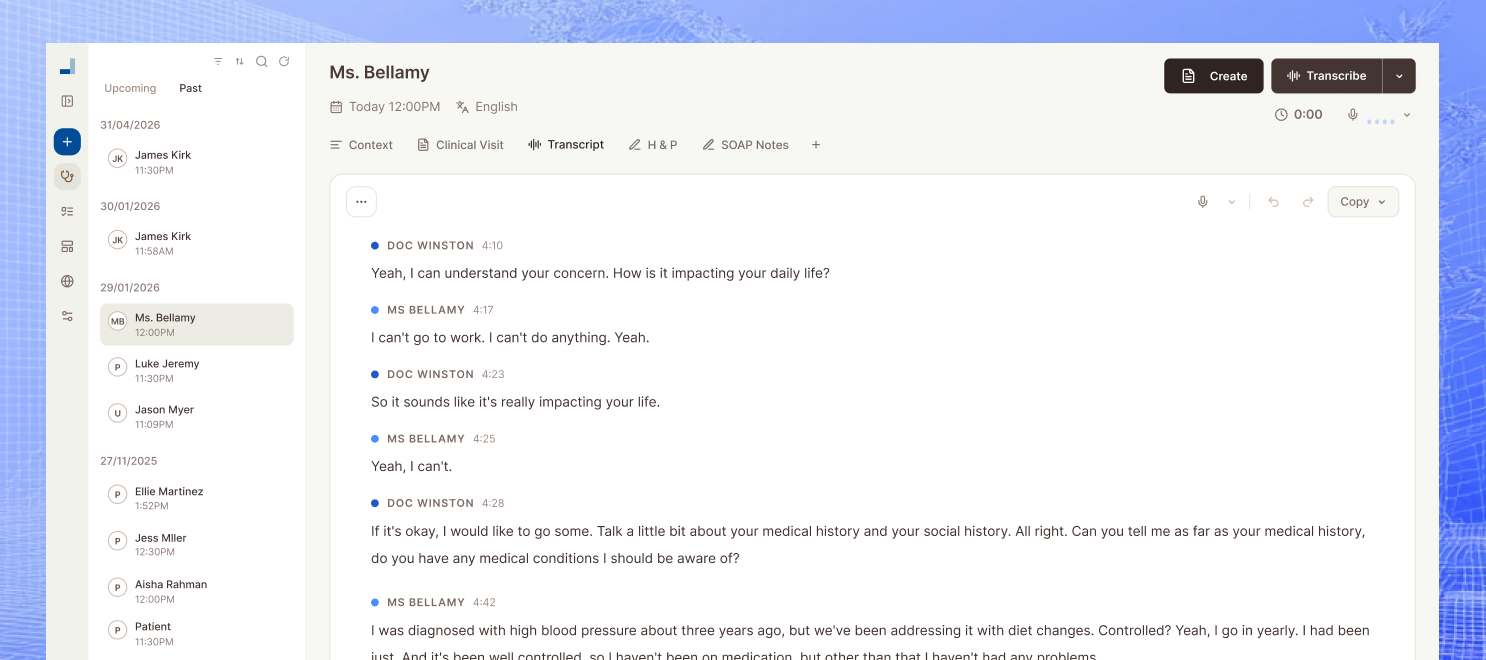
An AI medical scribe serves as an assistive partner in this process. It is important to distinguish that while these tools are highly efficient at capturing data, the clinician remains the ultimate authority, responsible for reviewing and signing off on the final record. This technology bridges the gap between a natural conversation and a structured medical record, ensuring that nothing is lost in translation during busy shifts.
- Reduces the cognitive load associated with simultaneous listening and typing.
- Eliminates the lag time between the patient encounter and note completion.
- Captures granular details that might be forgotten in traditional dictation.
- Allows clinicians to focus entirely on the patient rather than a screen.
Note types you can generate beyond SOAP (H&P and more)
While the SOAP note is the industry standard for daily progress, clinical practice often requires a much broader spectrum of documentation. Transitions of care, specialized procedures, and initial evaluations demand specific structures that a basic SOAP template cannot always accommodate. Utilizing a system that can handle diverse note types ensures continuity of care across different departments and specialties.
Comprehensive History and Physical (H&P) notes, detailed consult reports, and complex procedure notes are vital for audit readiness and clear communication with referring providers. A robust documentation strategy involves selecting the right format for the specific clinical context, whether it is a routine follow-up or a high-stakes discharge summary. High-quality documentation acts as a vital communication tool for the entire care team.
- H&P and Progress Notes: Essential for tracking longitudinal patient care.
- Consult and Referral Letters: Vital for professional communication and care coordination.
- Procedure Notes and Discharge Summaries: Critical for hospital-based and surgical workflows.
- Follow-up Notes: Streamlined documentation for chronic disease management.
How to implement how to convert dictation into SOAP notes automatically step-by-step
Starting your journey to convert dictation into SOAP notes automatically should begin with a low-stakes approach. Select one specific visit type, such as routine follow-ups or wellness checks, to test the workflow. This allows you to calibrate the system without the pressure of a complex multi-system complaint during your first attempt.
Once you are comfortable, you should configure your templates by specialty. Different fields—like Orthopedics versus Psychiatry—require different emphasis on specific data points. Having these presets ready ensures the AI knows exactly how to structure the transcribed data before the encounter even begins. During the patient visit, simply focus on the conversation, whether it is an in-person exam or a telehealth session, letting the capture tool work in the background.
After the encounter, the system will present a draft. Your role shifts from ‘writer’ to ‘editor,’ allowing you to review and refine the output in a fraction of the time it would take to type from scratch. Finally, these structured outputs can be instantly repurposed. A well-drafted SOAP note can be the foundation for a referral letter or a patient education form with minimal additional effort.
- Pilot the system with simple, predictable visit types first.
- Standardize specialty-specific templates to save time on formatting.
- Review and edit the AI-generated draft immediately after the session.
- Convert final notes into letters or summaries for external stakeholders.
How to keep note quality high and reduce mistakes
Even the most advanced automation requires human oversight. Typical failure points in clinical documentation include missing medication dosages, incorrect values for lab results, or ‘note bloat’ where irrelevant history is carried over. To prevent these issues, it is essential to establish a lightweight review habit. Spending sixty seconds checking the AI’s work immediately after the visit is far more effective than trying to fix errors days later.
Consistency is key for any medical team. By setting clear standards for what constitutes a ‘high-quality note’ within your practice, you ensure that every provider is working from the same playbook. This reduce variability and makes it easier for staff to find critical information during follow-up visits or emergencies. Regular audits can also help identify if the AI is consistently missing specific types of data.
- Adopt a ‘review-and-sign’ habit immediately following the encounter.
- Establish practice-wide standards for documentation length and detail.
- Periodically audit notes for accuracy in medications and dosages.
- Check for note bloat to ensure only relevant clinical data is included.
Privacy, consent, and patient trust (plain English)
Patient privacy is the cornerstone of the medical profession. When introducing recording technology, it is important to follow your local regional policies and healthcare regulations. While specific requirements vary, transparency is always the best policy. Most patients are comfortable with technology if they understand it helps their doctor focus more on their care and less on a computer screen.
A simple script can ease any concerns. You might say: ‘I’m using an AI assistant today to help me capture our conversation so I can focus entirely on you rather than typing. It’s secure and helps me make sure your record is 100% accurate. Is that alright with you?’ This approach frames the technology as a benefit to the patient, reinforcing the therapeutic alliance.
- Verify compliance with local privacy laws (like HIPAA or GDPR).
- Use a transparent, patient-centered script to obtain consent.
- Ensure the recording tool strictly follows data retention and security protocols.
- Allow patients to opt-out at any time to maintain trust.
Rolling it out across a clinic without disruption
Scaling technology across an entire clinic requires a phased approach. Start with a two-week pilot involving one or two ‘tech-forward’ clinicians. Use this period to iron out any kinks in the workflow and to see how the templates perform in real-world scenarios. This prevents common frustrations from spreading to the entire staff simultaneously.
During the rollout, track specific metrics such as time saved per day and the reduction in after-hours charting. Seeing these tangible results often motivates more hesitant staff members to adopt the new system. Training sessions should focus not just on the software itself, but on how to integrate it naturally into the patient room flow, ensuring the transition is as seamless as possible for everyone involved.
- Begin with a 14-day small-scale pilot to identify workflow bottlenecks.
- Measure KPIs like time saved and provider satisfaction scores.
- Align templates across the team to ensure documentation consistency.
- Provide brief, practical training sessions for all support staff.
Mcoy AI is an AI medical scribe that records and transcribes patient encounters, then generates multiple clinical note types (H&P, progress notes, consult notes, follow-up notes, procedure notes, discharge summaries, referral letters, and more). It features 200+ customizable templates and an AI chat to create letters, forms, and documents, helping clinicians spend less time on administrative tasks and more time with patients.
Conclusion
The transition to an automated clinical workflow is no longer a luxury—it is a necessity for the modern practitioner. By learning how to convert dictation into SOAP notes automatically, you can eliminate the clerical burden that leads to burnout and reclaim your personal time. From selecting the right templates to establishing a review cycle, the steps outlined here provide a sustainable path forward. Take the first step by piloting this technology in your clinic today and experience the difference that high-quality, efficient documentation can make.
What a serious review table should cover
| Decision area | Common mistake | Better clinic-ready approach | Metric to watch |
|---|---|---|---|
| Workflow design | Treat how to convert dictation into soap notes automatically as a one-off documentation task | Build a repeatable process with clear ownership and review points | Time to complete documentation |
| Team adoption | Assume every clinician will naturally use the same process | Train for consistency and define exception handling early | Active user adoption |
| Quality review | Only check notes when a problem is reported | Audit a sample of notes weekly and review edge cases | Edit rate per note |
| Operational follow-through | Leave admin actions outside the documentation workflow | Use the same encounter data for referrals, letters, and follow-up tasks | Completion rate for next-step tasks |
Related reading
If you are working through how to convert dictation into soap notes automatically, it helps to read this alongside AI & Medicine: How to Simplify Clinical Notes for Busy Doctors, AI & Medicine: How Doctors Can Improve SOAP Notes, and Practice Operations: Secure Audio & Transcript Storage for Clinics | Guide. Those guides cover adjacent workflow, implementation, and evaluation questions so the decision does not sit in isolation.
FAQ
How accurate are AI medical scribes in real clinics?
AI medical scribes have reached high levels of accuracy, often capturing nuances that manual typing might miss. However, they are assistive tools, not replacements for clinical judgment. Accuracy is highest when the clinician speaks clearly and reviews the output for specific medical values like dosages.
Do I still need to review every note?
Yes, reviewing every note is a mandatory clinical and legal responsibility. AI generates a draft based on the encounter, but the clinician must verify the details, correct any misinterpretations, and finalize the document. This review usually takes less than a minute compared to minutes of typing.
What note types can an AI scribe generate besides SOAP?
Beyond the standard SOAP format, advanced AI scribes can generate H&P reports, consult notes, procedure descriptions, and discharge summaries. They can also assist in drafting referral letters and patient education summaries based on the captured conversation. This versatility supports diverse clinical needs.
Will this work for telehealth and in-person consults?
Yes, AI scribes are designed to function across multiple settings, including in-person exams and various telehealth platforms. As long as the audio can be captured clearly, the AI can process the information and generate structured notes regardless of the physical location of the patient.
How do I explain recording/transcription to patients?
The most effective way is to be transparent and focus on the benefit to the patient. Explain that the tool allows you to maintain eye contact and listen better because you don’t have to type. Most patients appreciate the extra attention and are comfortable with the process once explained.
How do clinics prevent note bloat?
Note bloat is prevented by using concise, specialty-specific templates that prioritize relevant information. Clinicians should also review the AI’s summary to ensure it hasn’t included redundant data from previous visits. Effective software allows for customization to keep notes focused and brief.
How long does template setup take?
Initial template setup usually takes only a few minutes per clinician, especially if starting from pre-built industry standards. Customizing these to fit specific preferences might take slightly longer, but the time invested pays off immediately in the form of faster note generation.
What’s the safest way to start if I’m skeptical?
The safest approach is to start with a small pilot program. Use the tool for five to ten non-complex follow-up visits to see how it performs. This low-risk environment allows you to evaluate the accuracy and time-saving potential without any significant clinical or operational pressure.