Compare & Choose: How to Choose an AI Medical Scribe: 2024 Clinician Guide
Discover how to choose an AI medical scribe to eliminate charting burnout. Learn about note types, implementation, and privacy for your clinic today.
Choosing the Right Path for Clinical Documentation
For many doctors and private practitioners, the end of the patient day doesn’t mark the end of work. Instead, it signals the start of the ‘pajama time’ shift—hours spent staring at an EHR screen, trying to recall the nuances of a morning consultation. This administrative burden is a leading cause of burnout, often resulting in rushed notes, inconsistent documentation, and a constant baseline of medico-legal anxiety. When you choose an AI medical scribe, you are not just buying software; you are reclaiming your personal time and clinical focus.
This comprehensive guide is designed to help university clinics, general practitioners, and specialists navigate the rapidly evolving landscape of ambient AI technology. We will explore the essential workflows, look at diverse note formats beyond the standard SOAP note, and establish a clear rollout plan for your practice. By the end of this article, you will have a framework for assessing quality control, ensuring patient privacy, and choosing a tool that fits your unique specialty needs.
What a medical scribe solves in modern practice
The real cost of manual documentation extends far beyond the minutes spent typing. It includes a significant cognitive load—the mental energy required to remember details while simultaneously engaging with a patient. When a clinician is tethered to a keyboard, the patient-doctor connection suffers, and critical non-verbal cues are often missed. Delayed notes also lead to ‘forgetting curves,’ where the accuracy of the clinical record diminishes the longer the gap between the encounter and the documentation.
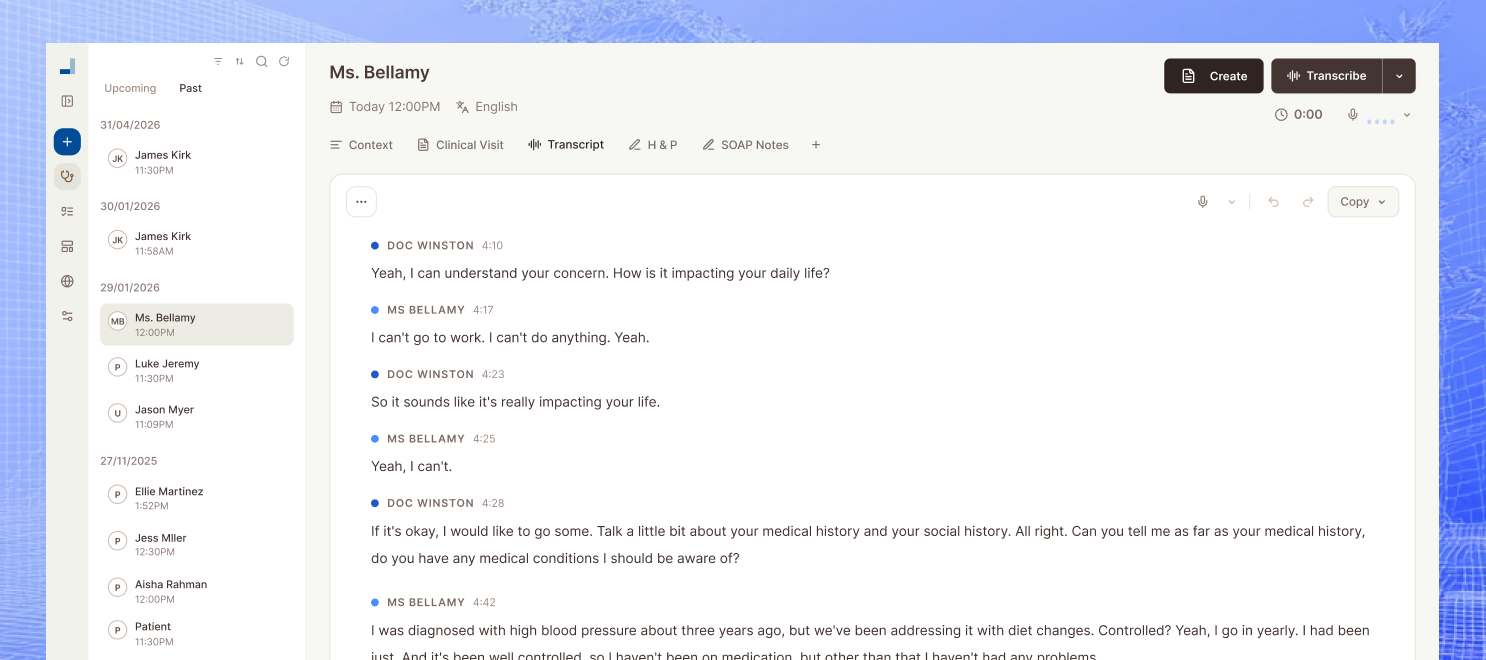
An AI medical scribe acts as an assistive partner that listens to the conversation and structures the information into a clinical format. It is important to understand that these tools are not independent practitioners; the clinician remains the ultimate authority and is responsible for reviewing and signing off on every entry. The AI handles the heavy lifting of transcription and formatting, allowing the doctor to remain fully present with the patient. This transition from ‘data entry clerk’ back to ‘healer’ is the primary value proposition of modern AI scribing solutions.
- Reduces cognitive load by capturing details in real-time.
- Eliminates after-hours charting and ‘pajama time.’
- Improves patient satisfaction through better eye contact and engagement.
- Ensures more detailed and accurate clinical records.
- Serves as an assistive tool where the clinician retains final oversight.
Note types you can generate beyond SOAP (H&P and more)
While the SOAP note is a staple of medical education, modern practice requires a much broader range of documentation styles. A versatile AI tool should be able to handle History and Physicals (H&P), detailed consult notes for specialists, and concise follow-up notes for chronic disease management. For surgical or procedural specialties, the ability to generate procedure notes and discharge summaries accurately is vital for hospital compliance and patient safety.
Structure matters immensely for the continuity of care and audit readiness. When a referral letter is generated automatically from a consultation, it ensures that the specialist receiving the patient has the exact context they need without the GP having to write a separate document from scratch. High-quality documentation provides a clear trail for insurance audits and legal protection, ensuring that the complexity of the patient’s condition is fully captured and billed appropriately.
- Generates H&P, progress notes, and complex consult notes.
- Creates procedure notes, discharge summaries, and referral letters.
- Supports audit readiness through consistent, structured documentation.
- Facilitates better handover quality between different care providers.
- Reduces manual drafting of administrative forms and letters.
How to implement an AI medical scribe step-by-step in a real clinic
To successfully choose an AI medical scribe and integrate it into your daily routine, start by selecting one specific visit type or a half-day session to pilot the technology. This allows you to get comfortable with the interface without the pressure of a full patient load. You should begin by selecting or customizing templates that align with your specialty’s standard operating procedures. Having these templates ready ensures the AI knows exactly which data points are most relevant to your specific branch of medicine.
During the encounter, whether it is in-person or via telehealth, simply activate the capture device. Focus entirely on the patient, speaking naturally as you normally would. Once the visit concludes, the AI will process the audio and generate a draft. Take a brief moment—usually less than 80 seconds—to review the output, make any necessary edits for clinical nuance, and move it into your EHR. Finally, leverage the AI outputs to quickly generate secondary documents like patient summaries or referral letters, maximizing the utility of a single recording sessions.
- Start with one visit type or a small pilot block to build confidence.
- Set up and customize templates for your specific medical specialty.
- Capture the encounter naturally, focusing on the patient interaction.
- Review, edit, and transfer the note to the EHR immediately.
- Reuse the captured data to generate letters and forms instantly.
How to keep note quality high and reduce mistakes
Even the most advanced AI can encounter failure points if not monitored. Common issues include missing specific dosages, misinterpreting brand-name medications, or ‘note bloat’—where the AI includes too much irrelevant conversational filler. The key to high-quality documentation is creating a lightweight review habit. Clinicians should skim the draft specifically looking for ‘hallucinations’ or omitted laboratory values that are critical to the diagnosis.
Establishing team standards for documentation also helps maintain consistency across a multi-clinician practice. By agreeing on what constitutes a ‘perfect’ note, the AI can be further calibrated via template adjustments. Modern tools allow you to refine the prompt instructions to ensure the output matches your personal style, whether you prefer 1-word headings or long narrative descriptions. Regular spot-checks of notes ensure that the quality remains high over time.
- Implement a ‘skim-review’ habit for every AI-generated draft.
- Check for specific clinical values like medication dosages and vitals.
- Adjust templates to prevent ‘note bloat’ and irrelevant data capture.
- Set clinic-wide standards for documentation consistency.
- Update instructions if the AI consistently misses a specific nuance.
Privacy, consent, and patient trust (plain English)
Privacy is the most common concern when clinicians decide to choose an AI medical scribe. Consent requirements vary significantly by region and local medical boards, so it is essential to follow your local policy. Generally, obtaining verbal consent and documenting it within the note is a standard best practice. Most patients are receptive when they understand that the technology allows the doctor to listen more closely to their concerns rather than staring at a computer screen.
A simple way to explain this to a patient is: ‘I am using a secure AI assistant to help me take notes today so I can focus entirely on you instead of the computer. It records our conversation to create my medical report and then securely processes it. Is that alright with you?’ This transparency builds trust and often leads to a more positive patient experience. Ensure the tool you select uses encryption and follows data retention principles that align with your local healthcare regulations.
- Follow local jurisdiction guidelines for patient consent and recording.
- Use a simple, transparent script to explain the AI’s role to patients.
- Ensure the software uses high-level encryption for data in transit and at rest.
- Document the patient’s consent at the start of every recorded encounter.
- Prioritize tools with clear data retention and deletion policies.
Rolling it out across a clinic without disruption
A successful rollout requires a structured approach rather than an all-at-once switch. A two-week pilot plan is usually sufficient for most clinics. In the first week, one ‘champion’ clinician uses the tool and refines the templates. In the second week, they train the rest of the staff on the specific workflow that worked best. This peer-to-peer training is often more effective than reading a manual or watching a corporate video.
To measure success, track specific metrics such as ‘time spent charting after 5 PM’ and ‘average time to complete a note.’ Most clinics see a significant reduction in these areas within the first month. Additionally, note completeness and the speed of sending out referral letters are excellent indicators of improved clinic efficiency. Aligning your templates across the team ensures that regardless of which doctor a patient sees, the quality of the documentation remains uniform.
- Use a 2-week pilot with a ‘champion’ clinician to test the workflow.
- Provide peer-to-peer training based on real-world clinic use.
- Track time saved and reduction in after-hours documentation.
- Monitor note completeness and referral turnaround times.
- Standardize templates across the clinic for maximum consistency.
Mcoy AI is an AI medical scribe that records and transcribes patient encounters, then generates multiple clinical note types including H&P, progress notes, consult notes, follow-up notes, procedure notes, discharge summaries, referral letters, and more. With over 200+ customizable templates and an interactive AI chat, it allows clinicians to create custom letters, patient forms, and legal documents instantly, ensuring that the administrative side of medicine is as efficient as the clinical side.
Conclusion
Transitioning to an automated documentation workflow is the most effective way to eliminate the burden of manual charting. By understanding the different note types available and following a structured rollout plan, clinics can significantly improve both provider well-being and patient care. When you choose an AI medical scribe, you are investing in a future where technology serves the clinician, not the other way around. Start with a small pilot today and experience the difference that ambient AI can make in your daily practice. Ready to transform your clinic? Start your pilot and rediscover the joy of medicine.
What a serious review table should cover
| Decision area | Common mistake | Better clinic-ready approach | Metric to watch |
|---|---|---|---|
| Workflow design | Treat how to choose an ai medical scribe: 2024 clinician guide as a one-off documentation task | Build a repeatable process with clear ownership and review points | Time to complete documentation |
| Team adoption | Assume every clinician will naturally use the same process | Train for consistency and define exception handling early | Active user adoption |
| Quality review | Only check notes when a problem is reported | Audit a sample of notes weekly and review edge cases | Edit rate per note |
| Operational follow-through | Leave admin actions outside the documentation workflow | Use the same encounter data for referrals, letters, and follow-up tasks | Completion rate for next-step tasks |
Related reading
If you are working through how to choose an ai medical scribe: 2024 clinician guide, it helps to read this alongside Compare & Choose: Best Tools Doctors Use to Save Time on Clinical Notes, Compare & Choose: Medical Scribing Services: Are They Worth It?, and Admin Management: How to Improve Handover Notes with an AI Medical Scribe. Those guides cover adjacent workflow, implementation, and evaluation questions so the decision does not sit in isolation.
FAQ
How accurate are AI medical scribes in real clinics?
AI medical scribes currently achieve high levels of accuracy, often exceeding 90-95% in capturing the core clinical facts of a conversation. They are particularly good at capturing patient stories and symptoms in the patient’s own words. However, accuracy can be affected by heavy accents, multiple people talking at once, or significant background noise. Because of this, they are designed as assistive tools that require a final human check.
Do I still need to review every note?
Yes, medical and legal standards require that the clinician remains responsible for the accuracy of the medical record. While the AI does the majority of the drafting, you must review the note to ensure clinical nuances, specific dosages, and diagnostic reasoning are correct. This review usually takes less than a minute per note, which is still a massive time saving compared to manual typing.
What note types can an AI scribe generate besides SOAP?
Advanced AI scribes can generate a vast array of documents including History and Physicals (H&P), specialist consultation letters, follow-up notes, and procedure summaries. They can also create discharge summaries and referral letters based on the encounter data. By using different templates, the same recorded conversation can be used to generate multiple different document types depending on the need.
Will this work for telehealth and in-person consults?
Most AI scribing solutions are designed to work seamlessly in both settings. For in-person consults, the app typically runs on a smartphone or tablet in the room. For telehealth, the AI can often be integrated directly into the video platform or can listen to the audio output of the computer. This flexibility ensures a consistent documentation workflow regardless of how the patient is seen.
How do I explain recording/transcription to patients?
The best approach is to be direct and highlight the benefit to the patient. You might say that you are using a secure assistant to help with notes so you can focus on listening to them rather than typing. Most patients are very supportive when they see their doctor is more engaged. Always ensure you have a clear understanding of your local consent laws to remain compliant.
How do clinics prevent note bloat?
Note bloat is prevented by using well-defined templates that instruct the AI exactly what to include and what to leave out. Instead of transcribing every word, the AI is told to summarize key clinical points. Clinicians can also adjust the ‘verbosity’ settings in many tools to ensure the output matches the level of detail required for that specific visit type.
How long does template setup take?
Basic template setup can take as little as 10 to 15 minutes if you are using pre-built specialty templates. If you wish to highly customize a template to match a very specific workflow, it might take 30 minutes of tweaking and testing. Once a template is set, it can be used indefinitely and shared across the entire clinic to save time for every provider.
What’s the safest way to start if I’m skeptical?
The safest way to start is with a ‘shadow’ pilot. Record a few sessions but continue to take your notes as you normally would for a few days. Compare your manual notes to the AI-generated ones to see if anything was missed. This allows you to build trust in the technology’s accuracy without any risk to your clinical documentation quality while you are learning the system.