Specialty Guides: Build a Daily AI Documentation Workflow [Full Guide]
Learn how to build an efficient daily documentation workflow using AI. Reduce burnout and improve patient care with our comprehensive clinical guide.
The Hidden Burden of Clinical Documentation
For many doctors and clinic owners, the workday doesn’t actually end when the last patient leaves. Instead, it transitions into a second shift of grueling administrative tasks, often referred to as ‘pajama time.’ This after-hours charting is a primary driver of physician burnout, leading to rushed notes, increased medico-legal anxiety, and a feeling of being tethered to an EHR rather than focusing on patient care.
This guide provides a comprehensive roadmap for integrating an AI-driven workflow into your daily practice. Whether you are a GP in a busy private practice, a specialist in a university clinic, or a provider managing a high volume of telehealth consults, you will learn how to move beyond basic SOAP formats, maintain quality control, and protect patient privacy. By the end of this article, you will have a clear rollout plan to reclaim your time without sacrificing note accuracy.
What a medical scribe solves in modern practice
The real cost of traditional documentation isn’t just measured in minutes; it is measured in cognitive load. When a clinician is trying to listen to a patient while simultaneously typing into a computer, the quality of the therapeutic relationship suffers. Delayed notes often result in lost details, as the nuances of a complex encounter fade from memory by the time the provider finally sits down to finalize the chart.
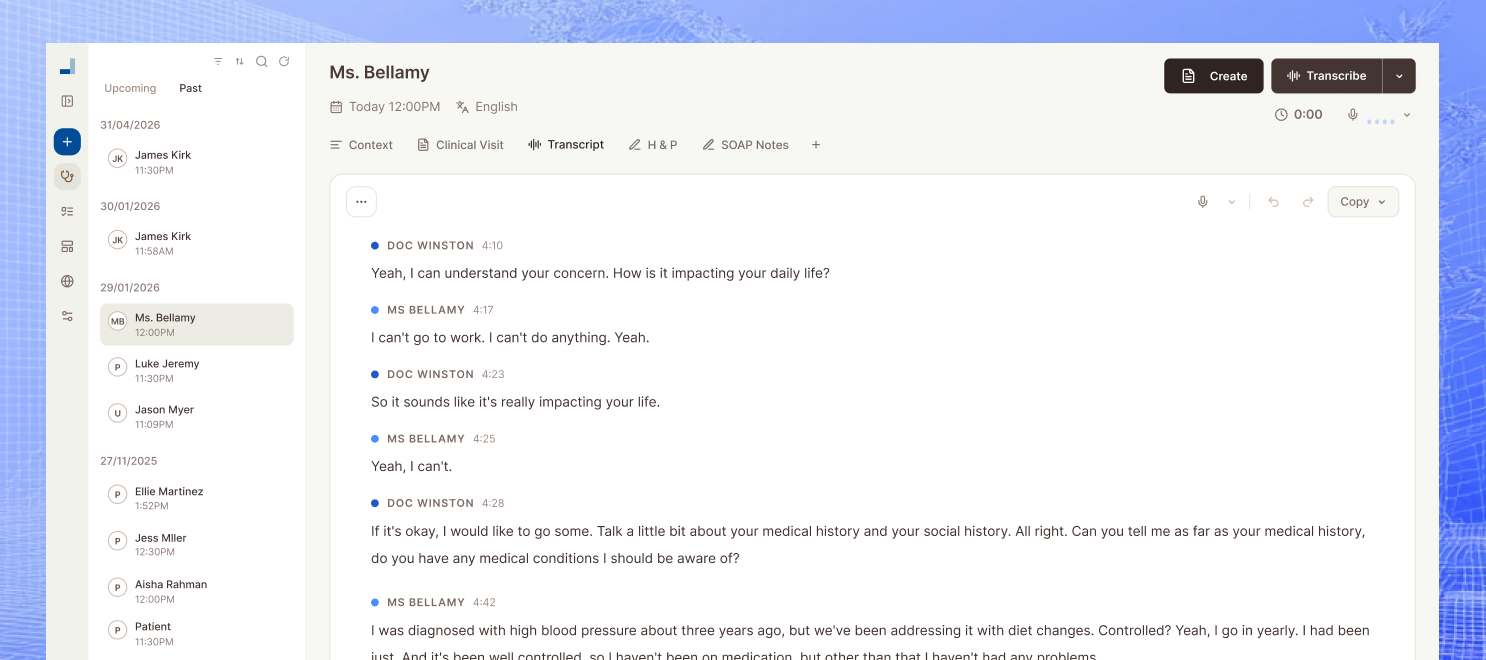
An AI medical scribe acts as an assistive layer that captures the clinical dialogue in real-time, allowing the doctor to remain present and engaged. It is important to remember that these tools are assistive, not autonomous; the clinician remains the final authority and is always responsible for the accuracy of the record. The goal is to eliminate the ‘blank page’ problem and provide a high-quality draft that is ready for human verification at the touch of a button.
- Reduces the cognitive burden of divided attention during consultations.
- Eliminates late-night charting by providing real-time drafts.
- Improves note detail by capturing dialogue as it happens.
- Allows clinicians to focus on physical exams and patient eye contact.
Note types you can generate beyond SOAP (H&P and more)
While the SOAP note is the industry standard for progress notes, modern clinical practice requires much more. For example, a new patient admission requires a comprehensive History and Physical (H&P), while a surgical case demands a detailed procedure note. Using a rigid format for every encounter often leads to ‘note bloat,’ where the truly important information is buried under irrelevant data points.
By utilizing an AI-driven documentation workflow, practitioners can generate consult notes that highlight specialist recommendations, or follow-up notes that track specific chronic disease markers. Transitioning between these formats should be seamless to ensure continuity of care. When a patient is ready to leave the clinic or hospital, generating a clear discharge summary or a referral letter is often the most time-consuming step—one that AI can automate based on the preceding encounters.
Structured documentation is not just about compliance; it is about audit readiness and professional communication. A well-formatted referral letter reflects a high standard of care to your colleagues, just as a clear progress note ensures that the next provider in the care chain has a perfect understanding of the clinical reasoning behind a treatment plan.
- H&P and Consult notes for complex new-patient evaluations.
- Procedure and Operation notes for surgical or outpatient interventions.
- Discharge summaries and referral letters generated from session data.
- Customizable templates to fit high-level specialty-specific needs.
How to implement daily documentation workflow with AI step-by-step
The best way to start is by selecting one specific visit type—such as standard follow-ups—to pilot the new system for a single morning. This prevents the team from feeling overwhelmed while they learn the nuances of the capture process. Before the first patient arrives, ensure your templates are pre-selected to match your specialty requirements, whether you are in orthopedics, psychiatry, or general practice.
During the encounter, whether it is an in-person visit or a telehealth session, initiate the capture and let the AI record the natural dialogue. There is no need to change how you speak; the technology is designed to understand medical jargon and conversational cues. Once the session ends, immediately review the generated draft. This review should take under 60 seconds if the capture was successful.
If the note requires adjustments, make them instantly using voice commands or quick typing. Once you are satisfied, the output can be reused to create secondary documents like work excuses or prescriptions. Finally, integrate the verified note into your EHR and move directly to the next patient, ensuring your clinical documentation stays current throughout the day.
- Start with one visit type to build confidence and refine your style.
- Configure templates beforehand to ensure the AI follows your preferred logic.
- Adopt a ‘review-and-go’ habit to keep charts finished in real-time.
- Leverage secondary outputs to handle letters and administrative forms.
How to keep note quality high and reduce mistakes
Common failure points in clinical notes often include incorrect dosages, missing medications, or ‘note bloat’ where the AI includes too much irrelevant small talk. To prevent these errors, it is vital to establish a lightweight review habit. Instead of reading every word like a novel, scan the ‘Assessment and Plan’ section first, as this is where the most critical clinical decisions reside.
Setting team standards is also key for larger practices. If every practitioner in a university clinic uses the same template logic, the quality of handovers improves significantly. Encourage a culture where clinicians spend thirty seconds ‘polishing’ the note rather than just accepting the first draft, ensuring that the final record accurately reflects the medical necessity of the visit.
- Focus your review on the ‘Assessment and Plan’ for clinical accuracy.
- Standardize templates across your team for consistent handover quality.
- Cross-check medications and numeric values against your verbal record.
- Train staff on identifying and removing irrelevant conversational filler.
Privacy, consent, and patient trust (plain English)
Patient consent is the foundation of a successful AI-integrated practice. While laws vary by region, transparency is always the best policy. You do not need a complex legal lecture; a simple, human-centric explanation is usually more than enough to put a patient at ease. Most patients appreciate that the technology allows their doctor to actually look at them rather than a screen.
A simple way to explain it is: “I’m using a secure AI assistant today to help me capture our conversation so I can focus entirely on you instead of my computer. It transcribes our talk into my clinical notes and is fully encrypted for your privacy. Are you comfortable with that?” Generally, patients are supportive when they understand the benefit to their own care experience.
- Always follow local regional policies regarding recording and consent.
- Use a short, transparent script to explain the benefit to the patient.
- Ensure your chosen tool uses end-to-end encryption and secure storage.
- Document the patient’s verbal consent within the medical record.
Rolling it out across a clinic without disruption
A successful rollout requires a 2-week pilot plan rather than a ‘big bang’ transition. In the first week, let one or two ‘tech-champion’ clinicians test the workflow. During the second week, gather their feedback to adjust templates and resolve any technical hurdles before expanding to the rest of the staff. This phased approach prevents the clinic from grinding to a halt due to learning curves.
Track basic metrics to measure success, such as the reduction in ‘pajama time’ and the speed of note completion. If clinicians find they are saving an hour a day and their notes are more complete, the moral argument for the new workflow becomes self-evident. Ensure that training sessions focus on template alignment so that the entire clinic speaks the same ‘documentation language.’
- Run a 2-week pilot with selected providers before a full clinic rollout.
- Monitor time saved and after-hours charting to quantify the ROI.
- Schedule a brief mid-pilot meeting to share best practices and shortcuts.
- Align templates across the organization to ensure data consistency.
Mcoy AI is an AI medical scribe that records and transcribes patient encounters, then generates multiple clinical note types including H&P, progress notes, consult notes, follow-up notes, procedure notes, discharge summaries, referral letters, and more. With over 200 customizable templates and an interactive AI chat, clinicians can effortlessly create letters, forms, and complex documents based on the session data, allowing for a highly personalized documentation experience that fits any medical specialty.
Conclusion
Building a daily documentation workflow with AI is the most effective way for modern practitioners to reclaim their time and focus on what truly matters: the patient. By moving away from manual typing and adopting a structured, AI-assisted approach, clinics can eliminate the burden of after-hours charting while improving the quality of their medical records. Start small, refine your templates, and watch your daily documentation workflow transform from a chore into a seamless background process.
What a serious review table should cover
| Decision area | Common mistake | Better clinic-ready approach | Metric to watch |
|---|---|---|---|
| Workflow design | Treat build a daily ai documentation workflow [full guide] as a one-off documentation task | Build a repeatable process with clear ownership and review points | Time to complete documentation |
| Team adoption | Assume every clinician will naturally use the same process | Train for consistency and define exception handling early | Active user adoption |
| Quality review | Only check notes when a problem is reported | Audit a sample of notes weekly and review edge cases | Edit rate per note |
| Operational follow-through | Leave admin actions outside the documentation workflow | Use the same encounter data for referrals, letters, and follow-up tasks | Completion rate for next-step tasks |
Related reading
If you are working through build a daily ai documentation workflow [full guide], it helps to read this alongside Specialty Guides: How to Run a More Efficient Medical Practice in 2026, Specialty Guides: How to Improve Patient Encounters, and Practice Operations: How Clinics Can Streamline Daily Operations. Those guides cover adjacent workflow, implementation, and evaluation questions so the decision does not sit in isolation.
FAQ
How accurate are AI medical scribes in real clinics?
AI medical scribes have reached a high level of accuracy, often correctly identifying 90-95% of clinical dialogue and medical terminology. However, errors can still occur with similar-sounding medication names or specific numeric values. This is why the clinician must always perform a final review to ensure the note is medically sound before signing off.
Do I still need to review every note?
Yes, professional responsibility dictates that the clinician must review every note. The AI serves as a powerful assistant that does the ‘heavy lifting’ by drafting the document, but the human doctor is the one who validates the information. Think of it as having a highly efficient intern who needs their work checked before it becomes official.
What note types can an AI scribe generate besides SOAP?
Modern AI tools are versatile and can generate H&P (History and Physical) notes, consult notes, procedure descriptions, follow-up notes, and discharge summaries. Beyond clinical notes, they can often draft referral letters to other specialists based on the conversation held during the visit, saving significant administrative time.
Will this work for telehealth and in-person consults?
Yes, AI documentation tools are designed to work across various platforms. For in-person visits, a smartphone or tablet can capture the audio. For telehealth, the AI can often be integrated directly into the video stream or record the audio from the computer speakers to generate the same high-quality notes.
How do I explain recording/transcription to patients?
Keep it simple and focus on the benefits for the patient. Explain that the tool allows you to look at them and listen more closely rather than typing on a keyboard. Once patients realize the technology leads to a more personal and attentive doctor’s visit, they are almost always supportive and comfortable with the process.
How do clinics prevent note bloat?
Note bloat is prevented by using specific templates that tell the AI exactly what information to prioritize. By instructing the AI to focus on ‘pertinent positives and negatives’ and clinical reasoning rather than a word-for-word transcript, the resulting notes become concise, actionable, and easy for other providers to read.
How long does template setup take?
Initial template setup usually takes about 5 to 10 minutes per note type. Once you have selected your preferred structure—such as your specific way of documenting a physical exam—that template can be saved and reused indefinitely, meaning the system gets faster the more you use it.
What’s the safest way to start if I’m skeptical?
The safest approach is to run a ‘shadow pilot’ where you use the AI tool alongside your current documentation method for 2-3 patients. Compare the AI-generated note to your own manual note. This low-risk comparison usually demonstrates the accuracy and time-saving potential of the AI, providing the confidence needed for a full transition.