AI & Medicine: How to Capture Physical Exam Findings With AI [Full Guide]
Learn how to capture physical exam findings with AI efficiently. Improve clinic workflow, reduce charting time, and ensure documentation accuracy today.
What a medical scribe solves in modern practice
The burden of clinical documentation is a primary driver of physician burnout in modern healthcare. Clinicians often spend more time staring at a screen than engaging with their patients, leading to after-hours charting and a significant increase in cognitive load. When providers are rushed, the risk of missing nuanced details increases, which can have downstream effects on patient safety and medico-legal security.
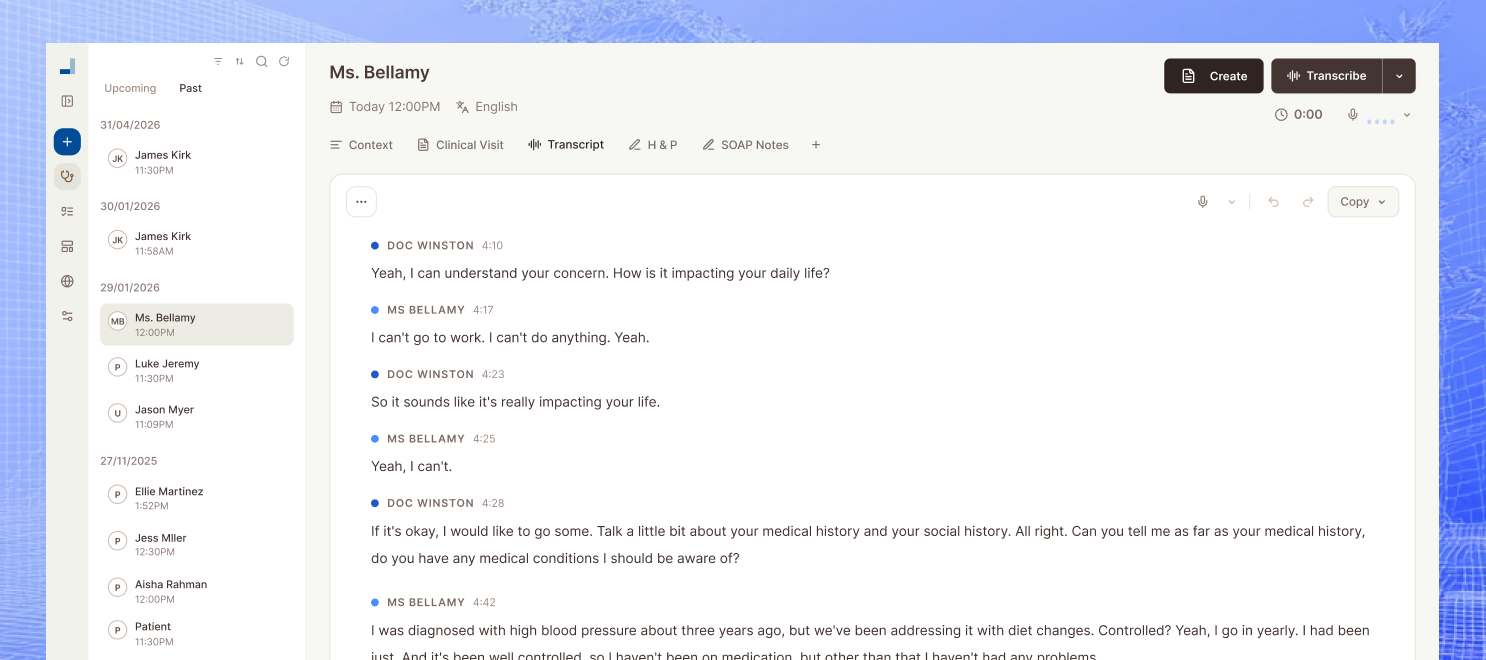
An AI medical scribe serves as a sophisticated assistant designed to alleviate this operational pressure. It interprets the dialogue between the clinician and the patient, extracting relevant clinical data in real-time. It is important to remember that these tools are assistive; while they automate the heavy lifting of transcription and formatting, the clinician remains the final authority on the accuracy of the record.
- Reduces the ‘pajama time’ spent on finishing notes after clinic hours.
- Enhances patient engagement by allowing for more eye contact and less typing.
- Captures granular details that might be forgotten during high-volume shifts.
- Provides a reliable safety net for medico-legal documentation requirements.
Note types you can generate beyond SOAP (H&P and more)
While the SOAP note is a staple in outpatient care, many clinical scenarios require more specialized formats. History and Physical (H&P) reports are vital for admissions and comprehensive initial assessments, requiring a level of detail that covers systemic reviews and complex histories. Without a structured approach, these notes can become disorganized, making it difficult for the next provider to follow the clinical reasoning.
Beyond the basics, specialized encounters such as procedure notes, discharge summaries, and referral letters require specific data points to be effective. A procedure note must detail the technique used and any complications, whereas a referral letter needs to synthesize the most relevant findings for a specialist. Using AI to generate these diverse formats ensures that the language remains consistent across the entire care continuum.
Structure matters significantly for audit readiness and continuity of care. A well-organized progress note or consult report provides a clear roadmap of the patient’s health over time. By moving beyond a one-size-fits-all template, clinics can ensure that every encounter is documented with the appropriate clinical rigor and professional tone.
- H&P and progress notes capture the longitudinal patient story.
- Consult notes and referral letters streamline inter-provider communication.
- Procedure notes and discharge summaries ensure billing and safety compliance.
- Customizable structures help maintain high standards for clinical audits.
How to implement how to capture physical exam findings with AI step-by-step in a real clinic
Transitioning to an AI-assisted workflow is most successful when approached in phases. Start by selecting one common visit type, such as a routine follow-up or a specific physical exam, to test the system’s capabilities. This allows the team to get comfortable with the interface without the pressure of a full-scale rollout across diverse specialties.
Before the patient enters the room, ensure you have set up templates specific to your specialty. In a physical exam scenario, you might have a template that prioritizes musculoskeletal findings or cardiovascular systems. During the encounter, speak your findings naturally; for instance, instead of typing, you might say, ‘The patient shows normal range of motion in the right shoulder with no signs of crepitus.’
Once the encounter ends, the AI prepares a draft based on the captured audio. This is the moment to perform a quick review and edit for precision. Most clinicians find that they can finalize a note in less than 60 seconds when the majority of the data is already organized for them.
Finally, leverage the outputs for administrative tasks. The details captured during the physical exam can be instantly repurposed for referral letters or school physical forms. This reusability is where the real efficiency gains happen, as it eliminates redundant data entry across multiple documents.
- Start with a single visit type to build confidence in the tool.
- Use specialty-specific templates to guide the AI’s output structure.
- Finalize notes immediately after the encounter for maximum accuracy.
- Repurpose exam findings for secondary documents like forms and letters.
How to keep note quality high and reduce mistakes
One of the risks of automated documentation is the potential for ‘note bloat’ or the inclusion of irrelevant information. To maintain high quality, clinicians should develop a lightweight review habit. This involves scanning the generated text for typical failure points such as incorrect lateralities (right vs. left) or misinterpreted medication dosages. Quality control is not just about catching errors; it is about ensuring the note reflects the specific clinical reality of the patient.
Setting team standards for what a ‘good note’ looks like in your practice is also essential. When everyone agrees on the level of detail required for a physical exam or a progress note, the AI can be better calibrated to meet those needs. Consistency across the clinic reduces confusion during handovers and ensures that all providers are working from the same high-quality data.
- Conduct a 30-second verification of every note before signing off.
- Standardize documentation expectations across all clinic staff.
- Focus on accuracy regarding medications, lateralities, and numeric values.
- Avoid note bloat by keeping templates focused on relevant clinical data.
Privacy, consent, and patient trust (plain English)
Patient trust is built on transparency. When introducing AI into the exam room, it is crucial to follow local regulations and your clinic’s specific privacy policies. Usually, a simple explanation is enough to put patients at ease. Most patients appreciate that the technology allows their doctor to listen more and type less, leading to better care.
A simple script for the clinician might sound like this: ‘I am using a secure AI tool to help me record our discussion so I can focus entirely on you rather than my computer. The data is encrypted and used only to create your medical record. Is that okay with you?’ This approach respects autonomy while highlighting the benefit to the patient.
From a security standpoint, it is important to ensure that the AI provider adheres to modern encryption and data retention standards. Protecting patient information is not just a legal requirement but a fundamental part of the therapeutic relationship. By being open about how data is handled, clinics can integrate modern technology without compromising the doctor-patient bond.
- Always secure verbal or written consent based on local requirements.
- Use a patient-centric script to explain the benefits of the technology.
- Ensure the tool meets high standards for data encryption and security.
- Empower patients by explaining that the tool helps you focus on their care.
Rolling it out across a clinic without disruption
A successful rollout starts with a two-week pilot program involving a small group of ‘super-users.’ These staff members can identify any friction points in the workflow and serve as resources for the rest of the team. During this time, it is important to track metrics like the number of hours saved on charting and the speed of note completion to demonstrate the value of the tool.
Education is the next step. Training should focus on template alignment—ensuring the AI knows exactly how your clinic prefers to document different encounter types. When the full team sees how much time is recovered for patient care, the adoption process becomes much smoother. Alignment between the clinical staff and IT ensures that technical requirements are met without disrupting daily operations.
- Launch a two-week pilot to find and fix workflow bottlenecks.
- Track time-savings and note completion rates to measure success.
- Provide tailored training on template customization for different roles.
- Align technology use with existing clinical workflows for a seamless transition.
Mcoy AI is an AI medical scribe that records and transcribes patient encounters, then generates multiple clinical note types (H&P, progress notes, consult notes, follow-up notes, procedure notes, discharge summaries, referral letters, and more). It features over 200+ customizable templates and an AI chat to create letters, forms, and documents, ensuring that clinicians can focus on their patients while the documentation is handled with precision and speed.
Conclusion
Integrating modern technology into your practice doesn’t have to be overwhelming. By following a structured implementation plan, you can significantly reduce the administrative burden on your staff. Knowing how to capture physical exam findings with AI is just the first step in reclaiming your time and refocusing on what truly matters: your patients. Start with a pilot today and experience the difference a streamlined documentation process can make in your professional life.
What a serious review table should cover
| Decision area | Common mistake | Better clinic-ready approach | Metric to watch |
|---|---|---|---|
| Workflow design | Treat how to capture physical exam findings with ai [full guide] as a one-off documentation task | Build a repeatable process with clear ownership and review points | Time to complete documentation |
| Team adoption | Assume every clinician will naturally use the same process | Train for consistency and define exception handling early | Active user adoption |
| Quality review | Only check notes when a problem is reported | Audit a sample of notes weekly and review edge cases | Edit rate per note |
| Operational follow-through | Leave admin actions outside the documentation workflow | Use the same encounter data for referrals, letters, and follow-up tasks | Completion rate for next-step tasks |
Related reading
If you are working through how to capture physical exam findings with ai [full guide], it helps to read this alongside AI & Medicine: How to Simplify Clinical Notes for Busy Doctors, AI & Medicine: How Doctors Can Improve SOAP Notes, and Specialty Guides: Identify Hallucinations in AI Clinical Notes | Full Guide. Those guides cover adjacent workflow, implementation, and evaluation questions so the decision does not sit in isolation.
FAQ
How accurate are AI medical scribes in real clinics?
AI medical scribes are remarkably accurate in capturing the dialogue and clinical findings discussed during an encounter. They excel at organizing complex conversations into structured notes, though they can occasionally misinterpret specific medical jargon if not clearly articulated. Because the clinician is still responsible for the final record, a quick review is always necessary to ensure 100% accuracy. Most users find that the drafts are 90-95% complete and correct right out of the gate.
Do I still need to review every note?
Yes, reviewing every note is a fundamental requirement for any clinical documentation tool. The AI acts as an assistant that does the heavy lifting, but the clinician must verify that the findings, diagnoses, and plans are accurate before signing off. This review process typically takes less than a minute. It ensures that the final document reflects your clinical judgment and meets all regulatory standards.
What note types can an AI scribe generate besides SOAP?
Modern AI scribes are capable of generating a wide variety of documentation beyond the standard SOAP format. This includes comprehensive History and Physical (H&P) reports, consult notes, procedure notes, and even discharge summaries. Most tools also support the creation of referral letters and follow-up notes. These formats are often customizable to fit the specific needs of different specialties and clinic types.
Will this work for telehealth and in-person consults?
Yes, AI medical scribes are designed to be versatile and work across various consultation environments. For in-person visits, the device captures audio from the room, while for telehealth, it can often integrate with the platform or record the audio from the clinician’s computer. The technology is built to filter out background noise and focus on the primary speakers. This ensures high-quality documentation regardless of whether the patient is in the room or on a screen.
How do I explain recording/transcription to patients?
The best approach is to be direct and highlight the benefits to the patient experience. You might say, ‘To help me focus on you instead of my computer, I use a secure assistant that records our conversation to create my clinical notes.’ Most patients are receptive when they understand it leads to better eye contact and undivided attention from their doctor. Always ensure you are following your local guidelines for obtaining consent.
How do clinics prevent note bloat?
Clinics can prevent note bloat by utilizing focused templates that only include necessary sections for a specific visit type. Instead of a generic template for every encounter, using a targeted ‘follow-up’ or ‘physical exam’ template keeps the AI focused on relevant data. Training clinicians to speak their findings concisely also helps the AI generate more pertinent notes. Regular audits of note length can help keep the documentation crisp and efficient.
How long does template setup take?
Setting up initial templates usually takes only a few minutes, especially if you use pre-built templates provided by the software. Once a baseline is established, fine-tuning them to your specific style might take an additional 10 to 15 minutes of tweaking. Because templates are often ‘set it and forget it,’ this small upfront investment pays off significantly in daily time savings. Many clinicians find they only need to update their templates a few times a year.
What’s the safest way to start if I’m skeptical?
The safest way to begin is with a small, low-risk pilot program involving just a few patients a day. Start with non-complex follow-up visits where the documentation requirements are straightforward. This allows you to evaluate the quality of the AI’s output without feeling pressured. As you gain trust in the system’s ability to accurately reflect your encounters, you can gradually expand its use to more complex cases and physical exams.