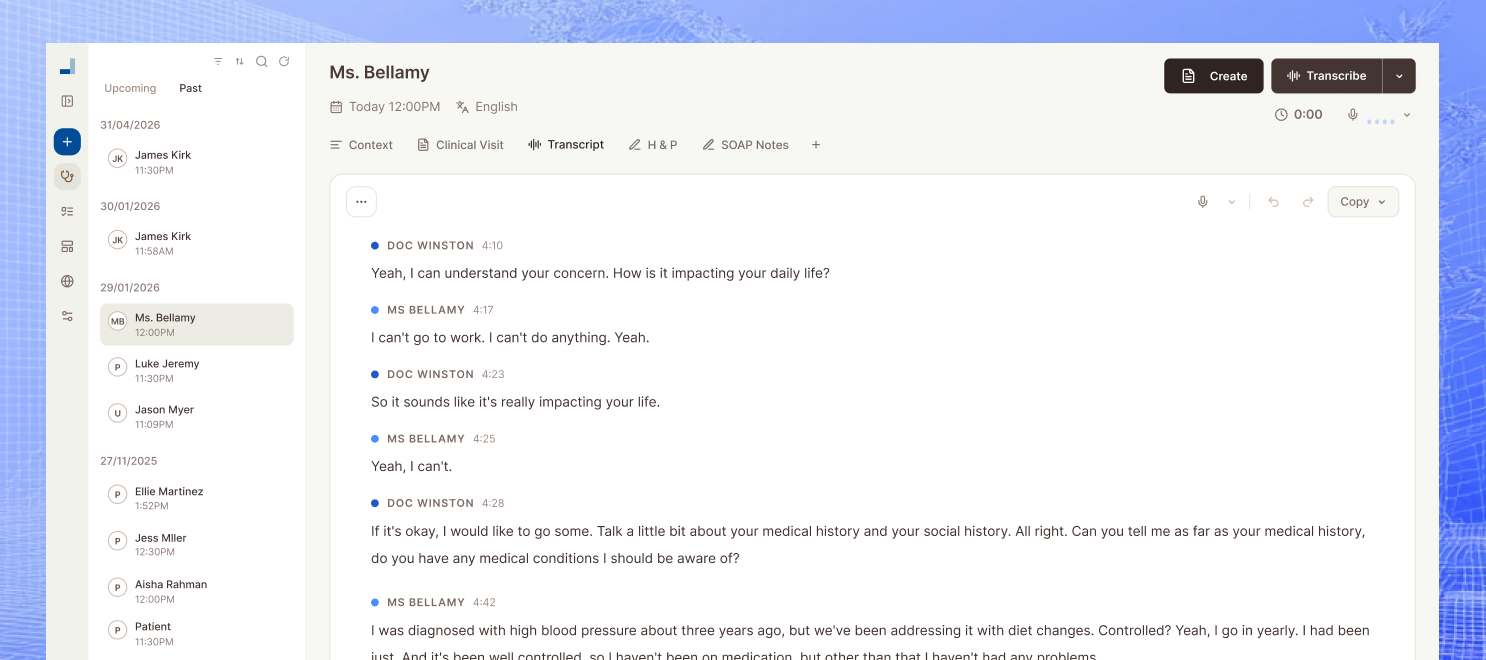
AI & Medicine: Capture HPI Automatically with AI Scribe: A Doctor's Guide
Learn how to automate HPI and clinical notes with an AI medical scribe. Reduce burnout, save time on charting, and improve HPI accuracy in your clinic.
What a medical scribe solves in modern practice
The burden of documentation is the leading cause of clinical burnout. Clinicians often spend two hours on administrative work for every one hour spent with a patient, frequently resulting in “pajama time”—charting late into the night at home. This cognitive load doesn’t just exhaust the provider; it creates a barrier between the doctor and the patient, as the computer screen often becomes a third party in the exam room.
An AI medical scribe serves as an assistive technology that captures the nuances of a patient conversation in real-time. It is important to remember that these tools are not intended to replace clinical judgment. Instead, they act as a highly efficient draftsperson, organizing raw dialogue into structured clinical data so the provider can focus on the human being sitting across from them.
- Eliminates after-hours charting and reduces administrative fatigue.
- Improves patient-provider eye contact and rapport during the visit.
- Captures granular details that might be forgotten by the end of the day.
- Serves as a drafting tool while keeping the clinician as the ultimate reviewer.
Note types you can generate beyond SOAP (H&P and more)
While the SOAP note is the standard for daily progress, complex presentations frequently require more comprehensive documentation styles. History and Physical (H&P) notes are essential for new admissions or comprehensive annual exams, requiring a deeper dive into the History of Present Illness (HPI), Review of Systems, and Past Medical History. Automating the capture of these deep-dive sections ensures that the narrative flow of the patient’s symptoms is preserved without manual typing.
Specialized encounters also demand unique formats. Consult notes need to focus heavily on the reason for referral and specific recommendations, while procedure notes must detail the steps, instruments, and immediate outcomes of an intervention. Using an AI scribe allows a clinic to generate follow-up notes that specifically track changes from the last visit, or discharge summaries that synthesize a complex stay into actionable instructions for the next care provider.
Consistency in these formats is vital for audit readiness and continuity of care. When notes are structured uniformly across a practice or university clinic, it becomes much easier for a multi-disciplinary team to review the patient history. This high-quality documentation also reduces the risk of insurance claim denials by providing the necessary clinical evidence to support the billed level of service.
- Generate H&P, consult, and procedure notes specialized by encounter type.
- Maintain consistent quality for audits and medicolegal protection.
- Improve transitions of care with clear discharge and referral letters.
- Standardize documentation across various providers within a clinic.
How to implement AI medical scribe step-by-step in a real clinic
Integrating an AI medical scribe starts with choosing a single visit type to pilot, such as standard follow-ups or routine physicals. Focusing on one area allows the clinical team to get comfortable with the recording process before moving to more complex cases. Once the initial workflow is established, the provider should select or customize templates that align with their specialty, ensuring the AI knows exactly how to categorize the captured HPI and physical exam findings.
During the patient encounter, whether it is in-person or via a telehealth platform, the clinician simply activates the scribe at the start of the conversation. There is no need to change the way you speak; the AI is designed to filter out casual small talk and focus on clinical relevance. As the patient describes their symptoms, the AI begins structuring the HPI, capturing the onset, duration, and severity of the issues discussed.
After the encounter ends, the generated draft appears almost immediately for review. This is the stage where the clinician performs a quick audit—checking for accuracy in medication dosages or specific dates. Once the review is complete, the note can be finalized in the EMR. Finally, the clinician can reuse the captured data to generate secondary documents, like referral letters or work excuse forms, without having to re-type the patient’s story.
- Start with one visit type to master the recording workflow.
- Select specialty-specific templates to ensure proper data categorization.
- Review the generated draft immediately after the visit for maximum accuracy.
- Leverage the AI to create secondary forms and letters from the same data.
How to keep note quality high and reduce mistakes
Quality control is a shared responsibility between the AI and the clinician. Common pitfalls in clinical documentation include “note bloat,” where irrelevant details clutter the chart, or the omission of specific negative findings. To prevent this, clinicians should establish a lightweight review habit, spending 30 to 60 seconds scanning the AI output for any hallucinations or misplaced data points. Modern AI is incredibly accurate, but it remains a tool that requires human oversight.
Standardizing what constitutes a “high-quality” note within your practice can also help. This might include specific requirements for how the HPI is phrased or which sections must be included for specific ICD-10 codes. By aligning the team on these standards, the AI can be better directed via templates to produce notes that meet the highest professional and legal benchmarks.
- Develop a 60-second review habit for every generated clinical note.
- Identify and correct common errors like incorrect problem lists early.
- Use standardized templates to prevent unnecessary note bloat.
- Ensure the final note reflects the clinician’s unique professional voice.
Privacy, consent, and patient trust (plain English)
Data privacy is the foundation of digital health. While specific consent requirements vary by region and state, the general principle is transparency. Patients are generally very receptive to AI scribes when they understand that the tool allows their doctor to listen more intently and document their concerns more accurately. It is always best to follow your local healthcare board’s guidance on whether written or verbal consent is required.
Explaining the tool to a patient doesn’t have to be complicated. A simple script such as, “I’m using an AI assistant today to help me take notes so I can focus entirely on you instead of my computer,” is usually all it takes to put a patient at ease. Most patients appreciate the extra attention and the fact that their medical records will be more detailed and accurate.
- Always follow local and federal guidelines regarding patient consent.
- Use a simple script to explain the benefits of the AI tool to the patient.
- Ensure the AI vendor uses modern encryption and data security standards.
- Maintain patient trust by being transparent about how data is handled.
Rolling it out across a clinic without disruption
A successful rollout requires a phased approach rather than a total overnight switch. A two-week pilot program involving one or two “champion” providers is the best way to uncover potential workflow bottlenecks. During this time, the clinic should track metrics such as time saved on charting and the reduction in after-hours work to demonstrate the value of the tool to the rest of the staff.
Training should focus not just on the software itself, but on template alignment. When every provider uses the same high-quality templates, it ensures a uniform standard of care across the university clinic or private practice. Once the pilot is successful, the rollout can be expanded to the entire team, provided there is a clear channel for feedback and troubleshooting.
- Conduct a 14-day pilot with a few providers to refine the workflow.
- Track time saved and note completeness to measure success.
- Standardize clinical templates across the organization for consistency.
- Provide a clear feedback loop for clinicians during the transition.
Mcoy AI is an AI medical scribe that records and transcribes patient encounters, then generates multiple clinical note types (H&P, progress notes, consult notes, follow-up notes, procedure notes, discharge summaries, referral letters, and more). With over 200 customizable templates and an AI chat feature to create letters, forms, and secondary documents, it helps clinicians spend more time with patients and less time on administrative tasks.
Conclusion
Transitioning to an automated workflow for your HPI and clinical notes is a transformative step for any modern practice. By following a structured implementation plan—from piloting with specific visit types to maintaining high quality through consistent review—clinicians can reclaim their time and focus on what truly matters: patient care. Using an AI medical scribe simplifies the most tedious part of the job while ensuring your documentation is more comprehensive than ever. If you are ready to eliminate the burden of manual charting, start your pilot today and experience how easy it is to capture HPI automatically with an AI medical scribe.
What a serious review table should cover
| Decision area | Common mistake | Better clinic-ready approach | Metric to watch |
|---|---|---|---|
| Workflow design | Treat capture hpi automatically with ai scribe: a doctor’s guide as a one-off documentation task | Build a repeatable process with clear ownership and review points | Time to complete documentation |
| Team adoption | Assume every clinician will naturally use the same process | Train for consistency and define exception handling early | Active user adoption |
| Quality review | Only check notes when a problem is reported | Audit a sample of notes weekly and review edge cases | Edit rate per note |
| Operational follow-through | Leave admin actions outside the documentation workflow | Use the same encounter data for referrals, letters, and follow-up tasks | Completion rate for next-step tasks |
Related reading
If you are working through capture hpi automatically with ai scribe: a doctor’s guide, it helps to read this alongside AI & Medicine: How to Simplify Clinical Notes for Busy Doctors, AI & Medicine: How Doctors Can Improve SOAP Notes, and AI & Medicine: How to Improve Transcription Accuracy in Consultations. Those guides cover adjacent workflow, implementation, and evaluation questions so the decision does not sit in isolation.
FAQ
How accurate are AI medical scribes in real clinics?
Modern AI scribes are highly accurate, often capturing nuances in the clinical conversation that a provider might overlook while typing. They use advanced natural language processing to distinguish between medical facts and casual conversation. However, the accuracy is highest when the clinician speaks clearly and the environment has minimal background noise. Most providers find the drafts require only minor edits before being finalized in the patient record.
Do I still need to review every note?
Yes, as the licensed clinician, you are legally and professionally responsible for the accuracy of the medical record. The AI acts as your assistant or draftsperson, but it cannot replace your clinical judgment. A quick 30 to 60-second review is usually sufficient to ensure that all dosages, dates, and clinical findings are correctly represented. This review habit is essential for maintaining the highest standard of patient safety.
What note types can an AI scribe generate besides SOAP?
The best AI scribes go far beyond the standard SOAP format. They can generate comprehensive History and Physical (H&P) notes, detailed procedure notes, consult letters for specialists, and discharge summaries. Additionally, they can create follow-up notes that track specific progress over time and even draft referral letters based on the dialogue from the visit. This versatility makes them useful across all medical specialties.
Will this work for telehealth and in-person consults?
Yes, AI medical scribes are designed to be flexible. For in-person visits, they typically run on a mobile device or tablet placed in the exam room. For telehealth, they can capture audio directly from the computer or through a browser extension. The AI processes the audio in the same way regardless of the setting, ensuring that your documentation remains consistent whether you are seeing patients in a clinic or remotely.
How do I explain recording/transcription to patients?
Transparency is key to maintaining patient trust. Most clinicians find success by telling the patient that the tool allows them to focus on the conversation instead of the computer screen. You might say, “I’m using an AI scribe to help me capture our notes today so I can give you my full attention.” Most patients appreciate the better eye contact and are familiar with similar technologies in other parts of their lives.
How do clinics prevent note bloat?
Note bloat is prevented by using concise, specialty-specific templates that tell the AI exactly which information is relevant. Instead of transcribing everything, the AI is trained to summarize and categorize the important clinical data. Clinicians can also adjust their templates to omit certain sections or use bullet points rather than long paragraphs, keeping the resulting clinical note clean, readable, and focused on essential facts.
How long does template setup take?
Setting up templates is usually a very quick process. Most AI scribes come with a library of pre-built templates for common specialties (like Family Medicine, Pediatrics, or Orthopedics) that can be used immediately. Customizing these to fit your personal style or specific clinic requirements typically takes just a few minutes per template. Once set up, the AI uses these every time to ensure your notes are structured exactly how you want them.
What’s the safest way to start if I’m skeptical?
The safest way to start is with a small pilot program. Choose three to five of your most standard, non-complex visits per day and use the scribe for those encounters. This allows you to see the quality of the output without the pressure of a full schedule transition. As you gain confidence in the AI’s ability to capture history and create accurate drafts, you can gradually expand its use to more complex patient visits.