Specialty Guides: How to Capture Differential Diagnosis With AI | Full Guide
Learn how to use an AI medical scribe to capture a complex differential diagnosis accurately. Optimize clinical workflows and reduce charting burnout.
What a medical scribe solves in modern practice
The modern clinical environment is increasingly defined by its documentation burden, where the real cost of a patient visit often extends far beyond the time spent in the exam room. High cognitive load, delayed note-taking, and the constant pressure of after-hours charting lead to significant clinician burnout and a higher risk of missing subtle clinical details. When a doctor is focused on typing while a patient speaks, they lose the ability to observe non-verbal cues and deeply process the patient’s narrative, which is often where the key to a complex diagnosis lies.
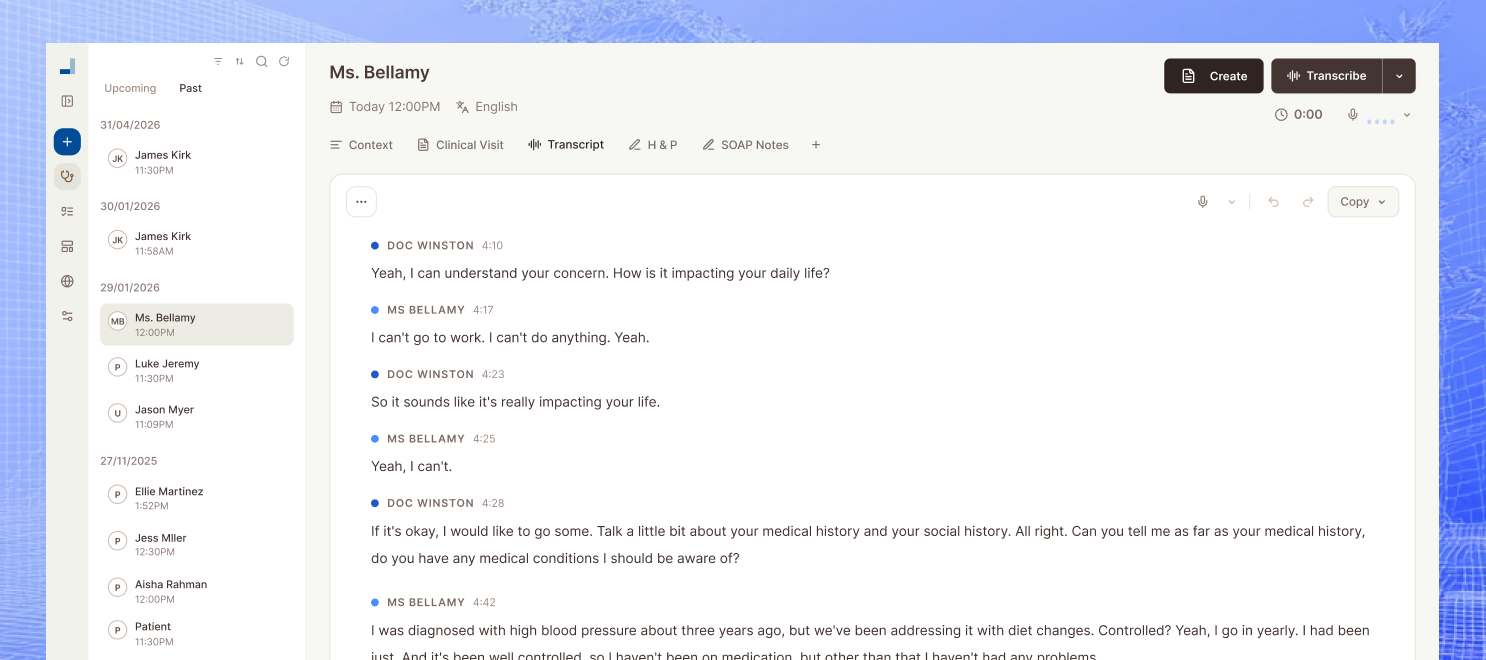
An AI medical scribe acts as a sophisticated digital assistant that bridges the gap between the clinical encounter and the electronic health record. By capturing the natural dialogue between clinician and patient, these tools remove the mechanical burden of typing, allowing the practitioner to focus entirely on the person in front of them. It is important to note, however, that an AI scribe is an assistive technology; the clinician remains the final authority and is responsible for the accuracy and medical necessity of every note generated.
- Eliminates after-hours charting and reduces cognitive fatigue.
- Improves patient-clinician rapport by enabling eye contact.
- Ensures comprehensive capture of the patient’s history and symptoms.
- Acts as an assistant while maintaining clinician oversight and responsibility.
Note types you can generate beyond SOAP (H&P and more)
While the SOAP note is the industry standard for daily progress, many clinical encounters demand more specialized documentation formats. A comprehensive AI tool allows clinicians to generate detailed History and Physical (H&P) reports, consult notes for specialists, and complex procedure notes without starting from scratch. These varied formats ensure that the documentation matches the medical necessity of the visit, whether it is an initial diagnostic workup or a routine follow-up.
The importance of structure in these notes cannot be overstated, particularly when it comes to continuity of care and audit readiness. A well-organized referral letter or a clear discharge summary ensures that the next provider in the care continuum has a precise understanding of the patient’s status. By automating the transition from a raw audio transcript to a structured medical document, clinics can maintain a high standard of clinical accuracy across all departments, from primary care to university-level specialized clinics.
- Generates H&P, progress notes, and specialized consult summaries.
- Streamlines the creation of referral letters and discharge summaries.
- Enhases continuity of care through consistent documentation structure.
- Reduces the risk of audit failures with detailed, formatted outputs.
How to implement How to Capture Differential Diagnosis in Notes With AI step-by-step in a real clinic
Implementing a workflow to capture differential diagnosis in notes with AI begins with selecting a single, high-volume visit type to pilot. Start by identifying cases where the diagnostic process is complex—such as a new patient presenting with vague abdominal pain or chronic fatigue—where the differential diagnosis is likely to be broad. This allow you to see how the software handles the logic of excluding certain conditions while prioritizing others based on the verbal evidence captured during the exam.
Before you begin the recording, ensure your templates are tailored to your specialty. In a university clinic, for example, your template might require a specific section for academic teaching points or detailed pathophysiology. Once the encounter begins, simply speak naturally. Discussing the potential diagnoses out loud with the patient not only aids their understanding but also ensures the AI captures your clinical reasoning for the ‘Assessment and Plan’ section of the note.
After the encounter, the AI will present a draft that includes the various diagnostic possibilities discussed. Review this output immediately to refine the hierarchy of the differential diagnosis. This rapid review habit ensures that your clinical intent is perfectly preserved. Finally, the generated text can be seamlessly exported into your EHR or used to populate referral forms and patient education materials, closing the loop on the diagnostic process without the need for manual re-typing.
- Select one visit type to test the diagnostic capture depth.
- Utilize specialty-specific templates to guide the AI output structure.
- Narrate your clinical reasoning aloud to ensure AI capture.
- Review, edit, and export notes immediately to maintain accuracy.
How to keep note quality high and reduce mistakes
Even with advanced technology, clinical documentation can suffer from common failure points such as missing current medications, incorrect laboratory values, or the dreaded ‘note bloat.’ To maximize the utility of AI-generated notes, clinicians must adopt a lightweight review habit. This involves scanning the note for specific numerical data and ensuring the problem list accurately reflects the current visit rather than carrying over outdated information from previous encounters.
Setting team standards for documentation within a clinic or hospital department is also vital for long-term quality control. When everyone uses a consistent approach to reviewing AI drafts, the likelihood of systemic errors decreases significantly. Clinicians should look for clarity in the differential diagnosis section, making sure the AI hasn’t included improbable conditions that were only mentioned in passing or as part of a general screening dialogue.
- Perform a focused review of medications, dosages, and lab values.
- Avoid note bloat by excluding irrelevant historical data.
- Standardize documentation expectations across the clinical team.
- Ensure the differential diagnosis reflects actual clinical priority.
Privacy, consent, and patient trust (plain English)
Patient trust is the foundation of any successful clinical implementation involving technology. Consent requirements for recording and transcribing encounters vary widely by jurisdiction and local institutional policy. It is essential for providers to stay informed about their specific legal obligations while prioritizing transparent communication with their patients about how their data is being handled and protected.
Explaining the process to a patient can be simple and reassuring. You might say: ‘I’m using a secure AI tool to help me listen more closely to you today. It records our conversation so I can focus on your health instead of my computer, and it creates a medical note for your file. Your data is encrypted and handled with the highest level of privacy.’ This approach shifts the focus from ‘surveillance’ to ‘enhanced care quality.’
- Follow local laws and clinic-specific privacy protocols for consent.
- Use a clear, patient-friendly script to explain the tool’s benefits.
- Ensure the AI provider adheres to modern security and data retention standards.
- Maintain transparency in how medical records are generated and stored.
Rolling it out across a clinic without disruption
A successful rollout of an AI scribe requires a structured approach to minimize friction for both staff and patients. A two-week pilot program is generally sufficient to identify workflow bottlenecks and get clinicians comfortable with the interface. During this period, clinics should track key metrics such as the amount of time saved per day, the reduction in ‘pajama time’ (after-hours work), and the subjective quality of the medical notes compared to the previous manual system.
Training should focus not just on the software itself but on template alignment. When every clinician in the practice is using the same baseline templates for common procedures or consults, the data becomes more useful for practice-wide audits and quality improvement initiatives. By the end of the pilot, the goal is to have a seamless transition where the AI becomes an invisible but essential part of the care delivery team.
- Execute a 2-week pilot to test workflows and clinician tech-adoption.
- Measure time savings and improvements in documentation quality.
- Align templates across the clinic for data consistency.
- Provide focused training to ensure all staff understand the new workflow.
Mcoy AI is an AI medical scribe that records and transcribes patient encounters, then generates multiple clinical note types (H&P, progress notes, consult notes, follow-up notes, procedure notes, discharge summaries, referral letters, and more). It features 200+ customizable templates and an integrated AI chat to create letters, forms, and other essential medical documents, helping providers focus on the patient rather than the keyboard.
In summary, integrating AI into your practice allows for a more nuanced and accurate way to capture differential diagnosis in notes with AI while simultaneously curing the documentation headaches that plague modern medicine. By following a structured implementation plan and prioritizing clinician review, you can transform your clinical documentation from a chore into a high-value asset. Start your pilot today and reclaim your time for what matters most: patient care.
What a serious review table should cover
| Decision area | Common mistake | Better clinic-ready approach | Metric to watch |
|---|---|---|---|
| Workflow design | Treat how to capture differential diagnosis with ai | full guide as a one-off documentation task | Build a repeatable process with clear ownership and review points |
| Team adoption | Assume every clinician will naturally use the same process | Train for consistency and define exception handling early | Active user adoption |
| Quality review | Only check notes when a problem is reported | Audit a sample of notes weekly and review edge cases | Edit rate per note |
| Operational follow-through | Leave admin actions outside the documentation workflow | Use the same encounter data for referrals, letters, and follow-up tasks | Completion rate for next-step tasks |
Related reading
If you are working through how to capture differential diagnosis with ai | full guide, it helps to read this alongside Specialty Guides: How to Run a More Efficient Medical Practice in 2026, Specialty Guides: How to Improve Patient Encounters, and AI & Medicine: Build a Safe Review Process for AI Notes | Guide for Doctors. Those guides cover adjacent workflow, implementation, and evaluation questions so the decision does not sit in isolation.
FAQ
How accurate are AI medical scribes in real clinics?
AI medical scribes have reached a high level of accuracy, often capturing nuances that clinicians might forget during a busy shift. They are particularly adept at transcribing the natural flow of conversation into medical terminology. However, they rely on the quality of the audio and the clarity of the clinician’s verbal instructions. For this reason, accuracy is highest when clinicians narrate their findings and logic clearly during the exam.
Do I still need to review every note?
Yes, reviewing every note is a fundamental requirement for medical and legal reasons. While the AI does the heavy lifting of drafting the content, the clinician is the one responsible for validating its accuracy. A quick 60-second review is usually enough to catch minor errors or adjust the emphasis of the differential diagnosis. This ensures the final record is a true and safe reflection of the patient encounter.
What note types can an AI scribe generate besides SOAP?
Modern AI scribes are capable of generating a wide variety of documentation beyond standard SOAP notes. These include comprehensive History and Physical (H&P) reports, consultation summaries, procedure notes, and detailed discharge summaries. They can also create referral letters and follow-up notes based on specific templates. This flexibility makes them useful for both primary care and highly specialized clinical settings.
Will this work for telehealth and in-person consults?
Yes, AI scribes are designed to be versatile across different care delivery models. For in-person visits, the device captures the ambient audio in the room, while for telehealth, the AI can integrate with the virtual meeting platform or record via the system’s audio output. In both scenarios, the AI identifies the speakers and organizes the dialogue into a structured clinical format seamlessly.
How do I explain recording/transcription to patients?
The best way to explain the software is to emphasize that it helps you provide better care by allowing you to focus on the patient instead of a screen. You might explain that the tool is a HIPAA-compliant digital assistant that helps ensure their medical record is as accurate as possible. Most patients are supportive when they realize the technology allows their doctor to be more present and attentive during the visit.
How do clinics prevent note bloat?
Clinics prevent note bloat by using concise, specialized templates that only prompt the AI to include relevant information for the specific visit type. Clinicians should also be trained to specify which parts of the patient’s history are pertinent to the current encounter. During the final review, practitioners should delete any redundant information to keep the note focused and readable for other healthcare providers.
How long does template setup take?
Initial template setup usually takes only a few minutes per clinician, especially when using pre-built library templates. Most AI scribes come with a variety of specialty-specific options that can be used immediately or tweaked to fit personal preferences. Over time, clinicians can further refine these templates as they see how the AI responds to their specific speaking style and clinical workflow.
What’s the safest way to start if I’m skeptical?
The safest way to begin is to run a small pilot with simple, non-complex visits such as routine follow-ups or wellness exams. This allows you to observe how the AI processes information and generates notes without the pressure of a high-acuity diagnostic case. Once you gain confidence in the AI’s ability to draft accurate representations of your visits, you can gradually expand its use to more complex encounters and specialized note types.