Specialty Guides: Master Assessment and Plan Faster: AI Medical Scribe Guide
Learn how to use an AI medical scribe to streamline your assessment and plan. Reduce charting time, improve clinical accuracy, and prevent burnout.
The Hidden Burden of the Assessment and Plan
For most healthcare providers, the ‘Assessment and Plan’ section is the most intellectually demanding portion of a clinical note. After a long day of back-to-back patient encounters, synthesizing complex symptoms into a coherent diagnosis and a multi-step treatment plan can lead to significant after-hours charting. This cognitive load often results in rushed notes, a lack of specificity, and a growing sense of physician burnout.
This guide provides a comprehensive roadmap for implementing an AI medical scribe into your workflow. We will explore how to automate various note formats, maintain high-quality standards, and manage patient privacy within private practices and university clinics alike. By the end of this guide, you will understand how to leverage modern technology to reclaim your time without sacrificing the quality of your medical documentation.
What a medical scribe solves in modern practice
The real cost of traditional documentation is measured in more than just minutes; it is measured in cognitive fatigue and delayed patient care. When clinicians spend hours typing at a screen, they are less present during the actual encounter, which can lead to missed clinical details or a weakened patient-provider relationship. An AI medical scribe acts as a digital assistant that listens to the conversation in real-time, allowing the doctor to focus entirely on the person sitting across from them.
It is important to understand that an AI tool is assistive, not a replacement for clinical judgment. While the AI handles the heavy lifting of transcription and initial synthesis, the clinician remains the final authority. The scribe captures the nuance of the dialogue, ensuring that the final output reflects the actual clinical reasoning discussed during the visit rather than a generic template.
- Significant reduction in after-hours charting and administrative burnout.
- Improved eye contact and engagement during patient consultations.
- Greater detail captured in the history and physical examination.
- The clinician remains the final reviewer to ensure medical accuracy.
Note types you can generate beyond SOAP (H&P and more)
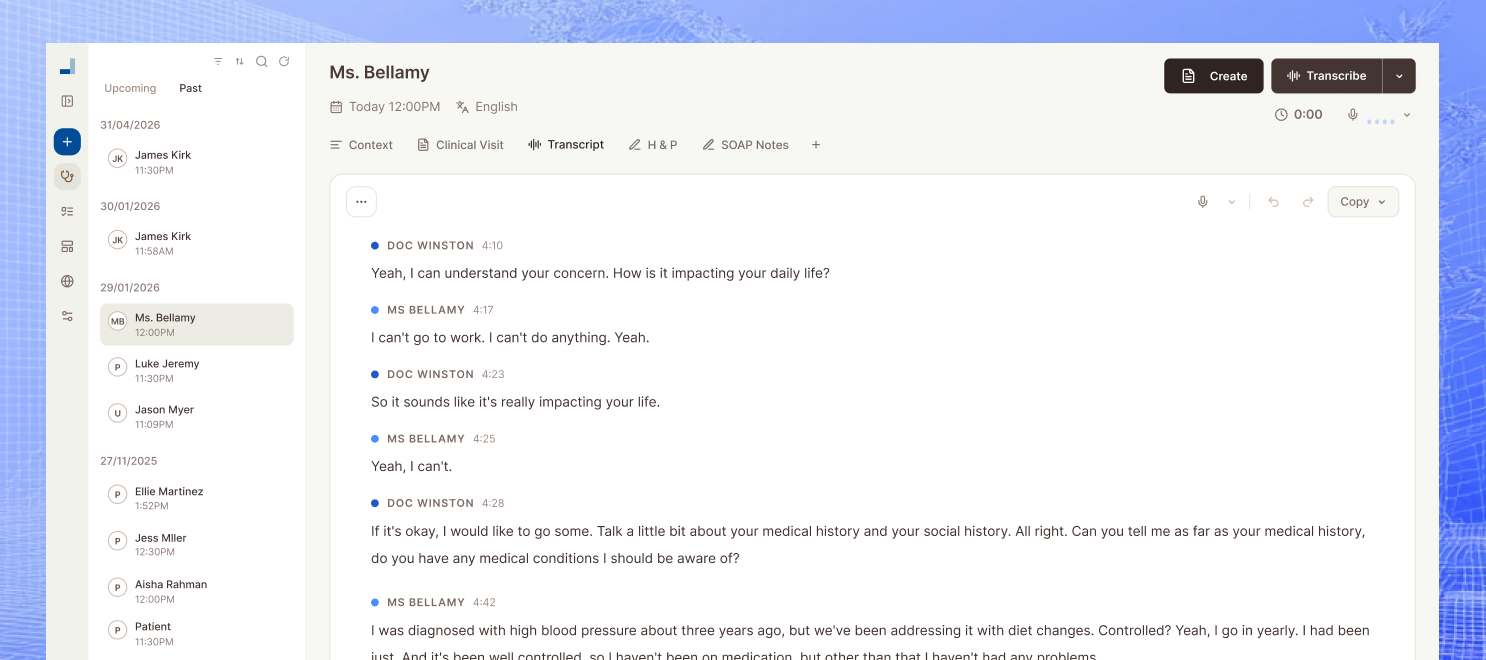
While the SOAP format is a staple in many clinics, complex cases often require more specialized documentation. An AI medical scribe is capable of generating History and Physical (H&P) reports, consult notes, and detailed procedure notes that go far beyond a simple progress update. This versatility is essential for specialists who need to document everything from a routine follow-up to a complex surgical referral.
Structure matters deeply for continuity of care and audit readiness. A well-organized discharge summary or referral letter ensures that the next provider in the care chain has all the necessary context. By using an AI to generate these diverse note types, you ensure that every document adheres to a high standard of professional formatting without requiring extra manual effort from your staff.
- Generate comprehensive H&P, consult notes, and procedure reports.
- Maintain high standards for discharge summaries and referral letters.
- Ensure audit readiness with structured and consistent documentation.
- Save time on follow-up notes by automatically pulling from the session audio.
How to implement an AI medical scribe step-by-step in a real clinic
Starting with an AI medical scribe does not require a total overhaul of your operations. Begin by selecting one specific visit type—such as routine follow-ups or wellness exams—to test the workflow. This allows you to get comfortable with the technology in a low-stakes environment before expanding to more complex diagnostic cases.
Once you choose your starting point, set up your templates. Most modern systems allow you to choose templates based on your specialty, whether you are in family medicine, orthopedics, or psychiatry. During the encounter, simply let the AI capture the dialogue naturally, whether you are working in-person or via a telehealth platform.
After the patient leaves, take a few moments to review and edit the generated draft. Because the AI has already structured the note, your role shifts from ‘writer’ to ‘editor,’ which is significantly faster. Finally, reuse these outputs to quickly generate necessary referral letters or patient instruction forms, maximizing the utility of a single recording.
- Pilot the technology with a single visit type to build confidence.
- Customize templates to match your specific specialty and workflow.
- Shift your documentation role from manual entry to high-level editing.
- Use the generated note to populate secondary forms and letters instantly.
How to keep note quality high and reduce mistakes
Even the most advanced AI can occasionally misinterpret technical values or miss specific medication adjustments if they aren’t clearly voiced. Common failure points often include ‘note bloat’—where the note becomes too wordy—or inaccuracies in the problem list. To prevent this, clinicians should adopt a lightweight review habit immediately following each encounter.
Establishing team standards for how notes are finalized ensures consistency across the clinic. When you narrate your clinical thinking out loud during the exam, the AI captures your ‘Assessment and Plan’ more accurately. This habit of ‘thinking out loud’ not only helps the AI but also helps the patient understand your reasoning.
- Review every note immediately for clinical accuracy and technical values.
- Narrate your findings out loud during the exam to guide the AI synthesis.
- Implement a consistent review standard for all practitioners in the clinic.
- Prune unnecessary text to prevent ‘note bloat’ and maintain clarity.
Privacy, consent, and patient trust (plain English)
Patient privacy is the foundation of the clinical relationship. While laws vary by region, the general principle is to be transparent about why you are using an AI medical scribe. Most patients are supportive once they realize it allows their doctor to listen to them better rather than looking at a computer screen.
A simple way to explain this is: ‘I’m using an AI assistant today to record our visit so I can focus on you instead of my computer. It helps me create your medical notes accurately, and your data is processed securely.’ This approach fosters trust and ensures the patient feels respected throughout the process.
- Always follow local regulations regarding recording and data retention.
- Explain the benefits of better engagement to help patients feel comfortable.
- Ensure the technology provider uses industry-standard encryption.
- Clearly state that the clinician maintains control over the final record.
Rolling it out across a clinic without disruption
A successful rollout starts with a two-week pilot involving a lead physician or a tech-savvy ‘champion.’ During this period, track metrics like after-hours charting time and note completion rates. Seeing a tangible reduction in administrative time is the best way to gain buy-in from the rest of the staff.
Training should focus on template alignment and the ‘thinking out loud’ technique. In university clinics, this can also be used as a teaching tool to help residents understand how to structure their own clinical reasoning. By the end of the pilot, the benefits of using an AI medical scribe should be clear enough to justify a full-scale implementation.
- Launch a 14-day pilot to gather data on time savings and note quality.
- Identify a clinic champion to lead the transition and train others.
- Focus on ‘thinking out loud’ to improve the quality of the ‘Assessment and Plan.’
- Compare before-and-after metrics to measure the reduction in burnout.
Mcoy AI is an AI medical scribe that records and transcribes patient encounters, then generates multiple clinical note types (H&P, progress notes, consult notes, follow-up notes, procedure notes, discharge summaries, referral letters, and more). It features 200+ customizable templates and an AI chat to create letters, forms, and documents, helping clinicians spend significantly less time on paperwork and more time delivering quality patient care.
Conclusion
Optimizing your workflow with an AI medical scribe is one of the most effective ways to reclaim your personal time and improve the quality of your documentation. By following the structured rollout and review habits outlined in this guide, you can ensure that your ‘Assessment and Plan’ is captured accurately every time. Transitioning to an automated system is the next logical step for any modern clinic looking to reduce burnout and prioritize patient care. Start your pilot today and discover how much time you can save.
What a serious review table should cover
| Decision area | Common mistake | Better clinic-ready approach | Metric to watch |
|---|---|---|---|
| Workflow design | Treat master assessment and plan faster: ai medical scribe guide as a one-off documentation task | Build a repeatable process with clear ownership and review points | Time to complete documentation |
| Team adoption | Assume every clinician will naturally use the same process | Train for consistency and define exception handling early | Active user adoption |
| Quality review | Only check notes when a problem is reported | Audit a sample of notes weekly and review edge cases | Edit rate per note |
| Operational follow-through | Leave admin actions outside the documentation workflow | Use the same encounter data for referrals, letters, and follow-up tasks | Completion rate for next-step tasks |
Related reading
If you are working through master assessment and plan faster: ai medical scribe guide, it helps to read this alongside Specialty Guides: How to Run a More Efficient Medical Practice in 2026, Specialty Guides: How to Improve Patient Encounters, and Specialty Guides: Mastering Accents in Medical Transcription: 2024 Guide. Those guides cover adjacent workflow, implementation, and evaluation questions so the decision does not sit in isolation.
FAQ
How accurate are AI medical scribes in real clinics?
Modern AI medical scribes are highly accurate, often capturing over 95% of clinical nuances when the clinician speaks clearly. They are designed to understand medical terminology and contextualize the dialogue between a doctor and patient. However, they are assistive tools, meaning their output is a draft that requires a final review by the practitioner. Most users find that only minor edits are needed to reach 100% accuracy.
Do I still need to review every note?
Yes, reviewing every note is a critical step in maintaining clinical excellence and medico-legal safety. The AI generates a comprehensive draft, but the clinician is ultimately responsible for the medical decisions and facts recorded in the patient file. Usually, this review takes less than 60 seconds because the structure and bulk of the narrative are already completed. It ensures that the ‘Assessment and Plan’ precisely matches your intentions.
What note types can an AI scribe generate besides SOAP?
Beyond the standard SOAP format, an AI scribe can generate History and Physical (H&P) notes, complex consultation summaries, and detailed procedure notes. It can also produce discharge summaries, referral letters, and follow-up notes tailored to specific specialties. With customizable templates, the scribe can adapt to virtually any clinical documentation requirement you have in your practice.
Will this work for telehealth and in-person consults?
Yes, AI medical scribes are versatile and work effectively in both settings. For in-person visits, the device records the ambient conversation, while for telehealth, it can capture audio directly from the computer or through a mobile app. The technology is built to filter out background noise and focus on the primary speakers, ensuring a clear transcript regardless of the medium.
How do I explain recording/transcription to patients?
The best way to explain it is to focus on the benefit to the patient: better quality of care. You might say, ‘I’m using a transcription tool so I can listen to you carefully rather than taking notes on my screen.’ Most patients appreciate the extra attention and are comfortable with the technology when they understand it improves the accuracy of their medical records. Transparency is key to maintaining trust.
How do clinics prevent note bloat?
Clinics can prevent note bloat by using concise templates and setting specific instructions for the AI on how much detail to include. Instead of transcribing every ‘um’ and ‘ah,’ the AI is programmed to extract only the medically relevant information. Clinicians can also perform a quick ‘pruning’ during their final review to remove any redundant or non-essential text that doesn’t add clinical value.
How long does template setup take?
Template setup typically takes very little time, often just a few minutes per clinician. Many systems come with a wide array of pre-built, specialty-specific templates that can be used immediately. If you want to customize your own local version, it is as simple as dragging and dropping fields or providing a sample of your preferred note style to the AI for learning.
What’s the safest way to start if I’m skeptical?
The safest approach is to start with a ‘non-clinical’ trial or use it for your most routine, straightforward cases first. This allows you to see the accuracy of the output without the pressure of a high-complexity diagnosis. Once you see the reduction in your documentation time and the quality of the drafts, you can gradually roll it out to more complex encounters and specialized note types.