Specialty Guides: Mastering Accents in Medical Transcription: 2024 Guide
Struggling with strong accents in medical transcription? Learn proven strategies to improve accuracy, reduce note bloat, and streamline clinical workflows.
What a medical scribe solves in modern practice
Clinical documentation has become a significant burden for healthcare providers, often leading to the phenomenon of ‘pajama time,’ where doctors spend hours after clinic finishing charts. When you add the complexity of strong regional or international accents, the cognitive load increases exponentially. This often leads to fatigue, delayed note completion, and a higher risk of transcribing incorrect clinical details.
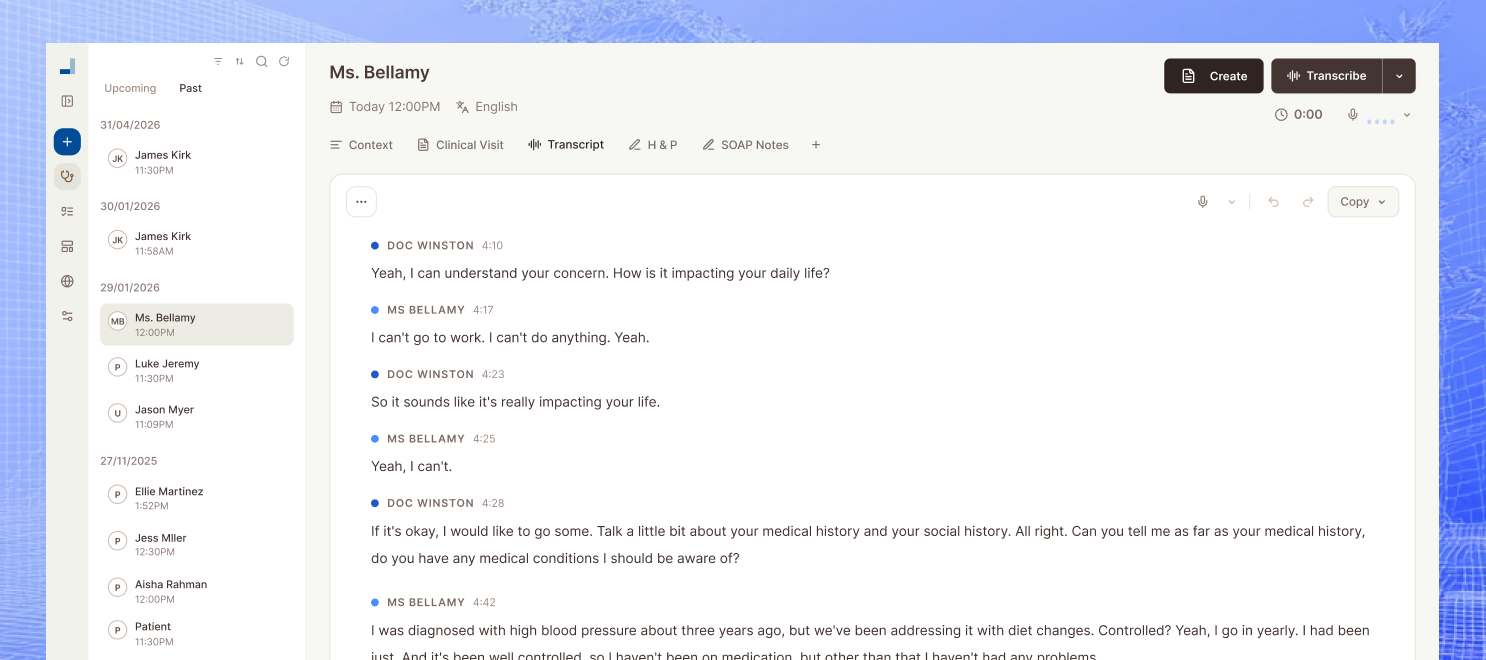
An AI medical scribe acts as a sophisticated digital assistant that processes audio in real-time. It is designed to filter out ambient noise and adapt to various speech patterns that might trip up a human scribe or a traditional speech-to-text engine. However, it is important to remember that these tools are assistive; the clinician remains the final authority on the accuracy of the medical record.
- Reduces the cognitive strain of deciphering complex phonetics.
- Eliminates hours of manually typing and re-listening to audio files.
- Provides a consistent draft even when speech patterns are irregular.
- Allows physicians to focus on patient eye contact rather than the screen.
Note types you can generate beyond SOAP (H&P and more)
While the SOAP note is the industry standard, medical transcription needs often extend far beyond simple subjective and objective assessments. Clinicians frequently require comprehensive History and Physical (H&P) reports, which provide a deep dive into a patient’s medical background. These documents must be precise, especially when capturing nuances from patients or colleagues with diverse accents.
Specialists often rely on consult notes, procedure notes, and referral letters which require a specific tone and structure. A robust documentation system should be able to handle discharge summaries and follow-up notes with equal fluidity. Having a system that understands context helps ensure that a ‘follow-up’ doesn’t just list symptoms but tracks longitudinal progress effectively.
Structuring these notes correctly is vital for audit readiness and medico-legal protection. When documentation is standardized across various note types, it ensures a seamless handover between departments and external specialists. High-quality documentation serves as a professional reflection of the care provided, regardless of the verbal complexity of the encounter.
- H&P and Progress Notes for daily clinical tracking.
- Detailed Procedure Notes and Discharge Summaries for hospitalists.
- Referral Letters and Consult Notes for specialty coordination.
- Customizable templates to fit unique department requirements.
How to implement medical transcription step-by-step in a real clinic
Integrating a modern solution for medical transcription starts with a focused approach rather than a total overhaul. Begin by selecting one specific visit type, such as routine follow-ups, to test how the system handles different voices and accents. This allows the staff to get comfortable with the interface without the pressure of a high-acuity patient encounter.
The next phase involves selecting and refining templates tailored to your specialty. If you are a cardiologist, ensure your templates focus on cardiac history and physical findings. Once the templates are ready, you can start capturing the encounter. Whether it is a telehealth session or an in-person consult, ensure the recording device is placed centrally to capture the clearest audio possible.
After the encounter, the generated draft should be reviewed immediately while the conversation is still fresh in your mind. This is where you can quickly correct any phonetic misunderstandings caused by thick accents. Finally, once the note is validated, you can reuse the structured data to auto-populate referral letters or school forms, saving significant administrative time.
- Start with low-complexity visits to build confidence.
- Use specialty-specific templates for better context recognition.
- Position recording hardware to optimize audio clarity.
- Review drafts immediately to ensure 100% clinical accuracy.
How to keep note quality high and reduce mistakes
The primary failure points in transcription often include missing medication dosages, incorrect lab values, or ‘note bloat’ where irrelevant filler words make the note unreadable. To prevent this, clinicians should adopt a lightweight review habit. Spending just sixty seconds scanning the output for key clinical indicators can prevent significant errors down the line.
Establishing team standards for documentation also helps maintain quality. For example, deciding ahead of time how to handle ‘hedging’ language or how to document interpreted conversations ensures that the final record is professional and concise. Standardizing these expectations reduces the variation between different providers in the same practice.
- Scan for high-risk data like dosages and dates.
- Use ‘smart’ editing to remove redundant or filler text.
- Set practice-wide standards for document length and style.
Privacy, consent, and patient trust (plain English)
Transparency is the most effective way to maintain patient trust when using transcription technology. While consent requirements vary by region, it is generally best practice to inform the patient that you are using a digital assistant to ensure their records are accurate. Most patients appreciate the fact that you are looking at them rather than your computer keyboard.
You might say: ‘I’m using a secure medical tool to record our conversation so I can focus entirely on you instead of typing. It helps me make sure your chart is perfectly accurate. Is that okay?’ This simple explanation usually alleviates any privacy concerns and positions the technology as a tool for better care.
- Explain the benefits of better eye contact and accuracy.
- Follow local HIPAA or GDPR regulations for data storage.
- Ensure all data is encrypted and handled securely.
Rolling it out across a clinic without disruption
Successful rollout requires a phased pilot plan, typically spanning two weeks. In the first week, a ‘champion’ provider uses the system to identify potential workflow bottlenecks. In the second week, they can train others based on their hands-on experience. This peer-to-peer training is often more effective than formal IT sessions.
Tracking metrics such as time saved per note and the reduction in after-hours charting provides the data needed to justify the shift. Many clinics find that after-hours documentation drops by 50-80% within the first month. Once the value is proven, you can align all templates across the organization to ensure a unified communication style.
- Start with one or two ‘champion’ users to lead the way.
- Measure ‘time-to-completion’ for clinical notes.
- Align templates across the clinic for consistent reporting.
Mcoy AI is an AI medical scribe that records and transcribes patient encounters, then generates multiple clinical note types including H&P, progress notes, consult notes, follow-up notes, procedure notes, discharge summaries, referral letters, and more. With over 200 customizable templates and an interactive AI chat, clinicians can effortlessly create letters, forms, and documents to streamline their administrative workload. It captures the nuances of every conversation, ensuring that no detail is lost regardless of the complexity of the speech.
Conclusion
Mastering medical transcription in a diverse clinical setting requires a blend of the right technology and a solid workflow. By focusing on structured templates and a consistent review process, you can overcome the challenges of strong accents and complex speech patterns. The ultimate goal is to return your focus to the patient while maintaining a gold-standard medical record. If you are ready to reclaim your personal time and improve your documentation quality, starting a pilot with a modern solution is the best next step. Implementing a high-quality medical transcription workflow today will safeguard your practice for years to come.
What a serious review table should cover
| Decision area | Common mistake | Better clinic-ready approach | Metric to watch |
|---|---|---|---|
| Workflow design | Treat mastering accents in medical transcription: 2024 guide as a one-off documentation task | Build a repeatable process with clear ownership and review points | Time to complete documentation |
| Team adoption | Assume every clinician will naturally use the same process | Train for consistency and define exception handling early | Active user adoption |
| Quality review | Only check notes when a problem is reported | Audit a sample of notes weekly and review edge cases | Edit rate per note |
| Operational follow-through | Leave admin actions outside the documentation workflow | Use the same encounter data for referrals, letters, and follow-up tasks | Completion rate for next-step tasks |
Related reading
If you are working through mastering accents in medical transcription: 2024 guide, it helps to read this alongside Specialty Guides: How to Run a More Efficient Medical Practice in 2026, Specialty Guides: How to Improve Patient Encounters, and Specialty Guides: Prevent AI Copy-Forward Errors | Guide for Clinic Owners. Those guides cover adjacent workflow, implementation, and evaluation questions so the decision does not sit in isolation.
FAQ
How accurate are AI medical scribes in real clinics?
AI medical scribes have reached high levels of accuracy, often exceeding 90-95% for standard English. When dealing with strong accents, their ability to use context clues helps them outperform traditional voice-to-text tools. However, they are meant to assist, not replace, the clinician’s review of the final document.
Do I still need to review every note?
Yes, clinical responsibility always rests with the provider. While the AI does the heavy lifting of transcribing and formatting, a quick review is necessary to ensure specific details like medication names or unique measurements are correct. Most providers find this review takes less than a minute.
What note types can an AI scribe generate besides SOAP?
Modern AI scribes can produce a wide variety of documentation beyond SOAP notes. This includes History and Physical (H&P) reports, consult notes, referral letters, procedure notes, and even discharge summaries. They use the context of the conversation to populate the appropriate template sections automatically.
Will this work for telehealth and in-person consults?
Yes, most AI transcription systems are designed to bridge the gap between in-person and digital care. For telehealth, the system can capture audio directly from the computer, while for in-person visits, a smartphone or tablet microphone is typically used to record the encounter.
How do I explain recording/transcription to patients?
Honesty is the best policy. Tell the patient that you are using a secure tool to capture the conversation so you can give them your full attention. Most patients are supportive when they realize it means their doctor won’t be staring at a screen for the entire visit.
How do clinics prevent note bloat?
Note bloat is prevented by using templates that prioritize ‘high-value’ information and AI models trained to filter out conversational filler. By setting specific instructions for length and detail, the system can generate concise summaries rather than raw transcripts.
How long does template setup take?
Setting up basic templates usually takes just a few minutes, especially if you start with pre-built options for your specialty. Customizing them to your specific preferences might take an hour or two of tweaking over the first week of use as you refine your workflow.
What’s the safest way to start if I’m skeptical?
The safest way to start is with a ‘shadow pilot.’ Use the tool during a few routine visits but keep your old documentation method as a backup. Once you see the accuracy and time savings firsthand, you can comfortably transition to using the tool as your primary documentation method.