AI & Medicine: How to Reduce Errors in Clinical Notes
Full guide on how doctors can reduce errors in clinical notes, improve documentation accuracy, and save time using smarter workflows and AI support.
Errors in clinical notes are more than just an administrative inconvenience. For doctors, private practitioners, and clinics, inaccurate or incomplete documentation can lead to clinical risk, compliance issues, billing problems, and unnecessary stress after hours. Many clinicians already feel the pressure of seeing more patients while keeping up with documentation, and that pressure is often where errors begin.
This guide explains how to reduce errors in clinical notes in a practical, realistic way. It focuses on workflow improvements, habits that actually work in busy clinics, and modern tools that support doctors without forcing them to replace their existing EHR. The goal is simple: clearer notes, fewer corrections, and more confidence in your documentation.
Why errors in clinical notes happen so often
Clinical note errors are rarely caused by a lack of medical knowledge. They usually come from the environment doctors are working in. Short appointment times, constant interruptions, and cognitive fatigue all contribute to mistakes. When you are documenting at the end of a long clinic day, it becomes easy to miss details, copy forward outdated information, or phrase something ambiguously.
Another major factor is context switching. Doctors are expected to listen, think clinically, communicate empathetically, type, click through EHR templates, and meet billing requirements all at the same time. When attention is divided, accuracy suffers. Over time, small documentation shortcuts can become habits, increasing the risk of errors across many patient records.
The real risks of inaccurate clinical documentation
Errors in clinical notes can affect patient care directly. Missing symptoms, incorrect medication histories, or unclear assessment plans may influence future clinical decisions. Even when the care itself is excellent, poor documentation can create confusion for colleagues, specialists, or allied health professionals reviewing the notes later.
There are also medicolegal and financial implications. Incomplete or inconsistent notes can weaken clinical defensibility if records are audited or reviewed. Billing errors often stem from documentation gaps rather than incorrect care. For clinics and hospitals, this translates into lost revenue, delayed claims, and compliance headaches.
Build better note-taking habits during the consultation
One of the most effective ways to reduce errors is to improve how notes are captured during the encounter, not hours later. Relying on memory after clinic almost guarantees omissions. Even brief, structured note capture in real time significantly improves accuracy.
Doctors who develop a consistent mental framework for each encounter tend to make fewer errors. Knowing exactly what you want to capture in the history, assessment, and plan reduces cognitive load. Instead of writing free text from scratch each time, you are mentally checking boxes as the consultation progresses.
Speaking clearly and summarising key points aloud during the visit can also help. When you verbalise your assessment or plan to the patient, you reinforce it in your own mind. This often results in clearer documentation and fewer inconsistencies between what was discussed and what was written.
Standardise templates without over-restricting yourself
Templates are a double-edged sword. Used well, they reduce errors by ensuring essential elements are not missed. Used poorly, they encourage copying and pasting, which can propagate incorrect or outdated information.
The key is flexible standardisation. Templates should guide, not dictate. A good template prompts the right questions and sections while still allowing clinical nuance. For example, having structured headings for history, examination, and plan improves completeness, but the content within those headings should reflect the actual encounter.
Regularly reviewing and refining templates is equally important. Clinical practice evolves, and so should your documentation structure. Removing irrelevant fields reduces noise and helps you focus on what truly matters for that patient.
Reduce copy-forward and autopilot documentation
Copying previous notes can save time, but it is one of the most common sources of errors in clinical documentation. Old symptoms, resolved conditions, or outdated medication lists often persist because they were never actively reviewed.
A simple habit shift can help. Before signing a note, consciously scan for copied content and ask whether it still applies. This takes seconds but prevents long-term inaccuracies from accumulating. Clinics that encourage this practice often see a noticeable improvement in note quality across providers.
Where possible, limit copy-forward to objective data that is unlikely to change, and rewrite subjective or assessment sections in your own words. This forces active thinking and reduces the chance of blindly carrying forward incorrect information.
Use technology to support accuracy, not add complexity
Technology should reduce cognitive load, not increase it. Many doctors struggle because their tools demand too much attention during the consultation, pulling focus away from the patient.
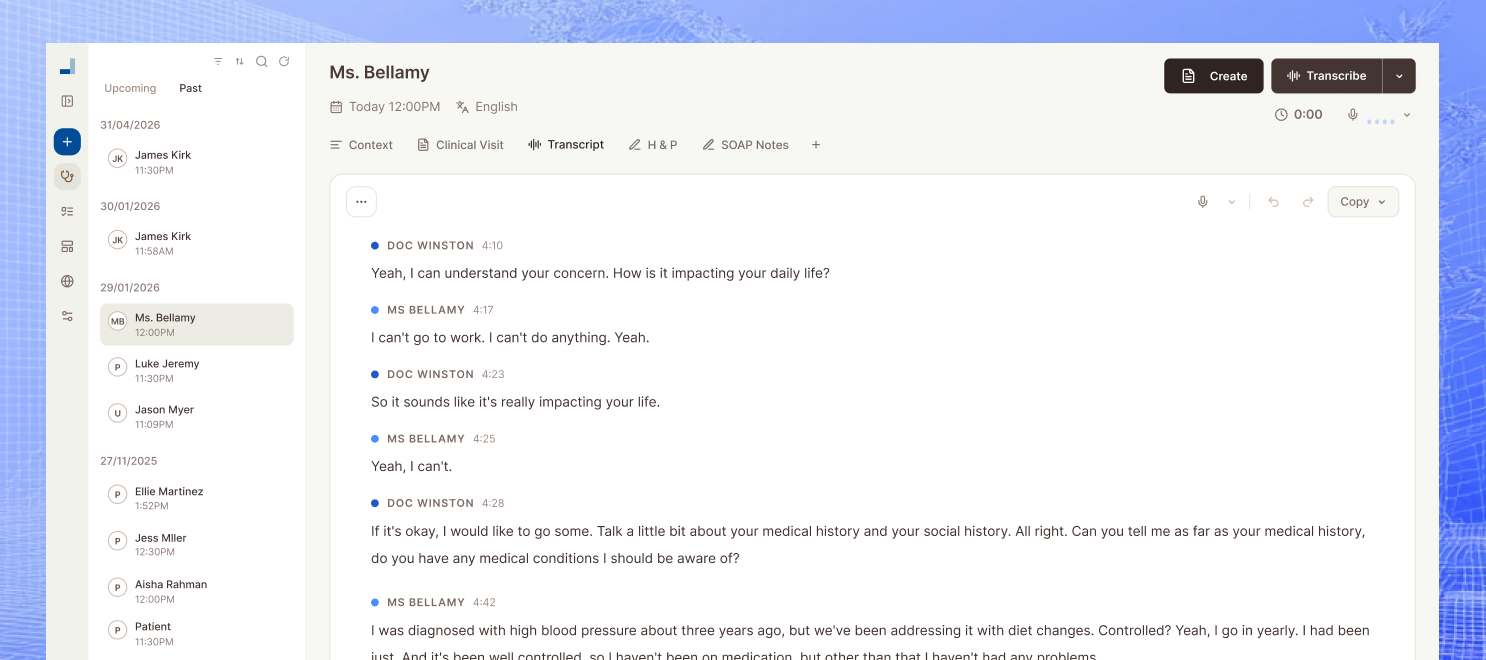
This is where ambient documentation and AI-assisted tools are changing how clinical notes are created. Instead of typing while listening, doctors can focus on the conversation while technology captures and structures the encounter in the background. When implemented properly, this significantly reduces missed details and transcription errors.
How Mcoy AIhelps reduce errors in clinical notes
Mcoy AI is designed specifically to support doctors without replacing their existing EHR. It works as an AI medical scribe that records and transcribes patient encounters, then turns them into structured SOAP notes and clinical documentation.
One of the biggest advantages of Mcoy AI is consistency. With over 200 customisable templates built for different specialties and workflows, notes are generated with the right structure every time. This reduces omissions, improves clarity, and ensures key clinical elements are always captured.
Mcoy AI also allows doctors to chat with their encounters, generate follow-up documents, referral letters, and forms, all from the same source of truth. By reducing manual re-entry and repetitive typing, it lowers the risk of transcription mistakes and copy-forward errors. The result is cleaner documentation, less after-hours charting, and more time focused on patient care rather than admin.
Review and sign notes with a fresh mindset
Even with good tools, a quick review step is essential. Many errors slip through because notes are signed in a rush. Building a short pause into your workflow before signing can make a big difference.
Reading the note as if you were another clinician seeing the patient for the first time helps highlight unclear language or missing context. If something would confuse you, it will likely confuse someone else. This habit improves not only accuracy but also communication quality across care teams.
Train your team and align clinic standards
In group practices, inconsistency between providers is a hidden source of documentation errors. Different styles, abbreviations, and structures can make records harder to interpret and audit.
Regular alignment sessions help. Discussing documentation standards, preferred templates, and common pitfalls creates shared expectations. This does not mean forcing everyone to write identically, but it does mean agreeing on minimum standards for clarity and completeness.
For clinics onboarding new doctors or registrars, early training on documentation workflows prevents bad habits from forming. Investing time upfront saves countless hours correcting notes later.
Measure and improve over time
Reducing errors is an ongoing process, not a one-time fix. Periodic audits of clinical notes can reveal patterns you may not notice day to day. Are certain sections frequently incomplete? Are follow-up plans unclear? Identifying trends allows targeted improvements rather than blanket changes.
Feedback loops are important as well. Encouraging clinicians to share what feels slow, confusing, or error-prone helps leadership choose better tools and workflows. When doctors feel supported rather than policed, documentation quality improves naturally.
The long-term benefits of fewer documentation errors
When clinical notes are accurate and clear, everything downstream improves. Patient care becomes safer and more coordinated. Billing is smoother. Compliance stress decreases. Perhaps most importantly, doctors spend less time fixing mistakes after hours and more time doing meaningful clinical work.
Reducing errors in clinical notes is not about perfection. It is about building systems and habits that support accuracy even on the busiest days. With the right approach and the right tools, high-quality documentation can become the default rather than the exception.
What a serious review table should cover
| Decision area | Common mistake | Better clinic-ready approach | Metric to watch |
|---|---|---|---|
| Workflow design | Treat how to reduce errors in clinical notes as a one-off documentation task | Build a repeatable process with clear ownership and review points | Time to complete documentation |
| Team adoption | Assume every clinician will naturally use the same process | Train for consistency and define exception handling early | Active user adoption |
| Quality review | Only check notes when a problem is reported | Audit a sample of notes weekly and review edge cases | Edit rate per note |
| Operational follow-through | Leave admin actions outside the documentation workflow | Use the same encounter data for referrals, letters, and follow-up tasks | Completion rate for next-step tasks |
Related reading
If you are working through how to reduce errors in clinical notes, it helps to read this alongside AI & Medicine: How to Simplify Clinical Notes for Busy Doctors, AI & Medicine: How Doctors Can Improve SOAP Notes, and AI & Medicine: Medical Scribing: Everything You Need to Know. Those guides cover adjacent workflow, implementation, and evaluation questions so the decision does not sit in isolation.
FAQ
Frequently asked questions
What are the most common errors in clinical notes
The most common errors include missing information, outdated copied text, unclear assessment plans, and incorrect medication or problem lists.
Does better documentation mean longer notes
No. Clear documentation is about relevance and structure, not length. Well-structured notes are often shorter and easier to understand.
Can AI really reduce documentation errors
Yes, when used correctly. AI tools that capture conversations and structure notes consistently can reduce omissions and transcription mistakes, especially when combined with clinician review.
Do I need to change my EHR to improve note accuracy
No. Many solutions, including AI scribes, are designed to support existing EHRs rather than replace them.