Specialty Guides: How to Avoid Double Entry With AI Medical Scribing Guide
Learn how to eliminate dual documentation and double entry using AI medical scribing. Optimize your clinical workflow and reclaim your personal time.
The Burden of Double Entry in Modern Medicine
For many clinicians, the workday doesn’t end when the last patient leaves. Instead, it transitions into a second shift of grueling administrative work. The phenomenon of double entry—where a doctor must jot down quick notes during a visit and then spend hours re-typing those details into an Electronic Health Record (EHR)—is a primary driver of professional burnout. This repetitive cycle leads to rushed notes, mental fatigue, and a constant sense of being behind on documentation.
This guide provides a comprehensive roadmap for medical professionals, private practitioners, and university clinic admins to break the cycle of manual data entry. We will explore how to transition from fragmented note-taking to a seamless AI-driven workflow that covers everything from initial H&Ps to complex discharge summaries. By the end of this article, you will understand how to implement a system that ensures your first note is your final note, maintaining high quality without the extra hours.
Whether you are a specialist managing high-volume consultations or a GP in a busy university health center, the goal remains the same: accuracy and efficiency. Moving beyond basic SOAP templates involves a strategic approach to digital transformation, patient privacy, and staff alignment. Let’s look at how AI shifts the paradigm of medical documentation from a clerical chore back to a clinical output.
What a medical scribe solves in modern practice
The real cost of documentation is measured in more than just minutes; it is measured in cognitive load. Every time a clinician pauses a conversation to type a specific value or medication dosage, the patient-provider connection is fractured. Traditional scribing and manual entry often result in delayed notes, where critical details from the morning are recalled under stress in the evening. This delay increases the risk of medico-legal errors and missed longitudinal data points.
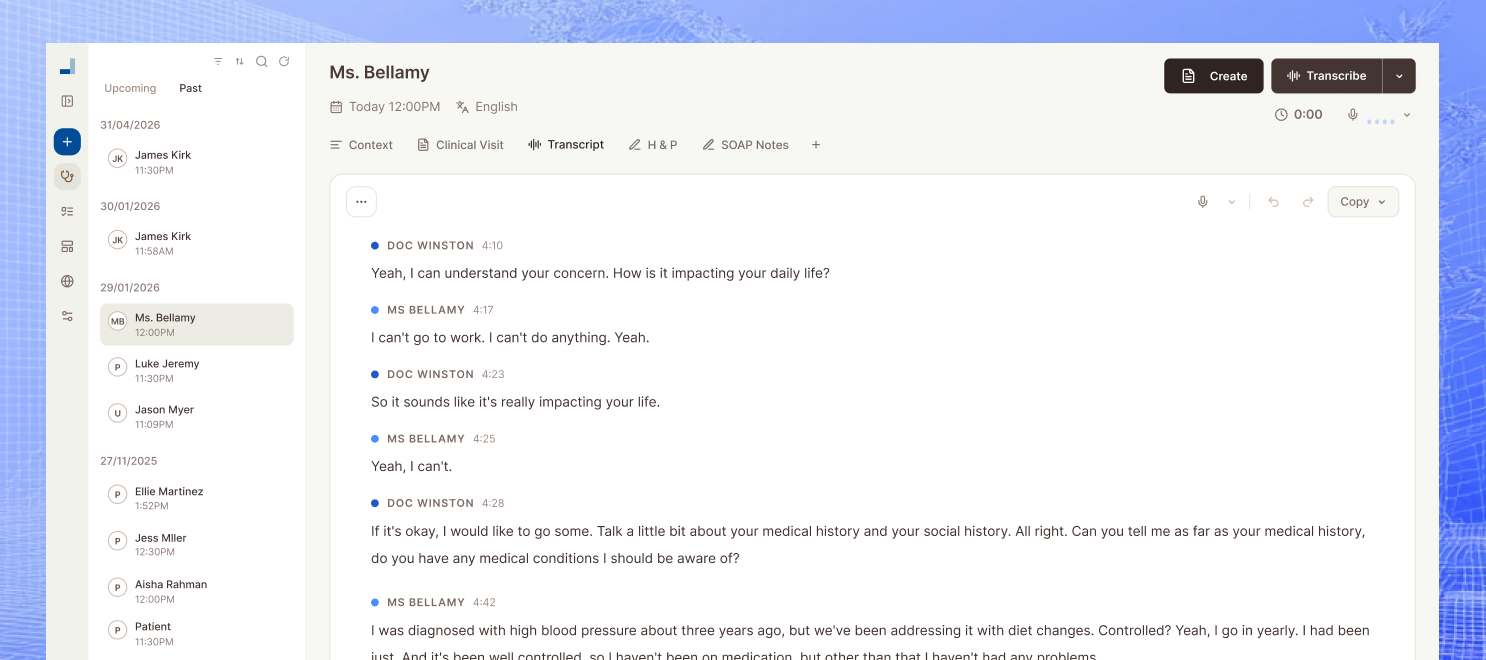
An AI medical scribe serves as an intelligent listener that captures the nuances of a clinical encounter in real-time. It is important to remember that these tools are assistive, not autonomous. The AI handles the heavy lifting of transcription and structural formatting, but the clinician remains the final authority. By removing the need to choose between eye contact and a keyboard, practitioners can focus entirely on the diagnostic process while the background system handles the administrative capture.
- Eliminates the ‘pajama time’ spent on evening documentation.
- Reduces cognitive switching between patient care and clerical tasks.
- Ensures immediate capture of objective data and subjective complaints.
- Provides a structured draft that mirrors the actual conversation flow.
Note types you can generate beyond SOAP (H&P and more)
While the SOAP format is a staple of clinical medicine, it often falls short for more complex scenarios. Modern practice requires a diverse array of documentation styles to ensure continuity of care. Using AI, clinicians can effortlessly generate History and Physicals (H&Ps), detailed consult notes for specialist referrals, and comprehensive procedure notes that meet strict billing requirements. Each of these formats serves a unique purpose in the patient’s longitudinal record and legal protection.
Structuring these notes correctly is vital for audit readiness and successful handovers. A follow-up note needs to highlight changes since the last visit, whereas a discharge summary must consolidate a vast amount of inpatient data into a digestible format for the primary care provider. AI allows you to flip between these structures based on the specific encounter type, ensuring that the right data is categorized in the right place every time.
Beyond standard notes, the ability to generate referral letters and patient instructions directly from the encounter transcript saves significant overhead. When the documentation is structured automatically, the data is more searchable and less prone to the ‘copy-paste’ errors that plague manual EHR entries. This higher standard of documentation leads to better communication within multidisciplinary teams.
- H&Ps, progress notes, and complex consultation reports.
- Specialized procedure notes and discharge summaries.
- Referral letters and formal follow-up documentation.
- Improved audit trails and compliance through structured formatting.
How to implement AI medical scribing step-by-step in a real clinic
Transitioning to an AI-assisted workflow should be a gradual, iterative process rather than an overnight overhaul. Start by selecting one common visit type, such as routine follow-ups or wellness exams, to test the technology. This allows you to calibrate the AI’s output to your specific speaking style and clinical preferences without the stress of managing complex new cases simultaneously. Once you feel comfortable with the baseline output, you can move on to more intensive encounters.
The next step involves setting up specialty-specific templates. A cardiologist requires different data points than a psychiatrist, and your AI tool should reflect those differences. Configure your system to recognize the specific headings and clinical logic common to your field. During the encounter, whether it is in-person or via telehealth, ensure the recording device is placed centrally to capture both voices clearly. This initial capture is the most critical stage for avoiding double entry later.
After the session, the AI will present a structured draft. Most clinicians find that a quick 60-second review and edit are all that is needed to finalize the document. Instead of re-typing, you are simply verifying. Once the note is validated, use the same data to generate ancillary documents like school excuses or referral letters. This reuse of information ensures that you never have to enter the same clinical fact twice across different forms.
- Begin with a single, predictable visit type to build confidence.
- Customize templates to match your specialty’s unique requirements.
- Capture audio clearly to maximize transcription accuracy.
- Review and verify the draft rather than rewriting from scratch.
How to keep note quality high and reduce mistakes
AI is a powerful tool, but it is not immune to the inconsistencies of human conversation. Typical failure points include ‘note bloat,’ where the AI includes irrelevant small talk, or missing specific medication dosages if they were whispered or mumbled. To keep quality high, clinics should establish a lightweight review habit. This involves checking high-risk areas like medication lists, allergy updates, and specific numeric values before signing off on the note.
Standardizing the team’s approach to AI notes also helps maintain consistency. If multiple providers in a clinic use the tool, having agreed-upon standards for how to handle ‘negative findings’ or ‘social history’ ensures the medical record remains cohesive. Regular peer reviews of AI-generated notes can help identifying recurring errors or areas where templates need further refinement, keeping the documentation sharp and professional.
- Verify all dosages, dates, and laboratory values manually.
- Trim unnecessary conversational filler to prevent note bloat.
- Establish clinic-wide standards for documentation quality.
- Conduct periodic reviews to ensure template accuracy.
Privacy, consent, and patient trust (plain English)
Patient trust is the foundation of digital health implementation. While privacy laws vary by region, the core principle is transparency. Most patients are comfortable with recording once they understand it leads to more focused care and fewer errors. You should follow your local healthcare regulations regarding data retention and encryption, ensuring that any tool used meets high security standards like HIPAA or GDPR.
Communicating this to patients is best done with a simple, direct script. You might say: ‘To make sure I’m giving you my full attention today and keeping your records perfectly accurate, I’m using an AI assistant to take notes for us. It records our conversation and turns it into a medical note, then deletes the recording. Is that okay with you?’ Most patients appreciate the honesty and the fact that you won’t be staring at a screen the whole time.
- Always obtain verbal or written consent based on local policy.
- Use a transparent, patient-friendly script to explain the technology.
- Ensure the platform uses enterprise-grade encryption for data.
- Maintain a clear record of patient consent preferences.
Rolling it out across a clinic without disruption
A successful rollout depends on a ‘pilot and pivot’ strategy. Start with a two-week pilot involving one or two tech-savvy clinicians. This small-scale launch allows you to identify any workflow bottlenecks—like Wi-Fi dead zones or template mismatches—before they affect the whole team. During this phase, track metrics such as time spent on ‘after-hours’ charting and the total time taken to close an encounter record.
Once the pilot is successful, align the rest of the staff through brief training sessions. Showing a live demo of the time saved is usually the best way to gain buy-in. Ensure that all templates are pre-aligned with the clinic’s existing EHR structure to make the final ‘copy and paste’ or integration step as seamless as possible. By focusing on the tangible benefit of leaving the clinic on time, you create a culture that embraces the transition.
- Conduct a 14-day pilot with a small group of early adopters.
- Track time-savings and note completeness to prove ROI.
- Train staff on specific template use and review protocols.
- Align AI outputs with the existing EHR documentation requirements.
Mcoy AI is an AI medical scribe that records and transcribes patient encounters, then generates multiple clinical note types (H&P, progress notes, consult notes, follow-up notes, procedure notes, discharge summaries, referral letters, and more). With over 200+ customizable templates and an interactive AI chat, clinicians can quickly create letters, forms, and complex documents tailored to their specific needs. This tool is designed to integrate smoothly into any workflow, helping you focus more on the patient and less on the paperwork.
FAQ
Implementing new documentation workflows often brings up practical questions. Here are the answers to common concerns about transitioning to AI-assisted scribing.
How accurate are AI medical scribes in real clinics?
In most clinical settings, AI scribes are highly accurate at capturing the medical narrative, often outperforming manual note-taking in terms of detail. They are particularly good at capturing specific patient quotes and longitudinal history. However, accuracy can be affected by heavy background noise or multiple people speaking at once, so high-quality audio capture is essential.
Do I still need to review every note?
Yes, as the licensed provider, you are legally and ethically responsible for the contents of the medical record. The AI provides a ‘90% complete’ draft, but you must perform a final verification to ensure all clinical facts, medications, and plans are accurate. This review typically takes about a minute, which is still a massive time reduction compared to manual entry.
What note types can an AI scribe generate besides SOAP?
AI scribes are incredibly versatile and can generate specialized formats like H&P (History and Physical), detailed consultation reports, procedure-specific notes, and post-operative summaries. They can also be used to create patient-facing discharge instructions and formal referral letters to other specialists based on the same encounter data.
Will this work for telehealth and in-person consults?
Yes, most AI scribing tools are designed to work across both modalities. For telehealth, the system can often capture audio directly from the computer’s output, while in-person consults rely on a smartphone or tablet microphone. The core transcription and note-generation processes remain the same regardless of how you meet the patient.
How do I explain recording/transcription to patients?
The best approach is to be brief and emphasize the benefit to the patient. Explain that the tool allows you to focus on them rather than the computer screen. Most patients respond positively when they realize it leads to a more engaged and attentive physician during their visit.
How do clinics prevent note bloat?
Note bloat is prevented by using highly specific templates that instruct the AI on exactly what information to include and what to leave out. Clinicians can also use the ‘edit’ or ‘chat’ features to refine the summary, ensuring that only clinically relevant data stays in the final note while conversational filler is discarded.
How long does template setup take?
Initial setup for basic templates usually takes just a few minutes, as many systems come with pre-built options for most specialties. Fine-tuning a template to perfectly match your personal style or a specific institutional requirement might take an additional 10 to 15 minutes of testing and adjustment.
What’s the safest way to start if I’m skeptical?
The safest way to start is to use the tool for your most straightforward ‘Follow-Up’ visits for a week. This allows you to see the results in a low-stakes environment. You don’t have to fully commit your entire workflow on day one; just use it as a secondary capture tool until you trust the output quality.
Conclusion
Eliminating double entry is not just about adopting new software; it is about reclaiming your time and mental energy. By moving toward a structured, AI-driven documentation process, you can ensure that every encounter is recorded accurately the first time. The transition from manual scribbling to automated generation allows for more comprehensive notes, better patient interaction, and a significant reduction in administrative burden. As you explore how to avoid double entry with AI medical scribing, remember that the goal is a more sustainable and focused medical practice. Start with a small pilot today and experience the difference that modern documentation can make for your clinic.
What a serious review table should cover
| Decision area | Common mistake | Better clinic-ready approach | Metric to watch |
|---|---|---|---|
| Workflow design | Treat how to avoid double entry with ai medical scribing guide as a one-off documentation task | Build a repeatable process with clear ownership and review points | Time to complete documentation |
| Team adoption | Assume every clinician will naturally use the same process | Train for consistency and define exception handling early | Active user adoption |
| Quality review | Only check notes when a problem is reported | Audit a sample of notes weekly and review edge cases | Edit rate per note |
| Operational follow-through | Leave admin actions outside the documentation workflow | Use the same encounter data for referrals, letters, and follow-up tasks | Completion rate for next-step tasks |
Related reading
If you are working through how to avoid double entry with ai medical scribing guide, it helps to read this alongside Specialty Guides: How to Run a More Efficient Medical Practice in 2026, Specialty Guides: How to Improve Patient Encounters, and AI & Medicine: 200+ Mcoy AI Templates: Guide to Faster Medical Charting. Those guides cover adjacent workflow, implementation, and evaluation questions so the decision does not sit in isolation.
FAQ
How accurate are AI medical scribes in real clinics?
AI scribes are highly accurate at capturing the medical narrative, generally exceeding manual note-taking for detail. However, they rely on clear audio, so high-quality capture is essential for accuracy.
Do I still need to review every note?
Yes, clinicians must review and sign every note. The AI provides a near-final draft, but the provider is responsible for verifying medical facts and dosages prior to finalization.
What note types can an AI scribe generate besides SOAP?
AI scribes generate H&Ps, consult notes, procedure notes, discharge summaries, and referral letters. They are much more flexible than traditional templates.
Will this work for telehealth and in-person consults?
Yes, these tools work for both. They capture audio from telehealth platforms or via mobile devices for in-person exams, ensuring consistent documentation across all visit types.
How do I explain recording/transcription to patients?
Use a simple script emphasizing that it allows you to focus on the patient instead of the screen. Most patients are comfortable when they see the benefit of your full attention.
How do clinics prevent note bloat?
By using specific templates that highlight only clinical data. AI tools can be programmed to ignore small talk and summarize only relevant medical points.
How long does template setup take?
Standard templates take minutes to implement. Customizing a template to a specific sub-specialty or nuanced workflow typically takes less than 15 minutes.
What’s the safest way to start if I’m skeptical?
Start with a small pilot of 5-10 routine visits. This low-risk approach allows you to evaluate accuracy and time-savings before rolling it out clinic-wide.