Specialty Guides: Free Telehealth Note Template Pack: Clinical Workflow Guide
Learn how to build a professional telehealth note template pack for your clinic. Streamline documentation, reduce burnout, and improve note accuracy today.
What a medical scribe solves in modern practice
Documentation is the single largest contributor to clinician burnout in the modern era. Between back-to-back video calls and physically seeing patients in the clinic, the cognitive load of remembering every detail while maintaining eye contact is exhausting. Often, clinicians find themselves finishing notes late at night, leading to ‘pajama time’ work that erodes work-life balance and increases the risk of documentation errors.
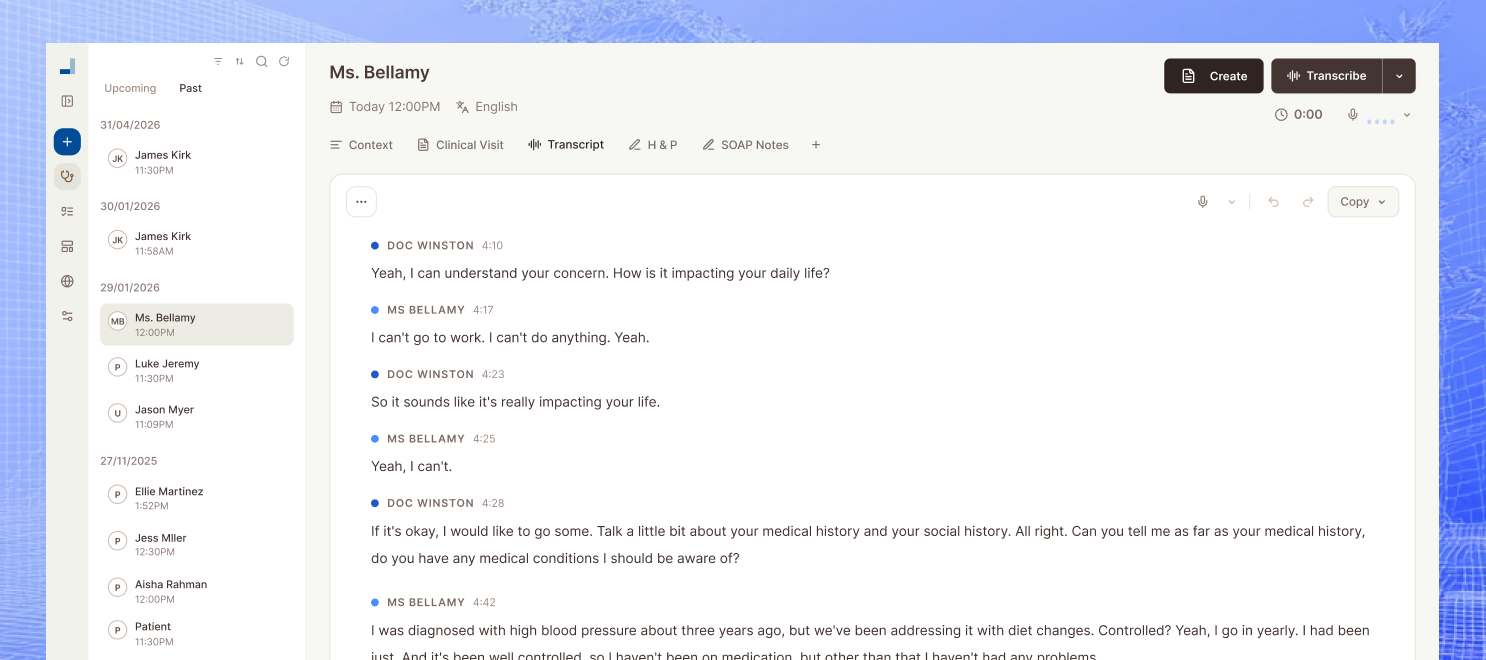
An AI medical scribe serves as a digital assistant that captures the nuance of the conversation in real-time. It doesn’t replace the clinician; rather, it acts as a high-fidelity listener that organizes raw dialogue into structured clinical data. This allows the provider to focus entirely on the patient’s narrative and physical cues rather than a keyboard, ensuring that the final output is reflective of a high-quality encounter.
- Eliminates after-hours charting by generating drafts instantly.
- Reduces cognitive load so doctors can focus on patient interaction.
- Ensures no critical details are forgotten during long shifts.
- Maintains a consistent standard of documentation across the whole clinic.
Note types you can generate beyond SOAP (H&P and more)
While the SOAP note is the industry standard, modern medicine requires a more diverse range of documentation formats. A comprehensive telehealth note template pack should include History and Physical (H&P) reports for new intakes, which provide a deep dive into a patient’s background. For ongoing care, follow-up notes and progress notes are essential to track the trajectory of chronic conditions or recovery phases.
Specialized encounters often demand even more specific structures. Consult notes must clearly outline the specialist’s findings and recommendations for the referring physician, while procedure notes document the specifics of interventions. Discharge summaries and referral letters are equally vital for ensuring continuity of care as the patient moves between different levels of the healthcare system.
Structure matters because it impacts audit readiness and the clarity of the medical record. When documents are structured correctly, it is easier for other team members to step in and provide care without confusion. Using a standardized set of templates ensures that regardless of the visit type, the most pertinent information is always highlighted and easy to find.
- H&Ps and progress notes provide longitudinal patient tracking.
- Consult and referral letters ensure seamless handovers between providers.
- Procedure notes and discharge summaries improve medico-legal safety.
- Customizable templates allow for specialty-specific documentation accuracy.
How to implement a free telehealth note template pack step-by-step in a real clinic
To begin implementing your free telehealth note template pack, start small by selecting a single, common visit type, such as routine follow-ups or medication reviews. This allows your team to get comfortable with the digital workflow without feeling overwhelmed by a total system overhaul. Once you have a feel for the rhythm, you can begin expanding the library to include more complex encounter types.
The next phase involves setting up your templates by specialty or clinician preference. In a university clinic or large practice, different departments will have different requirements for what constitutes a ‘perfect’ note. Use the initial feedback from your first pilot week to tweak the headers and data fields within your pack. During the actual telehealth encounter, ensure the audio capture is clear and the patient is aware that digital assistance is being used to improve their record quality.
After the encounter, the clinician should perform a rapid review of the generated text. This ensures that any specific nuances or rare clinical terms are captured accurately. Because the core content is already there, this review usually takes less than sixty seconds. Once reviewed, these outputs can be instantly repurposed for patient instructions, pharmacy forms, or referral documents, doubling the efficiency of a single documentation event.
- Start with one common visit type to minimize initial disruption.
- Customize templates by specialty to ensure all relevant data is captured.
- Conduct a quick 60-second review to maintain clinical accuracy.
- Reuse note content for multiple administrative forms and letters.
How to keep note quality high and reduce mistakes
High-quality documentation is a safeguard against both medical errors and legal risks. Common failure points in digital notes include ‘note bloat,’ where irrelevant information is pulled into the record, or missing medication updates. To prevent these issues, clinics should establish a clear standard for what a ‘gold standard’ note looks like for their specific patient population.
Developing a lightweight review habit is the most effective way to keep quality high. Instead of waiting until the end of the day, clinicians should check the draft immediately following the visit while the details are still fresh. This practice ensures that the problem list is accurate and that the plan of care reflects the exact conversation had with the patient, rather than a generic summary.
- Establish team-wide standards for what belongs in each note type.
- Perform immediate reviews after visits to catch small errors early.
- Watch for ‘note bloat’ to keep the medical record concise and useful.
Privacy, consent, and patient trust (plain English)
Trust is the foundation of the patient-provider relationship, especially in a virtual setting. While consent requirements vary by region, transparency is always the best policy. Patients are generally very supportive of tools that allow their doctor to look at them instead of a computer screen, provided they understand how their data is handled.
You might explain it to a patient by saying: ‘To give you my full attention, I use a secure assistant that helps me write my clinical notes so I don’t have to type while we talk. It is private and aids in the accuracy of your medical record. Is that okay with you?’ Most patients appreciate the honesty and the focus on their care.
- Always follow local regulations regarding recording and data storage.
- Use transparent, plain-English scripts to explain the process to patients.
- Ensure all digital tools meet high-level security and encryption standards.
Rolling it out across a clinic without disruption
A successful rollout requires a phased approach. Begin with a two-week pilot involving a small group of ‘early adopters’ who can provide honest feedback on the workflow. This phase is crucial for identifying any technical hurdles—like microphone quality or internet stability—that might interfere with the clinical process.
During this pilot, track specific metrics such as the reduction in after-hours charting and the time spent on administrative tasks. If the data shows a significant improvement in clinician well-being and note completeness, you can then scale the templates to the rest of the clinic. Providing a structured training session for the remaining staff ensures everyone is aligned on how to use the free telehealth note template pack effectively.
- Run a 14-day pilot with a small group to iron out technical kinks.
- Track time saved and note completeness to measure the impact.
- Provide a clear training guide to ensure consistent template usage.
Mcoy AI is an AI medical scribe that records and transcribes patient encounters, then generates multiple clinical note types (H&P, progress notes, consult notes, follow-up notes, procedure notes, discharge summaries, referral letters, and more). It features 200+ customizable templates and an AI chat to create letters, forms, and other documents instantly, helping clinicians maintain a higher standard of care with less stress.
Conclusion
Transitioning to a digital-first documentation strategy doesn’t have to be difficult. By implementing a free telehealth note template pack, clinics can reclaim hours of lost time and focus on what truly matters: patient outcomes. Whether you are in a university setting or a private practice, the right workflow ensures your documentation is accurate, compliant, and professional. Start your pilot today and see how a streamlined approach to your free telehealth note template pack can transform your daily practice.
What a serious review table should cover
| Decision area | Common mistake | Better clinic-ready approach | Metric to watch |
|---|---|---|---|
| Workflow design | Treat free telehealth note template pack: clinical workflow guide as a one-off documentation task | Build a repeatable process with clear ownership and review points | Time to complete documentation |
| Team adoption | Assume every clinician will naturally use the same process | Train for consistency and define exception handling early | Active user adoption |
| Quality review | Only check notes when a problem is reported | Audit a sample of notes weekly and review edge cases | Edit rate per note |
| Operational follow-through | Leave admin actions outside the documentation workflow | Use the same encounter data for referrals, letters, and follow-up tasks | Completion rate for next-step tasks |
Related reading
If you are working through free telehealth note template pack: clinical workflow guide, it helps to read this alongside Specialty Guides: How to Run a More Efficient Medical Practice in 2026, Specialty Guides: How to Improve Patient Encounters, and Admin Management: How to Use an AI Medical Scribe for Faster Follow-Ups. Those guides cover adjacent workflow, implementation, and evaluation questions so the decision does not sit in isolation.
FAQ
How accurate are AI medical scribes in real clinics?
AI medical scribes have reached a high level of accuracy, often capturing nuances that manual typing might miss. However, they are assistive tools, and the final precision depends on clear audio and the clinician’s brief review. In most clinical settings, they provide a much higher level of detail than rushed manual notes.
Do I still need to review every note?
Yes, the clinician remains the legally responsible party for every medical record produced. While the AI does the heavy lifting of drafting, a quick review is necessary to confirm medications, dosages, and the final plan. This review typically takes less than a minute but is essential for patient safety.
What note types can an AI scribe generate besides SOAP?
Beyond the standard SOAP format, modern AI tools can generate History and Physicals, consult notes, referral letters, and procedure summaries. They can also create progress notes and discharge summaries by pulling the relevant facts from the conversation. The flexibility of templates allows for almost any specialty-specific format.
Will this work for telehealth and in-person consults?
Absolutely, these workflows are designed to be hardware-agnostic. Whether you are speaking into a laptop during a Zoom call or using a mobile device in an exam room, the AI captures the dialogue. The result is a consistent documentation style regardless of how the patient is being seen.
How do I explain recording/transcription to patients?
The best approach is complete transparency focused on patient benefit. Explain that the tool allows you to listen more closely and ensures their record is 100% accurate. Most patients are comfortable when they realize it leads to better care and more eye contact during their visit.
How do clinics prevent note bloat?
Note bloat is prevented by using concise templates and setting clear standards for the AI’s output. By choosing templates that only ask for necessary information, the generated draft remains professional and readable. Regular audits of the notes can also help keep the documentation focused and efficient.
How long does template setup take?
Setting up a basic set of templates can take as little as 30 minutes if you have a clear idea of your current workflow. Most clinicians find that they refine their templates over the first week of use. Once established, these templates serve as a permanent ‘set and forget’ solution for the practice.
What’s the safest way to start if I’m skeptical?
The safest way to start is by trialing the tool for non-complex follow-up visits. This allows you to verify the accuracy and the flow of the documentation without the pressure of a high-stakes emergency or new patient intake. As your confidence grows, you can gradually introduce the system to more complex cases.