AI & Medicine: Build a Free SOAP Note Template Pack | Clinician Guide
Learn how to build a professional SOAP note template pack to save time. Optimize your clinical workflow with free resources for better documentation.
What a medical scribe solves in modern practice
Modern clinical practice is often weighed down by the sheer volume of documentation required for every patient interaction. For many practitioners, especially those in university clinics or high-volume private practices, the time spent on after-hours charting has become a primary driver of burnout. This administrative burden distracts from the diagnostic process and reduces the quality of the patient-clinician bond.
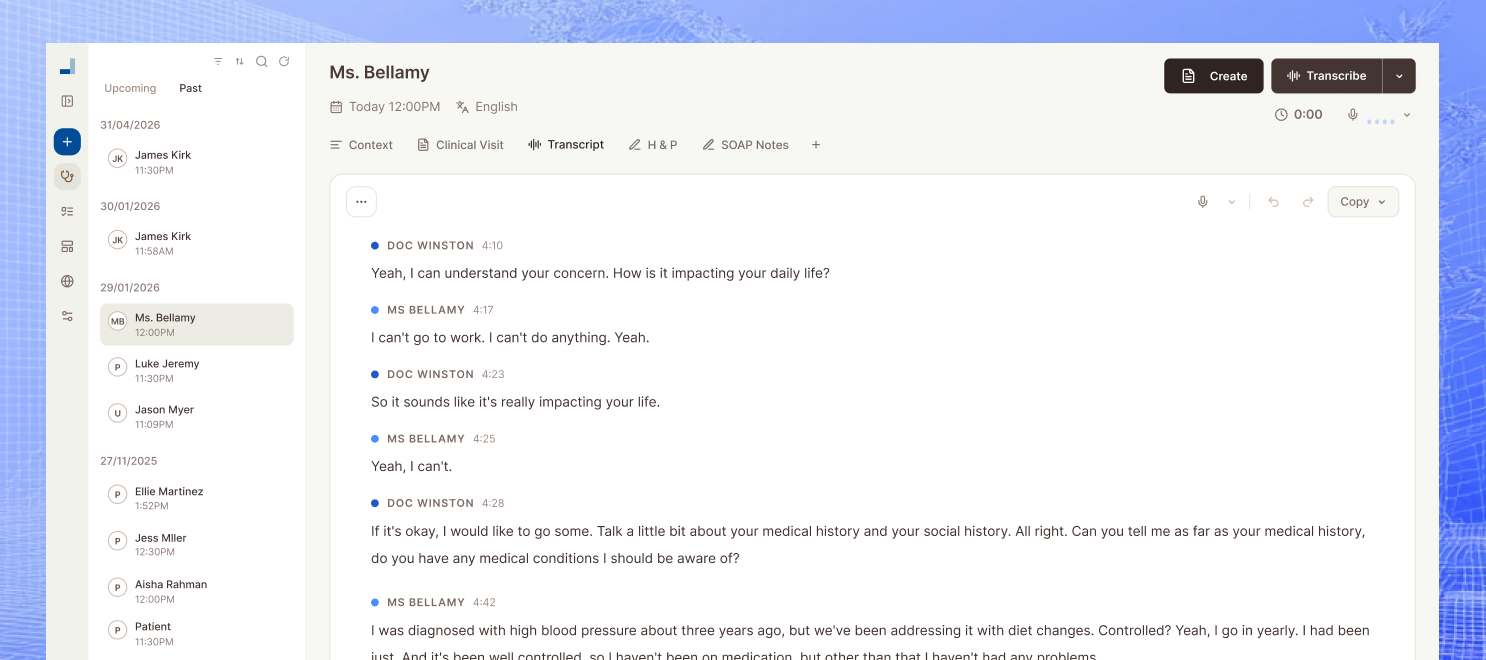
An AI medical scribe serves as a digital assistant that captures the nuances of a conversation in real-time. It is important to remember that these tools are assistive technologies; while they dramatically reduce the manual labor of typing, the clinician remains the final authority and responsible party for the accuracy of every word in the medical record. By offloading the synthesis of raw data, doctors can focus on the human being sitting across from them.
- Significantly reduces cognitive load during and after patient encounters.
- Eliminates the ‘pajama time’ spent on finishing charts at home.
- Captures granular details that are often forgotten by the end of the day.
- Ensures consistency in note structure across the entire clinic team.
Note types you can generate beyond SOAP (H&P and more)
While a free SOAP note template pack is a great starting point, clinical documentation extends far beyond the traditional Subjective, Objective, Assessment, and Plan format. Comprehensive care requires specialized structures for History and Physicals (H&P), complex consult notes, and detailed procedure reports. Each of these serves a unique purpose in the longitudinal record of the patient.
Consistent structure across different note types is vital for audit readiness and medico-legal protection. For example, a crisp referral letter or a succinct discharge summary ensures that the next provider in the care chain has exactly what they need without digging through pages of fluff. Using specialized templates for follow-up notes ensures that only pertinent changes are highlighted, rather than repeating the entire history.
By diversifying the types of documents you generate, you improve the quality of handovers and ensure continuity of care. High-quality documentation is not just about recording what happened; it is about communicating the clinical reasoning clearly to other healthcare professionals and insurance payers.
- H&P and Progress Notes for inpatient and acute care consistency.
- Consultation and Referral letters to streamline professional communication.
- Procedure notes and Discharge summaries for specialized reporting.
- Follow-up notes focusing on interval changes and treatment adherence.
How to implement free SOAP note template pack step-by-step in a real clinic
The journey to a more efficient clinic begins by selecting a single visit type to standardize first. Rather than overhauling your entire workflow overnight, choose a common encounter, like a routine follow-up or a standard physical exam. This allows you to test your free SOAP note template pack in a controlled environment where the variables are predictable.
Once you have selected the visit type, you should set up or select a template tailored to your specific specialty. A cardiologist’s SOAP note requirements differ significantly from a pediatrician’s. Ensure that the template include fields for the specific metrics and screenings you perform most frequently. During the patient encounter, focus on capturing the narrative naturally, whether in-person or via telehealth, knowing your structure is already waiting for you.
After the encounter, the review and edit phase should be lightning-fast. Since the structure is fixed, you only need to verify the specific clinical findings and assessments. Once the note is finalized, you can leverage that structured data to auto-populate other necessary documents, such as lab orders or work excuse letters, without re-typing the same information.
- Start small with one high-volume visit type to build momentum.
- Customize templates to fit the unique linguistic needs of your specialty.
- Capture the encounter naturally and review the structured output quickly.
- Reuse the data from your templates to generate secondary administrative forms.
How to keep note quality high and reduce mistakes
Even with a robust free SOAP note template pack, errors can creep in if the review process is lax. Common failure points include ‘note bloat,’ where unnecessary information is carried over, or the accidental inclusion of incorrect medication dosages if a template isn’t updated. Maintaining high quality requires a disciplined approach to the final review before signing off.
Establishing team-wide standards for what constitutes a ‘complete’ note is essential. This includes a lightweight review habit where the clinician checks for the ‘red flags’—wrong lateralities, outdated problem lists, or conflicting information between the objective and assessment sections. A standard of quality ensures that the documentation is a true reflection of the care provided.
- Implement a 60-second ‘final check’ habit for every note before signing.
- Audit the problem list periodically to ensure only active issues are listed.
- Train staff on the specific definitions of each template field.
- Monitor for note bloat to keep the medical record concise and readable.
Privacy, consent, and patient trust (plain English)
Patient trust is built on transparency, especially when introducing new technology into the exam room. While consent requirements vary by region, the best approach is always to follow local policy and state-specific regulations. It is not just about legal compliance; it is about making the patient feel secure in how their health data is being handled.
A simple, patient-friendly explanation goes a long way. You might say: ‘I’m using a digital assistant today to help me capture our conversation so I can focus entirely on you instead of my computer screen. It helps me make sure my notes are perfectly accurate. Is that okay with you?’ Most patients appreciate the extra attention they receive when the doctor isn’t buried in a keyboard.
- Always verify local and state consent laws for recording.
- Use a simple script to explain the benefits of the technology to the patient.
- Ensure any digital tool maintains high encryption and data retention standards.
- Give patients the option to opt-out without any impact on their care.
Rolling it out across a clinic without disruption
Successfully rolling out a new documentation system across a multi-provider clinic requires a phased approach. A two-week pilot program with one or two ‘tech-forward’ providers allows the clinic to identify potential workflow bottlenecks before a full-scale launch. During this time, the team can refine the templates and ensure they align with the clinic’s specific coding and billing requirements.
Metrics are key to evaluating success. Track the reduction in after-hours charting time and the speed of note completion. If clinicians are finishing their notes by the end of the shift rather than the end of the weekend, the project is a success. Training sessions should focus on template alignment and sharing ‘best practices’ among the staff to ensure a smooth transition for everyone.
- Run a two-week pilot to iron out issues before the full clinic rollout.
- Track time saved and the reduction in ‘pajama time’ charting.
- Align templates across the team to ensure billing and coding accuracy.
- Provide hands-on training for staff to boost confidence with the new tools.
Mcoy AI is an AI medical scribe that records and transcribes patient encounters, then generates multiple clinical note types (H&P, progress notes, consult notes, follow-up notes, procedure notes, discharge summaries, referral letters, and more). It offers 200+ customizable templates and features an AI chat to create letters, forms, and other documents, helping clinicians move from raw conversation to finished documentation in seconds.
FAQ
Implementing new documentation workflows often brings up practical questions. Here are the most common inquiries clinicians have when looking to upgrade their note-taking process.
How accurate are AI medical scribes in real clinics?
AI scribes are highly accurate at capturing the dialogue and clinical facts shared during a visit. However, like any speech-to-text or transcription technology, they can occasionally misinterpret complex medical terminology or background noise. The clinician must always perform a final review to ensure the nuances of the diagnosis are correct. Over time, the systems often learn a provider’s specific style and vocabulary.
Do I still need to review every note?
Yes, reviewing every note is a strict clinical and legal requirement. While the AI does the heavy lifting of drafting the narrative and organizing the SOAP sections, the clinician is the person providing the actual care. Your signature on the note indicates that you have verified its contents as accurate and complete. Most users find that reviewing an AI-generated note takes a fraction of the time it takes to write one from scratch.
What note types can an AI scribe generate besides SOAP?
Modern AI tools are versatile and can generate nearly any clinical document required. This includes comprehensive H&Ps, surgical procedure notes, behavioral health assessments, and specialty-specific follow-up notes. They can also assist in drafting referral letters to colleagues or discharge instructions for patients. The flexibility depends on the templates you choose to implement in your workflow.
Will this work for telehealth and in-person consults?
Most AI scribe solutions are designed to be environment-agnostic, meaning they work equally well during in-person visits and virtual telehealth calls. For telehealth, the system usually captures the audio directly from the computer, while in-person visits use a mobile device or room microphone. The quality of the transcription remains high as long as the audio input is clear and understandable.
How do I explain recording/transcription to patients?
The best way to explain it is to focus on the benefit to the patient: better eye contact and more focused care. Simply state that you are using a tool to help with your notes so you can spend your time listening rather than typing. Most patients are very supportive when they realize the technology allows the doctor to be more present during the encounter.
How do clinics prevent note bloat?
Clinics prevent note bloat by using concise templates and training the AI to focus only on ‘billable’ or clinically relevant information. Setting clear standards for what should be included in the ‘Objective’ and ‘Plan’ sections helps keep notes from becoming unnecessarily wordy. Regularly reviewing note lengths as a team can also help maintain a high standard of brevity and clarity.
How long does template setup take?
Basic template setup can take as little as 15 to 30 minutes if you are using pre-existing clinical structures. For more customized or specialty-specific needs, it might take a few hours of testing and refining. The goal is to create a library of templates that covers 90% of your common visit types, which can be done incrementally over the first week of use.
What’s the safest way to start if I’m skeptical?
The safest way to start is with a ‘shadow’ pilot. Use the tool to record your encounters but continue your manual charting as a backup for the first few days. This allows you to compare the AI’s output with your own notes without the risk of losing data. Once you see the accuracy and time savings firsthand, you can gradually transition to using the generated notes as your primary draft.
Conclusion
Standardizing your workflow with a free SOAP note template pack is one of the most effective ways to reclaim your time and improve practice efficiency. By moving beyond just basic note-taking and embracing a broader range of clinical documents, you ensure better care coordination and reduced administrative stress. Whether you are in a small private practice or a large university clinic, the transition to structured, AI-assisted documentation is a proven path to reducing burnout. Take the first step today by piloting a new template and see how a refined free SOAP note template pack can transform your daily clinical routine.
SEO description: Learn how to implement a free SOAP note template pack plus AI scribing to reduce charting time and improve note quality for modern medical clinics.
What a serious review table should cover
| Decision area | Common mistake | Better clinic-ready approach | Metric to watch |
|---|---|---|---|
| Workflow design | Treat build a free soap note template pack | clinician guide as a one-off documentation task | Build a repeatable process with clear ownership and review points |
| Team adoption | Assume every clinician will naturally use the same process | Train for consistency and define exception handling early | Active user adoption |
| Quality review | Only check notes when a problem is reported | Audit a sample of notes weekly and review edge cases | Edit rate per note |
| Operational follow-through | Leave admin actions outside the documentation workflow | Use the same encounter data for referrals, letters, and follow-up tasks | Completion rate for next-step tasks |
Related reading
If you are working through build a free soap note template pack | clinician guide, it helps to read this alongside AI & Medicine: How to Simplify Clinical Notes for Busy Doctors, AI & Medicine: How Doctors Can Improve SOAP Notes, and Practice Operations: Training Guide for AI Scribe Adoption | Free Resources. Those guides cover adjacent workflow, implementation, and evaluation questions so the decision does not sit in isolation.
FAQ
How accurate are AI medical scribes in real clinics?
AI scribes are highly accurate at capturing the dialogue and clinical facts shared during a visit. However, like any speech-to-text technology, they can occasionally misinterpret complex terminology. The clinician must always perform a final review to ensure the nuances of the diagnosis are correct.
Do I still need to review every note?
Yes, reviewing every note is a strict clinical and legal requirement. While the AI does the heavy lifting of drafting, the clinician is the one providing the actual care. Your signature indicates that you have verified its contents as accurate and complete.
What note types can an AI scribe generate besides SOAP?
AI tools can generate nearly any clinical document, including comprehensive H&Ps, surgical procedure notes, and behavioral health assessments. They can also assist in drafting referral letters or discharge instructions, depending on the templates used.
Will this work for telehealth and in-person consults?
Most AI scribe solutions work equally well during in-person visits and virtual telehealth calls. For telehealth, the system captures audio from the computer, while in-person visits use a mobile device. The quality remains high as long as the audio is clear.
How do I explain recording/transcription to patients?
Focus on the benefit to the patient: better eye contact and more focused care. State that you are using a tool to help with notes so you can spend your time listening rather than typing. Most patients are very supportive of this approach.
How do clinics prevent note bloat?
Clinics prevent note bloat by using concise templates and training providers to focus on clinically relevant information. Setting clear standards for what should be included helps keep notes from becoming unnecessarily wordy or redundant.
How long does template setup take?
Basic template setup can take as little as 15 to 30 minutes using pre-existing structures. For more customized needs, it might take a few hours of testing. The goal is to build a library that covers the majority of your common visit types.
What’s the safest way to start if I’m skeptical?
The safest way is a ‘shadow’ pilot. Record your encounters but continue manual charting as a backup for the first few days. Comparing the AI’s output with your own notes helps build trust in the system’s accuracy and efficiency.